
BuddhistCatholicContemplativeEvangelicalGeneral ChristianHinduJewishLatter-day SaintMuslimNew VisionsProgressive Christian
Beliefs
- Buddhist
- Catholic
- Contemplative
- Evangelical
- General Christian
- Hindu
- Jewish
- Latter-day Saint
- More Voices
- Muslim
- New Visions
- Pagan
- Progressive Christian
Topics
- Religion News
- Food and Religion
- Sports and Religion
- Religious Art
- Religious Music and Entertainment
- Religious Events
- History and Religion
- Style and Religion
- Politics and Religion
- Women in Religion
- Recreation Outdoors and Religion
- Business Finance and Religion
- Careers Workplace and Religion
- Education and Religion
- Family Parenting and Religion
- Health Fitness and Religion
- Home and Religion
- Relationships and Religion
- Technology and Religion
- Travel and Religion
Columnists
- Buddhist Columnists
- Business Finance and Religion Columnists
- Careers Workplace and Religion Columnists
- Catholic Columnists
- Contemplative Columnists
- Education and Religion Columnists
- Evangelists Columnists
- Family Parenting and Religion Columnists
- General Christian Columnists
- Health Fitness and Religion Columnists
- Hindu Columnists
- History and Religion Columnists
- Home and Religion Columnists
- Jewish Columnists
- More Voices Columnists
- Latter Day Columnists
- Muslim Columnists
- New Visions Columnists
- Nonreligious Columnists
- Pagan Columnists
- Politics and Religion Columnists
- Progressive Columnists
- Recreation Outdoors and Religion Columnists
- Relationships and Religion Columnists
- Religion News Columnists
- Religious Art Columnists
- Religious Events Columnists
- Religious Music and Entertainment Columnists
- Sports and Religion Columnists
- Style and Religion Columnists
- Technology and Religion Columnists
- Travel and Religion Columnists
- Women in Religion Columnists
Resource Library
- 2026 Calendar
- Library of World Religions
- The 100 Most Holy Places on Earth
- Patheos Answers
- Podcasts
- Videos
- Faith Leaders Database
- Anglican Episcopalian
- Bahai
- Baptist
- Buddhism
- Christianity
- Confucianism
- Eastern Orthodoxy
- Hinduism
- Holiness and Pentecostal
- ISKCON
- Islam
- Judaism
- Lutheran
- Methodist
- The Church of Jesus Christ of Latter-day Saints
- New Age
- Paganism
- Presbytarian and Reformed
- Protestantism
- Religion Behind the Scenes
- Roman Catholic
- Scientology
- Shia Islam
- Sikhism
- Sufism
- Sunni Islam
- Taoism
- Zen
- See all religions
Research Tools
 Ad-Free & Subscriber Log-In Subscription Support
Ad-Free & Subscriber Log-In Subscription Support
Follow Patheos 

- Trending:
- Forgiveness
- |
- Marriage
- |
- Consciousness
- |
- Death Penalty
- |
- Election
- |
- Halloween
 suspended in her jar
- Home
- Catholic
- How Can We Call this Friday Good?
How Can We Call this Friday Good?
Last updated on: March 30, 2018 at 11:19 am by Rebecca Bratten Weiss
How Can We Call this Friday Good? 2018-03-30T11:19:21-04:00 Rebecca Bratten Weiss
Patheos Explore the world's faith through different perspectives on religion and spirituality! Patheos has the views of the prevalent religions and spiritualities of the world.
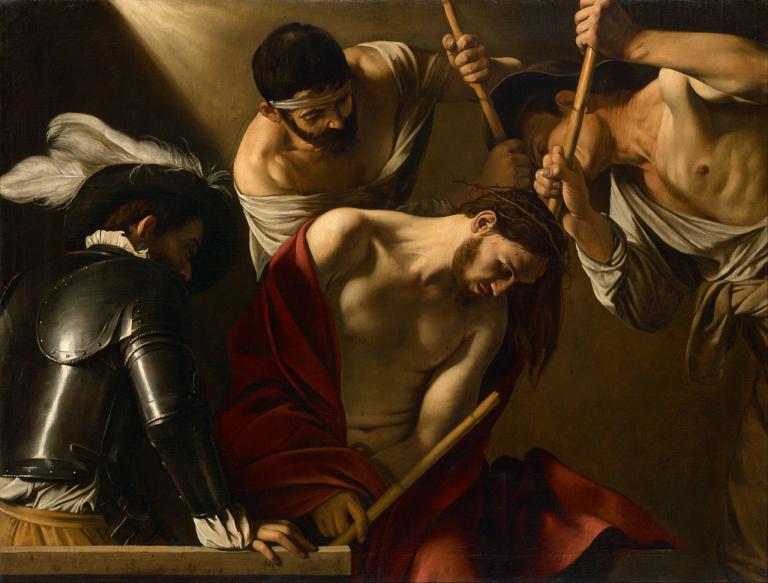
The spirit of Good Friday does not come easily to me. This is a day on which we deliberately enter into a spirit of self-denial, and I can’t help but ask – isn’t life is painful enough already? Days of suffering inevitably await us all; there’s no guarantee that any time of peace, with good health and comfort, won’t be cut short abruptly by war or disease or natural disaster. The tenuousness of just ordinary living makes me want to embrace it all the more. Especially when I read the news about the horrors of war and genocide abroad – or the mass shootings right around the corner.
I’m uncomfortable with any ethic that tells me to seek out pain, to deny basic simple pleasures. You might accuse me of hedonism, but I’d rather be that than the kind of nihilist who preaches an obliteration of the ordinary goods that are right before our eyes, in favor of some ineffable inexpressible and wholly undetected “beyond.” That’s the logic of the torterer, after all, who flays the skin off the body because, somehow, you must have faith, it does the soul good.
One of the most striking lines in Nietzsche’s Thus Spoke Zarathustra is a very simple one: “be true to the earth.” This means accepting the immediacy of the goods that experience provides, the joys of the earth, the pleasure in life – not denying them in favor of spiritual nihilism, whether a religious masochism that claims pain as a good, or a practical Kantianism that says an act is only ethical if we suffer to perform it. For Nietzsche, Christianity was especially guilty of this, with its demands of asceticism, sermons against the body, suspicion of pleasure. And sometimes I think he had a point.
How is it that we can call this Friday “good” when we meditate on the spectacle of Jesus tortured to death? How is it at all spiritually healthy to dwell lingeringly over the mutilation of the body?
The pat answer is that suffering is good, because it purifies, and Good Friday sorrow leads to Easter joy. But the joy of Easter Sunday, historically, didn’t put an end to death. We sing that death has lost its sting, but really it hasn’t. Sorrow and torment and death came to Jesus’ friends, and for two thousand years death has been bitter, and even with the promise of resurrection Christians have embraced the logic of the torturer, continuing to oppress and kill one another. And even if we did get it into our heads to behave like Christians, still we have to face floods and famine, natural disasters, ironically termed “acts of God.” Our very idea that God is in control of everything ought to make us wonder whether God is a sadist. Was there no way to resolve the problem of sin without sending God’s own son to face gruesome execution? Theodicy strikes again.
Religious bromides work neatly in a sheltered first-world existence. “When God closes a door he opens a window.” “Everything happens for a reason.” “God will provide.” God is only taking away your little teddy bear because there’s a bigger better teddy bear in store for you.
But you loved your little teddy bear, and don’t want a different one. And anyway, probably there is no larger teddy bear. Maybe somewhere in a nice little Midwestern town a guy got laid off, prayed to God, and ended up with a better job two weeks later. What about all the others who got laid off and didn’t get a new job at all? What about the atheist who was laid off and didn’t pray, but still got a better job? What about the guy who got laid off and whose wife left him and who got cancer and died alone? What about the victims of war crimes? People suffering debilitating depression? Women raped and tortured and left to die? Children abused and abandoned? There is no teddy bear for them. And if you wish to assert that somehow this was the only way God could bring about some wondrous resolution, what kind of inept monster god do you worship?
Sometimes I think, with Joyce, that God is a master novelist – a novelist a little like George R.R. Martin, who knows that in a high-quality story the characters you love get killed off.
On a theoretical level I understand that the promise of salvation is such that all wrongs will be mended, and indeed, one reason I believe obstinately in an afterlife is that I can’t live with a universe in which so much suffering goes unresolved, and the sum of misery outweighs that of joy. There is an essential imbalance in the universe if this is all there is.
It is impossible for me to imagine that this level of suffering is due to us because of original sin, though perhaps it is because of original sin that we ignore or inflict it, make excuses for it.
Rene Girard writes in Violence and the Sacred of the need human civilizations have, if they are to maintain order, to offer up victims in sacrifice, and that this act of violence, the act of sacrifice, is profoundly connected with religion. The act of sacrifice is a kind of release of the impulse for violence rising out of mimetic competition, and thus the sacrificial victim is a pharmakos, both poison and medicine, both sacred and profane.
This is one way to think about original sin. Our very pursuit of happiness leads to competition. Our very claim to identity necessitates an “Other.” Pilate knew that if he was going to maintain his political order he needed a victim – and the crowds chose Jesus.
But wait.
In Things Hidden Since the Foundation of the World, Girard goes on to explore what sets the Christian myth apart from others: that the victim in this story is not both sacred and profane. The victim is wholly sacred, and wholly innocent. This is affirmed by the text itself. The resurrection of Jesus is not an external miracle but arises from the internal moral and religious logic of the event.
Unfortunately, for a variety of reasons, this does not mean that people stopped being violent or making scapegoats – Christians are as bad as anyone else about this.
But the whole idea of being a victim has changed. Christianity instituted a profound reversal in set interpretations of value. Whereas before the rich and powerful were given preference, the poor and sick regarded with suspicion, the ethic of the beatitudes mean that we see those who are poor, sorrowful, and oppressed as the “blessed” ones.
To return to Nietzsche: in Genealogy of Morals, he asserts that this reversal arose out of ressentiment, the “creative” rancor that sets up a false value system as an act of revenge. But Max Scheler, responding to this, shows how while Nietzsche is right about ressentiment as a phenomenon that creates false nihilistic values, he is wrong about Christianity. The Christian love of the poor and oppressed victim is not a wallowing in nothingness or weakness, but rather an assertion of the fundamental goodness and dignity of the person no matter what his circumstances. The image of Christ reminds us of this: that the person who on Good Friday was despised and rejected, pierced and defiled, was also completely innocent and completely good.
It is ironic that Nietzsche should have written, earlier, in The Birth of Tragedy, that “the gods justify our existence by living it themselves: the only satisfactory theodicy” – and not notice that Jesus did this, too. Jesus, suffering and innocent, is an advocate for all those who suffer, Jesus suffers with them. If the story is true, no one suffers alone.
The grief experienced by the disciples of Jesus on Good Friday was unrelieved. Everything was destroyed before their eyes, their beloved friend was killed, they were in danger. To say to them “everything happens for a reason” would have been ridiculous. Good Friday suffering happens in the moment of profound darkness when it is impossible to imagine that anything ever could be bright again. There is nothing one can say, no answer to the question. Even after the resurrection these moments happen, and perhaps we are still left struggling with the mystery of how it could possibly ever be all right. As Ivan Karamazov points out in Dostoevsky’s most famous novel, there is no sense to the suffering of children. No cosmic answer can make up for the sadistic violence of those who torture and kill without even a bad reason for it. Just because. “No pleasure but meanness” Flannery O’Connor’s “Misfit” says, before he makes his final kill.
Good Friday is the day when we face the reality that we carry this suffering with us, throughout history. On this day, we enter into and acknowledge this darkness, the answer that cries out for a question, because any ideological or religious engagement with the world that denies this will be mere fantasy.
https://en.wikipedia.org/wiki/The_Crowning_with_Thorns_(Caravaggio)#/media/File:Michelangelo_Merisi,_called_Caravaggio_-_The_Crowning_with_Thorns_-_Google_Art_Project.jpg
Things Hidden Since the FOundation of the World
Previous Post
March 24, 2016
Holy Thursday and the Carnivalesque
Next Post
March 25, 2016 the descent to the underworld
Browse Our Archives
Select a Category abortion anti-semitism art Atwood Betrothed church clergy abuse coronavirus culture economics education environmentalism ethics faith family feminism gardening gun violence immigration Judaism literature MaddAddam New Pro Life Movement news pandemic personalism poem politics politics blue Pope Francis racism religion salvation sexuality social justice spirituality Station eleven Stephen King The Stand Trump Uncategorized war World Health Organization
Select a Month March 2021 February 2021 January 2021 December 2020 November 2020 October 2020 September 2020 August 2020 July 2020 June 2020 May 2020 April 2020 March 2020 February 2020 January 2020 December 2019 November 2019 October 2019 September 2019 August 2019 July 2019 June 2019 May 2019 April 2019 March 2019 February 2019 January 2019 December 2018 November 2018 October 2018 September 2018 August 2018 July 2018 June 2018 May 2018 April 2018 March 2018 February 2018 January 2018 December 2017 November 2017 October 2017 September 2017 August 2017 July 2017 June 2017 May 2017 April 2017 March 2017 February 2017 January 2017 December 2016 November 2016 October 2016 September 2016 August 2016 July 2016 June 2016 May 2016 April 2016 March 2016 February 2016
Follow Us!
TAKE THE
Religious Wisdom Quiz
What happened to the golden calf?
Select your answer to see how you score.
Taken to Canaan Set up for worship Burned, ground to powder Hidden
Support this
Column


Related posts from suspended in her jar

Catholics Are De-Toxing From their Experiences With Traumatic...

How Has the Pandemic Changed Us? Has It...

Rush Limbaugh Would Never Have Succeeded In an...
People are in Therapy to Recover from Religion...
TRENDING AT PATHEOS Catholic

Rejecting Doom: Christian Hope And Human Action
Christianity is a religion of hope. We are to have hope and...

It’s What Comes From Within Which Matters
One of the most difficult things for us to understand is why...

Why I Choose the Eucharist Over the Sermon
Choose the Eucharist, Not the Sermon What are we supposed to get...

5 Design Elements Found in Spiritually Rooted Homes
Putting Spirituality Into Home Decor Our homes are more than our living...

Credo: A Story of God Told with the...
About 10 years ago, I began to imagine a personal "Credo" that...

The Anatomy of Divine Revelation in Catholic Thought
The claim that God has made Himself known to human beings is...
view all Catholic blogs
Ad-Free & Subscriber Log-In Subscription Support
- About Us
- 2026 Calendar
- Videos
- Podcasts
- Library of World Religions
- Faith In Media Tracker
- Advertise With Us
- Write for Us
- Privacy Policy
- Terms of Service
- Do Not Sell My Data
- Contact Us
- Radiant Digital
- Manage Newsletter Subscriptions
- Unsubscribe From Notifications
- Sitemap
Copyright 2008-2026, Patheos. All rights reserved.
Subscription Support Ad-Free & Subscriber Log-In
Follow Patheos