
BuddhistCatholicContemplativeEvangelicalGeneral ChristianHinduJewishLatter-day SaintMuslimNew VisionsProgressive Christian
Beliefs
- Buddhist
- Catholic
- Contemplative
- Evangelical
- General Christian
- Hindu
- Jewish
- Latter-day Saint
- More Voices
- Muslim
- New Visions
- Pagan
- Progressive Christian
Topics
- Religion News
- Food and Religion
- Sports and Religion
- Religious Art
- Religious Music and Entertainment
- Religious Events
- History and Religion
- Style and Religion
- Politics and Religion
- Women in Religion
- Recreation Outdoors and Religion
- Business Finance and Religion
- Careers Workplace and Religion
- Education and Religion
- Family Parenting and Religion
- Health Fitness and Religion
- Home and Religion
- Relationships and Religion
- Technology and Religion
- Travel and Religion
Columnists
- Buddhist Columnists
- Business Finance and Religion Columnists
- Careers Workplace and Religion Columnists
- Catholic Columnists
- Contemplative Columnists
- Education and Religion Columnists
- Evangelists Columnists
- Family Parenting and Religion Columnists
- General Christian Columnists
- Health Fitness and Religion Columnists
- Hindu Columnists
- History and Religion Columnists
- Home and Religion Columnists
- Jewish Columnists
- More Voices Columnists
- Latter Day Columnists
- Muslim Columnists
- New Visions Columnists
- Nonreligious Columnists
- Pagan Columnists
- Politics and Religion Columnists
- Progressive Columnists
- Recreation Outdoors and Religion Columnists
- Relationships and Religion Columnists
- Religion News Columnists
- Religious Art Columnists
- Religious Events Columnists
- Religious Music and Entertainment Columnists
- Sports and Religion Columnists
- Style and Religion Columnists
- Technology and Religion Columnists
- Travel and Religion Columnists
- Women in Religion Columnists
Resource Library
- 2026 Calendar
- Library of World Religions
- The 100 Most Holy Places on Earth
- Patheos Answers
- Podcasts
- Videos
- Faith Leaders Database
- Anglican Episcopalian
- Bahai
- Baptist
- Buddhism
- Christianity
- Confucianism
- Eastern Orthodoxy
- Hinduism
- Holiness and Pentecostal
- ISKCON
- Islam
- Judaism
- Lutheran
- Methodist
- The Church of Jesus Christ of Latter-day Saints
- New Age
- Paganism
- Presbytarian and Reformed
- Protestantism
- Religion Behind the Scenes
- Roman Catholic
- Scientology
- Shia Islam
- Sikhism
- Sufism
- Sunni Islam
- Taoism
- Zen
- See all religions
Research Tools
 Ad-Free & Subscriber Log-In Subscription Support
Ad-Free & Subscriber Log-In Subscription Support
Follow Patheos 

- Trending:
- Forgiveness
- |
- Marriage
- |
- Consciousness
- |
- Death Penalty
- |
- Election
- |
- Halloween
 suspended in her jar
- Home
- Catholic
- Holy Thursday and the Carnivalesque
Holy Thursday and the Carnivalesque
Last updated on: March 29, 2018 at 3:54 pm by Rebecca Bratten Weiss
Holy Thursday and the Carnivalesque 2018-03-29T15:54:52-04:00 Rebecca Bratten Weiss
Patheos Explore the world's faith through different perspectives on religion and spirituality! Patheos has the views of the prevalent religions and spiritualities of the world.
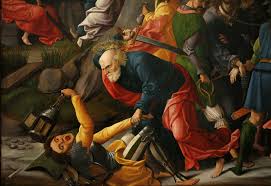
Holy week begins with an aura of pomp and victory, as Jesus triumphantly enters Jerusalem, to the sound of Hosannas. But this worldly glory is brief, transitory. The Gospel makes this uncomfortably clear, as we the crowd who shout “blessed is he that comes in the name of the Lord” are the same who will shout “crucify him, crucify him.” In so short a time, everything is upset, the wild hopes of the disciples shattered, the image of glory dimmed.
In this year of our lord, our Christian rituals have been around a while, and we enter into them dutifully, preparing the correct emotions for the correct times. Holy Thursday we enter with solemnity. We are about to descend to the tragic, the time of mourning, but we know we will emerge into the high comic, the time of feasting.
But when we turn to the Gospel accounts of the day before Christ’s crucifixion, what we find is not solemnity but confusion, sometimes to the point of absurdity. This is not surprising, because the long mythos of salvation history leading up to the culmination of Christ’s earthly mission has been punctuated by the bizarre, even the buffoonish. From the very beginning, there is a running motif of human folly. Silly Adam and Eve risk everything for a bit of fruit. The Tower of Babel is the work of grandiose buffons. After surviving an apocalyptic flood, the first thing Noah does is figure out how to make wine, then pass out naked in his tent. Lot offers to sell his daughters to rapists. Esau sells is birthright for lentils. Lentils. Think about that for a minute. Samson comes off as a sex-mad muscular oaf. David does everything an epic hero is supposed to do – murder a lot, and take people’s wives – and is chastened for it. Consider the trepidations of the prophets, the sulks of Jonah.
And through it all, the women of the Old Testament are nothing like the modest dutiful maidens one would expect. Sarah laughs at an angel; Rachel steals her father’s household gods; Rebekah deceives her husband; Ruth crawls into a man’s bed; Esther risks death by defying the king’s decree; Judith cuts off a general’s head.
The motif running through the Old Testament is that we humans are fools and scoundrels, yet God is very interested in us, and willing to be involved in our folly – and he works through the most rebellious among us.
The procession of divine will through human history is one of constant disruption, reversal of expectations.
The events of Holy Thursday, from the initiation of the Eucharist, to the arrest of Jesus, we are accustomed to taking seriously. But to read the account in the Gospels is to enter into a strange world of reversals, riddles, and even a kind of clownishness. Imagine how confused the disciples must have been, when Jesus radically altered the Passover ritual. Why would he call the bread his body? Why would he call the wine his blood? Mixing flesh and blood was forbidden by Jewish law, and yet here is Jesus, claiming to do just this, profaning the holy Passover. The apostles do not object. They seem to be fascinated. What will Jesus do next? Perhaps, they imagine, Jesus is about to use his mighty powers to overthrow Roman rule and establish his kingdom – and thus, apparently having learned nothing from the Sermon on the Mount, they begin to quarrel over who will be the greatest. How perplexed they must have been when he knelt to wash their feet at this time. The apostles have managed to acquire swords, even though it was forbidden by the occupying Roman forces for Jews to carry arms; there is something incongruous about their apparent hope that with these two swords they will raise the country against the Empire. Then instead of leading them out to war, Jesus leads them to a garden, to pray, and they are bored, and fall asleep during his deepest anguish. Then out comes the mob to arrest Jesus, and Peter in his manly prowess cuts off a servant’s ear, and Jesus heals it, and Mark is nearly caught, but gets away and runs off naked.
Depictions of the life of Jesus, in film, vacillate between the sentimental and the gory. But the events of Holy Thursday would probably best be depicted in a Coen Brothers film. Absurd expectations, cocksure males, ridiculous injuries, strange banter, overturned expectations, and a naked kid scampering off along the edges of things.
Then also despair.
And note this: Jesus’ followers, when telling their stories, could have decided to cut out all the parts in in which they behave like confused and power-hungry buffoons, but clearly they and others who passed on and recorded their memories considered these parts necessary. St. Peter clearly could have commanded everyone: “don’t talk about the part where I was an idiot. And could you maybe cut that bit…you know, the one with the rooster crowing?”
They could have revised the part where Jesus chooses to appear to Mary Magdalene first, or at least decided not to mention that initially they didn’t believe her.
The narrative of these holy days could have been rewritten, casting the apostles as wise and holy and obedient. But instead we find them confused, addled, even stupid. Even faithless. And those who might have been expected to hide away, timidly – the women disciples of Jesus – stayed by his side. And the writers of the Gospel accounts understood that this truth, too, needed to be recorded.
Apparently this divinely inspired text is supposed to suggest to readers not simply the austere and the solemn, but also something that can best be described as the carnivalesque: a spirit of disorder, upheaval, even license.
The idea of the carnivalesque was developed by Russian literary critic Mikhail Bakhtin, to describe a motif in both culture and literature. The term refers originally to the celebrations of Fat Tuesday, Mardi Gras, feasting before fasting, “carne vale” a “farewell to meat.”
For Bakhtin, the time of carnival is a time in which the usual structures of society are reversed, the world is turned upside down. Carnival is marked by free expression, eccentric behavior, licit misalliances, even licensed sacrilege. Costumes and masks allow for change in identity. Masters become slaves – the Son of God washes the feet of mere mortal sinners. Beggars become kings. The custom at some medieval carnivals was to elect a “pope of fools” – and yet, the first pope behaved very much a fool in his own day. The sacred is mingled with the profane – as, perhaps, it may have seemed to the apostles that Jesus was profaning their Passover tradition. But the sacred was already mingled with the profane when the Logos became incarnate flesh. Christianity is carnival.
Carnival is about participation, not about spectacle, which is why our contemporary secular “carnivals” have none of the religious or ritual significance of the great medieval festivals. And carnival is necessary for the health of civilization, because the forced structures and laws of an ordered civilization are burdensome and exhausting to us. We need release, especially from artificial human laws, human interpretations. The order of human civilization is not identical with the heavenly kingdom.
Carnival is central to comedy, which shatters the petrified power-structures that hold us in place, and allows for the renewal of life – which is why comedy ends, usually, with a marriage feast. And comedy is of all the art forms best suited to understanding salvation history, as the divine surprises us again and again by working vitally amidst human folly and frailty. And this cycle has been repeated through church history, when at every turn we have imagined that we have it all down pat, and been surprised again at how wrong we were, when we believed we were certain.
Imagine the surprise in the early church when it turned out to be no longer only for the Jews. When it turned out to be for everyone. “Here Comes Everybody” – to quote that most carnivalesque of writers, James Joyce.
And so the church has grown wider, richer, embracing more and more of human experience, continuing to surprise us with possibility.
image credit: https://upload.wikimedia.org/wikipedia/commons/8/8c/The_capture_of_Christ_mg_1674.jpg
Previous Post

March 22, 2016
Disturbing Nature
Next Post
March 25, 2016 How Can We Call this Friday Good?
Browse Our Archives
Select a Category abortion anti-semitism art Atwood Betrothed church clergy abuse coronavirus culture economics education environmentalism ethics faith family feminism gardening gun violence immigration Judaism literature MaddAddam New Pro Life Movement news pandemic personalism poem politics politics blue Pope Francis racism religion salvation sexuality social justice spirituality Station eleven Stephen King The Stand Trump Uncategorized war World Health Organization
Select a Month March 2021 February 2021 January 2021 December 2020 November 2020 October 2020 September 2020 August 2020 July 2020 June 2020 May 2020 April 2020 March 2020 February 2020 January 2020 December 2019 November 2019 October 2019 September 2019 August 2019 July 2019 June 2019 May 2019 April 2019 March 2019 February 2019 January 2019 December 2018 November 2018 October 2018 September 2018 August 2018 July 2018 June 2018 May 2018 April 2018 March 2018 February 2018 January 2018 December 2017 November 2017 October 2017 September 2017 August 2017 July 2017 June 2017 May 2017 April 2017 March 2017 February 2017 January 2017 December 2016 November 2016 October 2016 September 2016 August 2016 July 2016 June 2016 May 2016 April 2016 March 2016 February 2016
Follow Us!
TAKE THE
Religious Wisdom Quiz
Go to this tiny creature, you sluggard! Observe its ways and be wise, for it has no commander yet stores provisions. What industrious insect is this?
Select your answer to see how you score.
The grasshopper The ant The bee The spider
Support this
Column


Related posts from suspended in her jar

Immigrants: They Need Us, and We Need Them

Four Takeaways from Oprah’s Interview with the Duke...

Catholics Are De-Toxing From their Experiences With Traumatic...

How Has the Pandemic Changed Us? Has It...
TRENDING AT PATHEOS Catholic

The Parable Of The Sower And The Word...
One of Christ’s most famous parables is that of the sower who...

Rejecting Doom: Christian Hope And Human Action
Christianity is a religion of hope. We are to have hope and...

Why I Choose the Eucharist Over the Sermon
Choose the Eucharist, Not the Sermon What are we supposed to get...

5 Design Elements Found in Spiritually Rooted Homes
Putting Spirituality Into Home Decor Our homes are more than our living...

Credo: A Story of God Told with the...
About 10 years ago, I began to imagine a personal "Credo" that...

The Anatomy of Divine Revelation in Catholic Thought
The claim that God has made Himself known to human beings is...
view all Catholic blogs
Ad-Free & Subscriber Log-In Subscription Support
- About Us
- 2026 Calendar
- Videos
- Podcasts
- Library of World Religions
- Faith In Media Tracker
- Advertise With Us
- Write for Us
- Privacy Policy
- Terms of Service
- Do Not Sell My Data
- Contact Us
- Radiant Digital
- Manage Newsletter Subscriptions
- Unsubscribe From Notifications
- Sitemap
Copyright 2008-2026, Patheos. All rights reserved.
Subscription Support Ad-Free & Subscriber Log-In
Follow Patheos