
BuddhistCatholicContemplativeEvangelicalGeneral ChristianHinduJewishLatter-day SaintMuslimNew VisionsProgressive Christian
Beliefs
- Buddhist
- Catholic
- Contemplative
- Evangelical
- General Christian
- Hindu
- Jewish
- Latter-day Saint
- More Voices
- Muslim
- New Visions
- Pagan
- Progressive Christian
Topics
- Religion News
- Food and Religion
- Sports and Religion
- Religious Art
- Religious Music and Entertainment
- Religious Events
- History and Religion
- Style and Religion
- Politics and Religion
- Women in Religion
- Recreation Outdoors and Religion
- Business Finance and Religion
- Careers Workplace and Religion
- Education and Religion
- Family Parenting and Religion
- Health Fitness and Religion
- Home and Religion
- Relationships and Religion
- Technology and Religion
- Travel and Religion
Columnists
- Buddhist Columnists
- Business Finance and Religion Columnists
- Careers Workplace and Religion Columnists
- Catholic Columnists
- Contemplative Columnists
- Education and Religion Columnists
- Evangelists Columnists
- Family Parenting and Religion Columnists
- General Christian Columnists
- Health Fitness and Religion Columnists
- Hindu Columnists
- History and Religion Columnists
- Home and Religion Columnists
- Jewish Columnists
- More Voices Columnists
- Latter Day Columnists
- Muslim Columnists
- New Visions Columnists
- Nonreligious Columnists
- Pagan Columnists
- Politics and Religion Columnists
- Progressive Columnists
- Recreation Outdoors and Religion Columnists
- Relationships and Religion Columnists
- Religion News Columnists
- Religious Art Columnists
- Religious Events Columnists
- Religious Music and Entertainment Columnists
- Sports and Religion Columnists
- Style and Religion Columnists
- Technology and Religion Columnists
- Travel and Religion Columnists
- Women in Religion Columnists
Resource Library
- 2026 Calendar
- Library of World Religions
- The 100 Most Holy Places on Earth
- Patheos Answers
- Podcasts
- Videos
- Faith Leaders Database
- Anglican Episcopalian
- Bahai
- Baptist
- Buddhism
- Christianity
- Confucianism
- Eastern Orthodoxy
- Hinduism
- Holiness and Pentecostal
- ISKCON
- Islam
- Judaism
- Lutheran
- Methodist
- The Church of Jesus Christ of Latter-day Saints
- New Age
- Paganism
- Presbytarian and Reformed
- Protestantism
- Religion Behind the Scenes
- Roman Catholic
- Scientology
- Shia Islam
- Sikhism
- Sufism
- Sunni Islam
- Taoism
- Zen
- See all religions
Research Tools
 Ad-Free & Subscriber Log-In Subscription Support
Ad-Free & Subscriber Log-In Subscription Support
Follow Patheos 

- Trending:
- Forgiveness
- |
- Marriage
- |
- Consciousness
- |
- Death Penalty
- |
- Election
- |
- Halloween
 suspended in her jar
- Home
- Catholic
- to begin with, let’s talk about death
to begin with, let’s talk about death
Last updated on: February 19, 2016 at 2:04 pm by Rebecca Bratten Weiss
to begin with, let’s talk about death 2016-02-19T14:04:30-04:00 Rebecca Bratten Weiss
Patheos Explore the world's faith through different perspectives on religion and spirituality! Patheos has the views of the prevalent religions and spiritualities of the world.

As an organic farmer, I am keenly aware of the how bodily death is implicated in the eco-system, and therefore in our bodily relationship with the millions of other organisms thriving and surviving and perishing constantly around us, those with whom we consciously interact and those of which we are unaware. A plant requires a living soil – teeming with microbes – in order to grow, and yet a living soil requires death and decay. Composting is a condition for good growing. Rot is necessary.
So I would like to greet you, readers of my first post here, with a short meditation on how we engage with death.
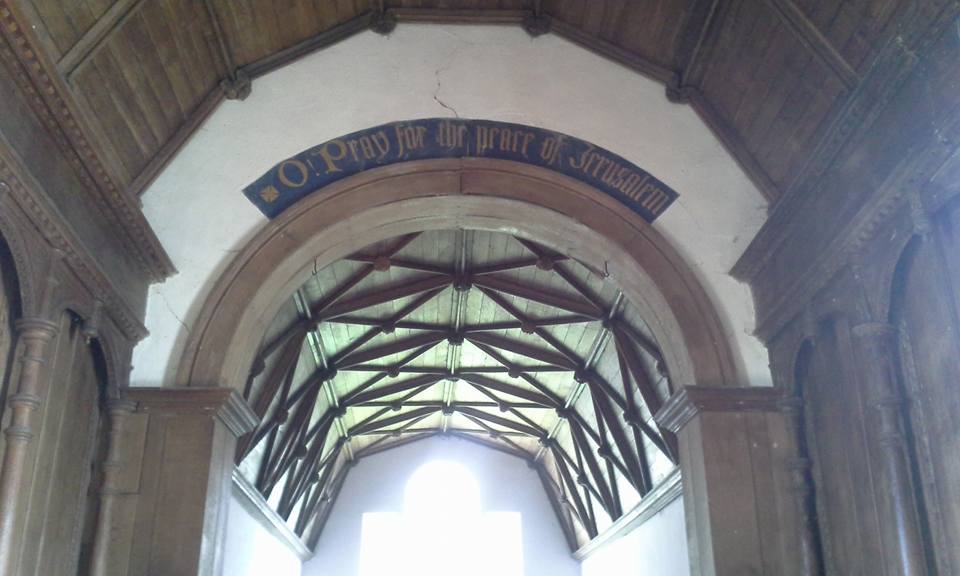
Very recently I had the opportunity to visit the tiny church of St. John’s, in Little Gidding, familiar to my fellow literature geeks as one of the sites for T.S. Eliot’s Four Quartets. It is a grey church dappled with lichens, in a green space, surrounded by keeling crooked tombstones, and the first few snowdrops of the year. “Little Gidding” is, of course, the poem in which Eliot alludes directly to the famous quotation from Julian of Norwich:
…And all shall be well and
All manner of thing shall be well…
IN times of luxury and contentment it is easy enough to believe Julian’s words. But the challenge of the statement, and of the poem, and of the church in the graveyard is to understand how all shall be well amidst civil war and violence and death. “Little Gidding” is a poem in which historical strife, the flight of the “broken king” Charles I, who refuged near St. John’s church, is tethered to the stillness of eternity, between one wave and the next. The sense that all is not lost is reiterated in the snowdrops, in the lichens on the church, in the stillness, but really there is no political solution nor human code which ensures anything. This could be after all the madness of poets. I have no proof that it is not. If we are looking globally and not simply through the brief haze of contentment after a particularly pleasing meal or yoga session, we ought to see that Julian’s statement is possibly commpletely insane. All is not well. It never has been. Death has fed death and this is not pleasant. Belief that all shall be well requires something beyond the platitudes of first-world philosophies.
What one finds in St. John’s, and in T.S. Eliot’s poem, is not a promise of luxury or contentment but a reminder of the crisis of violence through human history, a violence that has been perpetuated precisely by those movements that have sought to bring about utopia – whether by Cromwell’s Roundheads or by any other group religious or secular, and intent upon the slaying of the scapegoat, whether king or erring woman or innocent animal. In our attempt to escape death we end up becoming dealers of death.
Politically, as dealers of death, we have done a very fine job of pretending that death is not death. Phenomenologically we blind ourselves. How else could we be content with the “collateral damage” necessary for us to carry on with our utilitarian schemes of capitalist exploitation of the earth, animals, the unborn, the poor, the racially other, the inconveniently located civilian? We have a whole gamut of euphemisms for death. Pomp and circumstance and flags and memorials hide its reality.
Dualism is a veil: we politicize the deaths of public figures, so that we forget that what has happened is that a living body has gone through a terrifying transmutation from being a person to being a collection of cells to feed microbes (if microbes can even get into an expensive sealed coffin). We even pretend that the body itself was never the person, but only a container for the person, falling back on a sloppy Platonism that conjures an angel springing its cage and winging heavenward, away from the corruption of material being.
Capitalism is a veil: the view of the person as a unique being is replaced with an idea of the person as a kind of machine that produced a kind of product; death is mourned or celebrated depending on whether we liked or disliked the product. A beloved artist is mourned because we will miss the product. An unpopular politician is not mourned because we’re glad to be rid of the product. Public disputations on the seemliness of this are a fine civic distraction from the reality of decay.
Even modern agriculture is a veil: compost is considered unseemly, so instead we poison the earth with chemical fertilizers. Nothing can grow in these soils.
It is terrifying to pull the veil aside and consider death frankly, to face history and its violence without the soothing bromides of first-world pop philosophy, whether of bubbly optimism or smooth cynicism. Or aestheticism: that’s a veil, also. It’s a mistake to think that what Little Gidding (the poem or the place, the poem in the place) has to offer is meaningful simply because of its beauty. The snowdrops around the grave are beautiful, and that’s very nice for us tourists passing by, but fairly inconsequential to anyone who kneels in mourning beside that grave. There’s no real comfort for Echo in Narcissus having become a flower. Compost is good for poetry but if poetry is all there is, we are fools.Henry James called death “that distinguished thing” but, as it turned out, he wasn’t really dying when he said it.
What the pilgrim finds in the little church is perhaps most meaningful because it does not lie to us with easy answers. Julian’s statement that “all shall be well” may be complete lunacy. Or, yet, it may be an affirmation that the thing we are searching for is there, though we have not yet found the gate that opens to it. Do not cease from exploration.
Previous Post

March 12, 2021
Immigrants: They Need Us, and We Need Them
Next Post
February 20, 2016 Umberto Eco, gnosis, and nihilism
Browse Our Archives
Select a Category abortion anti-semitism art Atwood Betrothed church clergy abuse coronavirus culture economics education environmentalism ethics faith family feminism gardening gun violence immigration Judaism literature MaddAddam New Pro Life Movement news pandemic personalism poem politics politics blue Pope Francis racism religion salvation sexuality social justice spirituality Station eleven Stephen King The Stand Trump Uncategorized war World Health Organization
Select a Month March 2021 February 2021 January 2021 December 2020 November 2020 October 2020 September 2020 August 2020 July 2020 June 2020 May 2020 April 2020 March 2020 February 2020 January 2020 December 2019 November 2019 October 2019 September 2019 August 2019 July 2019 June 2019 May 2019 April 2019 March 2019 February 2019 January 2019 December 2018 November 2018 October 2018 September 2018 August 2018 July 2018 June 2018 May 2018 April 2018 March 2018 February 2018 January 2018 December 2017 November 2017 October 2017 September 2017 August 2017 July 2017 June 2017 May 2017 April 2017 March 2017 February 2017 January 2017 December 2016 November 2016 October 2016 September 2016 August 2016 July 2016 June 2016 May 2016 April 2016 March 2016 February 2016
Follow Us!
TAKE THE
Religious Wisdom Quiz
Who refused to bow to the king's statue and was thrown in the fire?
Select your answer to see how you score.
Daniel Paul Shadrach, Meshach, Abednego Joseph
Support this
Column


Related posts from suspended in her jar

Immigrants: They Need Us, and We Need Them

Four Takeaways from Oprah’s Interview with the Duke...

Catholics Are De-Toxing From their Experiences With Traumatic...

How Has the Pandemic Changed Us? Has It...
TRENDING AT PATHEOS Catholic

Rejecting Doom: Christian Hope And Human Action
Christianity is a religion of hope. We are to have hope and...

It’s What Comes From Within Which Matters
One of the most difficult things for us to understand is why...

Why I Choose the Eucharist Over the Sermon
Choose the Eucharist, Not the Sermon What are we supposed to get...

5 Design Elements Found in Spiritually Rooted Homes
Putting Spirituality Into Home Decor Our homes are more than our living...

Credo: A Story of God Told with the...
About 10 years ago, I began to imagine a personal "Credo" that...

The Anatomy of Divine Revelation in Catholic Thought
The claim that God has made Himself known to human beings is...
view all Catholic blogs
Ad-Free & Subscriber Log-In Subscription Support
- About Us
- 2026 Calendar
- Videos
- Podcasts
- Library of World Religions
- Faith In Media Tracker
- Advertise With Us
- Write for Us
- Privacy Policy
- Terms of Service
- Do Not Sell My Data
- Contact Us
- Radiant Digital
- Manage Newsletter Subscriptions
- Unsubscribe From Notifications
- Sitemap
Copyright 2008-2026, Patheos. All rights reserved.
Subscription Support Ad-Free & Subscriber Log-In
Follow Patheos