
BuddhistCatholicContemplativeEvangelicalGeneral ChristianHinduJewishLatter-day SaintMuslimNew VisionsProgressive Christian
Beliefs
- Buddhist
- Catholic
- Contemplative
- Evangelical
- General Christian
- Hindu
- Jewish
- Latter-day Saint
- More Voices
- Muslim
- New Visions
- Pagan
- Progressive Christian
Topics
- Religion News
- Food and Religion
- Sports and Religion
- Religious Art
- Religious Music and Entertainment
- Religious Events
- History and Religion
- Style and Religion
- Politics and Religion
- Women in Religion
- Recreation Outdoors and Religion
- Business Finance and Religion
- Careers Workplace and Religion
- Education and Religion
- Family Parenting and Religion
- Health Fitness and Religion
- Home and Religion
- Relationships and Religion
- Technology and Religion
- Travel and Religion
Columnists
- Buddhist Columnists
- Business Finance and Religion Columnists
- Careers Workplace and Religion Columnists
- Catholic Columnists
- Contemplative Columnists
- Education and Religion Columnists
- Evangelists Columnists
- Family Parenting and Religion Columnists
- General Christian Columnists
- Health Fitness and Religion Columnists
- Hindu Columnists
- History and Religion Columnists
- Home and Religion Columnists
- Jewish Columnists
- More Voices Columnists
- Latter Day Columnists
- Muslim Columnists
- New Visions Columnists
- Nonreligious Columnists
- Pagan Columnists
- Politics and Religion Columnists
- Progressive Columnists
- Recreation Outdoors and Religion Columnists
- Relationships and Religion Columnists
- Religion News Columnists
- Religious Art Columnists
- Religious Events Columnists
- Religious Music and Entertainment Columnists
- Sports and Religion Columnists
- Style and Religion Columnists
- Technology and Religion Columnists
- Travel and Religion Columnists
- Women in Religion Columnists
Resource Library
- 2026 Calendar
- Library of World Religions
- The 100 Most Holy Places on Earth
- Patheos Answers
- Podcasts
- Videos
- Faith Leaders Database
- Anglican Episcopalian
- Bahai
- Baptist
- Buddhism
- Christianity
- Confucianism
- Eastern Orthodoxy
- Hinduism
- Holiness and Pentecostal
- ISKCON
- Islam
- Judaism
- Lutheran
- Methodist
- The Church of Jesus Christ of Latter-day Saints
- New Age
- Paganism
- Presbytarian and Reformed
- Protestantism
- Religion Behind the Scenes
- Roman Catholic
- Scientology
- Shia Islam
- Sikhism
- Sufism
- Sunni Islam
- Taoism
- Zen
- See all religions
Research Tools
 Ad-Free & Subscriber Log-In Subscription Support
Ad-Free & Subscriber Log-In Subscription Support
Follow Patheos 

- Trending:
- Forgiveness
- |
- Marriage
- |
- Consciousness
- |
- Death Penalty
- |
- Election
- |
- Halloween
 Surprising Faith
- Home
- Progressive Christian
- “God sent you here to make our family whole”: Growing up adopted in a Christian household
“God sent you here to make our family whole”: Growing up adopted in a Christian household
Last updated on: August 18, 2015 at 2:28 pm by Alicia de los Reyes
“God sent you here to make our family whole”: Growing up adopted in a Christian household 2015-08-18T14:28:43-08:00 Alicia de los Reyes
Patheos Explore the world's faith through different perspectives on religion and spirituality! Patheos has the views of the prevalent religions and spiritualities of the world.
This is a guest post by Larry Clow. Larry is a writer and editor living in the NH Seacoast. He’s the editor of The Sound. He’s also hard at work on a forthcoming book about adoption and social media. Follow him on Twitter.
Fifth in a series on adoption and modern Christianity; read more here.
My family lingered after mass. We were first in, last out Catholics — partly because my parents were lay ministers and I was an altar boy, and partly because my parents believed those extra few minutes on either side of the services helped move us up the scoreboard. And because we lingered, we chatted. With Father Jim, our priest; Shirley, the parish secretary, and the gaggle of old ladies who also lingered by virtue of age.
“I swear, when Larry walked down the center aisle, in his white robe and holding the candle, he looked just like a priest,” said Doris, one of the old women, after an Easter vigil mass when I was 12.
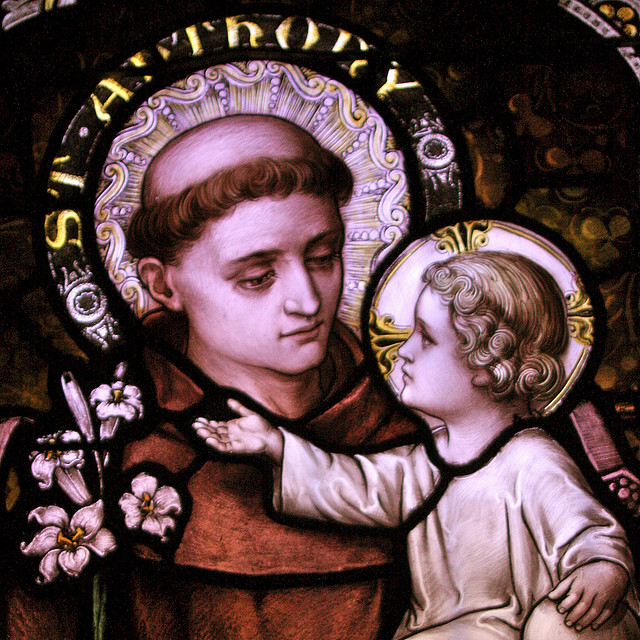
St. Anthony stained glass, from St. Mary’s in Phoenix, AZ, c/o Kevin Dooley
“He did,” said Nancy, her friend. “Just like a priest.”
I smiled, though it probably looked more like a grimace, and my parents beamed. “You never know!” my mother said. She cast in my direction a significant glance, suggesting that I consider this banter vocational advice.
“Just like a priest,” Doris said again, making it sound like a prophecy. “He looks so good up there at the altar.”
I was no stranger to predictions like this. It’s part of being adopted. “You’re special because you’re adopted — it means God chose you specifically for us.” My mother told me this as early as I can remember. I knew, too, that my parents had tried for years to have a child, but couldn’t, and that my grandfather, who raised three daughters, desperately wanted a grandson. The subtext was really just text: God sent you here to make our family whole. You’re meant for great things. Don’t mess this up.
Sound familiar? Christianity informs the roots of modern American adoption. It was Charles Loring Brace, a Congregational minister, who started the Orphan Train movement in the mid-19th century, which sent thousands of children from poor neighborhoods in Eastern cities to families in the rural Midwest. The idea was to “save” children from institutional care and place them with farm families. The Orphan Train movement ended in the 1920s, but the ideas behind it formed the basis for modern adoption practices.
And so it’s not surprising that all sorts of savior complexes and religious undercurrents are found in adoption. (As an added bonus, I was adopted through Catholic Charities.) Adoptive parents are encouraged to feel like they’ve “saved” a child from some horrible fate, and adoptees sometimes get cast as their family’s personal savior. Birth/first mothers are either pegged as saintly Marys who made a difficult decision for the good of her child or harlots who, either by choice or force, were relieved of their child.
These myths are messy, damaging stuff (Kathryn Joyce has done some great reporting on adoption and modern evangelical Christianity). Even in the best scenarios, these underpinnings can change how adoptees, biological parents, and adoptive parents think about themselves and each other. It gets even more complicated for transracial adoptees, for whom racism and colonialism gets mixed in with the usual religious baggage.
For me, these attitudes about religion and adoption fully informed my faith — more precisely, my lack of it. My parents and I were the picture of a perfect Catholic family. My father taught a kindergarten Sunday school class, and I helped him prepare lessons. Both he and my mother were lay ministers; I was an altar server. My father was in the Knights of Columbus; I was in the youth group and on the CYO basketball team. We worked church picnics and clean-up days and stayed late after functions to load folding chairs on to massive rolling carts.
But I didn’t believe. I don’t know if I ever did. I went through the motions and played the part, and though I appeared sincere, I wasn’t. (I was, however, sincere about wanting to please my family, so perhaps that’s why my appearance of faith was so convincing.)
I didn’t believe because when I thought about my adoption, I didn’t see God’s hand. I was 10 or 11 when I realized this. For many years, my parents had hanging in the dining room the letter from the Catholic Charities caseworker who approved my adoption. I saw the letter every day, and it told me that there was no prophecy behind my adoption, no destiny, no special plan. Just an accident of bureaucracy. I was there and not somewhere else because of paperwork — not God.
It helped, too, that I was nothing like my family. We didn’t share interests or even similar attitudes. At 10 years old, I could already see how different I was from them, a quiet kid obsessed with books and movies and comic books in a family where no one owned books and everyone slept through movies. My mother and grandfather, the two parental figures who tried hardest to influence me, spoke in shouts and barked orders and distrusted anyone they deemed as too educated (“They just think they’re better than everyone else.”). They viewed god not as a loving figure or creator of awesome power, but as a judgmental scorekeeper who sat in the clouds and kept track of the minutes you spent in church and made special note when you forgot to mail a birthday card or didn’t spend enough time with your family.
It was a perfect mix for inoculating me against belief and religion. If my only choice was a rules-obsessed deity who cared more about my grandfather’s weekly church attendance than the fact he verbally abused everyone else in the family, then I’d believe in nothing except accidents of paperwork and systems that don’t work. And if I didn’t believe, then the prophecies didn’t apply. I didn’t have to save the family or do great things. I could just be myself.
But that’s easier said than done, for me and for many other adoptees. It takes years of work to untangle those knots of belief and expectations and familial obligation. Apart from a handful of weddings and a few funerals, I haven’t been to mass in 17 years. On the rare occasions I see my parents, they ask if I’ve been to church lately. When I say that I haven’t, they reminisce about how nice I looked up at the altar, how the old ladies in the parish fawned over me. I feel for a moment the familiar weight of guilt. Then it’s gone, and I quietly savor its absence.
Previous Post

August 11, 2015
Talking Adoption: An Interview with Benjamin Corey (Part 3)
Next Post

August 25, 2015 Talking Adoption: Fighting with the Foster Care System (Part 1)
Browse Our Archives
Select a Category Activism Catholicism Evangelical Christianity Faith & Daily Life Fundamentalism History Mainstream Christianity Nondenominational Christianity Orthodox Christianity Progressive Christianity
Select a Month February 2016 January 2016 December 2015 November 2015 October 2015 September 2015 August 2015 July 2015 June 2015 May 2015 April 2015 March 2015 February 2015
Follow Us!
TAKE THE
Religious Wisdom Quiz
Who found a wife for Isaac?
Select your answer to see how you score.
Ishmael Lot Jacob Abraham's servant
Related posts from Surprising Faith

An atheist and a deist walk into a...

Something like a socialist dream

Beyond the Pulpit and the Prayers

What does Ethiopian Orthodox Christianity look like?
TRENDING AT PATHEOS Progressive Christian

Why Christians Have a Sacred Duty to Vote:...
The Bible offers strong support for the sacred duty to vote. Here...

What Being a Modern-Day Apostle Means to Me
In my last column, I discussed the ins and outs of modern-day...

Did Ancient China Once Worship the God of...
Across human history, a common thread weaves through the origins of the...

Love Your Neighbor – Including Earth-Kin: Lev. 19,...
God’s command to love your neighbor means acting in an ethical and...

Lead a Church Study of “Jesus and Lao...
Guest writer Jack Thomas (The Irreverent Reverend) reflects on leading his church...

Principles for Understanding the Apostolic Ministry Today
Whenever people discover that my formal ministry title is "apostle," as in...
view all Progressive Christian blogs
Ad-Free & Subscriber Log-In Subscription Support
- About Us
- 2026 Calendar
- Videos
- Podcasts
- Library of World Religions
- Faith In Media Tracker
- Advertise With Us
- Write for Us
- Privacy Policy
- Terms of Service
- Do Not Sell My Data
- Contact Us
- Radiant Digital
- Manage Newsletter Subscriptions
- Unsubscribe From Notifications
- Sitemap
Copyright 2008-2026, Patheos. All rights reserved.
Subscription Support Ad-Free & Subscriber Log-In
Follow Patheos