
BuddhistCatholicContemplativeEvangelicalGeneral ChristianHinduJewishLatter-day SaintMuslimNew VisionsProgressive Christian
Beliefs
- Buddhist
- Catholic
- Contemplative
- Evangelical
- General Christian
- Hindu
- Jewish
- Latter-day Saint
- More Voices
- Muslim
- New Visions
- Pagan
- Progressive Christian
Topics
- Religion News
- Food and Religion
- Sports and Religion
- Religious Art
- Religious Music and Entertainment
- Religious Events
- History and Religion
- Style and Religion
- Politics and Religion
- Women in Religion
- Recreation Outdoors and Religion
- Business Finance and Religion
- Careers Workplace and Religion
- Education and Religion
- Family Parenting and Religion
- Health Fitness and Religion
- Home and Religion
- Relationships and Religion
- Technology and Religion
- Travel and Religion
Columnists
- Buddhist Columnists
- Business Finance and Religion Columnists
- Careers Workplace and Religion Columnists
- Catholic Columnists
- Contemplative Columnists
- Education and Religion Columnists
- Evangelists Columnists
- Family Parenting and Religion Columnists
- General Christian Columnists
- Health Fitness and Religion Columnists
- Hindu Columnists
- History and Religion Columnists
- Home and Religion Columnists
- Jewish Columnists
- More Voices Columnists
- Latter Day Columnists
- Muslim Columnists
- New Visions Columnists
- Nonreligious Columnists
- Pagan Columnists
- Politics and Religion Columnists
- Progressive Columnists
- Recreation Outdoors and Religion Columnists
- Relationships and Religion Columnists
- Religion News Columnists
- Religious Art Columnists
- Religious Events Columnists
- Religious Music and Entertainment Columnists
- Sports and Religion Columnists
- Style and Religion Columnists
- Technology and Religion Columnists
- Travel and Religion Columnists
- Women in Religion Columnists
Resource Library
- 2026 Calendar
- Library of World Religions
- The 100 Most Holy Places on Earth
- Patheos Answers
- Podcasts
- Videos
- Faith Leaders Database
- Anglican Episcopalian
- Bahai
- Baptist
- Buddhism
- Christianity
- Confucianism
- Eastern Orthodoxy
- Hinduism
- Holiness and Pentecostal
- ISKCON
- Islam
- Judaism
- Lutheran
- Methodist
- The Church of Jesus Christ of Latter-day Saints
- New Age
- Paganism
- Presbytarian and Reformed
- Protestantism
- Religion Behind the Scenes
- Roman Catholic
- Scientology
- Shia Islam
- Sikhism
- Sufism
- Sunni Islam
- Taoism
- Zen
- See all religions
Research Tools
 Ad-Free & Subscriber Log-In Subscription Support
Ad-Free & Subscriber Log-In Subscription Support
Follow Patheos 

- Trending:
- Forgiveness
- |
- Marriage
- |
- Consciousness
- |
- Death Penalty
- |
- Election
- |
- Halloween
 Surprising Faith
- Home
- Progressive Christian
- One Way to Fight Racism (as a white person)
One Way to Fight Racism (as a white person)
Last updated on: July 7, 2015 at 8:09 am by Alicia de los Reyes
One Way to Fight Racism (as a white person) 2015-07-07T08:09:25-08:00 Alicia de los Reyes
Patheos Explore the world's faith through different perspectives on religion and spirituality! Patheos has the views of the prevalent religions and spiritualities of the world.
In the wake of what can only be called a wave of violence against Black people, I’ve been trying to find a way that I, a white person, can help.
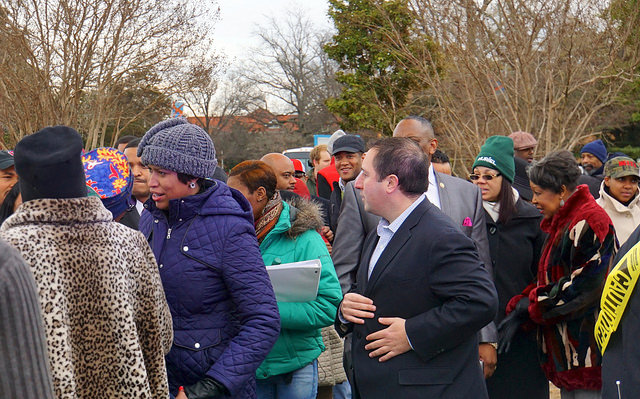
MLK Parade, 2015, Anacostia, Washington, DC. c/o Ted Eytan
After I read fellow Patheos Progressive Christian blogger Tim Suttle’s post on feeling like a phony when talking about race, I realized that maybe I do have something to offer. Tim wrote about not knowing what to do when confronted with his own racism; he lives in an essentially segregated community, and though he’s sympathetic to what’s going on, he doesn’t know where to begin:
I am a pastor in an era when the church is also largely segregated along racial lines. I feel like I need to do or say something, but I have a huge problem:
When I talk about race, I feel like a phony.
Later, he adds,
I fear that most white Christians struggle to find anything to say that doesn’t sound glib or insincere or outright racist.
As a white person, I wholeheartedly agree. It’s hard to talk about race. But there is at least one way to figure it out: spend time with Black people.
I grew up in New Jersey, a diverse but segregated state. Though Black and white people might live less than a mile apart, they usually attend different schools; my high school had a handful of Black students while our chief rival, less than five miles away, had a handful of white students.
The first time I was in a high school-level class with Black students was in a summer program. At an all-girls writing program that basically introduced us to college essays, we spent a few hours a day sitting in a circle in a light, window-filled classroom, discussing readings. I was acutely aware of how different our discussion (about a text on marginalization) was because of the diversity of the students.
In my all-white high school English class, we skirted the topic of race or talked about it in hypothetical terms. When we read Native Son, there was a lot of, “I don’t know what it would be like to experience this, but…”
I’d never talked about being a minority with someone who was a minority. In the summer program classroom, I was incredibly self-conscious about saying the “right” thing, about offending someone. But because I’m a polite, normal person, I figured it out. The conversation was insightful and exciting, occasionally entertaining and occasionally boring. Because it turns out, Black people really are just people.
Of course, I wish I had absorbed this lesson before I was in high school, that I knew from the get-go and not just the inclusive songs on Sesame Street that deep down, we’re all humans who want to be loved, live in a safe place, spend time with people we care about, and do the things that we like to do. But this is what we miss out on growing up, living, and working in separate spheres.
It’s surprisingly difficult to live and work in a truly integrated society. Many communities are segregated; church is one of the most segregated places you can go. And yet, it’s the responsibility of the people with more status and power to try to change the status quo.
This means that the onus is on us white folks to reach out to the Black community. How?
Here are a few ideas:
- The United Methodist General Board of Church and Society, of which my congregation (Valley and Mountain) is a member, suggests: “If you are in a predominantly Anglo church, walk across the street or drive across town and sit down with leaders of a church that is predominantly made up of people of color.” As a member of a predominantly white church, you could attend a predominantly Black church (an A.M.E. church, for example). Yes, of course you might feel awkward. You might feel uncomfortable, and there’s even a chance you won’t be welcomed. But this is our responsibility. And it’s church, for crying out loud. It’s literally written in our codes to be welcoming.
- Run errands in the part of town that isn’t white: Go grocery shopping, go to the dry cleaners, stop by somewhere for lunch, get your car tuned up. Join a gym in a predominantly Black neighborhood. Again, you might feel awkward. But you probably won’t offend every single person you meet buying milk and lifting weights.
- Go to a march or a rally and stand in solidarity with the Black community. Show your support by showing up; show the world that this is not just a Black issue but a human issue. We don’t want people to die; we don’t want churches to be burned.
We don’t need to think of ourselves as community liaisons or racial ambassadors. We don’t even need to be one big happy family. We just need more individual people, less “us” and “them.” Then, in addition to talking about race, we can talk about specific people with real concerns and injustices that we have seen.
We white people need to live life in a slightly more intentional manner. Segregation is what happens when we don’t think about it.
Finally: It’s easy to rationalize our non-action by saying I don’t own slaves; I don’t hate Black people. I’m not racist. I don’t want anyone to be oppressed.
And all those things are true. But though the violence against the Black community might not be our fault, we have the most power to try to stop it. As Martin Luther King, Jr., wrote in his Letter from a Birmingham Jail, white supremacists might not be the Black community’s worst enemy. White moderates might be. As Dr. King writes:
…over the past few years I have been gravely disappointed with the white moderate. I have almost reached the regrettable conclusion that the Negro’s great stumbling block in his stride toward freedom is not the White Citizen’s Counciler or the Ku Klux Klanner, but the white moderate, who is more devoted to “order” than to justice; who prefers a negative peace which is the absence of tension to a positive peace which is the presence of justice; who constantly says: “I agree with you in the goal you seek, but I cannot agree with your methods of direct action”; who paternalistically believes he can set the timetable for another man’s freedom; who lives by a mythical concept of time and who constantly advises the Negro to wait for a “more convenient season.” Shallow understanding from people of good will is more frustrating than absolute misunderstanding from people of ill will. Lukewarm acceptance is much more bewildering than outright rejection.
Fifty-two years later, we know that “negative peace” is not peace at all. Let’s not let these words be so relevant another 52 years from today.
Previous Post

June 30, 2015
5 Reasons this Millennial is Still a Christian
Next Post

July 14, 2015 Facebook for Christians
Browse Our Archives
Select a Category Activism Catholicism Evangelical Christianity Faith & Daily Life Fundamentalism History Mainstream Christianity Nondenominational Christianity Orthodox Christianity Progressive Christianity
Select a Month February 2016 January 2016 December 2015 November 2015 October 2015 September 2015 August 2015 July 2015 June 2015 May 2015 April 2015 March 2015 February 2015
Follow Us!
TAKE THE
Religious Wisdom Quiz
What animal was often used for sacrifice?
Select your answer to see how you score.
Lamb Dove Ox Goat
Related posts from Surprising Faith

An atheist and a deist walk into a...

Something like a socialist dream

Beyond the Pulpit and the Prayers

What does Ethiopian Orthodox Christianity look like?
TRENDING AT PATHEOS Progressive Christian

Why Christians Have a Sacred Duty to Vote:...
The Bible offers strong support for the sacred duty to vote. Here...

What Being a Modern-Day Apostle Means to Me
In my last column, I discussed the ins and outs of modern-day...

Did Ancient China Once Worship the God of...
Across human history, a common thread weaves through the origins of the...

Love Your Neighbor – Including Earth-Kin: Lev. 19,...
God’s command to love your neighbor means acting in an ethical and...

Lead a Church Study of “Jesus and Lao...
Guest writer Jack Thomas (The Irreverent Reverend) reflects on leading his church...

Principles for Understanding the Apostolic Ministry Today
Whenever people discover that my formal ministry title is "apostle," as in...
view all Progressive Christian blogs
Ad-Free & Subscriber Log-In Subscription Support
- About Us
- 2026 Calendar
- Videos
- Podcasts
- Library of World Religions
- Faith In Media Tracker
- Advertise With Us
- Write for Us
- Privacy Policy
- Terms of Service
- Do Not Sell My Data
- Contact Us
- Radiant Digital
- Manage Newsletter Subscriptions
- Unsubscribe From Notifications
- Sitemap
Copyright 2008-2026, Patheos. All rights reserved.
Subscription Support Ad-Free & Subscriber Log-In
Follow Patheos