
BuddhistCatholicContemplativeEvangelicalGeneral ChristianHinduJewishLatter-day SaintMuslimNew VisionsProgressive Christian
Beliefs
- Buddhist
- Catholic
- Contemplative
- Evangelical
- General Christian
- Hindu
- Jewish
- Latter-day Saint
- More Voices
- Muslim
- New Visions
- Pagan
- Progressive Christian
Topics
- Religion News
- Food and Religion
- Sports and Religion
- Religious Art
- Religious Music and Entertainment
- Religious Events
- History and Religion
- Style and Religion
- Politics and Religion
- Women in Religion
- Recreation Outdoors and Religion
- Business Finance and Religion
- Careers Workplace and Religion
- Education and Religion
- Family Parenting and Religion
- Health Fitness and Religion
- Home and Religion
- Relationships and Religion
- Technology and Religion
- Travel and Religion
Columnists
- Buddhist Columnists
- Business Finance and Religion Columnists
- Careers Workplace and Religion Columnists
- Catholic Columnists
- Contemplative Columnists
- Education and Religion Columnists
- Evangelists Columnists
- Family Parenting and Religion Columnists
- General Christian Columnists
- Health Fitness and Religion Columnists
- Hindu Columnists
- History and Religion Columnists
- Home and Religion Columnists
- Jewish Columnists
- More Voices Columnists
- Latter Day Columnists
- Muslim Columnists
- New Visions Columnists
- Nonreligious Columnists
- Pagan Columnists
- Politics and Religion Columnists
- Progressive Columnists
- Recreation Outdoors and Religion Columnists
- Relationships and Religion Columnists
- Religion News Columnists
- Religious Art Columnists
- Religious Events Columnists
- Religious Music and Entertainment Columnists
- Sports and Religion Columnists
- Style and Religion Columnists
- Technology and Religion Columnists
- Travel and Religion Columnists
- Women in Religion Columnists
Resource Library
- 2026 Calendar
- Library of World Religions
- The 100 Most Holy Places on Earth
- Patheos Answers
- Podcasts
- Videos
- Faith Leaders Database
- Anglican Episcopalian
- Bahai
- Baptist
- Buddhism
- Christianity
- Confucianism
- Eastern Orthodoxy
- Hinduism
- Holiness and Pentecostal
- ISKCON
- Islam
- Judaism
- Lutheran
- Methodist
- The Church of Jesus Christ of Latter-day Saints
- New Age
- Paganism
- Presbytarian and Reformed
- Protestantism
- Religion Behind the Scenes
- Roman Catholic
- Scientology
- Shia Islam
- Sikhism
- Sufism
- Sunni Islam
- Taoism
- Zen
- See all religions
Research Tools
 Ad-Free & Subscriber Log-In Subscription Support
Ad-Free & Subscriber Log-In Subscription Support
Follow Patheos 

- Trending:
- Forgiveness
- |
- Marriage
- |
- Consciousness
- |
- Death Penalty
- |
- Election
- |
- Halloween
 Surprising Faith
- Home
- Progressive Christian
- We can’t help ourselves: Why a former Jewish agnostic and current progressive Christian still like Catholicism
We can’t help ourselves: Why a former Jewish agnostic and current progressive Christian still like Catholicism
Last updated on: April 23, 2015 at 8:00 am by Alicia de los Reyes
We can’t help ourselves: Why a former Jewish agnostic and current progressive Christian still like Catholicism 2015-04-23T08:00:25-08:00 Alicia de los Reyes
Patheos Explore the world's faith through different perspectives on religion and spirituality! Patheos has the views of the prevalent religions and spiritualities of the world.
Many of you may know Eve Tushnet from her blog here on Patheos, where she writes about being gay, celibate, and Catholic (along

Eve Tushnet, current Catholic (photo c/o May Goren)
with World Figure Skating Championship costumes and other events of note). Eve grew up “somewhere between agnostic and Jewish” and converted to Catholicism when she was a sophomore in college. I did the inverse: I was raised firmly Catholic and started drifting away from “the Church” in college, when I just couldn’t stomach my church’s position on women priests and gay marriage, among other things, and eventually ended up at a social-justice-oriented spiritual
community.
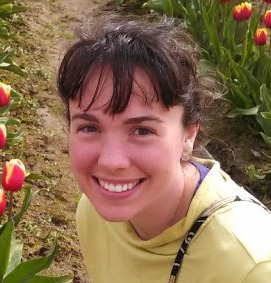
Alicia de los Reyes, former Catholic
I thought it would be fun to talk about why, despite our seemingly large hurdles (background, political beliefs, sexuality), we still really like the Catholic Church. (Even though my new church is Methodist, I still say that I was “raised Catholic.”) And a bit about why, even though we like it, it occasionally drives/drove us crazy. I’ll be posting our conversation in installments over the next few days. Please chime in in the comments about what you love/hate about Catholicism–no complaint/praise too large or too small!
Alicia: Ok, so here goes: I read a bit about your conversion story in Gay and Catholic, but I wonder if you could tell me about some of the specifically Catholic things that drew you to this church, either concrete or abstract? What was it about Catholicism in particular that drew you in? Eve: Ha, I don’t know if I *do* like Catholicism. I believe it and I love the Church, but… love is different from liking. Harder. But as to your specific question about things which drew me to Catholicism: Ah, there’s so much! I was initially attracted by the Crucifixion, 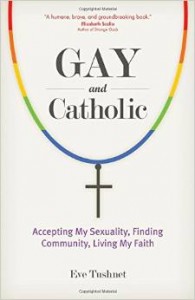 and especially by the promise that on the Cross Jesus reconciled justice and mercy. Also by the Catholic insistence on the goodness of the created world and the created body. The sensuality of Catholic worship, the “smells and bells,” really spoke to me. I love the ways we use our bodies in worship to indicate surrender: kneeling, genuflecting, bowing, kissing the Cross. I realize “surrender” is only one possible metaphor for talking about our relationship to God, but it’s one which really speaks to me, and I can’t help longing for some of the signs of surrender which we’ve largely abandoned, like the communion rail. The Eucharist was also huge in my conversion. It brings together the lurid violence of the Gospels–which imo is what makes them believable as an account of how God might respond to the luridly violent world we live in–and the Church’s honor for the created world. Bread and wine become God’s tortured flesh. We unite with God not just in our minds or even just in our souls, but also in our bodies. So the “real presence,” transubstantiation, was and is a very big deal to me. There are various other adornments of the Church which I love–St Francis, St Aelred, Caravaggio, “The
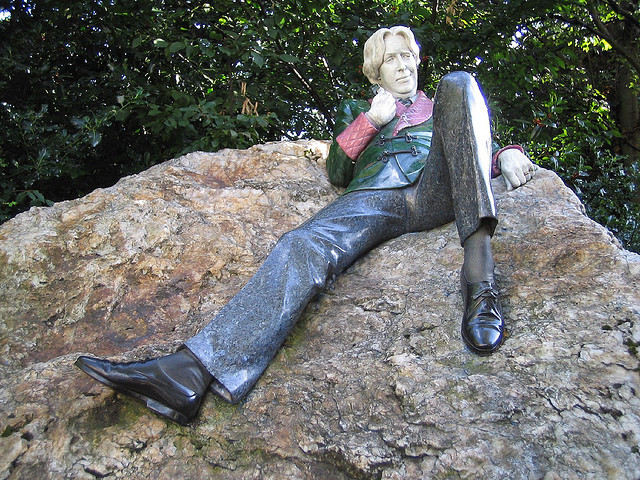
Oscar Wilde, c/o William Murphy
Imitation of Christ,” the Anima Christi, Oscar Wilde, Corpus Christi processions. Plus stuff we stole from other people like “Amazing Grace.” (I think my ideal Mass, which I will probably never get to celebrate, would be ad orientem Novus Ordo Latin Mass with a communion rail and “Amazing Grace” as the processional. Maybe “Let All Mortal Flesh Keep Silent” as recessional. And the Kiss of Peace instead of, like, the handshake of peace, why do we do that.) Your turn…. Alicia: It’s funny that you mention transubstantiation, because I always point to that as something I see as a silly difference between churches. When I learned in CCD (Catholic catechism) that we were eating the actual body of Christ, I thought, “That’s cool.” I still don’t know if I really believe that transubstantiation is possible–but I remember that as a kid, I was all in. It’s interesting to hear that someone was actually attracted to this idea as a young adult.
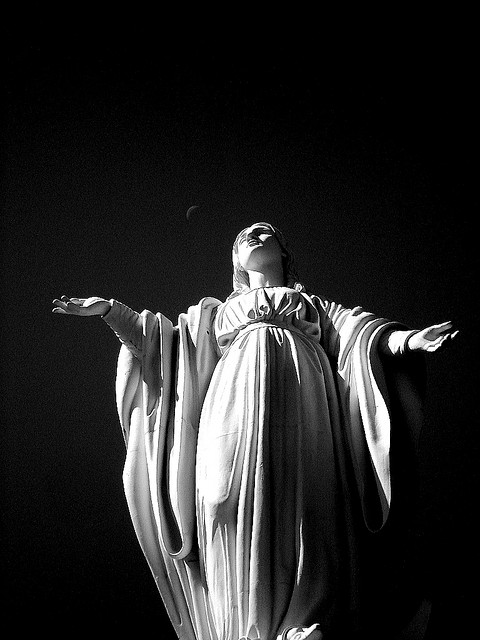
La Virgen y la luna (the Virgin and the moon), c/o Francisca Ulloa
The things that I miss about Catholicism now are the rituals associated with specific parts of the Mass, like the sign of the cross and bowing at certain times. My church did neither smells nor bells–the few times we had incense, I found the smoke unpleasant (what can I say, I was a sensitive child). But I liked the insider knowledge I had about all these little motions that symbolized both my respect for the moment commemorated in prayer (like bowing when you say “God came down from heaven” in the Nicene Creed) and my own membership to this group; other Christians don’t bow or kneel at all. I liked being different. I realize that’s a pretty egocentric reason to like Catholicism, but there you have it. I liked being a member of a slightly-mysterious-to-others club. Another thing that I really appreciated about Mass was that it made no pretenses about being the same every. single. time. I could go to Mass in any city of my choosing and know that the service would be exactly the same (perhaps with extra bells). It was comforting, but it was also an aspect of faith that I thought was lost in other churches that tried to “mix things up” by having different music, a different order of service, or “no” order (usually with a focus on the message). I thought the sameness embodied the constancy of God and Catholicism, and that it was up to me to stay engaged with the ritual or to allow my mind to wander. Both were productive uses of my worship time. I still think that, and I sometimes miss the time to reflect while going through the routine of Mass. Finally, the thing I like and miss most about Catholicism is its communion of saints. I believe in praying to the saints and I feel like some saints watch out for me. (I have total confidence that St. Lucy has helped me find things.) If I were
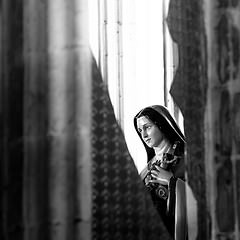
Virgin Mary, c/o Gzooh
to reveal my propensity to pray to saints to my Protestant friends, I’m pretty sure they would look at me sideways and question my belief in a single God. I think Catholicism has more room for holy beings (angels, for example) than other types of Christianity, and it’s fun and interesting. Also, it makes for way better church names: Our Lady of the ___, St. John the Divine, and St. Anything just roll off the tongue. Stay tuned! Up next: What we don’t love about Catholicism.
Previous Post
April 17, 2015
The "Hidden Christians" of Japan
Next Post

April 24, 2015 Modern-day Moneychangers?: How Seattle Church Leaders Turned Tables
Browse Our Archives
Select a Category Activism Catholicism Evangelical Christianity Faith & Daily Life Fundamentalism History Mainstream Christianity Nondenominational Christianity Orthodox Christianity Progressive Christianity
Select a Month February 2016 January 2016 December 2015 November 2015 October 2015 September 2015 August 2015 July 2015 June 2015 May 2015 April 2015 March 2015 February 2015
Follow Us!
TAKE THE
Religious Wisdom Quiz
True or False: Peter raised Tabitha (Dorcas) from the dead in Lydda.
Select your answer to see how you score.
FALSE TRUE
Related posts from Surprising Faith

Talking Adoption: How Adoption Became a Christian "Trend"
"God sent you here to make our family...

A Millennial Weighs in on the Pew Religious...
One woman's modern-day Anorexia Mirabilis
TRENDING AT PATHEOS Progressive Christian

What Being a Modern-Day Apostle Means to Me
In my last column, I discussed the ins and outs of modern-day...

Did Ancient China Once Worship the God of...
Across human history, a common thread weaves through the origins of the...

Love Your Neighbor – Including Earth-Kin: Lev. 19,...
God’s command to love your neighbor means acting in an ethical and...

Lead a Church Study of “Jesus and Lao...
Guest writer Jack Thomas (The Irreverent Reverend) reflects on leading his church...

Pastoral Wisdom for Responding to Sermon Pushback
Getting sermon pushback on your social justice sermon? Learn practical, Proverbs-based strategies...

Principles for Understanding the Apostolic Ministry Today
Whenever people discover that my formal ministry title is "apostle," as in...
view all Progressive Christian blogs
Ad-Free & Subscriber Log-In Subscription Support
- About Us
- 2026 Calendar
- Videos
- Podcasts
- Library of World Religions
- Faith In Media Tracker
- Advertise With Us
- Write for Us
- Privacy Policy
- Terms of Service
- Do Not Sell My Data
- Contact Us
- Radiant Digital
- Manage Newsletter Subscriptions
- Unsubscribe From Notifications
- Sitemap
Copyright 2008-2026, Patheos. All rights reserved.
Subscription Support Ad-Free & Subscriber Log-In
Follow Patheos