
BuddhistCatholicContemplativeEvangelicalGeneral ChristianHinduJewishLatter-day SaintMuslimNew VisionsProgressive Christian
Beliefs
- Buddhist
- Catholic
- Contemplative
- Evangelical
- General Christian
- Hindu
- Jewish
- Latter-day Saint
- More Voices
- Muslim
- New Visions
- Pagan
- Progressive Christian
Topics
- Religion News
- Food and Religion
- Sports and Religion
- Religious Art
- Religious Music and Entertainment
- Religious Events
- History and Religion
- Style and Religion
- Politics and Religion
- Women in Religion
- Recreation Outdoors and Religion
- Business Finance and Religion
- Careers Workplace and Religion
- Education and Religion
- Family Parenting and Religion
- Health Fitness and Religion
- Home and Religion
- Relationships and Religion
- Technology and Religion
- Travel and Religion
Columnists
- Buddhist Columnists
- Business Finance and Religion Columnists
- Careers Workplace and Religion Columnists
- Catholic Columnists
- Contemplative Columnists
- Education and Religion Columnists
- Evangelists Columnists
- Family Parenting and Religion Columnists
- General Christian Columnists
- Health Fitness and Religion Columnists
- Hindu Columnists
- History and Religion Columnists
- Home and Religion Columnists
- Jewish Columnists
- More Voices Columnists
- Latter Day Columnists
- Muslim Columnists
- New Visions Columnists
- Nonreligious Columnists
- Pagan Columnists
- Politics and Religion Columnists
- Progressive Columnists
- Recreation Outdoors and Religion Columnists
- Relationships and Religion Columnists
- Religion News Columnists
- Religious Art Columnists
- Religious Events Columnists
- Religious Music and Entertainment Columnists
- Sports and Religion Columnists
- Style and Religion Columnists
- Technology and Religion Columnists
- Travel and Religion Columnists
- Women in Religion Columnists
Resource Library
- 2026 Calendar
- Library of World Religions
- The 100 Most Holy Places on Earth
- Patheos Answers
- Podcasts
- Videos
- Faith Leaders Database
- Anglican Episcopalian
- Bahai
- Baptist
- Buddhism
- Christianity
- Confucianism
- Eastern Orthodoxy
- Hinduism
- Holiness and Pentecostal
- ISKCON
- Islam
- Judaism
- Lutheran
- Methodist
- The Church of Jesus Christ of Latter-day Saints
- New Age
- Paganism
- Presbytarian and Reformed
- Protestantism
- Religion Behind the Scenes
- Roman Catholic
- Scientology
- Shia Islam
- Sikhism
- Sufism
- Sunni Islam
- Taoism
- Zen
- See all religions
Research Tools
 Ad-Free & Subscriber Log-In Subscription Support
Ad-Free & Subscriber Log-In Subscription Support
Follow Patheos 

- Trending:
- Forgiveness
- |
- Marriage
- |
- Consciousness
- |
- Death Penalty
- |
- Election
- |
- Halloween
 Surprising Faith
- Home
- Progressive Christian
- Who are the Copts?
Who are the Copts?
Last updated on: March 25, 2015 at 8:43 am by Alicia de los Reyes
Who are the Copts? 2015-03-25T08:43:06-08:00 Alicia de los Reyes
Patheos Explore the world's faith through different perspectives on religion and spirituality! Patheos has the views of the prevalent religions and spiritualities of the world.
In the wake of the tragic capturing and beheadings of Christians in Egypt known as the Copts, I found myself asking who the Coptic Christians were. Growing up Roman Catholic, I was led to believe that there was one true church, and mine was it: we were oldest, wisest,and you know, catholic, which meant we (in theory) included everyone. But of course, that is not the case. There are several churches with traditions that go back to the time of the apostles.
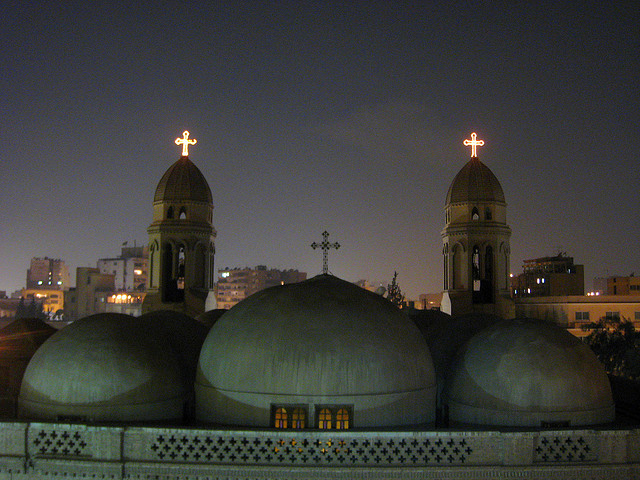
St. Mark Church in Heliopolis, Cairo, Egypt, c/o Andrew A. Shenouda
One of these is the Coptic Church, which is specifically the church of some Christians in Egypt led by their own pope, Pope Tawadross II. The Copts are part of the See of Alexandria (the Roman Catholic Pope Francis oversees the See of Rome). The Coptic Church is in communion with several other churches, such as the Armenian Apostolic church, and they, together, make up the Oriental Orthodox tradition.
For those of you who are wondering if “Oriental” is the same as “Eastern” — yes, it is. In meaning, at least. “Oriental” is a synonym for “eastern.” However, the Oriental Orthodox tradition is separate from the Eastern Orthodox tradition, which includes the Greek Orthodox and Romanian Orthodox traditions, among others.
The split between these churches was caused by an equally subtle argument during the Council of Chalcedon, which took place in 451 AD. The Oriental Orthodox churches disagreed with the Eastern Orthodox churches about whether Jesus is “of two natures” or “in two natures.” The Oriental Orthodox maintained that Jesus was of two natures, meaning that he was both divine and human, but not separate in them. The Eastern Orthodox claimed that Jesus was in two natures, meaning that he was both fully divine and fully human, separate but unified. The Roman Catholic tradition also accepted that Jesus was in two natures. “In two natures” is also know as “Chalcedonian.” The Oriental Orthodox churches are “Non-Chalcedonian.” Essentially, the Oriental Orthodox were given the boot at this council.
Can’t tell the difference? Neither can they, anymore. The Oriental Orthodox church says that they have always believed that Christ is one being, both divine and human. In fact, they feel that the Chalcedonian kicking-out was a political move to limit the power of their pope.
Still, the Oriental Orthodox and Eastern Orthodox churches remain separate, not in communion. At this point, loyalty to particular worship

Coptic Cross, c/o Sagredo

traditions and iconography seems to define differences more than any theological disagreement. The Copts have a special love for the martyrs, even basing their calendar on them, and their own elaborate ankh-like cross. They honor Mark (the Gospel writer) as their founder and
emphasize the time that Jesus spent in Egypt in their history.
As a former Roman Catholic (though I write that with trepidation–it feels like saying I used to have brown hair, when in fact I will always feel like I have brown hair, no matter how much of it turns prematurely white), I embrace sectarian loyalties to things like stained glass, bells, and calendars. I like the variety in Christian faiths; it reminds us that there are lots of pieces of this tradition, and different emphases are not only valid but important. Learning about a new tradition or visiting a new church can remind us of the parts of our faith that we routinely ignore or minimize.
For example, I had the great pleasure of attending a good friend’s Armenian Orthodox (Chalcedonian, Eastern Orthodox) wedding. In addition to being the most formal wedding I’ve ever been to (as another friend put it, the guests “dressed to the 10’s”), the ceremony was about twice as long as any church wedding I’ve seen. The best man had to hold a cross above the groom’s head while the couple was blessed several times by the priest–all in all, for about 45 minutes. The poor guy was sweating so much that an attendant wiped his forehead off with a handkerchief.
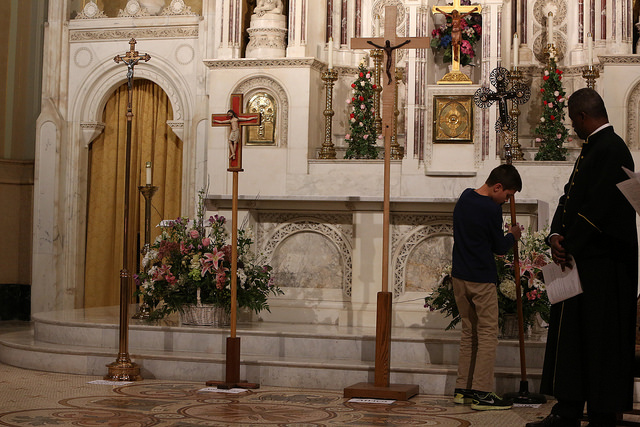
Ecumenical Prayer for the Martyrs held at Basilica of Our Lady of Perpetual Help in Boston, c/o
I can’t think of my friends’ wedding without remembering the best man’s white, terrified face and shaking arm as the priest launched into yet another line. Heroism like that doesn’t happen during a standard Catholic wedding–all we have to do is awkwardly tell our unbaptized friends that they aren’t allowed to take communion.
Although the differences between some churches might seem downright silly to us now, and perhaps even to these churches’ own members, their evolution has created many rich, diverse traditions. Like Darwin’s island birds, they adapted to their surroundings, evolving in response to the widely ranging places that we humans dwell.
If you’re looking for more about the Copts, here are a few resources:
Introduction to the Coptic Orthodox Church – a downloadable PDF book about the Copts by a Coptic priest and scholar
The Encyclopedia Coptica – an online encyclopedia written by the Coptic Network
Previous Post

March 18, 2015
A Queer Evangelical Conference
Next Post

March 24, 2015 Crazy Faith
Browse Our Archives
Select a Category Activism Catholicism Evangelical Christianity Faith & Daily Life Fundamentalism History Mainstream Christianity Nondenominational Christianity Orthodox Christianity Progressive Christianity
Select a Month February 2016 January 2016 December 2015 November 2015 October 2015 September 2015 August 2015 July 2015 June 2015 May 2015 April 2015 March 2015 February 2015
Follow Us!
TAKE THE
Religious Wisdom Quiz
What color is traditionally worn by priests during the season of Advent?
Select your answer to see how you score.
Red White Green Purple
Related posts from Surprising Faith

What does Ethiopian Orthodox Christianity look like?

Book review: Inspiration and Incarnation

Coming Out Christian in a Roman World: A...

One woman's modern-day Anorexia Mirabilis
TRENDING AT PATHEOS Progressive Christian

What Being a Modern-Day Apostle Means to Me
In my last column, I discussed the ins and outs of modern-day...

Did Ancient China Once Worship the God of...
Across human history, a common thread weaves through the origins of the...

Love Your Neighbor – Including Earth-Kin: Lev. 19,...
God’s command to love your neighbor means acting in an ethical and...

Lead a Church Study of “Jesus and Lao...
Guest writer Jack Thomas (The Irreverent Reverend) reflects on leading his church...

Pastoral Wisdom for Responding to Sermon Pushback
Getting sermon pushback on your social justice sermon? Learn practical, Proverbs-based strategies...

Principles for Understanding the Apostolic Ministry Today
Whenever people discover that my formal ministry title is "apostle," as in...
view all Progressive Christian blogs
Ad-Free & Subscriber Log-In Subscription Support
- About Us
- 2026 Calendar
- Videos
- Podcasts
- Library of World Religions
- Faith In Media Tracker
- Advertise With Us
- Write for Us
- Privacy Policy
- Terms of Service
- Do Not Sell My Data
- Contact Us
- Radiant Digital
- Manage Newsletter Subscriptions
- Unsubscribe From Notifications
- Sitemap
Copyright 2008-2026, Patheos. All rights reserved.
Subscription Support Ad-Free & Subscriber Log-In
Follow Patheos