
BuddhistCatholicContemplativeEvangelicalGeneral ChristianHinduJewishLatter-day SaintMuslimNew VisionsProgressive Christian
Beliefs
- Buddhist
- Catholic
- Contemplative
- Evangelical
- General Christian
- Hindu
- Jewish
- Latter-day Saint
- More Voices
- Muslim
- New Visions
- Pagan
- Progressive Christian
Topics
- Religion News
- Food and Religion
- Sports and Religion
- Religious Art
- Religious Music and Entertainment
- Religious Events
- History and Religion
- Style and Religion
- Politics and Religion
- Women in Religion
- Recreation Outdoors and Religion
- Business Finance and Religion
- Careers Workplace and Religion
- Education and Religion
- Family Parenting and Religion
- Health Fitness and Religion
- Home and Religion
- Relationships and Religion
- Technology and Religion
- Travel and Religion
Columnists
- Buddhist Columnists
- Business Finance and Religion Columnists
- Careers Workplace and Religion Columnists
- Catholic Columnists
- Contemplative Columnists
- Education and Religion Columnists
- Evangelists Columnists
- Family Parenting and Religion Columnists
- General Christian Columnists
- Health Fitness and Religion Columnists
- Hindu Columnists
- History and Religion Columnists
- Home and Religion Columnists
- Jewish Columnists
- More Voices Columnists
- Latter Day Columnists
- Muslim Columnists
- New Visions Columnists
- Nonreligious Columnists
- Pagan Columnists
- Politics and Religion Columnists
- Progressive Columnists
- Recreation Outdoors and Religion Columnists
- Relationships and Religion Columnists
- Religion News Columnists
- Religious Art Columnists
- Religious Events Columnists
- Religious Music and Entertainment Columnists
- Sports and Religion Columnists
- Style and Religion Columnists
- Technology and Religion Columnists
- Travel and Religion Columnists
- Women in Religion Columnists
Resource Library
- 2026 Calendar
- Library of World Religions
- The 100 Most Holy Places on Earth
- Patheos Answers
- Podcasts
- Videos
- Faith Leaders Database
- Anglican Episcopalian
- Bahai
- Baptist
- Buddhism
- Christianity
- Confucianism
- Eastern Orthodoxy
- Hinduism
- Holiness and Pentecostal
- ISKCON
- Islam
- Judaism
- Lutheran
- Methodist
- The Church of Jesus Christ of Latter-day Saints
- New Age
- Paganism
- Presbytarian and Reformed
- Protestantism
- Religion Behind the Scenes
- Roman Catholic
- Scientology
- Shia Islam
- Sikhism
- Sufism
- Sunni Islam
- Taoism
- Zen
- See all religions
Research Tools
 Ad-Free & Subscriber Log-In Subscription Support
Ad-Free & Subscriber Log-In Subscription Support
Follow Patheos 

- Trending:
- Forgiveness
- |
- Marriage
- |
- Consciousness
- |
- Death Penalty
- |
- Election
- |
- Halloween
 Summa This, Summa That
- Home
- About
- Through a Lens, Darkly
- Streaming Video Suggestions (SVS)
- Summa Short Films (SSF)
- The Man Behind The Booth
- Home
- Catholic
- The Value of Knowing Another’s Secrets, Movie-Wise
The Value of Knowing Another’s Secrets, Movie-Wise
Last updated on: April 14, 2015 at 12:01 pm by Joseph Susanka
The Value of Knowing Another’s Secrets, Movie-Wise 2015-04-14T12:01:36-06:00 Joseph Susanka
Patheos Explore the world's faith through different perspectives on religion and spirituality! Patheos has the views of the prevalent religions and spiritualities of the world.
NOTE: I wrote this a couple of years ago and never posted it. I can’t remember why I didn’t post it, which means that posting it now is almost certainly a mistake. But as I look back through it, I find that I sort-of like parts of it. So…caution, meet wind.

I am happy to report that Billy Wilder’s The Apartment is a masterpiece. …you know, just in case y’all were wondering.
I am also happy to report that each successive viewing (of which there have been many) has further solidified its place in my affections. It’s wonderfully, amazingly written — somehow, that’s still an understatement — thoughtfully and subtly shot, superbly acted, and its unique mixture of humor and earnestness (combined with Wilder’s amazing gentleness in recounting the tribulations of his flawed creations) is extraordinary.
So, yes. The film’s a masterpiece. But if you haven’t seen it yet, leave now. The most productive use of your time at this moment is NOT to journey through my feeble, tortured attempts at analyzing Wilder’s legendary tour de force. It is to go in haste and find a copy of The Apartment. And to watch it. Right. NOW. Seriously. It’s easy. Netflix can hook you up. And so can Amazon Instant

 This most recent time around, in addition to a deepening appreciation for its brisk pacing, its inimitable tone, and its perfectly-realized, complex characters, I was particularly struck by a pair of thoughts — one technical, and one thematic.
The first is the superb way in which Billy Wilder — and co-writer I.A.L. Diamond, lest we forget — makes use of the discrepancy between knowledge held by his audience and that held by his protagonists. Some of the most emotional, suspenseful sequences in the entire film are those during which we viewers are forced to “wait for the other shoe to drop,” knowing all too well the damaging ties that bind our unsuspecting heroes together.
Watching as the goofy-but-lovable C.C. Baxter (Jack Lemmon) permits his sleazy supervisor Sheldrake (Fred MacMurray) to borrow his apartment for an adulterous fling with elevator girl Fran Kubelik (Shirley MacLaine) at the very same moment that Baxter — all unknowing — is so eagerly anticipating Fran’s arrival at a Broadway show? Brutal. Seeing Fran succumb to Sheldrake’s suave but empty assurances is even more agonizing because we know how blissfully happy (and unaware) Baxter is of her attachments, and of the role he is playing in his own disillusionment (as well as hers).
 During the office Christmas party — my favorite scene in the entire film — Fran’s preoccupied response to Baxter’s bowler questions go largely unnoticed …by him. But we’re on tender-hooks, knowing that her disinterest was brought on by the bombshell dropped only moments before by Sheldrake’s secretary. Will he recognize her pain and reach out to comfort her, or will he continue his champagne-addled attempts to win approbation for his headgear? Moments later, we hold our breath as we wait for him to recognize Fran’s broken compact. When recognition comes, the moment is rendered all the more powerful (and painful) because we can scream at the screen: “We’ve known it all along, darn you!” The meaning of her poignant defense of its brokenness — “I like it that way. Makes me look the way I feel.” — is lost on him, all absorbed in the shock of discovering her Sheldraked attachment. But for the audience, it stings not only because we recognize its painful symbolism, but because we know how quickly and completely he could ease her (and our) suffering.
Despite this serious of devastating reveals, their knowledge is fundamentally disparate as the scene closes. He knows she’s Sheldrake’s dame; she knows Sheldrake’s a liar and a cad. But the wonderful confluence that knowledge could bring is known only to we unhappy viewers, and the chance that these dear, damaged ships may pass one another in the loveless night is rendered all the more bitter by the fact that we have so clearly seen their nearness. In our minds, floodlights are sweeping; sirens, blaring. But for them, it’s nothing but darkness. And Wilder’s use of that frustrating divide drives much of the film’s tension-filled and lengthy setup. (A notable exception to the “We Know But They Don’t” rule? The fantastic Wash Room Key moment — a moment rendered all the more gratifying because it’s the first time Wilder’s kept something significant from us, and the trust he’s built up over the film makes the twist unexpected and wonderfully satisfying. Well worth the wait.)
 The second, more thematic idea that caught me by the ear this time around is similar, come to think of it. Knowledge is the key here, as well, though it’s not a technical, writerly use (or concealment) of knowledge so much as an increased understanding of the facts of the story. The film captures the key moment in Lemmon’s life — that moment when his flippant, somewhat-uncomfortable goofiness and his willing participation in the vices of his co-workers — a glancing participation, to be sure, but a real one none the less — is transformed by a deeper, more personal knowledge of the damage being done by the many liaisons and dalliances his apartment conceals. In the past, he has turned a blind (or worse, a self-deluding) eye to their dangers — not because he thinks adultery is fine, morality-wise, but because he never looks (or wants to look) beyond his role as helpful, likable “taken-er.” After all, nothing’s quite like clawing one’s way up to middle management, is it? Besides, “boys will be boys,” right? And no one’s really getting hurt, are they?
But they are, and deeply. You don’t see much of the injured in the film, since its focus is far more on the dalliances than on their consequences. Sheldrake’s secretary (and former lover) makes a significant appearance, and we see a single shot of Sheldrake’s wife, if I remember correctly. We also hear a few passing references to “the little lady” or the conscience-soothing “we’ve drifted apart.” But on the whole, the wronged or damaged parties are kept largely out of the picture.
Except for Fran. And she makes all the difference.

As he learns her story, Baxter’s indifference is shattered. She is one of the dalliancees, and a miserable, broken women because of it; a willing-ish participant, but one whose relationship with Sheldrake refutes Baxter’s helpfully-inaccurate categorizations. She’s not careless, carefree, and unharmed; she’s deeply wounded by her actions, and despairing enough to consider taking her own life. “Makes me look the way I feel,” remember? After that, there’s no way Baxter can hide behind his comfortable “friendly apartment provider” facade any longer. It’s not simply that he’s attracted to her and it stings to see her in the company of another, though that definitely colors his reactions. It’s that he sees and understands her pain, realizes the causes for that pain and that he is partially to blame, and refuses to take part in her (or anyone else’s) destruction any longer.
So, in that wonderful Wash Room Key moment, when he finally takes the step we’ve been begging him to take all along — refusing to allow Sheldrake the use of his apartment — he is rejecting his previous failure, and doing it because of what he now knows because of his relationship with Fran. He isn’t expecting a reward, as his departure and packing make abundantly clear. He’s doing it because it’s the right thing, goodness-wise. In that moment, he refuses the chance to become just another Sheldrake: a man unconcerned by the damaging consequences of his actions and one who cares not for the broken human beings he leaves in his wake. Baxter has a new and transformational knowledge now: self-knowledge. Because of the time he has spent with Fran, his ability to abstractly tolerate (and even, in a way, to condone and support) his friends’ failings is no longer sustainable. He’s seen the consequences of their (and his own) sin, and rejects them. The apartment key’s been handed out for the last time.
For Wilder the writer, knowledge is power, and the way he wields it is wonderful to behold. For Baxter, though, it’s much more than power. For him, it’s salvation.
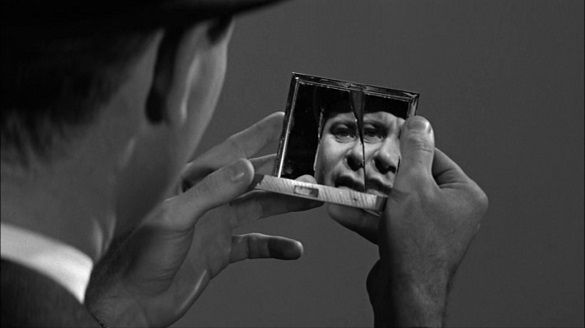 Attribution(s): All posters, publicity images, and stills are the property of United Artists/MGM and other respective production studios and distributors, and are intended for editorial use only.
Previous Post

April 13, 2015
SSF: "Simulacra"
Next Post

April 15, 2015 Parked by the Jukebox with Hollow Coves' "The Woods"
Browse Our Archives
Select a Category Art Baseball Faith Family Lenten Music Movies Music No Commentary Necessary Parked By the Jukebox Photography Politics Quodlibets Streaming Video Suggestions Summa Short Films Television The Man Behind the Booth Through a Lens, Darkly
Select a Month December 2015 November 2015 October 2015 September 2015 August 2015 July 2015 June 2015 May 2015 April 2015 March 2015 February 2015 January 2015 December 2014 November 2014 October 2014 September 2014 August 2014 July 2014 June 2014 May 2014 April 2014 March 2014 February 2014 January 2014 December 2013 November 2013 October 2013 September 2013 August 2013 July 2013 June 2013 May 2013 April 2013 March 2013 February 2013 January 2013 December 2012 November 2012 July 2012 April 2012 March 2012 February 2012 November 2011 August 2011 July 2011 June 2011 May 2011 April 2011 March 2011 February 2011 January 2011 December 2010 November 2010 October 2010
Follow Us!
TAKE THE
Religious Wisdom Quiz
Skin for skin! All that a man has he will give for something precious. What is it?
Select your answer to see how you score.
His wealth His life His family His soul
Related posts from Summa This, Summa That




TRENDING AT PATHEOS Catholic

Rejecting Doom: Christian Hope And Human Action
Christianity is a religion of hope. We are to have hope and...

It’s What Comes From Within Which Matters
One of the most difficult things for us to understand is why...

Why I Choose the Eucharist Over the Sermon
Choose the Eucharist, Not the Sermon What are we supposed to get...

5 Design Elements Found in Spiritually Rooted Homes
Putting Spirituality Into Home Decor Our homes are more than our living...

Credo: A Story of God Told with the...
About 10 years ago, I began to imagine a personal "Credo" that...

The Anatomy of Divine Revelation in Catholic Thought
The claim that God has made Himself known to human beings is...
view all Catholic blogs
Ad-Free & Subscriber Log-In Subscription Support
- About Us
- 2026 Calendar
- Videos
- Podcasts
- Library of World Religions
- Faith In Media Tracker
- Advertise With Us
- Write for Us
- Privacy Policy
- Terms of Service
- Do Not Sell My Data
- Contact Us
- Radiant Digital
- Manage Newsletter Subscriptions
- Unsubscribe From Notifications
- Sitemap
Copyright 2008-2026, Patheos. All rights reserved.
Subscription Support Ad-Free & Subscriber Log-In
Follow Patheos