
BuddhistCatholicContemplativeEvangelicalGeneral ChristianHinduJewishLatter-day SaintMuslimNew VisionsProgressive Christian
Beliefs
- Buddhist
- Catholic
- Contemplative
- Evangelical
- General Christian
- Hindu
- Jewish
- Latter-day Saint
- More Voices
- Muslim
- New Visions
- Pagan
- Progressive Christian
Topics
- Religion News
- Food and Religion
- Sports and Religion
- Religious Art
- Religious Music and Entertainment
- Religious Events
- History and Religion
- Style and Religion
- Politics and Religion
- Women in Religion
- Recreation Outdoors and Religion
- Business Finance and Religion
- Careers Workplace and Religion
- Education and Religion
- Family Parenting and Religion
- Health Fitness and Religion
- Home and Religion
- Relationships and Religion
- Technology and Religion
- Travel and Religion
Columnists
- Buddhist Columnists
- Business Finance and Religion Columnists
- Careers Workplace and Religion Columnists
- Catholic Columnists
- Contemplative Columnists
- Education and Religion Columnists
- Evangelists Columnists
- Family Parenting and Religion Columnists
- General Christian Columnists
- Health Fitness and Religion Columnists
- Hindu Columnists
- History and Religion Columnists
- Home and Religion Columnists
- Jewish Columnists
- More Voices Columnists
- Latter Day Columnists
- Muslim Columnists
- New Visions Columnists
- Nonreligious Columnists
- Pagan Columnists
- Politics and Religion Columnists
- Progressive Columnists
- Recreation Outdoors and Religion Columnists
- Relationships and Religion Columnists
- Religion News Columnists
- Religious Art Columnists
- Religious Events Columnists
- Religious Music and Entertainment Columnists
- Sports and Religion Columnists
- Style and Religion Columnists
- Technology and Religion Columnists
- Travel and Religion Columnists
- Women in Religion Columnists
Resource Library
- 2026 Calendar
- Library of World Religions
- The 100 Most Holy Places on Earth
- Patheos Answers
- Podcasts
- Videos
- Faith Leaders Database
- Anglican Episcopalian
- Bahai
- Baptist
- Buddhism
- Christianity
- Confucianism
- Eastern Orthodoxy
- Hinduism
- Holiness and Pentecostal
- ISKCON
- Islam
- Judaism
- Lutheran
- Methodist
- The Church of Jesus Christ of Latter-day Saints
- New Age
- Paganism
- Presbytarian and Reformed
- Protestantism
- Religion Behind the Scenes
- Roman Catholic
- Scientology
- Shia Islam
- Sikhism
- Sufism
- Sunni Islam
- Taoism
- Zen
- See all religions
Research Tools
 Ad-Free & Subscriber Log-In Subscription Support
Ad-Free & Subscriber Log-In Subscription Support
Follow Patheos 

- Trending:
- Forgiveness
- |
- Marriage
- |
- Consciousness
- |
- Death Penalty
- |
- Election
- |
- Halloween
 Summa This, Summa That
- Home
- About
- Through a Lens, Darkly
- Streaming Video Suggestions (SVS)
- Summa Short Films (SSF)
- The Man Behind The Booth
- Home
- Catholic
- SVS: “The Diving Bell and the Butterfly”
SVS: “The Diving Bell and the Butterfly”
Last updated on: January 9, 2015 at 5:00 pm by Joseph Susanka
SVS: “The Diving Bell and the Butterfly” 2015-01-09T17:00:34-07:00 Joseph Susanka
Patheos Explore the world's faith through different perspectives on religion and spirituality! Patheos has the views of the prevalent religions and spiritualities of the world.
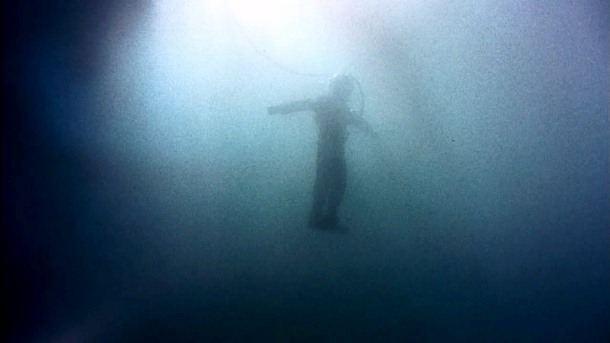 When The Diving Bell and the Butterfly first flitted over the turbid waters of my cinematic consciousness some years ago, I didn’t give it much thought.
To be perfectly honest, my initial reactions were almost entirely incidental. The first, a mild curiosity over the fact that its director shared a surname with the famous pianist and composer, Artur Schnabel. And the second, an amusement at the juxtaposition of two such disparate objects in the film’s title itself. A diving bell, huge and ponderous and archaic, yet life-giving. And a butterfly, all gossamer wings and rebirth and weightless, fleeting beauty.
In other words (and yes, I shouldn’t be so surprised), the perfect title for this film, which is available on NETFLIX STREAMING and YOUTUBE($).
In 1995 at the age of 43, Elle France editor Jean-Dominique Bauby suffered a stroke that paralyzed his entire body, with the exception of his left eye. Using that eye to blink out his memoir, Bauby eloquently described the aspects of his interior world, from the psychological torment of being trapped inside his body to his imagined stories from lands he’d only visited in his mind.
Bauby’s story is astonishing, though (as is often/always the case), not reproduced with absolute faithfulness by the film. But it’s not a very cinematic story, at least on the face of it. And that’s where this film’s real genius surfaces, because it somehow manages to be incredibly cinematic. It will definitely appeal more to the “art-house crowdsters” out there, because it’s languid and artsy and nonlinear; a bit “stream-of-conscious-y” (again, fittingly). Also, subtitles. So, fast-paced and easily accessible, it is not. But lyrical and gorgeous and deeply moving? That, and in spades.
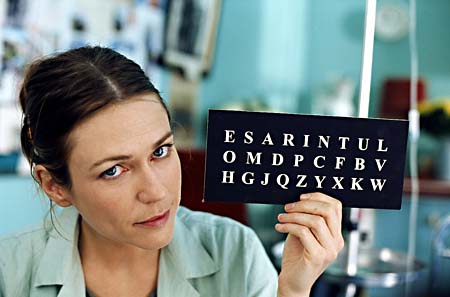 Part of this is surely the result of its cast subtlety-yet-powerful performances. Mathieu Amalric, who plays Bauby, was greatly heralded at the time of the film’s release. Yet his performance is almost imperceptible, by its very nature. So it was the supporting turns that really caught my attention. Emmanuelle Seigner is wonderful as the estranged mother of Bauby’s children. (The scene where she sits at his bedside, serving as the intermediary between her beloved “Jean-Do” and his current paramour — too terrified to visit in person — is brutal.) Marie-Josée Croze as the speech therapist who helps Bauby find his “voice” is fantastic. (That moment when Bauby confesses to her that he wishes to die and she breaks down? Spine-tingling.) Anne Consigny, his translator and scribe, provides us with an anchor point as the film increasingly blurs the lines between its narrator’s “locked-in” reality and his expansive, imagined worlds. And Max von Sydow as his father, struggling with his own failing health and isolation, is searingly, achingly sad. (Incredibly human, real, emotional stuff throughout. Yes, I teared up, time and again. And was glad of it.)
Don’t let the bleak synopsis scare you off, either. This is a deeply hopeful film about a man finding a way to connect with the outside world in the face of nearly insurmountable challenges. But it’s not the fact that he overcomes the seemingly impossible that is so moving. It’s that he refuses to succumb to the despair that would be a perfectly understandable result of his condition, instead turning the crushing blow he’s been dealt into the opportunity for an incredibly important internal transformation.
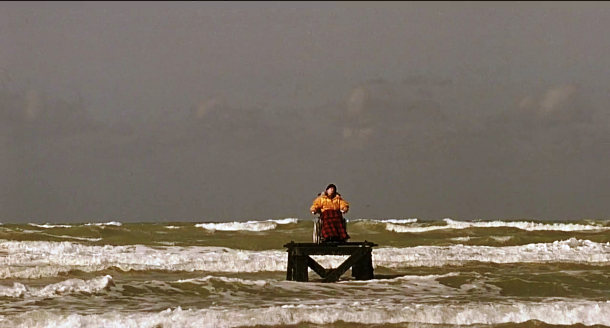
For me, though, the most memorable stuff was the countless little ways in which Schnabel made me feel — in an astonishingly, even disturbingly visceral way — like I was Bauby; that I, too, was “locked in.” It helps to be working with a genius like Janusz Kaminski, I’m sure, but the first 20 minutes of “First Person Perspective” were as mesmerizing as anything I’ve seen in the past few years, using a whole host of cinematic tools to incredible effect. Extreme close-ups, strange focus planes, framing that’s frustratingly off, and the fact that Bauby can talk but no one can hear him, all adding up to an extraordinary mood and effectiveness. And the gradual opening up-and-out as the film progresses is …hard to describe, really. It’s not particularly story/script-driven, but highly emotional, instinctive stuff. As you can see for yourself.
I decided to stop pitying myself. Other than my eye, two things aren’t paralyzed, my imagination and my memory.
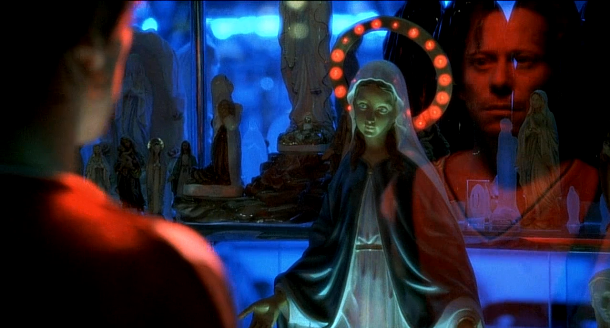
Brief final notes: I don’t care for that trailer. It accurate, sort of. But it’s also all wrong. So if this recommendation doesn’t really strike your fancy based on that trailer, you might still give it a try. Also, this is most definitely not a film for kids. Troubling material, fleeting medical nudity, fleeting sexualized nudity, and a challenging story and style. Also, if you have trouble with eye-trauma (like I do), you might bail about 10 minutes in. Don’t, though. Keep going.
Attribution(s): All posters, publicity images, and movie stills are the property of Miramax and other respective production studios and distributors, and are intended for editorial use only.
Previous Post

May 1, 2014
Life Got You Down Lately? Here's A Visual Antidote.
Next Post

May 5, 2014 SSF: "Writers' Block"
Browse Our Archives
Select a Category Art Baseball Faith Family Lenten Music Movies Music No Commentary Necessary Parked By the Jukebox Photography Politics Quodlibets Streaming Video Suggestions Summa Short Films Television The Man Behind the Booth Through a Lens, Darkly
Select a Month December 2015 November 2015 October 2015 September 2015 August 2015 July 2015 June 2015 May 2015 April 2015 March 2015 February 2015 January 2015 December 2014 November 2014 October 2014 September 2014 August 2014 July 2014 June 2014 May 2014 April 2014 March 2014 February 2014 January 2014 December 2013 November 2013 October 2013 September 2013 August 2013 July 2013 June 2013 May 2013 April 2013 March 2013 February 2013 January 2013 December 2012 November 2012 July 2012 April 2012 March 2012 February 2012 November 2011 August 2011 July 2011 June 2011 May 2011 April 2011 March 2011 February 2011 January 2011 December 2010 November 2010 October 2010
Follow Us!
TAKE THE
Religious Wisdom Quiz
What was the primary economic system in Biblical times?
Select your answer to see how you score.
Silver coins Barter Taxation Gold standard
Related posts from Summa This, Summa That




TRENDING AT PATHEOS Catholic

Rejecting Doom: Christian Hope And Human Action
Christianity is a religion of hope. We are to have hope and...

It’s What Comes From Within Which Matters
One of the most difficult things for us to understand is why...

Why I Choose the Eucharist Over the Sermon
Choose the Eucharist, Not the Sermon What are we supposed to get...

5 Design Elements Found in Spiritually Rooted Homes
Putting Spirituality Into Home Decor Our homes are more than our living...

Credo: A Story of God Told with the...
About 10 years ago, I began to imagine a personal "Credo" that...

The Anatomy of Divine Revelation in Catholic Thought
The claim that God has made Himself known to human beings is...
view all Catholic blogs
Ad-Free & Subscriber Log-In Subscription Support
- About Us
- 2026 Calendar
- Videos
- Podcasts
- Library of World Religions
- Faith In Media Tracker
- Advertise With Us
- Write for Us
- Privacy Policy
- Terms of Service
- Do Not Sell My Data
- Contact Us
- Radiant Digital
- Manage Newsletter Subscriptions
- Unsubscribe From Notifications
- Sitemap
Copyright 2008-2026, Patheos. All rights reserved.
Subscription Support Ad-Free & Subscriber Log-In
Follow Patheos