
BuddhistCatholicContemplativeEvangelicalGeneral ChristianHinduJewishLatter-day SaintMuslimNew VisionsProgressive Christian
Beliefs
- Buddhist
- Catholic
- Contemplative
- Evangelical
- General Christian
- Hindu
- Jewish
- Latter-day Saint
- More Voices
- Muslim
- New Visions
- Pagan
- Progressive Christian
Topics
- Religion News
- Food and Religion
- Sports and Religion
- Religious Art
- Religious Music and Entertainment
- Religious Events
- History and Religion
- Style and Religion
- Politics and Religion
- Women in Religion
- Recreation Outdoors and Religion
- Business Finance and Religion
- Careers Workplace and Religion
- Education and Religion
- Family Parenting and Religion
- Health Fitness and Religion
- Home and Religion
- Relationships and Religion
- Technology and Religion
- Travel and Religion
Columnists
- Buddhist Columnists
- Business Finance and Religion Columnists
- Careers Workplace and Religion Columnists
- Catholic Columnists
- Contemplative Columnists
- Education and Religion Columnists
- Evangelists Columnists
- Family Parenting and Religion Columnists
- General Christian Columnists
- Health Fitness and Religion Columnists
- Hindu Columnists
- History and Religion Columnists
- Home and Religion Columnists
- Jewish Columnists
- More Voices Columnists
- Latter Day Columnists
- Muslim Columnists
- New Visions Columnists
- Nonreligious Columnists
- Pagan Columnists
- Politics and Religion Columnists
- Progressive Columnists
- Recreation Outdoors and Religion Columnists
- Relationships and Religion Columnists
- Religion News Columnists
- Religious Art Columnists
- Religious Events Columnists
- Religious Music and Entertainment Columnists
- Sports and Religion Columnists
- Style and Religion Columnists
- Technology and Religion Columnists
- Travel and Religion Columnists
- Women in Religion Columnists
Resource Library
- 2026 Calendar
- Library of World Religions
- The 100 Most Holy Places on Earth
- Patheos Answers
- Podcasts
- Videos
- Faith Leaders Database
- Anglican Episcopalian
- Bahai
- Baptist
- Buddhism
- Christianity
- Confucianism
- Eastern Orthodoxy
- Hinduism
- Holiness and Pentecostal
- ISKCON
- Islam
- Judaism
- Lutheran
- Methodist
- The Church of Jesus Christ of Latter-day Saints
- New Age
- Paganism
- Presbytarian and Reformed
- Protestantism
- Religion Behind the Scenes
- Roman Catholic
- Scientology
- Shia Islam
- Sikhism
- Sufism
- Sunni Islam
- Taoism
- Zen
- See all religions
Research Tools
 Ad-Free & Subscriber Log-In Subscription Support
Ad-Free & Subscriber Log-In Subscription Support
Follow Patheos 

- Trending:
- Forgiveness
- |
- Marriage
- |
- Consciousness
- |
- Death Penalty
- |
- Election
- |
- Halloween
 Summa This, Summa That
- Home
- About
- Through a Lens, Darkly
- Streaming Video Suggestions (SVS)
- Summa Short Films (SSF)
- The Man Behind The Booth
- Home
- Catholic
- SVS: “The Conversation”
SVS: “The Conversation”
Last updated on: January 9, 2015 at 1:46 pm by Joseph Susanka
SVS: “The Conversation” 2015-01-09T13:46:43-07:00 Joseph Susanka
Patheos Explore the world's faith through different perspectives on religion and spirituality! Patheos has the views of the prevalent religions and spiritualities of the world.
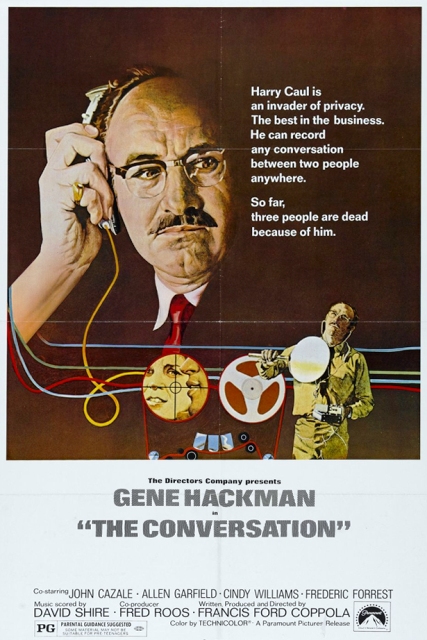 Monday marked the 40th Anniversary of what I have long considered Francis Ford Coppola’s best film (“to date,” Joseph says hopefully). A film which I now happily share with y’all: The Conversation is currently available from NETFLIX INSTANT.
I realize that’s a bit of a controversial claim, given that the legendary Godfathers feature prominently in his filmography. But I can’t help myself. It’s far-and-away my favorite. And has been for years, since long before that opinion was cool. (What do you mean, “It’s still not actually cool?” How dare you!)
Francis Ford Coppola follows The Godfather with this intimate film about an audio surveillance expert who faces a moral quandary when he suspects that a couple whose conversation he’s been hired to record will be murdered.
This isn’t just FFC’s best film, though. It’s also Gene Hackman’s best film. His performance as Harry Caul is subtle, subdued, and excruciatingly painful. Spiraling into madness is a tried-and-true trope, but this particular version remains one of my very favorite examples — a directly result of Coppola’s script, which gives us a fascinating (yet entirely plausible) account of the forces behind Caul’s descent. Just like last week’s recommendation, the seeds of the film’s finale are planted well in advance. Waiting for them to burst into demoralizing bloom is agonizing.
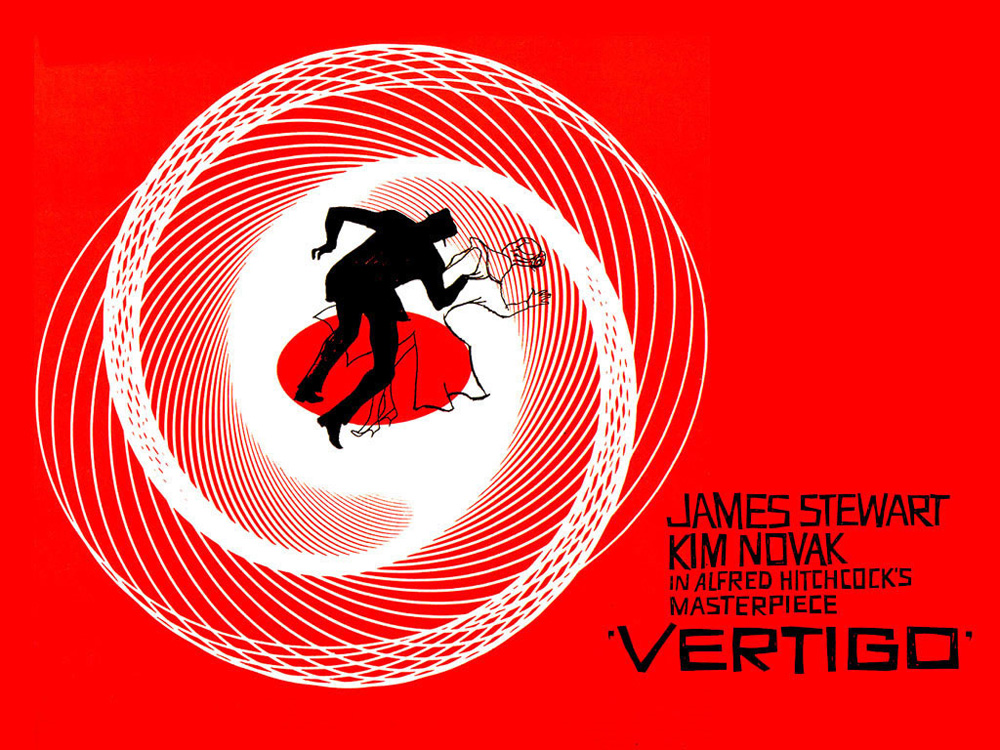
So, yeah, the ending’s a bit of a downer — sort of like a punch in the gut is a “bit of a downer.” But I could talk about that last scene for hours. It’s the perfect ending to the (And by “I could talk about it for hours,” I mean “I have absolutely talked about the last scene for hours and hours and hours. Yep.” Also, not for kids.)

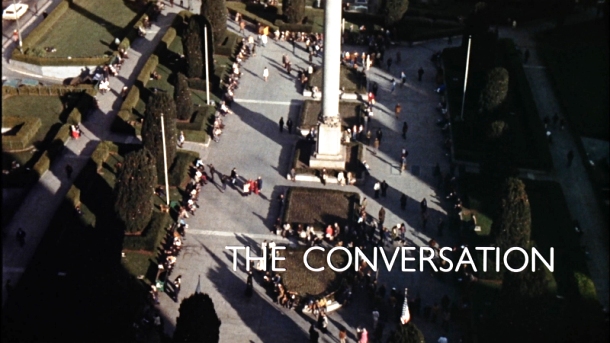
Two quick technical notes:
The film’s opening shot — a single, 3-minute-long zoom — is amazing, and the perfect visual introduction to the film. The legendary Haskell Wexler was responsible for that bravura shot, though he was quickly and legendarily fired from the project. Yet despite its high degree of difficulty, it gets almost drowned in the sea of amazing sound that serves as the opening sequence’s auditory backbone. And that brings me to the second technical thing I’d like to note: Walter Murch.
OK, that’s not a thing, that’s a person. But he and his mind-blowing sound work are absolutely essential to the film’s success. The opening “sound montage” remains one of the best examples of audio storytelling I’ve ever heard (if not quite my favorite). And the way it’s reused is …well, spectacular. But I can’t say more, BECAUSE! (Oh, and David Shire’s Satie-esque score is perfect. At first, it seems calm and straight-forward, even pleasant. But the longer it goes, the stranger it gets. Nothing changes, really. But the cumulative effect is amazing. Also, those last three sentences are entirely applicable to the film, as well.)

Looking for the perfect double-feature? Try pairing this with Florian Henckel von Donnersmarck’s The Lives of Others, which is a great and unsettling film. It’s not streaming presently, so you might try a library or two…unless you want to own it. If the latter’s true, you can try ITUNES($), AMAZON($), or YOUTUBE($). Or VUDU($), which I’ve never used. (Looking for a tangentially-connected-but-not-perfect double-feature? Enemy of the State’s Edward Lyle, played by Gene Hackman, is a pretty direct reference to Harry Caul. Not as interesting, and a whole lot louder. But still, all three films are growing more relevant/prescient as we go along. Talk about timely. And prophetic.)
“I’m not afraid of death. …but I am afraid of murder.”
 Attribution(s): Posters, publicity images, and movie stills are the property of Paramount Pictures, and other respective production studios and distributors, and are intended for editorial use only.
Previous Post

April 10, 2014
Gustave Doré and "The Raven"
Next Post
April 15, 2014 Musical Mediation for Holy Week
Browse Our Archives
Select a Category Art Baseball Faith Family Lenten Music Movies Music No Commentary Necessary Parked By the Jukebox Photography Politics Quodlibets Streaming Video Suggestions Summa Short Films Television The Man Behind the Booth Through a Lens, Darkly
Select a Month December 2015 November 2015 October 2015 September 2015 August 2015 July 2015 June 2015 May 2015 April 2015 March 2015 February 2015 January 2015 December 2014 November 2014 October 2014 September 2014 August 2014 July 2014 June 2014 May 2014 April 2014 March 2014 February 2014 January 2014 December 2013 November 2013 October 2013 September 2013 August 2013 July 2013 June 2013 May 2013 April 2013 March 2013 February 2013 January 2013 December 2012 November 2012 July 2012 April 2012 March 2012 February 2012 November 2011 August 2011 July 2011 June 2011 May 2011 April 2011 March 2011 February 2011 January 2011 December 2010 November 2010 October 2010
Follow Us!
TAKE THE
Religious Wisdom Quiz
Who repeatedly sent soldiers to capture Elijah, only to see fire consume them?
Select your answer to see how you score.
King Amaziah King Ahaziah King Asa King Ahab
Related posts from Summa This, Summa That




TRENDING AT PATHEOS Catholic

Rejecting Doom: Christian Hope And Human Action
Christianity is a religion of hope. We are to have hope and...

It’s What Comes From Within Which Matters
One of the most difficult things for us to understand is why...

Why I Choose the Eucharist Over the Sermon
Choose the Eucharist, Not the Sermon What are we supposed to get...

5 Design Elements Found in Spiritually Rooted Homes
Putting Spirituality Into Home Decor Our homes are more than our living...

Credo: A Story of God Told with the...
About 10 years ago, I began to imagine a personal "Credo" that...

The Anatomy of Divine Revelation in Catholic Thought
The claim that God has made Himself known to human beings is...
view all Catholic blogs
Ad-Free & Subscriber Log-In Subscription Support
- About Us
- 2026 Calendar
- Videos
- Podcasts
- Library of World Religions
- Faith In Media Tracker
- Advertise With Us
- Write for Us
- Privacy Policy
- Terms of Service
- Do Not Sell My Data
- Contact Us
- Radiant Digital
- Manage Newsletter Subscriptions
- Unsubscribe From Notifications
- Sitemap
Copyright 2008-2026, Patheos. All rights reserved.
Subscription Support Ad-Free & Subscriber Log-In
Follow Patheos