
BuddhistCatholicContemplativeEvangelicalGeneral ChristianHinduJewishLatter-day SaintMuslimNew VisionsProgressive Christian
Beliefs
- Buddhist
- Catholic
- Contemplative
- Evangelical
- General Christian
- Hindu
- Jewish
- Latter-day Saint
- More Voices
- Muslim
- New Visions
- Pagan
- Progressive Christian
Topics
- Religion News
- Food and Religion
- Sports and Religion
- Religious Art
- Religious Music and Entertainment
- Religious Events
- History and Religion
- Style and Religion
- Politics and Religion
- Women in Religion
- Recreation Outdoors and Religion
- Business Finance and Religion
- Careers Workplace and Religion
- Education and Religion
- Family Parenting and Religion
- Health Fitness and Religion
- Home and Religion
- Relationships and Religion
- Technology and Religion
- Travel and Religion
Columnists
- Buddhist Columnists
- Business Finance and Religion Columnists
- Careers Workplace and Religion Columnists
- Catholic Columnists
- Contemplative Columnists
- Education and Religion Columnists
- Evangelists Columnists
- Family Parenting and Religion Columnists
- General Christian Columnists
- Health Fitness and Religion Columnists
- Hindu Columnists
- History and Religion Columnists
- Home and Religion Columnists
- Jewish Columnists
- More Voices Columnists
- Latter Day Columnists
- Muslim Columnists
- New Visions Columnists
- Nonreligious Columnists
- Pagan Columnists
- Politics and Religion Columnists
- Progressive Columnists
- Recreation Outdoors and Religion Columnists
- Relationships and Religion Columnists
- Religion News Columnists
- Religious Art Columnists
- Religious Events Columnists
- Religious Music and Entertainment Columnists
- Sports and Religion Columnists
- Style and Religion Columnists
- Technology and Religion Columnists
- Travel and Religion Columnists
- Women in Religion Columnists
Resource Library
- 2026 Calendar
- Library of World Religions
- The 100 Most Holy Places on Earth
- Patheos Answers
- Podcasts
- Videos
- Faith Leaders Database
- Anglican Episcopalian
- Bahai
- Baptist
- Buddhism
- Christianity
- Confucianism
- Eastern Orthodoxy
- Hinduism
- Holiness and Pentecostal
- ISKCON
- Islam
- Judaism
- Lutheran
- Methodist
- The Church of Jesus Christ of Latter-day Saints
- New Age
- Paganism
- Presbytarian and Reformed
- Protestantism
- Religion Behind the Scenes
- Roman Catholic
- Scientology
- Shia Islam
- Sikhism
- Sufism
- Sunni Islam
- Taoism
- Zen
- See all religions
Research Tools
 Ad-Free & Subscriber Log-In Subscription Support
Ad-Free & Subscriber Log-In Subscription Support
Follow Patheos 

- Trending:
- Forgiveness
- |
- Marriage
- |
- Consciousness
- |
- Death Penalty
- |
- Election
- |
- Halloween
 Summa This, Summa That
- Home
- About
- Through a Lens, Darkly
- Streaming Video Suggestions (SVS)
- Summa Short Films (SSF)
- The Man Behind The Booth
- Home
- Catholic
- The Absurdity of God’s Forgiveness
The Absurdity of God’s Forgiveness
Last updated on: October 7, 2015 at 3:50 pm by Joseph Susanka
The Absurdity of God’s Forgiveness 2015-10-07T15:50:13-06:00 Joseph Susanka
Patheos Explore the world's faith through different perspectives on religion and spirituality! Patheos has the views of the prevalent religions and spiritualities of the world.
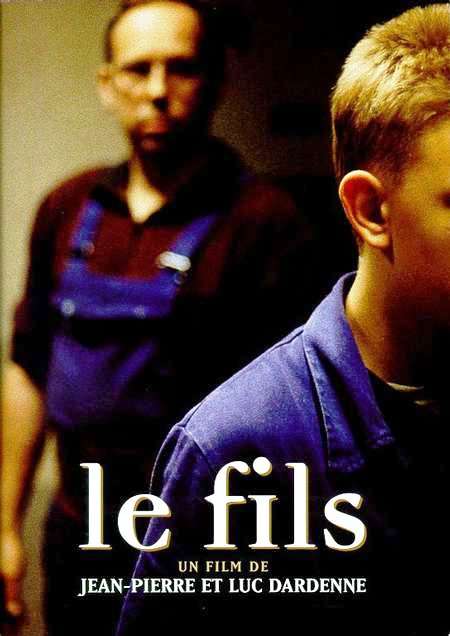 WARNING: This review reveals plot points perhaps best experienced in person. For those who have not yet seen The Son (Le Fils) from the Brothers Dardaine, it can be found on Netflix’s Watch Instantly.
As Lent draws to a close, I always find myself searching for a film to assist me in my preparations for Holy Week. This annual task has let to such gems as Ostrov, The Passion of Joan of Arc, and The Ninth Day, providing me with ample food for thought and soul during my Passiontide journey.
This year’s suggestion, The Son (Le Fils) from the Belgian brothers Jean-Pierre and Luc Dardenne, is both a revelation and a challenge. It follows the outwardly mundane life of Olivier, a middle-aged carpenter weighed down by a deep and devastating secret. (And I mean that “follows” quite literally, for the entire film is shot in a “hand-held,” claustrophobic style, the probing camera rarely more than a foot or two from Olivier’s face and shoulders.)
The story itself is deceptively simple: Francis, a troubled youth only recently released from prison, is brought to Olivier’s shop for rehabilitation into the workforce. Citing an already-excessive number of apprentices, the carpenter refuses to accept him, but abruptly changes his mind, agreeing to train the boy. All too soon, the reason for his sudden change of heart becoming clear: when Francis arrived, Olivier instantly recognized him as the one responsible for the death of Olivier’s son a few years before.
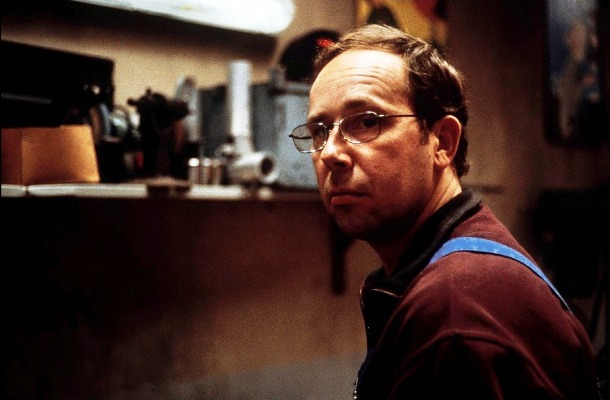
Brought face-to-face with the reason behind his lonely, sorrowful life, the carpenter grows obsessed with the boy, secretly following him throughout the city. Francis, unaware of his mentor’s spying and of the destructive role he has himself played in Olivier’s life, begins to grow attached to the quiet carpenter; he asks Olivier to become his guardian. Taken aback by this unexpected signal of trust, the long-suffering man finds himself torn between the thirst for vengeance and his genuine desire to forgive the troubled young boy. Can he move beyond the pain and heartbreak Francis has caused him, or will his halting attempts at mercy fall the final victim to the tragic events put in motion so many years before?
Yes, the story sounds contrived, and the unusual stylistic approach is sure to prove off-putting to some, but there is something coiled and unrelentingly suspenseful about it, thanks to the director-brothers’ shrewd way of using our own preconceptions against us.
When Olivier first begins to spy on Francis, one springs quickly to the ugliest, most prurient explanation for his interest. Yet as the audience learns of the violent history underlying the protagonists’ relationship, that potentially distasteful account is quickly erased, overshadowed by Olivier’s exhausting struggle between leniency and vengeance. Ordinary, everyday tools take on ominous possibilities entirely at odds with their commonplace reality—the shop’s table saw could easily be turned to a darker purpose; the pile of planks in the lumber yard would crush the young lad and easily be attributed to an unfortunate accident. Countless opportunities for revenge present themselves. But Olivier refuses to act on them.
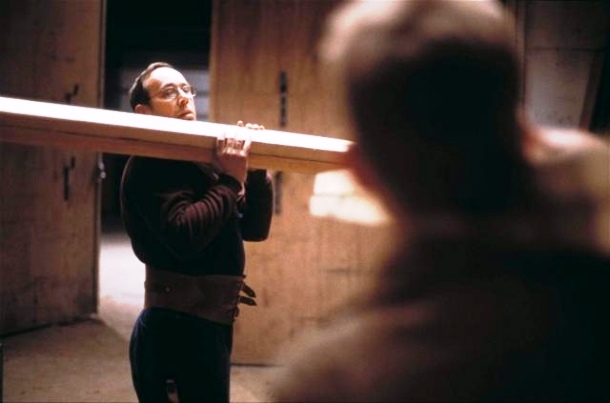
In fact, the question of whether he will ever act upon his vengeful tendencies is one that exists almost entirely in the minds of the audience. The notion of revenge, while ever-present, is never at the forefront of Olivier’s mind. He is after a completely different kind of retribution.
In one of the film’s most pivotal scenes, Olivier’s ex-wife, Magali, discovers Francis’ identity. Devastated by Olivier’s willingness to reach out to the very person responsible for their suffering, she berates him for his attempts at reconciliation: “Nobody would do that,” she says. When he agrees, she demands “So why you?”
His response? “I don’t know.” And neither do we.
The notion of turning the other cheek is almost impossibly difficult. We do it because we have been commanded to, but we do it grudgingly, and with resentment. “We’re being good,” we say, “but we’re not going to be happy about it.”
How poorly we have learned the lessons of Holy Week.
Olivier’s inactivity is a surprise to us only because we expect him to lash out against the evil that has been done to him. Even he is unable to understand why he wishes to forgive the young Francis; he only knows that he must try. I could not watch his unfathomable desire to bestow mercy without thinking of another Father, reaching out to forgive those very villains who took the life of His most precious Son.
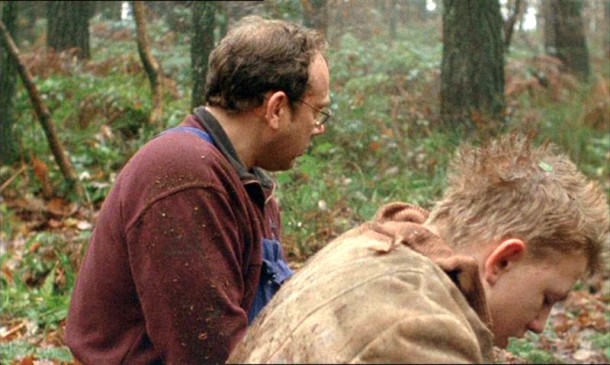
Like Olivier, our Heavenly Father lost His only Son at the hands of others. And like Olivier, He embraced His son’s killers with a love so far beyond all human comprehension that we find ourselves astounded by it. “Nobody would do that,” we say. “And even if someone did, He would never be able to understand why.”
But God’s forgiveness is even more absurd than Olivier’s, for His Son’s killer was not (nay,is not) a single, troubled young man. It is an entire race of fallen creatures—a race as obdurate and ungrateful in its rejection of His proffered grace as it is in need of it.
Yet He takes us back to Him even after the brutal betrayal of the Cross, and He has done it every moment of every day since that afternoon on Calvary. God does not do it because He needs to “move beyond” the Cross; He does it for no other reason than our own salvation. He has nothing to gain, and we have everything. How absurd and all-consuming is God’s forgiveness; how impossibly unlike human forgiveness.
Let us thank Him for it.
 Attribution(s): All posters, publicity images, and stills are the property of New Yorker Films and other respective production studios and distributors.
Previous Post

March 19, 2012
Obamacare Questions: Windmills or Giants?
Next Post

April 23, 2012 Embracing Martha While Pining for Mary: Win-Win?
Browse Our Archives
Select a Category Art Baseball Faith Family Lenten Music Movies Music No Commentary Necessary Parked By the Jukebox Photography Politics Quodlibets Streaming Video Suggestions Summa Short Films Television The Man Behind the Booth Through a Lens, Darkly
Select a Month December 2015 November 2015 October 2015 September 2015 August 2015 July 2015 June 2015 May 2015 April 2015 March 2015 February 2015 January 2015 December 2014 November 2014 October 2014 September 2014 August 2014 July 2014 June 2014 May 2014 April 2014 March 2014 February 2014 January 2014 December 2013 November 2013 October 2013 September 2013 August 2013 July 2013 June 2013 May 2013 April 2013 March 2013 February 2013 January 2013 December 2012 November 2012 July 2012 April 2012 March 2012 February 2012 November 2011 August 2011 July 2011 June 2011 May 2011 April 2011 March 2011 February 2011 January 2011 December 2010 November 2010 October 2010
Follow Us!
TAKE THE
Religious Wisdom Quiz
What city was Paul heading to when he encountered Jesus?
Select your answer to see how you score.
Rome Antioch Damascus Jerusalem
Related posts from Summa This, Summa That




TRENDING AT PATHEOS Catholic

Rejecting Doom: Christian Hope And Human Action
Christianity is a religion of hope. We are to have hope and...

It’s What Comes From Within Which Matters
One of the most difficult things for us to understand is why...

Why I Choose the Eucharist Over the Sermon
Choose the Eucharist, Not the Sermon What are we supposed to get...

5 Design Elements Found in Spiritually Rooted Homes
Putting Spirituality Into Home Decor Our homes are more than our living...

Credo: A Story of God Told with the...
About 10 years ago, I began to imagine a personal "Credo" that...

The Anatomy of Divine Revelation in Catholic Thought
The claim that God has made Himself known to human beings is...
view all Catholic blogs
Ad-Free & Subscriber Log-In Subscription Support
- About Us
- 2026 Calendar
- Videos
- Podcasts
- Library of World Religions
- Faith In Media Tracker
- Advertise With Us
- Write for Us
- Privacy Policy
- Terms of Service
- Do Not Sell My Data
- Contact Us
- Radiant Digital
- Manage Newsletter Subscriptions
- Unsubscribe From Notifications
- Sitemap
Copyright 2008-2026, Patheos. All rights reserved.
Subscription Support Ad-Free & Subscriber Log-In
Follow Patheos