
BuddhistCatholicContemplativeEvangelicalGeneral ChristianHinduJewishLatter-day SaintMuslimNew VisionsProgressive Christian
Beliefs
- Buddhist
- Catholic
- Contemplative
- Evangelical
- General Christian
- Hindu
- Jewish
- Latter-day Saint
- More Voices
- Muslim
- New Visions
- Pagan
- Progressive Christian
Topics
- Religion News
- Food and Religion
- Sports and Religion
- Religious Art
- Religious Music and Entertainment
- Religious Events
- History and Religion
- Style and Religion
- Politics and Religion
- Women in Religion
- Recreation Outdoors and Religion
- Business Finance and Religion
- Careers Workplace and Religion
- Education and Religion
- Family Parenting and Religion
- Health Fitness and Religion
- Home and Religion
- Relationships and Religion
- Technology and Religion
- Travel and Religion
Columnists
- Buddhist Columnists
- Business Finance and Religion Columnists
- Careers Workplace and Religion Columnists
- Catholic Columnists
- Contemplative Columnists
- Education and Religion Columnists
- Evangelists Columnists
- Family Parenting and Religion Columnists
- General Christian Columnists
- Health Fitness and Religion Columnists
- Hindu Columnists
- History and Religion Columnists
- Home and Religion Columnists
- Jewish Columnists
- More Voices Columnists
- Latter Day Columnists
- Muslim Columnists
- New Visions Columnists
- Nonreligious Columnists
- Pagan Columnists
- Politics and Religion Columnists
- Progressive Columnists
- Recreation Outdoors and Religion Columnists
- Relationships and Religion Columnists
- Religion News Columnists
- Religious Art Columnists
- Religious Events Columnists
- Religious Music and Entertainment Columnists
- Sports and Religion Columnists
- Style and Religion Columnists
- Technology and Religion Columnists
- Travel and Religion Columnists
- Women in Religion Columnists
Resource Library
- 2026 Calendar
- Library of World Religions
- The 100 Most Holy Places on Earth
- Patheos Answers
- Podcasts
- Videos
- Faith Leaders Database
- Anglican Episcopalian
- Bahai
- Baptist
- Buddhism
- Christianity
- Confucianism
- Eastern Orthodoxy
- Hinduism
- Holiness and Pentecostal
- ISKCON
- Islam
- Judaism
- Lutheran
- Methodist
- The Church of Jesus Christ of Latter-day Saints
- New Age
- Paganism
- Presbytarian and Reformed
- Protestantism
- Religion Behind the Scenes
- Roman Catholic
- Scientology
- Shia Islam
- Sikhism
- Sufism
- Sunni Islam
- Taoism
- Zen
- See all religions
Research Tools
 Ad-Free & Subscriber Log-In Subscription Support
Ad-Free & Subscriber Log-In Subscription Support
Follow Patheos 

- Trending:
- Forgiveness
- |
- Marriage
- |
- Consciousness
- |
- Death Penalty
- |
- Election
- |
- Halloween
 Summa This, Summa That
- Home
- About
- Through a Lens, Darkly
- Streaming Video Suggestions (SVS)
- Summa Short Films (SSF)
- The Man Behind The Booth
- Home
- Catholic
- A Cinematic Refuge for the Valentine-Averse
A Cinematic Refuge for the Valentine-Averse
Last updated on: February 13, 2015 at 1:16 pm by Joseph Susanka
A Cinematic Refuge for the Valentine-Averse 2015-02-13T13:16:36-07:00 Joseph Susanka
Patheos Explore the world's faith through different perspectives on religion and spirituality! Patheos has the views of the prevalent religions and spiritualities of the world.

Well, here we go again.
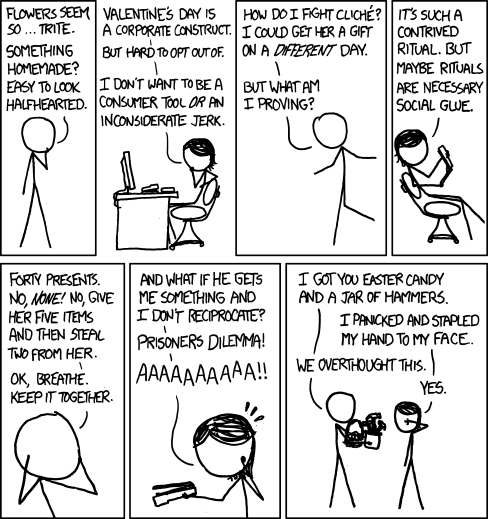
After a year of relative safety, we have arrived once more at Valentine’s Day, that most awkward of holidays, straddling the line twixt Twitterpation and Crass Consumerism. The day crabby old-timers love to hate; the day unromantic types hate because they are expected to love it so much; and the one shining day to which true romantics look forward for most of the other 364.
A quick look at multiplexes ’round the country reveals an obvious candidate for the Valentine’s Day Crowd: Nicholas Sparks’ latest “Romancetrophe,” The Vow. Far be it from me to begrudge it the smitten crowds to which it is so clearly targeted; I remember those days of young love well, and cherished every moment of them. Yet, six sons into the adventure, I find such fare a great deal less appealing—not because they deal with something untrue or even unimportant—but because they deal with it on such a superficial level; it’s the stuff of beginners. (Besides, schmaltzfests like The Vow have always failed to live up to my inflexible ideals.)
Instead, I offer this list of cinematic alternatives to the formulaic set-pieces this day offers, for those who no longer count ourselves among the Implacably Twitterpated — while first mentioning that my all-time favorite romantic film is Ushpizin, but since I have already written about its genre-busting awesomeness elsewhere, I will simply urge everyone to see it and move along:
 Random Harvest: That this film features an almost-impossibly charming Ronald Coleman and a luminous Greer Garson would be reason enough to recommend it. And good thing, too, because that’s about as much as I can say about the film, lest I spoil its effect on the first-time viewer. One of Hollywood’s truest classics, it tells the story of Smithy (Coleman), a happily married World War I vet whose mysterious past comes rushing darkly back to threaten his happiness. A fantastic performance from Garson (playing Smithy’s beloved wife, Paula) anchors the film, and its unexpected twists and turns will leave many a hardened cynic with a serious case of the warm-fuzzies. I cannot recommend it highly enough; I only wish I could be watching it for the first time—again.
 Away from Her: “All good things must come to an end,” and marriage is no exception to that heartless rule. But what happens when that dissolution is not precipitated by Death? Such is the situation in Sarah Polley’s sweetly melancholic directorial debut, where a couple struggles with the onset of Alzheimer’s and the unavoidable damage the disease is inflicting on their marriage. Grant (Gordon Pinsent) struggles to confront the fact that his wife, Fiona (Julie Christie)—moved to a medical facility in their fight to contain the debilitating effects of her disease—grows more and more distant, even to the point of forgetting her relationship with her husband altogether. Grant’s struggles grow more pointed as Fiona, believing herself husband-less, is attracted to another of the nursing home’s attendees. Eventually, Grant must confront for the last time the struggle that faces every married couple: the submission of one’s own wants and desires for the good of one’s spouse.
 Brief Encounter: Hollywood legend David Lean is rightfully revered for the epic films he produced in the ’50s and ’60s, but in the early ’40s he collaborated with playwright Noel Coward on three play adaptations. And it is one of those, Brief Encounter, which may well be his finest all-around work. A British housewife and a married doctor meet by chance in a train station, accidentally fall in love, and spend the next several weeks pitting their desires against the tangible needs of their respective families. A fascinating examination of the role of the will in married love, it deals with themes and issues that have been addressed by any number of other directors, but the finale of Lean’s film is so unexpected and so subtly rewarding that it deserves pride of place.
 Unbreakable: M. Night Shyamalan’s “realistic superhero” film is about the never-ending conflict between good and evil, the importance of the relationship between father and son, and the way in which all of us must come to terms with the fact that we have been created for a higher purpose. But perhaps most importantly, it is a film about the damaging pressures placed upon a marriage when we allow it to stagnate. It chronicles one man’s realization that marriage is not “unbreakable” by its nature, and that one must work (and work hard) to assure that it is preserved unbroken. There are many reasons to watch the film, but its defense of (and fundamentally optimistic view of) the vital nature of marriage is at the top of the list.
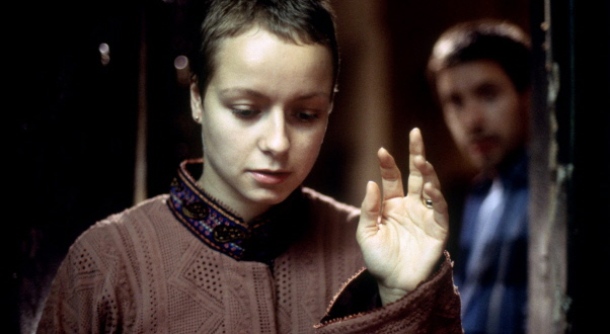 In America: Many of the most interesting films about marriage deal with infidelity; there is no more profound threat to an individual marriage than unfaithfulness, and the dramatic impact of such an attack has been used to excellent effect by countless filmmakers. Nearly as common a theme, however, is that of fertility. The fundamental role that procreation plays in the institution of marriage makes it (or its lack) a fertile playground for dramatic conflict. In Jim Sheridan’s fantastic film about a young Irish immigrant family struggling to make it in New York City, the unexpected, unwanted pregnancy of wife Sarah (Samantha Morton) is the catalyst that finally brings husband Johnny (Paddy Considine) to terms with the event that caused them to flee Ireland in the first place, and which has been eating away at their family. As pro-life and pro-family a film as has been made in some time, it is filled to bursting with small, insightful moments about the way spouses relate to each other and to the most tangible signs of their love: their children.
Both In America and Away from Her contain some adult material, of a nature that might be expected from films dealing with marriage.
Attribution(s): Publicity images and stills are the property of their respective creators and/or distributors and are used for editorial purposes only.
Previous Post

February 7, 2012
Waiting On Happiness In Mateo Gil's "Blackthorn"
Next Post

March 19, 2012 Obamacare Questions: Windmills or Giants?
Browse Our Archives
Select a Category Art Baseball Faith Family Lenten Music Movies Music No Commentary Necessary Parked By the Jukebox Photography Politics Quodlibets Streaming Video Suggestions Summa Short Films Television The Man Behind the Booth Through a Lens, Darkly
Select a Month December 2015 November 2015 October 2015 September 2015 August 2015 July 2015 June 2015 May 2015 April 2015 March 2015 February 2015 January 2015 December 2014 November 2014 October 2014 September 2014 August 2014 July 2014 June 2014 May 2014 April 2014 March 2014 February 2014 January 2014 December 2013 November 2013 October 2013 September 2013 August 2013 July 2013 June 2013 May 2013 April 2013 March 2013 February 2013 January 2013 December 2012 November 2012 July 2012 April 2012 March 2012 February 2012 November 2011 August 2011 July 2011 June 2011 May 2011 April 2011 March 2011 February 2011 January 2011 December 2010 November 2010 October 2010
Follow Us!
TAKE THE
Religious Wisdom Quiz
Who denied Jesus three times before the rooster crowed?
Select your answer to see how you score.
Peter Thomas Judas John
Related posts from Summa This, Summa That




TRENDING AT PATHEOS Catholic

Rejecting Doom: Christian Hope And Human Action
Christianity is a religion of hope. We are to have hope and...

It’s What Comes From Within Which Matters
One of the most difficult things for us to understand is why...

Why I Choose the Eucharist Over the Sermon
Choose the Eucharist, Not the Sermon What are we supposed to get...

5 Design Elements Found in Spiritually Rooted Homes
Putting Spirituality Into Home Decor Our homes are more than our living...

Credo: A Story of God Told with the...
About 10 years ago, I began to imagine a personal "Credo" that...

The Anatomy of Divine Revelation in Catholic Thought
The claim that God has made Himself known to human beings is...
view all Catholic blogs
Ad-Free & Subscriber Log-In Subscription Support
- About Us
- 2026 Calendar
- Videos
- Podcasts
- Library of World Religions
- Faith In Media Tracker
- Advertise With Us
- Write for Us
- Privacy Policy
- Terms of Service
- Do Not Sell My Data
- Contact Us
- Radiant Digital
- Manage Newsletter Subscriptions
- Unsubscribe From Notifications
- Sitemap
Copyright 2008-2026, Patheos. All rights reserved.
Subscription Support Ad-Free & Subscriber Log-In
Follow Patheos