
BuddhistCatholicContemplativeEvangelicalGeneral ChristianHinduJewishLatter-day SaintMuslimNew VisionsProgressive Christian
Beliefs
- Buddhist
- Catholic
- Contemplative
- Evangelical
- General Christian
- Hindu
- Jewish
- Latter-day Saint
- More Voices
- Muslim
- New Visions
- Pagan
- Progressive Christian
Topics
- Religion News
- Food and Religion
- Sports and Religion
- Religious Art
- Religious Music and Entertainment
- Religious Events
- History and Religion
- Style and Religion
- Politics and Religion
- Women in Religion
- Recreation Outdoors and Religion
- Business Finance and Religion
- Careers Workplace and Religion
- Education and Religion
- Family Parenting and Religion
- Health Fitness and Religion
- Home and Religion
- Relationships and Religion
- Technology and Religion
- Travel and Religion
Columnists
- Buddhist Columnists
- Business Finance and Religion Columnists
- Careers Workplace and Religion Columnists
- Catholic Columnists
- Contemplative Columnists
- Education and Religion Columnists
- Evangelists Columnists
- Family Parenting and Religion Columnists
- General Christian Columnists
- Health Fitness and Religion Columnists
- Hindu Columnists
- History and Religion Columnists
- Home and Religion Columnists
- Jewish Columnists
- More Voices Columnists
- Latter Day Columnists
- Muslim Columnists
- New Visions Columnists
- Nonreligious Columnists
- Pagan Columnists
- Politics and Religion Columnists
- Progressive Columnists
- Recreation Outdoors and Religion Columnists
- Relationships and Religion Columnists
- Religion News Columnists
- Religious Art Columnists
- Religious Events Columnists
- Religious Music and Entertainment Columnists
- Sports and Religion Columnists
- Style and Religion Columnists
- Technology and Religion Columnists
- Travel and Religion Columnists
- Women in Religion Columnists
Resource Library
- 2026 Calendar
- Library of World Religions
- The 100 Most Holy Places on Earth
- Patheos Answers
- Podcasts
- Videos
- Faith Leaders Database
- Anglican Episcopalian
- Bahai
- Baptist
- Buddhism
- Christianity
- Confucianism
- Eastern Orthodoxy
- Hinduism
- Holiness and Pentecostal
- ISKCON
- Islam
- Judaism
- Lutheran
- Methodist
- The Church of Jesus Christ of Latter-day Saints
- New Age
- Paganism
- Presbytarian and Reformed
- Protestantism
- Religion Behind the Scenes
- Roman Catholic
- Scientology
- Shia Islam
- Sikhism
- Sufism
- Sunni Islam
- Taoism
- Zen
- See all religions
Research Tools
 Ad-Free & Subscriber Log-In Subscription Support
Ad-Free & Subscriber Log-In Subscription Support
Follow Patheos 

- Trending:
- Forgiveness
- |
- Marriage
- |
- Consciousness
- |
- Death Penalty
- |
- Election
- |
- Halloween
 Summa This, Summa That
- Home
- About
- Through a Lens, Darkly
- Streaming Video Suggestions (SVS)
- Summa Short Films (SSF)
- The Man Behind The Booth
- Home
- Catholic
- Losing for the Sake of Winning
Losing for the Sake of Winning
Last updated on: February 5, 2015 at 5:41 pm by Joseph Susanka
Losing for the Sake of Winning 2015-02-05T17:41:10-07:00 Joseph Susanka
Patheos Explore the world's faith through different perspectives on religion and spirituality! Patheos has the views of the prevalent religions and spiritualities of the world.

Sorry that you feel that way
The only thing there is to say
Every silver lining’s got a
Touch of grey.
There are few things in life that bring home the value of a good cliché as quickly as becoming a new parent.
A few short months as a father were all it took for me to find a personal favorite: “Pick your battles.” Convincing my sons to look both ways before wandering across the street? I’ll go to the mat for that one. “Speaking politely and respectfully to one’s mother,” or indeed “any variety of adult?” Non-negotiable. Eagerly consuming last night’s serving of tomato-based side dish? Or embracing the newly-freed Dodgers as one’s team of choice? I’ve learned to keep my parental powder dry.
The vital corollary to the battle-picking adage—one nearly as important to me now as its predecessor was in my first years of fatherhood: don’t be stubborn simply for stubbornness’ sake.
The Music Never Stopped, an indie film that appeared briefly in theaters earlier this year, elegantly illustrates this very point. Based on “The Last Hippie,” the second story in renowned neurologist Oliver Sacks‘ “An Anthropologist On Mars: Seven Paradoxical Tales”
When Gabriel stormed out of his parents’ house some twenty years earlier, he was a vibrant young man with a bright future—an aspiring musician intoxicated by the anti-war sentiment and revolutionary music permeating one of the most perplexing periods in our history. Now, rendered nearly catatonic by the massive tumor, Gabriel is a shadow of his former self; eerily unresponsive to his surroundings, he meets his distraught parents’ efforts at communication with indifference.
Most painfully of all, the cancerous growth has destroyed the parts of Gabriel’s brain upon which he relies for the creation of new memories. He is a man locked in a painful past, with no hope of ever escaping it.
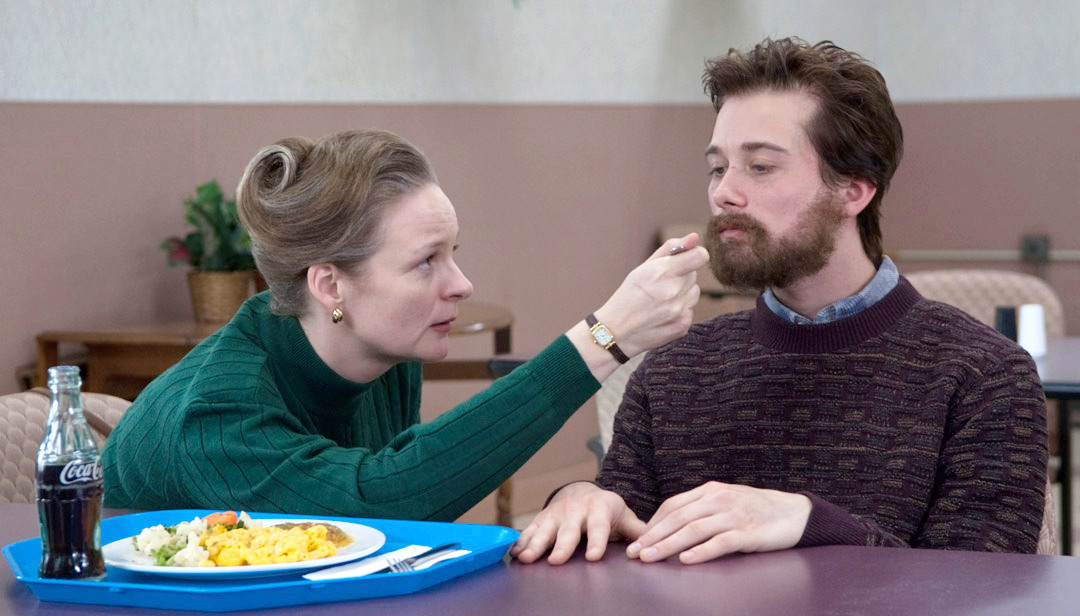
But Henry, whose pig-headed, domineering personality played a significant part in their estrangement, refuses to relinquish his son without a fight. Henry discovers that there is a way through the nearly perpetual darkness and silence that surrounds Gabriel—a wildly improbable, wonderfully fitting way for him to once again communicate with his son: music. When Gabriel hears the music he loved most dearly during his formative years—the now-famous sounds of such artists as Bob Dylan, the Beatles, and The Grateful Dead—he comes to life, recalling with vivid detail the events for which their music served as a melodic backdrop. Eagerly recounting those events and reveling in the songs that accompanied them, he is freed from the prison of his mind, and is finally able to recognize his parents and their love for him.
Henry—a dyed-in-the-wool “Jazz & Big Band” man who raised his son on the mellifluous tones of such classic singers as Bing Crosby and Peggy Lee—is appalled. But the stakes are too high for such selfish thinking, and Henry embraces the once-despised music for the sake of his son. He hopes to atone for the harshness of his past by providing his son with a new musical memory.
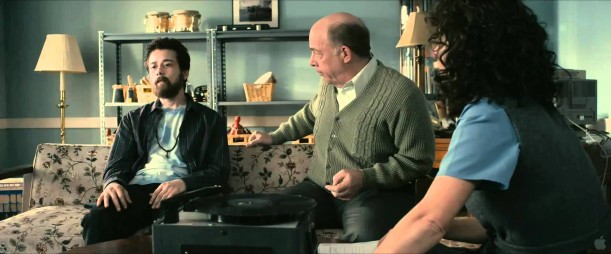
The two distinct eras in which the film takes place present its creators with a bit of a challenge; Simmons and Seymour are too old to be Pucci’s parents in the “flashback” years, and Pucci is too young to be a convincing “last hippie” in the present day segments. There is a nostalgic sentimentality in its handling of the 60’s that may come across as heavy-handed to non-boomers. And the story’s predictability (particularly in the second act) leaves some of its more emotional moments feeling a bit contrived. But the film easily atones for these shortcomings through powerful performances—Simmons, best known for his cigar-chomping turn as Spiderman’s J. Jonah Jameson, is particularly revelatory—an entertaining soundtrack, and the evergreen message.
Realizing that enthrallment to a particular genre of music or a particular political view could never serve as a replacement for his son, Henry steps outside the battlements that have held Gabriel at bay. Age has not lessened his willingness to fight, but it has given him enough wisdom to realize that Gabriel’s opposition to his way of life was not a rejection of his father, and that a two-decade “scorched earth” policy was both unhelpful and unfair.
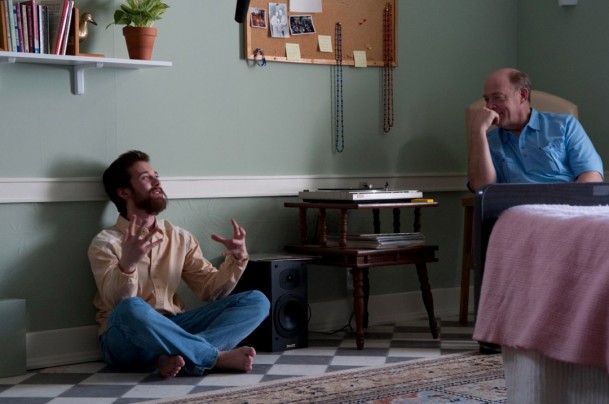 Henry has finally learned to pick his battles. He no longer has the stomach to fight with with Gabriel, but fighting for Gabriel? Battling to win back his love and affection? He’ll take it to the mat.
Henry’s regret and eventual transformation are deeply moving, especially to someone like me, who is too inclined to stick to my guns simply because they’re “mine.” Americans love winners, and that makes admitting error a difficult pill to swallow. Combine the inherent longing for victory with the inescapable fact that some battles are deeply and profoundly worth fighting, and it is small wonder that we are such a contentious society. But heat without light avails nothing, hindering not only our ability to understand the positions of those we have engaged in debate, but our ability to learn from them, as well.
Despite the encouragement of Charlie Sheen and Al Davis, winning is far less important than being right. Our stubbornness and our pride in the validity of our positions can be a valuable tool. But we must never allow that stubbornness—our own deep-seated desire for victory—to get in the way of what is true.
Picking one’s battles is incredibly important. So is understanding one’s opponent. But knowing how to examine and refine one’s own principles once the battle is joined might be most important of all.
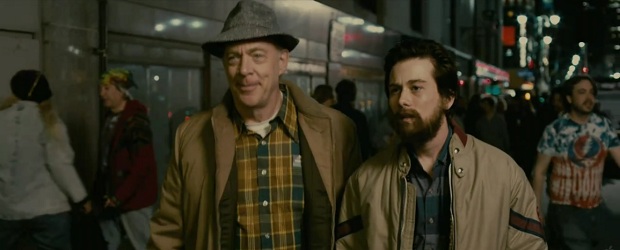
Attribution(s): All posters, publicity images, and movie stills are the property of Roadside Attractions and other respective production studios and distributors, and are intended for editorial use only.
Previous Post
August 25, 2011
Self-Sacrifice in Miyazaki's "Spirited Away"
Next Post
November 11, 2011 Shadow-Warriors No More
Browse Our Archives
Select a Category Art Baseball Faith Family Lenten Music Movies Music No Commentary Necessary Parked By the Jukebox Photography Politics Quodlibets Streaming Video Suggestions Summa Short Films Television The Man Behind the Booth Through a Lens, Darkly
Select a Month December 2015 November 2015 October 2015 September 2015 August 2015 July 2015 June 2015 May 2015 April 2015 March 2015 February 2015 January 2015 December 2014 November 2014 October 2014 September 2014 August 2014 July 2014 June 2014 May 2014 April 2014 March 2014 February 2014 January 2014 December 2013 November 2013 October 2013 September 2013 August 2013 July 2013 June 2013 May 2013 April 2013 March 2013 February 2013 January 2013 December 2012 November 2012 July 2012 April 2012 March 2012 February 2012 November 2011 August 2011 July 2011 June 2011 May 2011 April 2011 March 2011 February 2011 January 2011 December 2010 November 2010 October 2010
Follow Us!
TAKE THE
Religious Wisdom Quiz
What did Jesus ride into Jerusalem on?
Select your answer to see how you score.
A donkey A horse A chariot A camel
Related posts from Summa This, Summa That




TRENDING AT PATHEOS Catholic

Rejecting Doom: Christian Hope And Human Action
Christianity is a religion of hope. We are to have hope and...

It’s What Comes From Within Which Matters
One of the most difficult things for us to understand is why...

Why I Choose the Eucharist Over the Sermon
Choose the Eucharist, Not the Sermon What are we supposed to get...

5 Design Elements Found in Spiritually Rooted Homes
Putting Spirituality Into Home Decor Our homes are more than our living...

Credo: A Story of God Told with the...
About 10 years ago, I began to imagine a personal "Credo" that...

The Anatomy of Divine Revelation in Catholic Thought
The claim that God has made Himself known to human beings is...
view all Catholic blogs
Ad-Free & Subscriber Log-In Subscription Support
- About Us
- 2026 Calendar
- Videos
- Podcasts
- Library of World Religions
- Faith In Media Tracker
- Advertise With Us
- Write for Us
- Privacy Policy
- Terms of Service
- Do Not Sell My Data
- Contact Us
- Radiant Digital
- Manage Newsletter Subscriptions
- Unsubscribe From Notifications
- Sitemap
Copyright 2008-2026, Patheos. All rights reserved.
Subscription Support Ad-Free & Subscriber Log-In
Follow Patheos