
BuddhistCatholicContemplativeEvangelicalGeneral ChristianHinduJewishLatter-day SaintMuslimNew VisionsProgressive Christian
Beliefs
- Buddhist
- Catholic
- Contemplative
- Evangelical
- General Christian
- Hindu
- Jewish
- Latter-day Saint
- More Voices
- Muslim
- New Visions
- Pagan
- Progressive Christian
Topics
- Religion News
- Food and Religion
- Sports and Religion
- Religious Art
- Religious Music and Entertainment
- Religious Events
- History and Religion
- Style and Religion
- Politics and Religion
- Women in Religion
- Recreation Outdoors and Religion
- Business Finance and Religion
- Careers Workplace and Religion
- Education and Religion
- Family Parenting and Religion
- Health Fitness and Religion
- Home and Religion
- Relationships and Religion
- Technology and Religion
- Travel and Religion
Columnists
- Buddhist Columnists
- Business Finance and Religion Columnists
- Careers Workplace and Religion Columnists
- Catholic Columnists
- Contemplative Columnists
- Education and Religion Columnists
- Evangelists Columnists
- Family Parenting and Religion Columnists
- General Christian Columnists
- Health Fitness and Religion Columnists
- Hindu Columnists
- History and Religion Columnists
- Home and Religion Columnists
- Jewish Columnists
- More Voices Columnists
- Latter Day Columnists
- Muslim Columnists
- New Visions Columnists
- Nonreligious Columnists
- Pagan Columnists
- Politics and Religion Columnists
- Progressive Columnists
- Recreation Outdoors and Religion Columnists
- Relationships and Religion Columnists
- Religion News Columnists
- Religious Art Columnists
- Religious Events Columnists
- Religious Music and Entertainment Columnists
- Sports and Religion Columnists
- Style and Religion Columnists
- Technology and Religion Columnists
- Travel and Religion Columnists
- Women in Religion Columnists
Resource Library
- 2026 Calendar
- Library of World Religions
- The 100 Most Holy Places on Earth
- Patheos Answers
- Podcasts
- Videos
- Faith Leaders Database
- Anglican Episcopalian
- Bahai
- Baptist
- Buddhism
- Christianity
- Confucianism
- Eastern Orthodoxy
- Hinduism
- Holiness and Pentecostal
- ISKCON
- Islam
- Judaism
- Lutheran
- Methodist
- The Church of Jesus Christ of Latter-day Saints
- New Age
- Paganism
- Presbytarian and Reformed
- Protestantism
- Religion Behind the Scenes
- Roman Catholic
- Scientology
- Shia Islam
- Sikhism
- Sufism
- Sunni Islam
- Taoism
- Zen
- See all religions
Research Tools
 Ad-Free & Subscriber Log-In Subscription Support
Ad-Free & Subscriber Log-In Subscription Support
Follow Patheos 

- Trending:
- Forgiveness
- |
- Marriage
- |
- Consciousness
- |
- Death Penalty
- |
- Election
- |
- Halloween
 Summa This, Summa That
- Home
- About
- Through a Lens, Darkly
- Streaming Video Suggestions (SVS)
- Summa Short Films (SSF)
- The Man Behind The Booth
- Home
- Catholic
- Self-Sacrifice in Miyazaki’s “Spirited Away”
Self-Sacrifice in Miyazaki’s “Spirited Away”
Last updated on: April 16, 2015 at 5:55 pm by Joseph Susanka
Self-Sacrifice in Miyazaki’s “Spirited Away” 2015-04-16T17:55:28-06:00 Joseph Susanka
Patheos Explore the world's faith through different perspectives on religion and spirituality! Patheos has the views of the prevalent religions and spiritualities of the world.
Hayao Miyazaki is a rare and indispensible artist.
In a creative industry that flits happily between the brutal demythification and saccharine sentimentalization of childhood, his ability to capture the innocence, exuberance, and boundless imagination of youth is unusual. Watching My Neighbor Totoro, Laputa, or Ponyo with an audience of youngsters is a marvelous experience; their rapt expressions and delighted laughter prove how thoroughly the legendary Japanese animator “gets” children.
Yet it would be a shame to dismiss his gentler work as nothing but childish amusement. Like the Pixar films he has influenced, Miyazaki’s creations are both entertaining and enlightening; for him, animation is the lens through which he looks at life, not a way to distance himself or his audience from its lessons.
Spirited Away, widely regarded as his finest work, is the paradigm example of Miyazaki’s genius. Blending imaginative (and occasionally unsettling) imagery with a rich tapestry of fantastical creatures, the film recounts the tribulations of Chihiro, a young girl transported without warning from her safe, spoiled life to a vivid “spirit world” of ghosts and sorcerers. Cut off from her over-indulgent parents, bewildered by the inexplicable setting in which she finds herself, she is befriended by a mysterious young boy, Haku, who tells her that the only way to return to her familiar life is to land a job at the mysterious bathhouse that towers above them.
Braving the wrath of the building’s proprietor, the spiteful enchantress Yubaba, Chihiro secures employment, becoming an Assistant Serving Girl and immersing herself in the strange world around her. With a bit of amateurish sleuthing, she discovers that Haku is under Yubaba’s evil curse, constrained by the sorceress’ magical powers to do her dirty work, which puts him in a position of extreme danger.

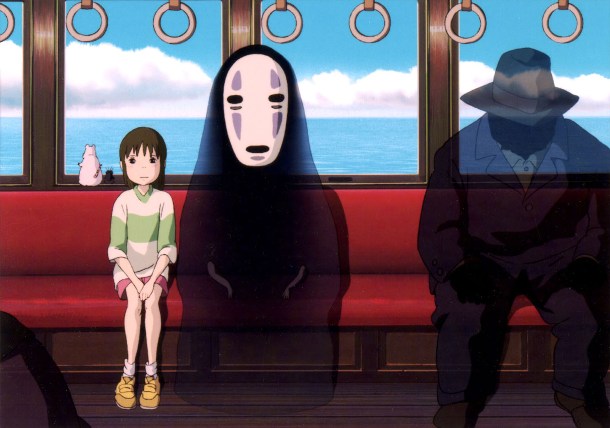
At the same time, she becomes embroiled with one of the house’s most problematic clients: a particularly disquieting spirit known as “No-Face.” When Chihiro first encounters him, he can barely communicate. His loneliness is palpable, though, and Chihiro attempts to make him welcome. Initially, he seeks nothing more than her company, but his hunger (which is both metaphorical and physical) grows acute, and he begins to consume Chihiro’s fellow employees at a truly alarming rate. The gluttonous spirit does more than simply devour his victims: it absorbs them, taking on their characteristics and personality traits, as well.
The situation rapidly grows unmanageable in the bathhouse; Haku’s impending doom and No-Face’s appalling binge forces Chihiro to step far outside her comfort zone in order to overcome the obstacles before her and return safely home.
Miyazaki’s film presents its viewers with an embarrassment of riches. The conflict between Japanese customs and the advance of modernity is lurking just beneath the surface; there is a sense of fond wistfulness behind his pervasive use of traditional Japanese folkloric imagery (pdf). His representation of hard, honest labor as both necessary and ennobling is a too-seldom explored theme, as is the emptiness of the capitalistic, consumerist mentality of Chihiro’s parents. The environmental concerns that underlie so many of Miyazaki’s stories are found here, too, but their restraint is a key component in setting Spirited Away apart from its siblings. And the character of No-Face, concealing his true nature behind his traditional Noh mask, is a rich duality—at once representing how dramatically (and incontrovertibly) we are nurtured and shaped by those around us and how quickly our desire for adulation can grow parasitic and all-consuming. In No-Face we are reminded that the best way to rein in our ego is through self-denial, and an acceptance of our state in life.
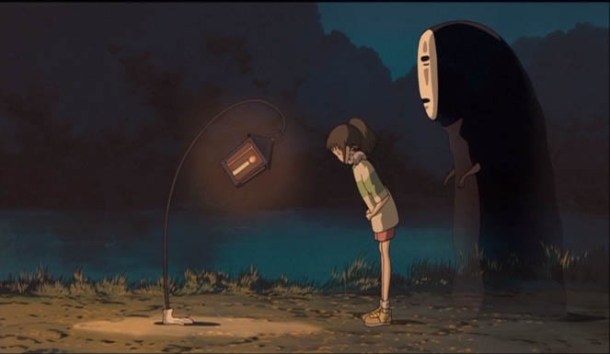
Yet it is the transformation of Chihiro herself—and the reason behind that profound change—that stands out as the clearest and most important message in Spirited Away. We meet her as a selfish, self-centered young child: the unsurprising product of selfish and self-centered parents, and her first terrifying moments in the Spirit World are all the more difficult for her, precisely because she is so closed off and used to having her own way.
As her days in the bathhouse wear on, however, her motivations grow more clearly admirable. Her desire to rescue her parents, once inextricably linked to her wish to return home, is now driven by a desire for their safety and happiness. Her interaction with No-Face and the other bathhouse patrons grows more genuine. Even the moments spent with Yubaba and her henchmen grow more manageable, as Chihiro matures. And when the time comes for her to choose between her own safety and the life of her dear Haku, her decision is instantaneous and without self-consideration.
We all have a bit of the Selfish Chihiro in us, waging an endless battle against the urge to place our wants before the needs of those we love. But Miyazaki’s masterpiece reminds us that we must never stop fighting that urge—that it is only in subsuming our desires to the will of Another that we will find true freedom.
It seems that we can always do with a bit more spiriting away.
 Attribution(s): All posters, publicity images, and stills are the property of GKIDD Films and other respective production studios and distributors, and are intended for editorial use only.
Previous Post

July 14, 2011
Elmer Gantry and the Cult of Personality
Next Post

November 3, 2011 Losing for the Sake of Winning
Browse Our Archives
Select a Category Art Baseball Faith Family Lenten Music Movies Music No Commentary Necessary Parked By the Jukebox Photography Politics Quodlibets Streaming Video Suggestions Summa Short Films Television The Man Behind the Booth Through a Lens, Darkly
Select a Month December 2015 November 2015 October 2015 September 2015 August 2015 July 2015 June 2015 May 2015 April 2015 March 2015 February 2015 January 2015 December 2014 November 2014 October 2014 September 2014 August 2014 July 2014 June 2014 May 2014 April 2014 March 2014 February 2014 January 2014 December 2013 November 2013 October 2013 September 2013 August 2013 July 2013 June 2013 May 2013 April 2013 March 2013 February 2013 January 2013 December 2012 November 2012 July 2012 April 2012 March 2012 February 2012 November 2011 August 2011 July 2011 June 2011 May 2011 April 2011 March 2011 February 2011 January 2011 December 2010 November 2010 October 2010
Follow Us!
TAKE THE
Religious Wisdom Quiz
What does "Moses" mean?
Select your answer to see how you score.
Born Amid Trouble Drawn Out (of water) Rescued Gifted
Related posts from Summa This, Summa That




TRENDING AT PATHEOS Catholic

Rejecting Doom: Christian Hope And Human Action
Christianity is a religion of hope. We are to have hope and...

It’s What Comes From Within Which Matters
One of the most difficult things for us to understand is why...

Why I Choose the Eucharist Over the Sermon
Choose the Eucharist, Not the Sermon What are we supposed to get...

5 Design Elements Found in Spiritually Rooted Homes
Putting Spirituality Into Home Decor Our homes are more than our living...

Credo: A Story of God Told with the...
About 10 years ago, I began to imagine a personal "Credo" that...

The Anatomy of Divine Revelation in Catholic Thought
The claim that God has made Himself known to human beings is...
view all Catholic blogs
Ad-Free & Subscriber Log-In Subscription Support
- About Us
- 2026 Calendar
- Videos
- Podcasts
- Library of World Religions
- Faith In Media Tracker
- Advertise With Us
- Write for Us
- Privacy Policy
- Terms of Service
- Do Not Sell My Data
- Contact Us
- Radiant Digital
- Manage Newsletter Subscriptions
- Unsubscribe From Notifications
- Sitemap
Copyright 2008-2026, Patheos. All rights reserved.
Subscription Support Ad-Free & Subscriber Log-In
Follow Patheos