
BuddhistCatholicContemplativeEvangelicalGeneral ChristianHinduJewishLatter-day SaintMuslimNew VisionsProgressive Christian
Beliefs
- Buddhist
- Catholic
- Contemplative
- Evangelical
- General Christian
- Hindu
- Jewish
- Latter-day Saint
- More Voices
- Muslim
- New Visions
- Pagan
- Progressive Christian
Topics
- Religion News
- Food and Religion
- Sports and Religion
- Religious Art
- Religious Music and Entertainment
- Religious Events
- History and Religion
- Style and Religion
- Politics and Religion
- Women in Religion
- Recreation Outdoors and Religion
- Business Finance and Religion
- Careers Workplace and Religion
- Education and Religion
- Family Parenting and Religion
- Health Fitness and Religion
- Home and Religion
- Relationships and Religion
- Technology and Religion
- Travel and Religion
Columnists
- Buddhist Columnists
- Business Finance and Religion Columnists
- Careers Workplace and Religion Columnists
- Catholic Columnists
- Contemplative Columnists
- Education and Religion Columnists
- Evangelists Columnists
- Family Parenting and Religion Columnists
- General Christian Columnists
- Health Fitness and Religion Columnists
- Hindu Columnists
- History and Religion Columnists
- Home and Religion Columnists
- Jewish Columnists
- More Voices Columnists
- Latter Day Columnists
- Muslim Columnists
- New Visions Columnists
- Nonreligious Columnists
- Pagan Columnists
- Politics and Religion Columnists
- Progressive Columnists
- Recreation Outdoors and Religion Columnists
- Relationships and Religion Columnists
- Religion News Columnists
- Religious Art Columnists
- Religious Events Columnists
- Religious Music and Entertainment Columnists
- Sports and Religion Columnists
- Style and Religion Columnists
- Technology and Religion Columnists
- Travel and Religion Columnists
- Women in Religion Columnists
Resource Library
- 2026 Calendar
- Library of World Religions
- The 100 Most Holy Places on Earth
- Patheos Answers
- Podcasts
- Videos
- Faith Leaders Database
- Anglican Episcopalian
- Bahai
- Baptist
- Buddhism
- Christianity
- Confucianism
- Eastern Orthodoxy
- Hinduism
- Holiness and Pentecostal
- ISKCON
- Islam
- Judaism
- Lutheran
- Methodist
- The Church of Jesus Christ of Latter-day Saints
- New Age
- Paganism
- Presbytarian and Reformed
- Protestantism
- Religion Behind the Scenes
- Roman Catholic
- Scientology
- Shia Islam
- Sikhism
- Sufism
- Sunni Islam
- Taoism
- Zen
- See all religions
Research Tools
 Ad-Free & Subscriber Log-In Subscription Support
Ad-Free & Subscriber Log-In Subscription Support
Follow Patheos 

- Trending:
- Forgiveness
- |
- Marriage
- |
- Consciousness
- |
- Death Penalty
- |
- Election
- |
- Halloween
 Summa This, Summa That
- Home
- About
- Through a Lens, Darkly
- Streaming Video Suggestions (SVS)
- Summa Short Films (SSF)
- The Man Behind The Booth
- Home
- Catholic
- Elmer Gantry and the Cult of Personality
Elmer Gantry and the Cult of Personality
Last updated on: March 24, 2015 at 6:21 pm by Joseph Susanka
Elmer Gantry and the Cult of Personality 2015-03-24T18:21:17-06:00 Joseph Susanka
Patheos Explore the world's faith through different perspectives on religion and spirituality! Patheos has the views of the prevalent religions and spiritualities of the world.
“I have passed the test. I will diminish, and go into the West, and remain Galadriel.”
We Americans are obsessed with celebrity. We expend vast amounts of time, energy and money in the obsessive study of our heroes; we live vicariously through the paparazzi-plagued existences of those more “fortunate” than ourselves.
So it comes as no surprise that the Catholic Church in America has given rise to its own peculiar brand of media star: the Celebrity Priest.
Sadly, our knowledge of human nature should preclude our surprise when one of these “stars” of the church flames out. From “Life on the Rock’s” Father Francis Mary Stone to Father Thomas Euteneuer of Human Life International to Father Alberto Cutié, a rising televangelical star “gone rogue,” we find ourselves in a seemingly endless storm of bad news about the broken promises of our priests.
John Corapi’s sudden and precipitous fall from grace last month was perhaps the most sensational and damaging of all, unleashing a maelstrom of allegations reactions that have unsettled many of us who had cherished his stern and uncompromising stances. His videos were key components in a series of retreats I attended during my formative college years, so last month’s upheaval was personally very painful.
 In this troubling context, my recent return to Elmer Gantry and its account of a preacher’s meteoric rise and fall was both agonizing and timely, helping to address some of the questions stirred up by the unexpected appearance of Corapi’s “Black Sheepdog” why is it that we find ourselves in these predicaments so regularly?
Based on a controversial Sinclair Lewis novel, Elmer Gantry follows a traveling salesman of dubious morals and unlikely hair through a Christmas Eve of riotous carousing and a Christmas Morn of floozies and vicious hangovers. A brief phone conversation with his tearful mother reveals Gantry (Burt Lancaster) to be both charming and casually cruel—a man habituated to pursuing his desires above all else. Extricating himself from his mother (and his floozy), he spends the remainder of Christmas on a freight train, sleeping off the effects. Upon disembarking, he finds himself drawn to a small country church, where he spends a peaceful evening belting out spirituals with its parishioners.
The next day, he happens across an attractive young woman summoning the townsfolk to a revival meeting that very night with promises of a grace-filled evening of prayer and repentance under the guidance of Sister Sharon Falconer (Jean Simmons). His curiosity piqued as much by the promise as the attractive girl making the invitation, Gantry attends, only to find himself instantly smitten with the lovely young preacher.
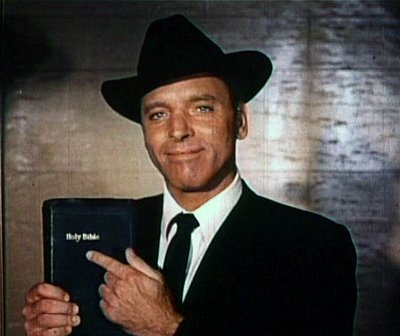 Gantry sets to work on Sister Sharon, eventually persuading her to let him participate in her revival services as a sinner who has seen the error of his ways and now embraces the challenge of converting anyone and everyone who stands in his way. His obvious flare for the dramatic and his keen salesman’s instincts soon earn Sister that which has eluded her for years: an invitation to the city of Zenith, and a chance to bring her message to thousands of unchurched urbanites.As the day of the big revival draws near, details of Gantry’s troubled past return to haunt him: Sharon learns that he was expelled from a Kansas theological seminary for brazenly seducing a young woman, Lulu Bains (Shirley Jones), the daughter of a local deacon. Shaken, Sharon assures herself (and Gantry) that “God sent you to me as His instrument, not as my lover.” Sadly, her naïveté is her undoing; her resistance as fleeting as was Lulu’s all those years before.
Gantry, busily beating off the attacks of the local newspapermen—who are too cynical to put their faith in spiritual figures, yet too self-righteous to allow others to do so—finds himself under attack from an unexpected quarter: the tarnished, vindictive Lulu reappears, and the resulting situation grows increasingly unmanageable. Gantry eventually finds himself an unwitting (if not entirely blameless) participant in a great tragedy, forced to reconsider both his previously-hedonistic life and the role God will (and must) play in his future exploits.
There is a similarity between Lewis’ Gantry and Corapi’s story in their checkered pasts—pasts inextricably bound up in their abilities to connect with their audiences. When Gantry’s “vulgar” preaching draws the ire of Sharon’s disapproving manager, Bill Morgan (Dean Jagger), he reminds Morgan that the power of his evangelizing comes from that very vulgarity: “You’re too good for the people,” he says. “I AM the people.”
 Gantry’s willing admission of his own sinful life is essential to his success; we American Catholics love (and seem suddenly to need) our heroes “formerly fallen.”
When John Corapi stood before an audience, his presence spoke as eloquently as his words. “Look where I once was,” it said. “And look where I am today. Thanks be to God! Now go thou and do likewise.” His life story, told in all its dark and troubling detail, was an integral part of why he was effective.
The spiritual dangers of a personality cult are great, and nowhere is that danger manifested so unsettlingly as when formed around a fallen “Celebrity Priest,” particularly one whose message is powerfully enhanced by their personal stories of vanquished sin. Well-publicized failures and subsequent successes are vital cogs in a message of reform; they give us hope, because we identify with weakness, and we want to forgive it in our heroes, and identify with the forgiven, too.
 It is no wonder that we become so strongly attached to particular individuals; no wonder the Cult of Personality takes such strong root in those places where we might least expect it. For while it is true that the message of salvation is always and everywhere the same, it is just as true that what one hears and how one responds can have everything to do with who is telling the story.
Though the story is Elmer’s, Sister Sharon Falconer has a vital lesson to teach. Once overlooked as an earnest, inexperienced supporting player in Gantry’s dramatic story of self-discovery, she becomes the all-important “flip-side” of the story – the effect that adulation can have upon the one being followed. This devout and well-intentioned young woman begins to view herself as more than a simple human instrument. Her followers have come to rely so completely on her spiritual strength that she now sees herself as The Only Instrument by which they can be saved, and her inability to reject her new-found fame for an “ordinary” life will have tragic and lasting consequences.
 Is it possible that John Corapi—like the fictional Sister Falconer—has lost the ability to recognize his own un-essentialness, confusing his undeniable gifts and their noteworthy results with the true Cause of his success? Pride is a devastating taskmaster, and one who lurks behind many good and noble intentions.
Let us be supremely cautious in the assumptions we make, for the sake of justice as well as that of charity. Even as the facts in Corapi’s case come to light, his motives will remain known to no one but himself and God. Labeling him a sinner is more accurate than many of us might have wished it to be, possibly because it makes him more “ordinary” than many of us care to admit.
To label him a fraud and an impostor is more dangerous territory. Even if the worst of his story’s details should prove true, who is to say that he has not struggled mightily against his demons all the while? Can we say with confidence that his difficulty in doing what he preaches means he does not believe what he preaches? God willing, that belief and that drive to overcome which stood him in such good stead in his early years will help him return to the Source of his former strength.
 All too often, God must employ drastic measures to free us from its clutches. Maybe these recent failures, catastrophic though they seem to Corapi’s faithful followers, are actually the ultimate opportunity and a sign of God’s unending efforts on behalf of a single lost sheep. Corapi, whose fame as a Celebrity Priest was unmatched, is being offered the chance to fade once again “into the West;” to become nothing more than an “ordinary” human being, struggling to find salvation.
I believe that these failures are a vital reminder to America’s Catholics, that we must stop confusing God with his messengers. Perhaps they are also are a painful opportunity for those same messengers to stop confusing themselves with God.

Attribution(s): All posters, publicity images, and stills are the property of United Artists/MGM and other respective production studios and distributors, and are intended for editorial use only.
Previous Post

July 11, 2011
The Booth at the End and Our Faustian Selves
Next Post

August 25, 2011 Self-Sacrifice in Miyazaki's "Spirited Away"
Browse Our Archives
Select a Category Art Baseball Faith Family Lenten Music Movies Music No Commentary Necessary Parked By the Jukebox Photography Politics Quodlibets Streaming Video Suggestions Summa Short Films Television The Man Behind the Booth Through a Lens, Darkly
Select a Month December 2015 November 2015 October 2015 September 2015 August 2015 July 2015 June 2015 May 2015 April 2015 March 2015 February 2015 January 2015 December 2014 November 2014 October 2014 September 2014 August 2014 July 2014 June 2014 May 2014 April 2014 March 2014 February 2014 January 2014 December 2013 November 2013 October 2013 September 2013 August 2013 July 2013 June 2013 May 2013 April 2013 March 2013 February 2013 January 2013 December 2012 November 2012 July 2012 April 2012 March 2012 February 2012 November 2011 August 2011 July 2011 June 2011 May 2011 April 2011 March 2011 February 2011 January 2011 December 2010 November 2010 October 2010
Follow Us!
TAKE THE
Religious Wisdom Quiz
In Revelation, what are the names of the two cities that the two witnesses' bodies lie in?
Select your answer to see how you score.
Babylon and Jerusalem Damascus and Tyre Rome and Athens Sodom and Egypt (figuratively called)
Related posts from Summa This, Summa That




TRENDING AT PATHEOS Catholic

The Parable Of The Sower And The Word...
One of Christ’s most famous parables is that of the sower who...

Rejecting Doom: Christian Hope And Human Action
Christianity is a religion of hope. We are to have hope and...

Why I Choose the Eucharist Over the Sermon
Choose the Eucharist, Not the Sermon What are we supposed to get...

5 Design Elements Found in Spiritually Rooted Homes
Putting Spirituality Into Home Decor Our homes are more than our living...

Credo: A Story of God Told with the...
About 10 years ago, I began to imagine a personal "Credo" that...

The Anatomy of Divine Revelation in Catholic Thought
The claim that God has made Himself known to human beings is...
view all Catholic blogs
Ad-Free & Subscriber Log-In Subscription Support
- About Us
- 2026 Calendar
- Videos
- Podcasts
- Library of World Religions
- Faith In Media Tracker
- Advertise With Us
- Write for Us
- Privacy Policy
- Terms of Service
- Do Not Sell My Data
- Contact Us
- Radiant Digital
- Manage Newsletter Subscriptions
- Unsubscribe From Notifications
- Sitemap
Copyright 2008-2026, Patheos. All rights reserved.
Subscription Support Ad-Free & Subscriber Log-In
Follow Patheos