
BuddhistCatholicContemplativeEvangelicalGeneral ChristianHinduJewishLatter-day SaintMuslimNew VisionsProgressive Christian
Beliefs
- Buddhist
- Catholic
- Contemplative
- Evangelical
- General Christian
- Hindu
- Jewish
- Latter-day Saint
- More Voices
- Muslim
- New Visions
- Pagan
- Progressive Christian
Topics
- Religion News
- Food and Religion
- Sports and Religion
- Religious Art
- Religious Music and Entertainment
- Religious Events
- History and Religion
- Style and Religion
- Politics and Religion
- Women in Religion
- Recreation Outdoors and Religion
- Business Finance and Religion
- Careers Workplace and Religion
- Education and Religion
- Family Parenting and Religion
- Health Fitness and Religion
- Home and Religion
- Relationships and Religion
- Technology and Religion
- Travel and Religion
Columnists
- Buddhist Columnists
- Business Finance and Religion Columnists
- Careers Workplace and Religion Columnists
- Catholic Columnists
- Contemplative Columnists
- Education and Religion Columnists
- Evangelists Columnists
- Family Parenting and Religion Columnists
- General Christian Columnists
- Health Fitness and Religion Columnists
- Hindu Columnists
- History and Religion Columnists
- Home and Religion Columnists
- Jewish Columnists
- More Voices Columnists
- Latter Day Columnists
- Muslim Columnists
- New Visions Columnists
- Nonreligious Columnists
- Pagan Columnists
- Politics and Religion Columnists
- Progressive Columnists
- Recreation Outdoors and Religion Columnists
- Relationships and Religion Columnists
- Religion News Columnists
- Religious Art Columnists
- Religious Events Columnists
- Religious Music and Entertainment Columnists
- Sports and Religion Columnists
- Style and Religion Columnists
- Technology and Religion Columnists
- Travel and Religion Columnists
- Women in Religion Columnists
Resource Library
- 2026 Calendar
- Library of World Religions
- The 100 Most Holy Places on Earth
- Patheos Answers
- Podcasts
- Videos
- Faith Leaders Database
- Anglican Episcopalian
- Bahai
- Baptist
- Buddhism
- Christianity
- Confucianism
- Eastern Orthodoxy
- Hinduism
- Holiness and Pentecostal
- ISKCON
- Islam
- Judaism
- Lutheran
- Methodist
- The Church of Jesus Christ of Latter-day Saints
- New Age
- Paganism
- Presbytarian and Reformed
- Protestantism
- Religion Behind the Scenes
- Roman Catholic
- Scientology
- Shia Islam
- Sikhism
- Sufism
- Sunni Islam
- Taoism
- Zen
- See all religions
Research Tools
 Ad-Free & Subscriber Log-In Subscription Support
Ad-Free & Subscriber Log-In Subscription Support
Follow Patheos 

- Trending:
- Forgiveness
- |
- Marriage
- |
- Consciousness
- |
- Death Penalty
- |
- Election
- |
- Halloween
 Summa This, Summa That
- Home
- About
- Through a Lens, Darkly
- Streaming Video Suggestions (SVS)
- Summa Short Films (SSF)
- The Man Behind The Booth
- Home
- Catholic
- No Sunrises Without Sunsets
No Sunrises Without Sunsets
Last updated on: January 22, 2015 at 6:39 pm by Joseph Susanka
No Sunrises Without Sunsets 2015-01-22T18:39:18-07:00 Joseph Susanka
Patheos Explore the world's faith through different perspectives on religion and spirituality! Patheos has the views of the prevalent religions and spiritualities of the world.
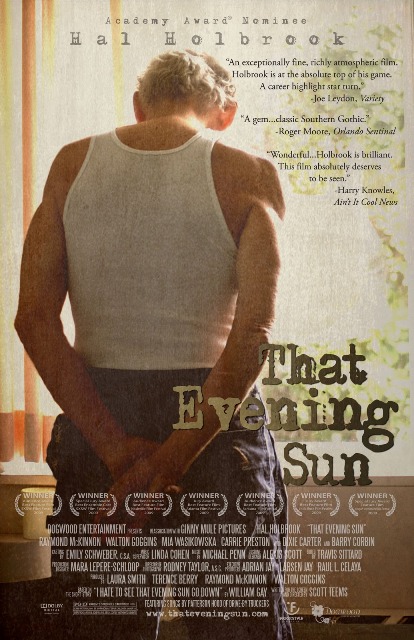
I hate to see this evening sun go down.
Lord, I hate to see this evening sun go down.
’cause it makes me think I’m on my last go ’round.
Few things are more enjoyable than watching a legendary actor, nearing the end of a long and illustrious career, who finds the passion and the courage to deliver an absolutely spell-binding performance—one that history may well remember as his finest. Eighty-six-year-old Hal Holbrook, who has appeared in over forty feature films and countless stage productions, is just such an actor. And That Evening Sun‘s Abner Meecham is his magnum opus.
Director Scott Teems—an alumnus of Barbara Nicolosi’s Act One program—adapted the film from William Gay’s short story “I Hate to See That Evening Sun Go Down,” and the result is as harsh and insightful a Southern Gothic fable as the big screen has seen in many a year. Set in the rural countryside of Tennessee, it follows Ol’ Abner (Holbrook) as he slips away from the retirement home so carefully selected by his son (Walter Goggins), and heads back to the sleepy little town of Ackerman’s Field to reclaim his farm. Upon arriving there, however, he receives a rather unpleasant surprise: during the old man’s reluctant stay at the old folks’ home, Abner’s son has decided to lease the farm to Lonzo Choat (Ray McKinnon), a local redneck who has tangled with Abner in the past, and whose reputation as a lazy, boorish loud-mouth has been well and truly earned.
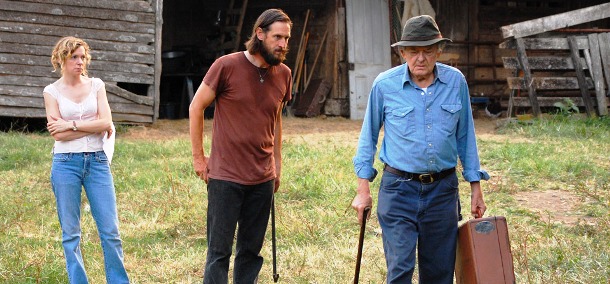 Incensed at finding interlopers on the homestead he so painstakingly carved out with his late wife Ellen, Abner vows to eliminate his rivals. When an innocent conversation with Choat’s teen-aged daughter Pamela (Mia Wasikowska) reveals the man to be both an inveterate dog hater and a mean drunk, Abner sees the perfect way to make his presence felt. Purchasing a mutt known as “the noisiest dog in Ackerman’s Field” from a local neighbor, Abner sets about making the Choats’ lives as miserable as possible, trusting that his irksome behavior will soon drive them from his property. “I’ll leave when I’m good and ready,” he tells Pamela stubbornly. “You tell Lonzo the same.”
 Choat, who sees Abner’s farm as his best and last chance of escape from the downward spiral of poverty and suffering that has dogged his family’s steps from their earliest days, is just as stubborn. Armed with a lease-to-own agreement from Abner’s son, he demands that the old man vacate the homesteader’s cabin where he has taken up residence; Abner responds by alerting the local sheriff’s deputies that Choat beats his womenfolk during the worst of his beer-fueled rages. Despite the repeated efforts of Abner’s son, Lonzo’s wife, and the young Pamela, both men dig in their heels, refusing to concede an inch to the other. As the situation escalates, Abner and Lonzo show themselves willing to go to any lengths to achieve their ends—a predicament that propels the two combatants inexorably towards a violent denouement that will leave both broken and adrift in its aftermath.
Teems is fascinated by the moral implications of his protagonists’ actions, and by the often murky motivations that drive them. And in no character is that murkiness more evident than in Abner himself. Teems describes him as an “untrustworthy narrator”; initially, the viewer is drawn to his gruff yet seemingly fair-minded demeanor. But as the film digs deeper into his past, his selfishness and stubborn ways—traits that have caused his loved ones immeasurable suffering in the past, yet ones that he seems unwilling to confront—begin to grate. His unwarranted certitude in the face of Choat’s frustrations make his actions increasingly difficult to defend, and one begins to wonder if there is anyone worth rooting for in this sad affair—a battle between an Unstoppable Force and an Immovable Object, where no one can truly “win.”
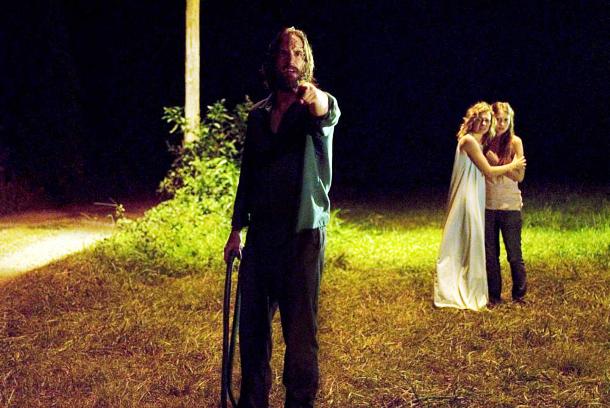 Yet despite the darkness of its “evening,” the film never loses sight of its “sun.” Grudging admiration comes gradually both for Choat (whose stubborn resolve to better himself for the sake of his family is undeniably praiseworthy) and Abner (whose eventual acceptance of his old age and deteriorating health is matched only by the painful, redeeming recognition of his own failings). The fingerprints of Flannery O’Connor (Teems’ favorite writer and one of his greatest inspirations) are everywhere. And while her beloved “moments of grace” may elude Choat and his family, they are clearly present in Abner’s acknowledgement of the damage caused by his stubborn selfishness.
When he first arrives in Ackerman’s Field, Abner is forced to contend not only with his deteriorating health, but with what he sees as the death and destruction of everything he holds dear. Growing old is a difficult cross for any of us to bear. But to lose his beloved farm—brimming with the memories of his beloved Ellen—to the very people he most despises? To see his way of life overturned by those who would do away with it altogether? That’s a difficult “last go ’round” to swallow. Abner’s hatred for the setting of the metaphorical Evening Sun is deep, virulent, and understandable.
His change of heart is understandable, as well. His acceptance of old age’s inevitable decline reveals him to be less selfish and less stubborn than his actions with Choat would suggest, and Choat has played no small part in that realization. Rather than breaking under the weight of his self-inflicted suffering (and under the guilt he feels over his indefensible actions towards his opponents) Abner learns from them. Late though it may be, he finally recognizes that peace comes not from getting what one wants, but from wanting what one gets. His age—the setting of his evening sun—is not within his control; learning to cope with it, however, is.
We humans have a long, venerable tradition of kicking against the goads. Thankfully, we can also learn to accept them before our sun goes down for the last time.

Attribution(s): All posters, publicity images, and film stills are the property of Image Entertainment and other respective production studios and distributors, and are intended for editorial use only.
Previous Post

May 26, 2011
The Illusion of Self-Sufficiency
Next Post

July 11, 2011 The Booth at the End and Our Faustian Selves
Browse Our Archives
Select a Category Art Baseball Faith Family Lenten Music Movies Music No Commentary Necessary Parked By the Jukebox Photography Politics Quodlibets Streaming Video Suggestions Summa Short Films Television The Man Behind the Booth Through a Lens, Darkly
Select a Month December 2015 November 2015 October 2015 September 2015 August 2015 July 2015 June 2015 May 2015 April 2015 March 2015 February 2015 January 2015 December 2014 November 2014 October 2014 September 2014 August 2014 July 2014 June 2014 May 2014 April 2014 March 2014 February 2014 January 2014 December 2013 November 2013 October 2013 September 2013 August 2013 July 2013 June 2013 May 2013 April 2013 March 2013 February 2013 January 2013 December 2012 November 2012 July 2012 April 2012 March 2012 February 2012 November 2011 August 2011 July 2011 June 2011 May 2011 April 2011 March 2011 February 2011 January 2011 December 2010 November 2010 October 2010
Follow Us!
TAKE THE
Religious Wisdom Quiz
What language was most of the Old Testament originally written in?
Select your answer to see how you score.
Hebrew Aramaic Greek Latin
Related posts from Summa This, Summa That




TRENDING AT PATHEOS Catholic

Rejecting Doom: Christian Hope And Human Action
Christianity is a religion of hope. We are to have hope and...

It’s What Comes From Within Which Matters
One of the most difficult things for us to understand is why...

Why I Choose the Eucharist Over the Sermon
Choose the Eucharist, Not the Sermon What are we supposed to get...

5 Design Elements Found in Spiritually Rooted Homes
Putting Spirituality Into Home Decor Our homes are more than our living...

Credo: A Story of God Told with the...
About 10 years ago, I began to imagine a personal "Credo" that...

The Anatomy of Divine Revelation in Catholic Thought
The claim that God has made Himself known to human beings is...
view all Catholic blogs
Ad-Free & Subscriber Log-In Subscription Support
- About Us
- 2026 Calendar
- Videos
- Podcasts
- Library of World Religions
- Faith In Media Tracker
- Advertise With Us
- Write for Us
- Privacy Policy
- Terms of Service
- Do Not Sell My Data
- Contact Us
- Radiant Digital
- Manage Newsletter Subscriptions
- Unsubscribe From Notifications
- Sitemap
Copyright 2008-2026, Patheos. All rights reserved.
Subscription Support Ad-Free & Subscriber Log-In
Follow Patheos