
BuddhistCatholicContemplativeEvangelicalGeneral ChristianHinduJewishLatter-day SaintMuslimNew VisionsProgressive Christian
Beliefs
- Buddhist
- Catholic
- Contemplative
- Evangelical
- General Christian
- Hindu
- Jewish
- Latter-day Saint
- More Voices
- Muslim
- New Visions
- Pagan
- Progressive Christian
Topics
- Religion News
- Food and Religion
- Sports and Religion
- Religious Art
- Religious Music and Entertainment
- Religious Events
- History and Religion
- Style and Religion
- Politics and Religion
- Women in Religion
- Recreation Outdoors and Religion
- Business Finance and Religion
- Careers Workplace and Religion
- Education and Religion
- Family Parenting and Religion
- Health Fitness and Religion
- Home and Religion
- Relationships and Religion
- Technology and Religion
- Travel and Religion
Columnists
- Buddhist Columnists
- Business Finance and Religion Columnists
- Careers Workplace and Religion Columnists
- Catholic Columnists
- Contemplative Columnists
- Education and Religion Columnists
- Evangelists Columnists
- Family Parenting and Religion Columnists
- General Christian Columnists
- Health Fitness and Religion Columnists
- Hindu Columnists
- History and Religion Columnists
- Home and Religion Columnists
- Jewish Columnists
- More Voices Columnists
- Latter Day Columnists
- Muslim Columnists
- New Visions Columnists
- Nonreligious Columnists
- Pagan Columnists
- Politics and Religion Columnists
- Progressive Columnists
- Recreation Outdoors and Religion Columnists
- Relationships and Religion Columnists
- Religion News Columnists
- Religious Art Columnists
- Religious Events Columnists
- Religious Music and Entertainment Columnists
- Sports and Religion Columnists
- Style and Religion Columnists
- Technology and Religion Columnists
- Travel and Religion Columnists
- Women in Religion Columnists
Resource Library
- 2026 Calendar
- Library of World Religions
- The 100 Most Holy Places on Earth
- Patheos Answers
- Podcasts
- Videos
- Faith Leaders Database
- Anglican Episcopalian
- Bahai
- Baptist
- Buddhism
- Christianity
- Confucianism
- Eastern Orthodoxy
- Hinduism
- Holiness and Pentecostal
- ISKCON
- Islam
- Judaism
- Lutheran
- Methodist
- The Church of Jesus Christ of Latter-day Saints
- New Age
- Paganism
- Presbytarian and Reformed
- Protestantism
- Religion Behind the Scenes
- Roman Catholic
- Scientology
- Shia Islam
- Sikhism
- Sufism
- Sunni Islam
- Taoism
- Zen
- See all religions
Research Tools
 Ad-Free & Subscriber Log-In Subscription Support
Ad-Free & Subscriber Log-In Subscription Support
Follow Patheos 

- Trending:
- Forgiveness
- |
- Marriage
- |
- Consciousness
- |
- Death Penalty
- |
- Election
- |
- Halloween
 Summa This, Summa That
- Home
- About
- Through a Lens, Darkly
- Streaming Video Suggestions (SVS)
- Summa Short Films (SSF)
- The Man Behind The Booth
- Home
- Catholic
- The Illusion of Self-Sufficiency
The Illusion of Self-Sufficiency
Last updated on: April 11, 2015 at 3:17 pm by Joseph Susanka
The Illusion of Self-Sufficiency 2015-04-11T15:17:40-06:00 Joseph Susanka
Patheos Explore the world's faith through different perspectives on religion and spirituality! Patheos has the views of the prevalent religions and spiritualities of the world.
![BLOGThe-Illusionist-Movie-Poster[1]](https://wp-media.patheos.com/blogs/sites/109/2011/05/BLOGThe-Illusionist-Movie-Poster1.jpg) Reinventing a cinematic icon is a daunting task.
Reinventing a cinematic icon is a daunting task.
Ask George Lucas, who has been struggling to rehabilitate one of the silver screen’s greatest villains for over thirty years. Or ask Stan Lee, whose Marvel characters are subjected to ill-conceived “reboots” on a nearly annual basis. Just don’t ask Sylvain Chomet, the insane genius behind The Triplets of Belleville, whose recent animated feature, The Illusionist (L’illusionniste), makes it abundantly clear that reinvention is not only possible, but worth the effort.
Based on a script from the legendary French director and comic Jacques Tati (whose cinematic alter-ego, Monsieur Hulot, appeared in a quartet of influential films during the 50’s, 60’s, and 70’s), The Illusionist tells the story of The Great Tatischeff, an aging stage magician struggling to survive in a world increasingly disinterested in his threadbare sleight-of-hand. Dismissed from his most recent Paris engagement as a result of profound audience indifference, he embarks for the British Isles in a last-ditch effort to resuscitate his moribund career.
Coming briefly to rest in a tiny village pub on a small Scottish island, he acquires an unexpected follower: Alice, a credulous young char-maid who is convinced that his trite conjurings are truly magical. Unfortunately, her fellow townsfolk are less enamored than she is, and Tatischeff is obliged to head for the bright city lights once again. Unbeknownst to him, Alice follows along behind, aglow at the opportunity to accompany such a bewitching celebrity.
Upon arriving in Edinburgh and discovering his unexpected disciple, the magician grudgingly takes the young Alice under his wing, but the results are far from pleasant. Juggling his dwindling illusionary career with the practical jobs he must pursue in an effort to pay the bills that result from his new devotee’s naïveté, Tatischeff is forced to confront his own social deficiencies.
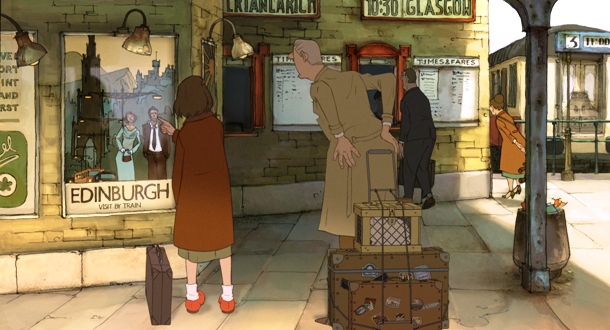
The similarities between Tati’s Hulot films—Les Vacances de Monsieur Hulot (1953), Mon Oncle (1958), Play Time (1967), and Trafic (1971)—and Chomet’s most recent work are many. The character of Tatischeff himself, in addition to the obvious patronymic reference, is strikingly similar to Hulot in look, feel, and behavior, even down to the bemused, slightly awkward way in which he moves through the crowded city streets. Like Tati’s films, The Illusionist is nearly entirely silent; dialogue, when it does occur, it is garbled and indistinct. For Chomet and Tati alike, inflection and mood are vastly more important to their storytelling than words. This lends an unusual—as in rare – Chaplinesque power to their images.
Chomet’s unusual artistic genius was stunningly showcased by The Triplets of Belleville, but his tendency towards bizarre surrealism often overwhelmed the message he sought to convey. The Illusionist, on the other hand, is a quieter, more mature work—no doubt the result of Tati’s subtly written characters and the mildly playful mood that permeates every frame of his films. While it retains much of the visual artistry of Triplets, the overall product is far more accessible.

Chomet’s offering, however, breathes exciting new life into a dauntingly legendary icon, and in an extraordinary way: The Illusionist is deeply faithful to Tati’s original characters and concepts, yet it advances the French master’s ideas into unexpected and intriguing places.
The single overriding theme permeating all of Tati’s work is the recognition of mankind’s endless struggle against the sterilizing, dehumanizing effects of modern technology. Monsieur Hulot is the perfect representation of that struggle: a bumbling, gentle soul who can never quite understand why everything grows so angular, so noisy, and so paradoxically inefficient when compared to the old, reliable objects of his past. Yet Hulot is always more bemused than angered by this clash of eras. His films are mildly-worded admonitions and nostalgic reminiscences rather than harsh diatribes against impending danger. One almost feels that Tati recognized the futility of resisting technology’s relentless march, and that his cinematic observations are more wistful than accusatory.
Chomet’s work reflects much of the awkwardness and melancholy embodied by Tati’s Hulot, clearly recognizing the corrosive effect of technology on the world of The Great Tatischeff. The growing disdain for the illusionist’s time-honored skills is tied closely to the advent of more modern amusements. Tatischeff’s departure from the small Scottish town, for example, is a direct result of the enormous electronic jukebox that appears at the local pub moments after his final performance. When the time comes for the illusionist to make the final fateful choice that will determine the course of his life for years to come, it is a decision thrust upon him by a society that grows more obsessed with shiny new gadgets than with the men who make them possible.
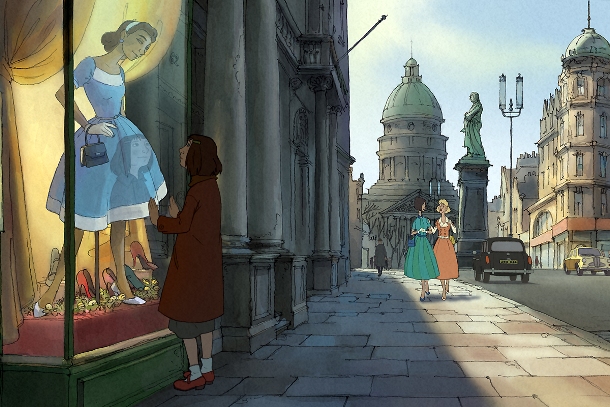
Yet The Illusionist also highlights an important question that Tati never adequately addressed in his films: Is it possible that only part of Hulot’s inability to interact with the modern world is the result of external technological influences?
At times, Hulot seems to struggle with the modern world because he wants to. He relishes being seen as awkward and out-of-place because so much less is required of him—an ennui driven in large measure by his inability or disinclination to interact with other humans. Hulot (and Tatischeff after him) is often childish rather than childlike; his simplicity a façade that masks an unbecoming reluctance to interact with others. Recognizing the dangers of modern technology is one thing; asking how one can best overcome those dangers is something else altogether.

Tati never allowed his Hulot to confront that question, but Chomet does.
The answer is profound in its simplicity: the dehumanizing effects of technology are defeated by renewing one’s commitment to human interaction. Young Alice, immature though she may be, gives Tatischeff a lens through which to view his own life, where he discovers the need to live through and for others. Technologically-advanced man does not grow increasingly self-sufficient; he grows less so. The notion that technology somehow lessens the need (or the opportunity) for human interaction is simply an excuse to retreat into one’s shell.
The Illusionist is more than simply the next artistic step along the Journey of Tati. It is the next moral step, as well. With the aid of Monsieur Hulot, we can identify the tendency of modern technology to isolate us from one another. Armed with that knowledge, we can set about Monsieur Tatischeff’s task of deepening and enriching the very relationships that lie at the core of our humanity.
If those human relationships are strong, no amount of technology will drive us apart.
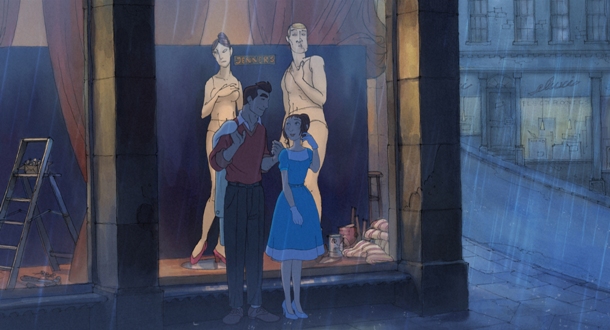 Attribution(s): All posters, publicity images, and stills are the property of Sony Pictures Classics and other respective production studios and distributors, and are intended for editorial use only.
Previous Post

April 21, 2011
Bruised for Our Iniquities: "The Passion of Joan of Arc"
Next Post

June 23, 2011 No Sunrises Without Sunsets
Browse Our Archives
Select a Category Art Baseball Faith Family Lenten Music Movies Music No Commentary Necessary Parked By the Jukebox Photography Politics Quodlibets Streaming Video Suggestions Summa Short Films Television The Man Behind the Booth Through a Lens, Darkly
Select a Month December 2015 November 2015 October 2015 September 2015 August 2015 July 2015 June 2015 May 2015 April 2015 March 2015 February 2015 January 2015 December 2014 November 2014 October 2014 September 2014 August 2014 July 2014 June 2014 May 2014 April 2014 March 2014 February 2014 January 2014 December 2013 November 2013 October 2013 September 2013 August 2013 July 2013 June 2013 May 2013 April 2013 March 2013 February 2013 January 2013 December 2012 November 2012 July 2012 April 2012 March 2012 February 2012 November 2011 August 2011 July 2011 June 2011 May 2011 April 2011 March 2011 February 2011 January 2011 December 2010 November 2010 October 2010
Follow Us!
TAKE THE
Religious Wisdom Quiz
How long did Persian empire rule?
Select your answer to see how you score.
200 years 150 years 180 years 250 years
Related posts from Summa This, Summa That




TRENDING AT PATHEOS Catholic

Rejecting Doom: Christian Hope And Human Action
Christianity is a religion of hope. We are to have hope and...

It’s What Comes From Within Which Matters
One of the most difficult things for us to understand is why...

Why I Choose the Eucharist Over the Sermon
Choose the Eucharist, Not the Sermon What are we supposed to get...

5 Design Elements Found in Spiritually Rooted Homes
Putting Spirituality Into Home Decor Our homes are more than our living...

Credo: A Story of God Told with the...
About 10 years ago, I began to imagine a personal "Credo" that...

The Anatomy of Divine Revelation in Catholic Thought
The claim that God has made Himself known to human beings is...
view all Catholic blogs
Ad-Free & Subscriber Log-In Subscription Support
- About Us
- 2026 Calendar
- Videos
- Podcasts
- Library of World Religions
- Faith In Media Tracker
- Advertise With Us
- Write for Us
- Privacy Policy
- Terms of Service
- Do Not Sell My Data
- Contact Us
- Radiant Digital
- Manage Newsletter Subscriptions
- Unsubscribe From Notifications
- Sitemap
Copyright 2008-2026, Patheos. All rights reserved.
Subscription Support Ad-Free & Subscriber Log-In
Follow Patheos