
BuddhistCatholicContemplativeEvangelicalGeneral ChristianHinduJewishLatter-day SaintMuslimNew VisionsProgressive Christian
Beliefs
- Buddhist
- Catholic
- Contemplative
- Evangelical
- General Christian
- Hindu
- Jewish
- Latter-day Saint
- More Voices
- Muslim
- New Visions
- Pagan
- Progressive Christian
Topics
- Religion News
- Food and Religion
- Sports and Religion
- Religious Art
- Religious Music and Entertainment
- Religious Events
- History and Religion
- Style and Religion
- Politics and Religion
- Women in Religion
- Recreation Outdoors and Religion
- Business Finance and Religion
- Careers Workplace and Religion
- Education and Religion
- Family Parenting and Religion
- Health Fitness and Religion
- Home and Religion
- Relationships and Religion
- Technology and Religion
- Travel and Religion
Columnists
- Buddhist Columnists
- Business Finance and Religion Columnists
- Careers Workplace and Religion Columnists
- Catholic Columnists
- Contemplative Columnists
- Education and Religion Columnists
- Evangelists Columnists
- Family Parenting and Religion Columnists
- General Christian Columnists
- Health Fitness and Religion Columnists
- Hindu Columnists
- History and Religion Columnists
- Home and Religion Columnists
- Jewish Columnists
- More Voices Columnists
- Latter Day Columnists
- Muslim Columnists
- New Visions Columnists
- Nonreligious Columnists
- Pagan Columnists
- Politics and Religion Columnists
- Progressive Columnists
- Recreation Outdoors and Religion Columnists
- Relationships and Religion Columnists
- Religion News Columnists
- Religious Art Columnists
- Religious Events Columnists
- Religious Music and Entertainment Columnists
- Sports and Religion Columnists
- Style and Religion Columnists
- Technology and Religion Columnists
- Travel and Religion Columnists
- Women in Religion Columnists
Resource Library
- 2026 Calendar
- Library of World Religions
- The 100 Most Holy Places on Earth
- Patheos Answers
- Podcasts
- Videos
- Faith Leaders Database
- Anglican Episcopalian
- Bahai
- Baptist
- Buddhism
- Christianity
- Confucianism
- Eastern Orthodoxy
- Hinduism
- Holiness and Pentecostal
- ISKCON
- Islam
- Judaism
- Lutheran
- Methodist
- The Church of Jesus Christ of Latter-day Saints
- New Age
- Paganism
- Presbytarian and Reformed
- Protestantism
- Religion Behind the Scenes
- Roman Catholic
- Scientology
- Shia Islam
- Sikhism
- Sufism
- Sunni Islam
- Taoism
- Zen
- See all religions
Research Tools
 Ad-Free & Subscriber Log-In Subscription Support
Ad-Free & Subscriber Log-In Subscription Support
Follow Patheos 

- Trending:
- Forgiveness
- |
- Marriage
- |
- Consciousness
- |
- Death Penalty
- |
- Election
- |
- Halloween
 Summa This, Summa That
- Home
- About
- Through a Lens, Darkly
- Streaming Video Suggestions (SVS)
- Summa Short Films (SSF)
- The Man Behind The Booth
- Home
- Catholic
- Standing Still at the Tipping Points
Standing Still at the Tipping Points
Last updated on: June 3, 2015 at 12:06 pm by Joseph Susanka
Standing Still at the Tipping Points 2015-06-03T12:06:22-06:00 Joseph Susanka
Patheos Explore the world's faith through different perspectives on religion and spirituality! Patheos has the views of the prevalent religions and spiritualities of the world.


Mr. Harley: Your impatience is quite understandable.
Klaatu: I’m impatient with stupidity. My people have learned to live without it.
Mr. Harley: I’m afraid my people haven’t. I’m very sorry… I wish it were otherwise.
It’s easy to see why writers and directors are attracted to remakes.
While studios like them for
the built-in audiences, low risk factor, and negligible pre-production, the “creatives” are often motivated by less economic considerations. They like the chance to introduce new generations of moviegoers to the works that most influenced them, and the chance to take the original ideas in new and unexpected directions is simply too tantalizing to ignore.
The 2008 remake of the legendary 1951 film The Day the Earth Stood Still is a perfect illustration of this dynamic—a film paying clear homage to its storied predecessor, while just as clearly exploring thematic material only hinted at in the original.
 The outline of the two films is essentially the same: Klaatu, a mysterious extraterrestrial being, arrives on Earth with a message of grave importance, only to be violently detained by a fearful American populace. Befriended by Helen Benson, an altruistic young widow quietly struggling to raise her son in an increasingly tumultuous world, Klaatu recognizes that there may be more to these humans than he and his fellow extraterrestrials assumed. With the help of Helen and her friends, the otherworldly messenger completes his mission and returns to the skies. His departure is a clarion call for humanity to repent of its wickedness and reform its ways.
The similarities between the original and remake run deeper, however. In both films, Klaatu remains one of cinema’s most striking Christological symbols. In the 1951 version of the film, Klaatu’s (Michael Rennie) assumed name—Carpenter—hints at the imagery to come, but the film’s finale leaves no doubt: Struck down by an angry and irrational mob, Klaatu is resurrected and ascends into the heavens with a warning that mankind must live well or suffer the consequences.
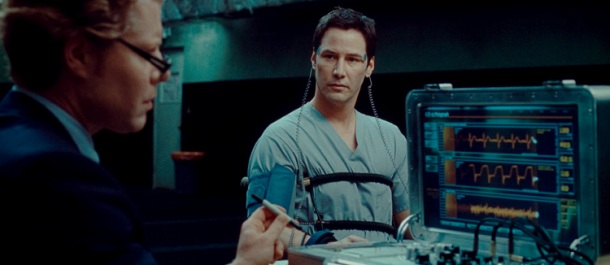
The “old wine in new wine skins” approach of the remake preserves the Christ-imagery but focuses more on Christ’s incarnation than His resurrection. Its Klaatu (Keanu Reeves) is not a humanoid life form of unknown origin but a mysterious being whose true appearance is too terrifying (or wonderful) for humans to bear. Described by the film’s creators as “an alien in a human body, not an alien with a human body,” the new Klaatu accepts his human form as a necessary part of carrying out his mission, eventually sacrificing that very form for the sake of all mankind.
While similarities between the two works are undeniable, differences abound. The 2008 retelling is action-and-effects-driven, depriving it of much of the introspection that remains the hallmark of the original. The decision to highlight mankind’s environmental transgressions rather than the war-mongering ones underscored in 1951—no doubt an effort to replicate the cultural relevancy of the original, while acknowledging the radically different era in which we now live—runs the risk of alienating those audience members less convinced of our proximity to Earth’s “tipping point.”
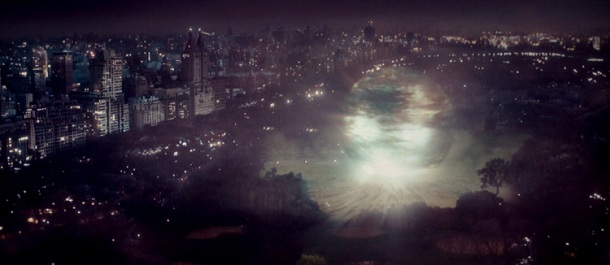
But perhaps the most dramatic difference between the two films is best demonstrated in how they portray that moment when the Earth finally does stand still. In the 1951 film, the event sounds a stern, Damoclean warning—a message to the world that Klaatu and his fellow extraterrestrials are benevolent-yet-unyielding dictators, that their power over the future of mankind is absolute, and that remorse and transformation are the only way to avoid the ultimate chastisement. In the recent remake, the stillness of the Earth is not a warning; it is a sign of a miraculously forestalled apocalypse. Rather than a threat of impending doom, it is a rainbow that signals the passing of a terrible deluge.
The new Klaatu is no prophet crying out for repentance; he is an avenging angel sent to mete out harsh justice on a race gone hopelessly astray. Yet he is also an angel transformed by his experiences and by the undeniable beauty and self-sacrifice he has seen on Earth. When he first arrives on the planet, his objective is nothing more than the purgation of its most dangerous scourge: humans. The compelling argument put forth by Helen’s scientist friend (“It is only on the brink that people find the will to change; only at the precipice that we evolve”) leaves him cold when it is first presented. But it is that very argument which returns to him during the film’s climactic moment—a revelatory scene in which he recognizes his own proclivity for the prideful destructiveness of which mankind stands accused, and yearns for that transformative self-sacrifice that is such a uniquely human trait.
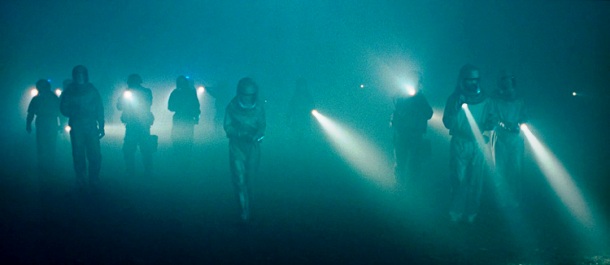
Klaatu’s transformation, a departure from the themes and ideas expressed in the original, highlights an essential element of the human dynamic. On the one hand, we have the 1951 film: a dark, silver-lined examination of the human tendency to violence and selfishness, a call to recognize that tendency, and a plea to transform ourselves through that recognition. It is a reminder that our fallen human nature is profoundly self-destructive, and that we must often use any means necessary—even fear of punishment—to overcome such dangerous inclinations.
The remake, on the other hand, while acknowledging the truth and eternal relevance of our brokenness, chooses to focus on an aspect of our lives that is just as true, and just as essential: our God-given capacity to rise above our fallen humanity. In a world where sin and suffering are omnipresent and all too real, we can ill-afford to lose sight of the beauty and redemptive power found in these “better angels of our nature.”

Attribution(s): Posters, publicity images, and stills for both films are the property of 20th Century Fox and other respective production studios and distributors, and are intended for editorial use only.
Previous Post

March 31, 2011
These Pricking Thorns of Guilt
Next Post
April 14, 2011 Love's Little Ways and "The Road Home"
Browse Our Archives
Select a Category Art Baseball Faith Family Lenten Music Movies Music No Commentary Necessary Parked By the Jukebox Photography Politics Quodlibets Streaming Video Suggestions Summa Short Films Television The Man Behind the Booth Through a Lens, Darkly
Select a Month December 2015 November 2015 October 2015 September 2015 August 2015 July 2015 June 2015 May 2015 April 2015 March 2015 February 2015 January 2015 December 2014 November 2014 October 2014 September 2014 August 2014 July 2014 June 2014 May 2014 April 2014 March 2014 February 2014 January 2014 December 2013 November 2013 October 2013 September 2013 August 2013 July 2013 June 2013 May 2013 April 2013 March 2013 February 2013 January 2013 December 2012 November 2012 July 2012 April 2012 March 2012 February 2012 November 2011 August 2011 July 2011 June 2011 May 2011 April 2011 March 2011 February 2011 January 2011 December 2010 November 2010 October 2010
Follow Us!
TAKE THE
Religious Wisdom Quiz
What was the primary worship language in the Bible?
Select your answer to see how you score.
Hebrew Aramaic Greek Latin
Related posts from Summa This, Summa That




TRENDING AT PATHEOS Catholic

Rejecting Doom: Christian Hope And Human Action
Christianity is a religion of hope. We are to have hope and...

It’s What Comes From Within Which Matters
One of the most difficult things for us to understand is why...

Why I Choose the Eucharist Over the Sermon
Choose the Eucharist, Not the Sermon What are we supposed to get...

5 Design Elements Found in Spiritually Rooted Homes
Putting Spirituality Into Home Decor Our homes are more than our living...

Credo: A Story of God Told with the...
About 10 years ago, I began to imagine a personal "Credo" that...

The Anatomy of Divine Revelation in Catholic Thought
The claim that God has made Himself known to human beings is...
view all Catholic blogs
Ad-Free & Subscriber Log-In Subscription Support
- About Us
- 2026 Calendar
- Videos
- Podcasts
- Library of World Religions
- Faith In Media Tracker
- Advertise With Us
- Write for Us
- Privacy Policy
- Terms of Service
- Do Not Sell My Data
- Contact Us
- Radiant Digital
- Manage Newsletter Subscriptions
- Unsubscribe From Notifications
- Sitemap
Copyright 2008-2026, Patheos. All rights reserved.
Subscription Support Ad-Free & Subscriber Log-In
Follow Patheos