
BuddhistCatholicContemplativeEvangelicalGeneral ChristianHinduJewishLatter-day SaintMuslimNew VisionsProgressive Christian
Beliefs
- Buddhist
- Catholic
- Contemplative
- Evangelical
- General Christian
- Hindu
- Jewish
- Latter-day Saint
- More Voices
- Muslim
- New Visions
- Pagan
- Progressive Christian
Topics
- Religion News
- Food and Religion
- Sports and Religion
- Religious Art
- Religious Music and Entertainment
- Religious Events
- History and Religion
- Style and Religion
- Politics and Religion
- Women in Religion
- Recreation Outdoors and Religion
- Business Finance and Religion
- Careers Workplace and Religion
- Education and Religion
- Family Parenting and Religion
- Health Fitness and Religion
- Home and Religion
- Relationships and Religion
- Technology and Religion
- Travel and Religion
Columnists
- Buddhist Columnists
- Business Finance and Religion Columnists
- Careers Workplace and Religion Columnists
- Catholic Columnists
- Contemplative Columnists
- Education and Religion Columnists
- Evangelists Columnists
- Family Parenting and Religion Columnists
- General Christian Columnists
- Health Fitness and Religion Columnists
- Hindu Columnists
- History and Religion Columnists
- Home and Religion Columnists
- Jewish Columnists
- More Voices Columnists
- Latter Day Columnists
- Muslim Columnists
- New Visions Columnists
- Nonreligious Columnists
- Pagan Columnists
- Politics and Religion Columnists
- Progressive Columnists
- Recreation Outdoors and Religion Columnists
- Relationships and Religion Columnists
- Religion News Columnists
- Religious Art Columnists
- Religious Events Columnists
- Religious Music and Entertainment Columnists
- Sports and Religion Columnists
- Style and Religion Columnists
- Technology and Religion Columnists
- Travel and Religion Columnists
- Women in Religion Columnists
Resource Library
- 2026 Calendar
- Library of World Religions
- The 100 Most Holy Places on Earth
- Patheos Answers
- Podcasts
- Videos
- Faith Leaders Database
- Anglican Episcopalian
- Bahai
- Baptist
- Buddhism
- Christianity
- Confucianism
- Eastern Orthodoxy
- Hinduism
- Holiness and Pentecostal
- ISKCON
- Islam
- Judaism
- Lutheran
- Methodist
- The Church of Jesus Christ of Latter-day Saints
- New Age
- Paganism
- Presbytarian and Reformed
- Protestantism
- Religion Behind the Scenes
- Roman Catholic
- Scientology
- Shia Islam
- Sikhism
- Sufism
- Sunni Islam
- Taoism
- Zen
- See all religions
Research Tools
 Ad-Free & Subscriber Log-In Subscription Support
Ad-Free & Subscriber Log-In Subscription Support
Follow Patheos 

- Trending:
- Forgiveness
- |
- Marriage
- |
- Consciousness
- |
- Death Penalty
- |
- Election
- |
- Halloween
 Summa This, Summa That
- Home
- About
- Through a Lens, Darkly
- Streaming Video Suggestions (SVS)
- Summa Short Films (SSF)
- The Man Behind The Booth
- Home
- Catholic
- These Pricking Thorns of Guilt
These Pricking Thorns of Guilt
Last updated on: March 3, 2015 at 11:54 am by Joseph Susanka
These Pricking Thorns of Guilt 2015-03-03T11:54:55-07:00 Joseph Susanka
Patheos Explore the world's faith through different perspectives on religion and spirituality! Patheos has the views of the prevalent religions and spiritualities of the world.
Can a mother forget her infant,
be without tenderness for the child of her womb?
Even should she forget,
I will never forget you. (Isa 49:15)

Death and Guilt have a great deal in common.
They both have the ability to bring life to a shuddering standstill. Both are terrifying consequences of our humanity. And both will have profound consequences for those we love, no matter how diligently we prepare for them.
I’ve Loved You So Long (Il y a longtemps que je t’aime), the acclaimed debut film from French novelist Philippe Claudel, delves deep into the issue of guilt, particularly the ways in which humans struggle to confront it, and the dramatic effect it has on those who suffer its pangs, and on their loved ones.
Juliette Fontaine (Kristen Scott Thomas), a soul-weary, middle-aged woman with a secret past, has just been released from the prison where she served a 15-year sentence for a heinous (and, initially, unknown) crime. The challenge of returning to normal life after such a long internment is a difficult one, and an offer of lodging and support from her younger sister, Léa (Elsa Zylberstein), is eagerly embraced by the counselors overseeing her rehabilitation. Juliette, whose apathetic demeanor earned her the name “The Absent One” from her former inmates, is unmoved by her sister’s generosity, but being without alternatives, she accepts.
 Léa, a professor of literature at Nancy-Université in Lorraine, welcomes Juliette into her home, which she shares with her husband, her father-in-law, and her two adopted Vietnamese daughters. Her efforts to rekindle their once-vibrant sisterly friendship are to no avail; Juliette’s facade is impenetrable. Undeterred by her sister’s implacable indifference, Léa struggles to revive Juliette’s joie de vivre, but finds the task made more difficult by the lack of shared memories between the two of them—an obstacle erected years ago when her parents chose to scrub every trace of her ignominious sister from Léa’s childhood.
 Forced to search for work in a world that barely interests her, Juliette is brought up sharply by the harsh realities of her past. Prospective employers, initially unconcerned by her previous troubles, are horrified and repulsed when they discover the true reason behind her lengthy prison stay. Léa’s husband, Luc, while trusting his wonderful wife completely, is far from comfortable with her sister; Juliette’s’ presence in his house and around his daughters is a constant source of concern. Her awkward job interviews, her weekly parole visits to the local police station, and her interaction with Léa’s university friends eventually coalesce into a distressingly coherent account of events, the details of her tragic and lamentable past drawn into sharper, more painful focus.
Gradually, Juliette’s exposure to the unstinting love of Léa and her children begins to wear down her aloofness; after a decade and a half spent steeping in a guilt-induced emotional hibernation, she begins to come alive once again. But this return to life and to reality is not without its price: stripped of her surest defense against the terrible crime she has committed, Juliette is forced to confront the demons of her past once again. Only this time, she is not alone; this time, her sister stands firmly beside her.
Claudel’s film, inspired by the tragic stories he encountered during his years teaching in the prisons of Nancy, is extraordinary both for the quiet, unhurried way in which it tells its heartbreaking story and for the power and excellence of its performances. Refreshing in its understatement and subtlety, the film still manages to be both clear and direct, and the examination of its protagonist and her failings are gentle, despite the unsettling truths upon which it must dwell. It mood is slow and subdued, befitting Juliette’s gradual rebirth, without losing sight of its destination.
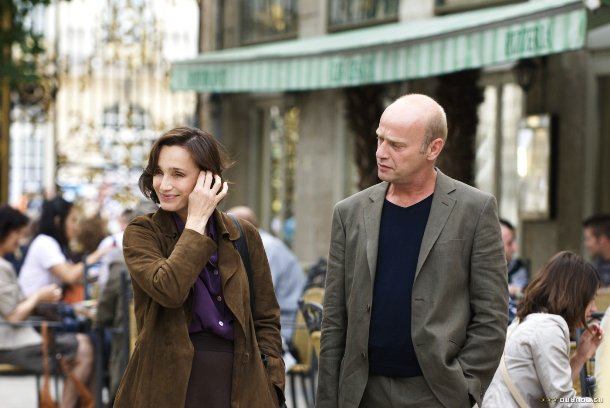 Zylberstein and Thomas are spectacular. The obvious discomfort and awkwardness they share while struggling to reacquaint themselves is extraordinary not only for its accuracy but for its courageous lack of theatrics. Léa and Juliette feel like real people battling with real problems. The rest of the cast is equally spectacular—a collection of performances so excellent and so suited to Claudel’s story that picking out Thomas and Zylberstein for particular mention seems almost unfair.
Yet the film is most extraordinary not for its mood or transcendent performances but for the vision of guilt, suffering, and redemption it offers to its audience.
Juliette’s crippling guilt and her fear of confronting it are things all humans can understand. The recognition of one’s failings and the self-accusation and self-condemnation it inspires, while necessary, are often profoundly painful. While our minds may understand the vital role guilt must play in any true transformation, our emotions are often far less willing to comply. It is small wonder that Juliette, living in a prison of her own devising, embraces her role as “The Absent One” rather that the pain and self-recrimination of her guilt.
 But it is Léa and her uncompromising, unquestioning love that gives Juliette the strength to move past her troubled history into a new and hope-filled future. Léa’s unstinting efforts on her sister’s behalf, her eager self-sacrifice and her passionate pleas for Juliette to divulge the painful and corrosive secrets that are eating her from within, are the catalysts for a real transformation.
Léa’s love is not contingent on her sister’s acknowledgment of the gravity of her crime, or even the sincerity of her repentance, and it is by means of the unconditional nature of this love that Juliette recognizes the one and fulfills the other. Without her, there would be no return to life for Juliette—no release from her debilitating guilt.
Blessedly, few of us will ever be called to confront remorse as grave as that which plagues Juliette. And yet, no matter how grievous our guilt may be, we have a far greater Friend than Léa to guide us through our repentance. Like Léa, God is uncompromising in His love; like hers, it is freely given and immeasurable, “pressed down, shaken together, running over” (Luke 6:38).
Just as Juliette was strengthened and guided by her sister’s love to transform her life, so too we are strengthened and guided to amend our own lives, not for fear of the justice of His punishments or as a means of escaping the guilty thorns which prick us, but because we have offend Him “Who art all good and deserving of all our love.”

Attribution(s): All posters, publicity images, and movie stills are the property of Sony Pictures Classics and other respective production studios and distributors, and are intended for editorial use only.
Previous Post

March 25, 2011
Familiarity, Complacency, and "The Man in the White Suit"
Next Post

April 7, 2011 Standing Still at the Tipping Points
Browse Our Archives
Select a Category Art Baseball Faith Family Lenten Music Movies Music No Commentary Necessary Parked By the Jukebox Photography Politics Quodlibets Streaming Video Suggestions Summa Short Films Television The Man Behind the Booth Through a Lens, Darkly
Select a Month December 2015 November 2015 October 2015 September 2015 August 2015 July 2015 June 2015 May 2015 April 2015 March 2015 February 2015 January 2015 December 2014 November 2014 October 2014 September 2014 August 2014 July 2014 June 2014 May 2014 April 2014 March 2014 February 2014 January 2014 December 2013 November 2013 October 2013 September 2013 August 2013 July 2013 June 2013 May 2013 April 2013 March 2013 February 2013 January 2013 December 2012 November 2012 July 2012 April 2012 March 2012 February 2012 November 2011 August 2011 July 2011 June 2011 May 2011 April 2011 March 2011 February 2011 January 2011 December 2010 November 2010 October 2010
Follow Us!
TAKE THE
Religious Wisdom Quiz
What does the name "Israel" mean?
Select your answer to see how you score.
He struggles with God Father of a multitude Mountain of God The Lord provides
Related posts from Summa This, Summa That




TRENDING AT PATHEOS Catholic

Rejecting Doom: Christian Hope And Human Action
Christianity is a religion of hope. We are to have hope and...

It’s What Comes From Within Which Matters
One of the most difficult things for us to understand is why...

Why I Choose the Eucharist Over the Sermon
Choose the Eucharist, Not the Sermon What are we supposed to get...

5 Design Elements Found in Spiritually Rooted Homes
Putting Spirituality Into Home Decor Our homes are more than our living...

Credo: A Story of God Told with the...
About 10 years ago, I began to imagine a personal "Credo" that...

The Anatomy of Divine Revelation in Catholic Thought
The claim that God has made Himself known to human beings is...
view all Catholic blogs
Ad-Free & Subscriber Log-In Subscription Support
- About Us
- 2026 Calendar
- Videos
- Podcasts
- Library of World Religions
- Faith In Media Tracker
- Advertise With Us
- Write for Us
- Privacy Policy
- Terms of Service
- Do Not Sell My Data
- Contact Us
- Radiant Digital
- Manage Newsletter Subscriptions
- Unsubscribe From Notifications
- Sitemap
Copyright 2008-2026, Patheos. All rights reserved.
Subscription Support Ad-Free & Subscriber Log-In
Follow Patheos