
BuddhistCatholicContemplativeEvangelicalGeneral ChristianHinduJewishLatter-day SaintMuslimNew VisionsProgressive Christian
Beliefs
- Buddhist
- Catholic
- Contemplative
- Evangelical
- General Christian
- Hindu
- Jewish
- Latter-day Saint
- More Voices
- Muslim
- New Visions
- Pagan
- Progressive Christian
Topics
- Religion News
- Food and Religion
- Sports and Religion
- Religious Art
- Religious Music and Entertainment
- Religious Events
- History and Religion
- Style and Religion
- Politics and Religion
- Women in Religion
- Recreation Outdoors and Religion
- Business Finance and Religion
- Careers Workplace and Religion
- Education and Religion
- Family Parenting and Religion
- Health Fitness and Religion
- Home and Religion
- Relationships and Religion
- Technology and Religion
- Travel and Religion
Columnists
- Buddhist Columnists
- Business Finance and Religion Columnists
- Careers Workplace and Religion Columnists
- Catholic Columnists
- Contemplative Columnists
- Education and Religion Columnists
- Evangelists Columnists
- Family Parenting and Religion Columnists
- General Christian Columnists
- Health Fitness and Religion Columnists
- Hindu Columnists
- History and Religion Columnists
- Home and Religion Columnists
- Jewish Columnists
- More Voices Columnists
- Latter Day Columnists
- Muslim Columnists
- New Visions Columnists
- Nonreligious Columnists
- Pagan Columnists
- Politics and Religion Columnists
- Progressive Columnists
- Recreation Outdoors and Religion Columnists
- Relationships and Religion Columnists
- Religion News Columnists
- Religious Art Columnists
- Religious Events Columnists
- Religious Music and Entertainment Columnists
- Sports and Religion Columnists
- Style and Religion Columnists
- Technology and Religion Columnists
- Travel and Religion Columnists
- Women in Religion Columnists
Resource Library
- 2026 Calendar
- Library of World Religions
- The 100 Most Holy Places on Earth
- Patheos Answers
- Podcasts
- Videos
- Faith Leaders Database
- Anglican Episcopalian
- Bahai
- Baptist
- Buddhism
- Christianity
- Confucianism
- Eastern Orthodoxy
- Hinduism
- Holiness and Pentecostal
- ISKCON
- Islam
- Judaism
- Lutheran
- Methodist
- The Church of Jesus Christ of Latter-day Saints
- New Age
- Paganism
- Presbytarian and Reformed
- Protestantism
- Religion Behind the Scenes
- Roman Catholic
- Scientology
- Shia Islam
- Sikhism
- Sufism
- Sunni Islam
- Taoism
- Zen
- See all religions
Research Tools
 Ad-Free & Subscriber Log-In Subscription Support
Ad-Free & Subscriber Log-In Subscription Support
Follow Patheos 

- Trending:
- Forgiveness
- |
- Marriage
- |
- Consciousness
- |
- Death Penalty
- |
- Election
- |
- Halloween
 Summa This, Summa That
- Home
- About
- Through a Lens, Darkly
- Streaming Video Suggestions (SVS)
- Summa Short Films (SSF)
- The Man Behind The Booth
- Home
- Catholic
- Familiarity, Complacency, and “The Man in the White Suit”
Familiarity, Complacency, and “The Man in the White Suit”
Last updated on: March 1, 2015 at 4:22 pm by Joseph Susanka
Familiarity, Complacency, and “The Man in the White Suit” 2015-03-01T16:22:06-07:00 Joseph Susanka
Patheos Explore the world's faith through different perspectives on religion and spirituality! Patheos has the views of the prevalent religions and spiritualities of the world.
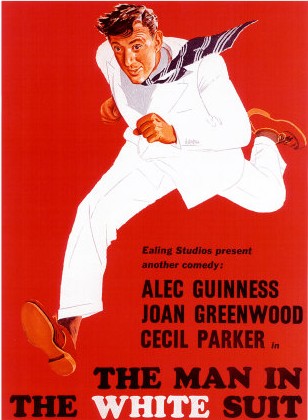 To misquote the old Aesopian saw, familiarity breeds complacency—a truth nowhere more painfully illustrated than in the classic Ealing Studios film, The Man in the White Suit.
Set in the textile mills and factories of early 20th-century England, the film tells the story of Sidney Stratton (Alec Guinness), an eccentric, secretive young scientist obsessed with creating the perfect artificial fiber: a synthetic polymer that will never wear out or deteriorate, rendering all other textiles obsolete. His brilliance is unquestioned; as he anxiously reminds nearly anyone who will listen, he once had “a first and fellowship at Cambridge.” But his willingness to go to any lengths to further his research, including surreptitiously acquiring and spending massive amounts of his employers’ funds, has made him nearly unemployable in his field.
Dismissed from his umpteenth job as a result of his financial shenanigans, Sidney remains convinced that a solution is near. Impatient to continue his work, he accepts a janitorial position at the Birnley Factory, one of the industry’s finest. Once there, he finds himself unexpectedly befriended by several of the local laborers, who embrace his eccentricities with gruff, kind-hearted joshing and bestow upon him their highest honor: an invitation to participate in their never-ending labor disputes with the factory owner. Further emboldened by a change encounter with the owner’s daughter, Daphne (Joan Greenwood), Sidney insinuates his way into the Birnley laboratory and finally (shockingly) conducts a successful experiment. As promised, the resulting fiber is indestructible, impervious to dirt, and dazzlingly, unimaginably white.

Sidney’s boss, Alan Birnley himself, is elated at his young Wunderkind’s success, eagerly anticipating the massive financial windfall that awaits him as a result of the groundbreaking research. Other factory owners in the area, however, are far less enthused. Recognizing the unique polymer as a threat to their continued existence, they band together in an effort to suppress the breakthrough.
Despite Daphne’s best efforts to convince him of the nobility of his vision, the doubts cast by his fellow workers are crippling. From there, the story weaves its way to its final, unsurprising conclusion: When Labor and Capital are allied against you, Idealism is of small comfort.
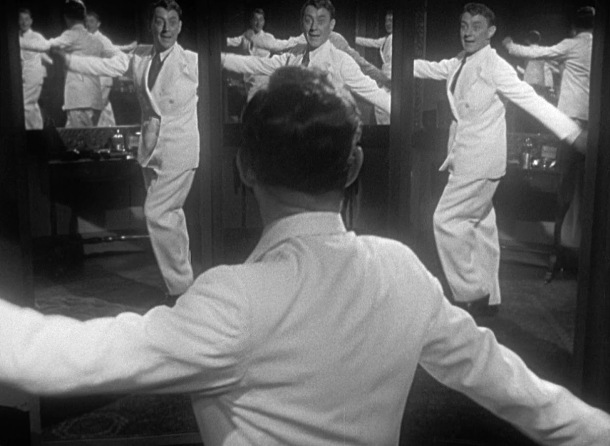 The four films Guinness made under the Ealing Studio banner are some of the finest of his career. But what sets The Man in the White Suit apart from the others is its stark, almost brutal tone. Billed as a “satirical comedy,” Suitcertainly has its moments of levity. Yet despite its self-proclaimed hilarity, it is not a comedy; it is a tragedy. The three others—The Ladykillers, Kind Hearts and Coronets, and The Lavender Hill Mob—all feature criminals who are hilariously (and justly) punished for their transgressions. But The Man in the White Suit is punished for his virtues, not for his vices, preyed upon by the very friends he most expected to support him. While Guinness is as infectiously droll and charming as the material will allow, his eventual downfall at the hands of the suddenly-hostile factory workers is a bitter pill to swallow.
The bizarre exploits and cacophonous inventions that populate the first act are both engaging and genuinely humorous. By the time the finale arrives, however, the film has tackled much larger issues than one might have expected from a comedy—a stinging sociopolitical critique that pits the “advancements” of the industrial age against the hypothetical (yet believable) improvement of an entire class, highlighting the peculiar way in which humanity reacts to progress.
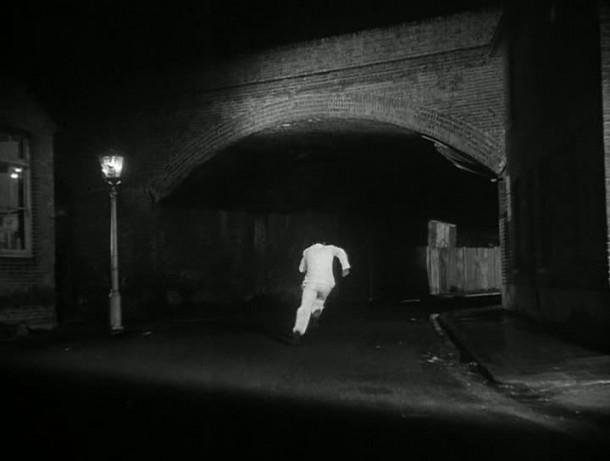
When Sidney first dons his unnaturally luminous suit, Daphne laughingly calls him “a knight in shining armor,” a description that is more accurate than either of them realize. In the finest chivalric tradition, the young scientist is driven by a desire to aid others, his soul as white and untainted as the material he wears. When the very friends he is struggling to help reject his efforts, he is bewildered and lost; for the first time, his drive fails him, damaged by the very people who gave it life. To be rejected by the capitalists and factory owners came as no surprise; his goals and ideals were always in conflict with theirs. But to have his work rejected by those it would benefit most? To have his heroic vision received as nothing more than an idle tilting at windmills? That was a cruel (if not entirely unexpected) blow.
 Familiarity breeds complacency.
The intended recipients of Sidney’s largess are comfortable with their way of life and deathly afraid of anything that may change it. They fear losing their livelihoods (arduous and soul-crushing though they be), clinging instead to their ordinary, inexplicably comfortable routines, even in the face of a true godsend. Our hero is defeated not by Labor or by Capital; he is defeated by the profoundly human tendency toward inertia. A life spent slaving away in a textile factory might not seem like much of a life, but at least it doesn’t require one to make difficult decisions, or strike out into an unknown and challenging new world.
Nowhere does this tendency for complacency show up as regularly (or as dangerously) as in the spiritual life. All too often, we grow habituated to our little routines, soothing ourselves with the easy, comforting rhymes of oft-repeated prayers. And while familiarity itself can be a blessing, we must be alert to the very real danger of stagnation. We need something to shake us out of such familiar territory from time to time—something (or Someone) to remind us that we are far from finished products, and that it is only by continually pushing ourselves that we can grow.
But isn’t that exactly why we have Lent?

Attribution(s): All posters, publicity images, and movie stills are the property of Universal Pictures and other respective production studios and distributors, and are intended for editorial use only.
Previous Post

March 18, 2011
It Takes a Town to "Get Low"
Next Post

March 31, 2011 These Pricking Thorns of Guilt
Browse Our Archives
Select a Category Art Baseball Faith Family Lenten Music Movies Music No Commentary Necessary Parked By the Jukebox Photography Politics Quodlibets Streaming Video Suggestions Summa Short Films Television The Man Behind the Booth Through a Lens, Darkly
Select a Month December 2015 November 2015 October 2015 September 2015 August 2015 July 2015 June 2015 May 2015 April 2015 March 2015 February 2015 January 2015 December 2014 November 2014 October 2014 September 2014 August 2014 July 2014 June 2014 May 2014 April 2014 March 2014 February 2014 January 2014 December 2013 November 2013 October 2013 September 2013 August 2013 July 2013 June 2013 May 2013 April 2013 March 2013 February 2013 January 2013 December 2012 November 2012 July 2012 April 2012 March 2012 February 2012 November 2011 August 2011 July 2011 June 2011 May 2011 April 2011 March 2011 February 2011 January 2011 December 2010 November 2010 October 2010
Follow Us!
TAKE THE
Religious Wisdom Quiz
Who helped Jesus carry His cross?
Select your answer to see how you score.
Peter Judas John Simon of Cyrene
Related posts from Summa This, Summa That




TRENDING AT PATHEOS Catholic

Rejecting Doom: Christian Hope And Human Action
Christianity is a religion of hope. We are to have hope and...

It’s What Comes From Within Which Matters
One of the most difficult things for us to understand is why...

Why I Choose the Eucharist Over the Sermon
Choose the Eucharist, Not the Sermon What are we supposed to get...

5 Design Elements Found in Spiritually Rooted Homes
Putting Spirituality Into Home Decor Our homes are more than our living...

Credo: A Story of God Told with the...
About 10 years ago, I began to imagine a personal "Credo" that...

The Anatomy of Divine Revelation in Catholic Thought
The claim that God has made Himself known to human beings is...
view all Catholic blogs
Ad-Free & Subscriber Log-In Subscription Support
- About Us
- 2026 Calendar
- Videos
- Podcasts
- Library of World Religions
- Faith In Media Tracker
- Advertise With Us
- Write for Us
- Privacy Policy
- Terms of Service
- Do Not Sell My Data
- Contact Us
- Radiant Digital
- Manage Newsletter Subscriptions
- Unsubscribe From Notifications
- Sitemap
Copyright 2008-2026, Patheos. All rights reserved.
Subscription Support Ad-Free & Subscriber Log-In
Follow Patheos