
BuddhistCatholicContemplativeEvangelicalGeneral ChristianHinduJewishLatter-day SaintMuslimNew VisionsProgressive Christian
Beliefs
- Buddhist
- Catholic
- Contemplative
- Evangelical
- General Christian
- Hindu
- Jewish
- Latter-day Saint
- More Voices
- Muslim
- New Visions
- Pagan
- Progressive Christian
Topics
- Religion News
- Food and Religion
- Sports and Religion
- Religious Art
- Religious Music and Entertainment
- Religious Events
- History and Religion
- Style and Religion
- Politics and Religion
- Women in Religion
- Recreation Outdoors and Religion
- Business Finance and Religion
- Careers Workplace and Religion
- Education and Religion
- Family Parenting and Religion
- Health Fitness and Religion
- Home and Religion
- Relationships and Religion
- Technology and Religion
- Travel and Religion
Columnists
- Buddhist Columnists
- Business Finance and Religion Columnists
- Careers Workplace and Religion Columnists
- Catholic Columnists
- Contemplative Columnists
- Education and Religion Columnists
- Evangelists Columnists
- Family Parenting and Religion Columnists
- General Christian Columnists
- Health Fitness and Religion Columnists
- Hindu Columnists
- History and Religion Columnists
- Home and Religion Columnists
- Jewish Columnists
- More Voices Columnists
- Latter Day Columnists
- Muslim Columnists
- New Visions Columnists
- Nonreligious Columnists
- Pagan Columnists
- Politics and Religion Columnists
- Progressive Columnists
- Recreation Outdoors and Religion Columnists
- Relationships and Religion Columnists
- Religion News Columnists
- Religious Art Columnists
- Religious Events Columnists
- Religious Music and Entertainment Columnists
- Sports and Religion Columnists
- Style and Religion Columnists
- Technology and Religion Columnists
- Travel and Religion Columnists
- Women in Religion Columnists
Resource Library
- 2026 Calendar
- Library of World Religions
- The 100 Most Holy Places on Earth
- Patheos Answers
- Podcasts
- Videos
- Faith Leaders Database
- Anglican Episcopalian
- Bahai
- Baptist
- Buddhism
- Christianity
- Confucianism
- Eastern Orthodoxy
- Hinduism
- Holiness and Pentecostal
- ISKCON
- Islam
- Judaism
- Lutheran
- Methodist
- The Church of Jesus Christ of Latter-day Saints
- New Age
- Paganism
- Presbytarian and Reformed
- Protestantism
- Religion Behind the Scenes
- Roman Catholic
- Scientology
- Shia Islam
- Sikhism
- Sufism
- Sunni Islam
- Taoism
- Zen
- See all religions
Research Tools
 Ad-Free & Subscriber Log-In Subscription Support
Ad-Free & Subscriber Log-In Subscription Support
Follow Patheos 

- Trending:
- Forgiveness
- |
- Marriage
- |
- Consciousness
- |
- Death Penalty
- |
- Election
- |
- Halloween
 Summa This, Summa That
- Home
- About
- Through a Lens, Darkly
- Streaming Video Suggestions (SVS)
- Summa Short Films (SSF)
- The Man Behind The Booth
- Home
- Catholic
- Film Noir Loves a Tell-Tale Heart
Film Noir Loves a Tell-Tale Heart
Last updated on: January 20, 2015 at 6:14 pm by Joseph Susanka
Film Noir Loves a Tell-Tale Heart 2015-01-20T18:14:40-07:00 Joseph Susanka
Patheos Explore the world's faith through different perspectives on religion and spirituality! Patheos has the views of the prevalent religions and spiritualities of the world.
He didn’t get away with it, did he? He’ll go to the chair, as he should.
A few dates are all it takes to realize that Miss Film Noir, despite her reputation as one of the most beloved and oft-studied genres in cinematic history, is one strange, frighteningly bipolar dame.
The deadly molls, hard-bitten gumshoes, and rain-drenched streets popularized by Dashiell Hammet, Raymond Chandler, and their compatriots (and brought to glorious cinematic life by directors like Billy Wilder, Otto Preminger, and John Huston) conjure up an era of inelegant theatrics and romanticized cynicism that has become difficult for the modern viewer to stomach. Their stories are yellowing snapshots of a past where improbably sarcastic characters battled for their souls against the backdrop of an eternal, obsolete night.
Yet despite the over-dark settings, archaic slang, and unlikely stereotypes that populate most noir film, they contain a persistent and morally relevant timelessness. To this day, no genre deals as clearly or as deeply with the never-ending conflict between a man and his temptations, or with the corrosive, devouring effects of sin. And what could possibly be more timely and relevant than that?
Scarlet Street, from legendary director Fritz Lang, is a lesser-known member of the noir family—an odd fact given that it is one of only a handful of films in the public domain—but one well-deserving of our attention for the way it makes use of typical noir characteristics, and then subverts them.
Edward G. Robinson, a classic-film icon best remembered for his breakout role as Rico in Little Caesar, is Christopher Cross: bland cashier by day; failed painter and hen-pecked husband by night. Fresh off the depressing celebration of his insignificant 25-year career at a clothing retailer in New York City, he happens across a young woman (Joan Bennett) being viciously attacked by a street thug, and rushes to her defense.
Oblivious to the unmistakable signs of her unsavory occupation, Chris is smitten with the bright young thing—Kitty March is the first ray of life and hope that has fallen on his mundane existence for many years. Reluctant to reveal his lack of accomplishments to his new-found acquaintance, Cross allows her to assume that he is a wealthy, unattached artist. She, in turn, conceals a secret of her own: the violent young man from whom she was rescued is actually her boyfriend, Johnny, who has been schooling her in underhanded dealings since they first met.
Recognizing the potential in Cross’ growing infatuation, and goaded on by Johnny’s desire for an “easy mark,” Kitty ensnares the hapless cashier with a mesmerizing mixture of brashness, beauty, and charm. But Johnny’s insistence forces Kitty to speed up her plans of entrapment: Soon, Cross is embezzling his employer’s funds, crafting a rift in his already-fragile marriage, and watching Kitty make a fine living posing as the “artist” behind his previously-unknown, but now surprisingly successful paintings.

All this, Cross suffers gladly for the sake of his new-found love, but when Johnny enters the picture and threatens to reveal the shallowness of Kitty’s devotions, things take an ugly turn. In a drunken, jealous rage, Cross confronts Kitty, only to learn that she finds him as useless and unappealing as he has always believed himself to be. Stung by her rejection, he lashes out violently, and Kitty pays the ultimate price.
Appalled at his uncharacteristic action, Cross resolves to punish the man he holds responsible for destroying something infinitely more precious than Kitty’s life—her innocence. Assisted by a series of strangely fortuitous circumstances, he frames the hapless Johnny for his crime, and escapes unscathed.
Or does he?
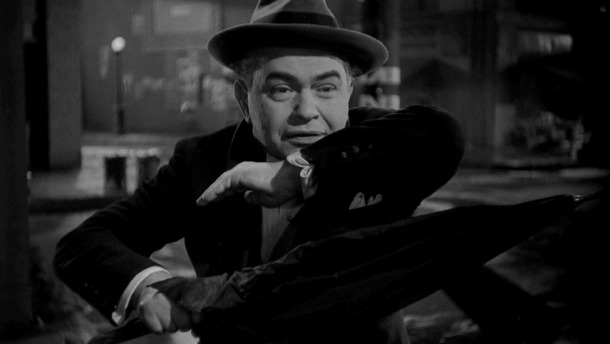 The film departs in a number of ways from the well-established noir path, particularly in its main characters. Cross’ age and lot in life are much less glamorous than that of most noir protagonists; he is not simply ordinary, he’s insignificant. And Kitty is an equally atypical noir woman, lacking much of the mystery and allure that makes her fellow femme fatales so deadly. But the most striking instance of Lang’s departure from the genre’s traditions is in Scarlet Street’s finale.
Film scholars have long remarked on the unexpectedly straight-forward and morally upright endings of many noir films, speculating that the Hays Code’s insistence on the victory of virtue over cynicism may have been to blame—an accusation which, if true, produced some of the most iconic endings in cinematic history: Walter Neff speaking his halting confession into a detective’s tape recorder; Joe Gillis floating face-down in Norma Desmond’s swimming pool; Harry Lyme reaching up from the Vienna sewers with his last breath.
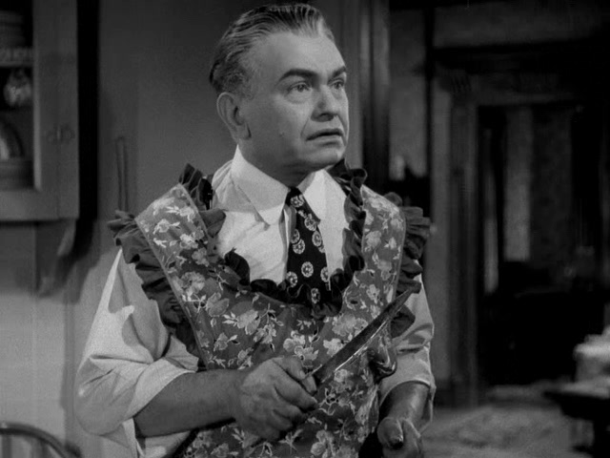 In Scarlet Street, however, such a memorable moment of justice and moral triumph is conspicuously absent. Lang takes great pains to convince his audience that there is no possible way that Cross will ever suffer publically for his crimes, despite his eventual efforts to admit to them. So thoroughly did Cross he succeed in convincing the police of his innocence (and sending Johnny to the chair) that his attempts to square the scales of justice fall on deaf ears.
The film’s final shot, with Cross shuffling woefully past the art gallery where his final masterpiece has just been sold, gives audiences a glimpse of his future—a future haunted by the clamorous imputations of his victims. He, like so many of us, has managed to avoid the public consequences of his sins, but he will spend the rest of his days confronting the one jury he cannot possibly escape: himself.
While the bleakness of the film’s finale is undeniable, it leaves behind a glimmer of hope, challenging us to move beyond Cross’ guilt-ridden desperation, to focus upon the possibility of his redemption.
Despite his unconscionable actions, Christopher Cross is a good man; as a good man, his future will be ever-clouded by the memory of the violence he has committed. Yet this memory may prove to be his saving grace, for it is an undeniable sign his conscience is working on him, reminding him at every turn of his heinous crime. In the daily struggle to appease the accusations of his conscience, he may finally work out his salvation, purified by the justice of his self-recriminations, and sanctified through the injustice of escaping unpunished in the face of such overwhelming guilt.
Cross is doomed (and blessed) to live out his name, carrying the cross of his transgressions until the end of his earthly days. As one of the film’s characters tells Cross, “Nobody gets away with murder. No one escapes punishment.”
That is true for all sin, and thank God for it. But let us be even more grateful for the role we ourselves are allowed to play in the drama of redemption, and the conscience plays such an active part in the working-out of our own salvation. God, in His infinite Wisdom, makes use of our own self-knowledge and guilt to prepare us for His grace, saving us through the poundings of our tell-tale hearts.
And Miss Noir is the surprising dame who can still be bothered to remind us of it.

Attribution(s): All posters, publicity images, and movie stills are the property of Universal Pictures and other respective production studios and distributors, and are intended for editorial use only.
Previous Post

February 18, 2011
The Road Less Traveled: Reconsidering the Easy Life
Next Post
March 4, 2011 Me, Myself, & GERTY
Browse Our Archives
Select a Category Art Baseball Faith Family Lenten Music Movies Music No Commentary Necessary Parked By the Jukebox Photography Politics Quodlibets Streaming Video Suggestions Summa Short Films Television The Man Behind the Booth Through a Lens, Darkly
Select a Month December 2015 November 2015 October 2015 September 2015 August 2015 July 2015 June 2015 May 2015 April 2015 March 2015 February 2015 January 2015 December 2014 November 2014 October 2014 September 2014 August 2014 July 2014 June 2014 May 2014 April 2014 March 2014 February 2014 January 2014 December 2013 November 2013 October 2013 September 2013 August 2013 July 2013 June 2013 May 2013 April 2013 March 2013 February 2013 January 2013 December 2012 November 2012 July 2012 April 2012 March 2012 February 2012 November 2011 August 2011 July 2011 June 2011 May 2011 April 2011 March 2011 February 2011 January 2011 December 2010 November 2010 October 2010
Follow Us!
TAKE THE
Religious Wisdom Quiz
This chapter in Psalms declares the blessed man who meditates on God's law day and night is like a tree planted by streams. What is its number?
Select your answer to see how you score.
Psalm 1 Psalm 23 Psalm 119 Psalm 100
Related posts from Summa This, Summa That




TRENDING AT PATHEOS Catholic

Rejecting Doom: Christian Hope And Human Action
Christianity is a religion of hope. We are to have hope and...

It’s What Comes From Within Which Matters
One of the most difficult things for us to understand is why...

Why I Choose the Eucharist Over the Sermon
Choose the Eucharist, Not the Sermon What are we supposed to get...

5 Design Elements Found in Spiritually Rooted Homes
Putting Spirituality Into Home Decor Our homes are more than our living...

Credo: A Story of God Told with the...
About 10 years ago, I began to imagine a personal "Credo" that...

The Anatomy of Divine Revelation in Catholic Thought
The claim that God has made Himself known to human beings is...
view all Catholic blogs
Ad-Free & Subscriber Log-In Subscription Support
- About Us
- 2026 Calendar
- Videos
- Podcasts
- Library of World Religions
- Faith In Media Tracker
- Advertise With Us
- Write for Us
- Privacy Policy
- Terms of Service
- Do Not Sell My Data
- Contact Us
- Radiant Digital
- Manage Newsletter Subscriptions
- Unsubscribe From Notifications
- Sitemap
Copyright 2008-2026, Patheos. All rights reserved.
Subscription Support Ad-Free & Subscriber Log-In
Follow Patheos