
BuddhistCatholicContemplativeEvangelicalGeneral ChristianHinduJewishLatter-day SaintMuslimNew VisionsProgressive Christian
Beliefs
- Buddhist
- Catholic
- Contemplative
- Evangelical
- General Christian
- Hindu
- Jewish
- Latter-day Saint
- More Voices
- Muslim
- New Visions
- Pagan
- Progressive Christian
Topics
- Religion News
- Food and Religion
- Sports and Religion
- Religious Art
- Religious Music and Entertainment
- Religious Events
- History and Religion
- Style and Religion
- Politics and Religion
- Women in Religion
- Recreation Outdoors and Religion
- Business Finance and Religion
- Careers Workplace and Religion
- Education and Religion
- Family Parenting and Religion
- Health Fitness and Religion
- Home and Religion
- Relationships and Religion
- Technology and Religion
- Travel and Religion
Columnists
- Buddhist Columnists
- Business Finance and Religion Columnists
- Careers Workplace and Religion Columnists
- Catholic Columnists
- Contemplative Columnists
- Education and Religion Columnists
- Evangelists Columnists
- Family Parenting and Religion Columnists
- General Christian Columnists
- Health Fitness and Religion Columnists
- Hindu Columnists
- History and Religion Columnists
- Home and Religion Columnists
- Jewish Columnists
- More Voices Columnists
- Latter Day Columnists
- Muslim Columnists
- New Visions Columnists
- Nonreligious Columnists
- Pagan Columnists
- Politics and Religion Columnists
- Progressive Columnists
- Recreation Outdoors and Religion Columnists
- Relationships and Religion Columnists
- Religion News Columnists
- Religious Art Columnists
- Religious Events Columnists
- Religious Music and Entertainment Columnists
- Sports and Religion Columnists
- Style and Religion Columnists
- Technology and Religion Columnists
- Travel and Religion Columnists
- Women in Religion Columnists
Resource Library
- 2026 Calendar
- Library of World Religions
- The 100 Most Holy Places on Earth
- Patheos Answers
- Podcasts
- Videos
- Faith Leaders Database
- Anglican Episcopalian
- Bahai
- Baptist
- Buddhism
- Christianity
- Confucianism
- Eastern Orthodoxy
- Hinduism
- Holiness and Pentecostal
- ISKCON
- Islam
- Judaism
- Lutheran
- Methodist
- The Church of Jesus Christ of Latter-day Saints
- New Age
- Paganism
- Presbytarian and Reformed
- Protestantism
- Religion Behind the Scenes
- Roman Catholic
- Scientology
- Shia Islam
- Sikhism
- Sufism
- Sunni Islam
- Taoism
- Zen
- See all religions
Research Tools
 Ad-Free & Subscriber Log-In Subscription Support
Ad-Free & Subscriber Log-In Subscription Support
Follow Patheos 

- Trending:
- Forgiveness
- |
- Marriage
- |
- Consciousness
- |
- Death Penalty
- |
- Election
- |
- Halloween
 Summa This, Summa That
- Home
- About
- Through a Lens, Darkly
- Streaming Video Suggestions (SVS)
- Summa Short Films (SSF)
- The Man Behind The Booth
- Home
- Catholic
- To Be Pickering in a Henry Higgins World
To Be Pickering in a Henry Higgins World
Last updated on: January 7, 2015 at 12:57 pm by Joseph Susanka
To Be Pickering in a Henry Higgins World 2015-01-07T12:57:28-07:00 Joseph Susanka
Patheos Explore the world's faith through different perspectives on religion and spirituality! Patheos has the views of the prevalent religions and spiritualities of the world.
When George Bernard Shaw first learned of the creative licenses taken in an effort to make the ending of his play Pygmalion more marketable, he was outraged. Confronted by Sir Herbert Beerbohm Tree’s claim that “My ending makes money, you ought to be grateful,” he responded (with his trademark sharpness of wit and tongue): “Your ending is damnable; you ought to be shot.”
Two years later, still stinging from the change, he penned a 5,000-word essay—“Sequel: What Happened Afterwards”—in which he emphatically (and bitingly) defended his original ending. In it, he argued that any version that returns the transformed Eliza Doolittle to Professor Henry Higgins’ home is undermining the very core of the play’s message, tossing away the power and relevance of his modernized myth for the sake of a cheapened and shallow emotional payoff.
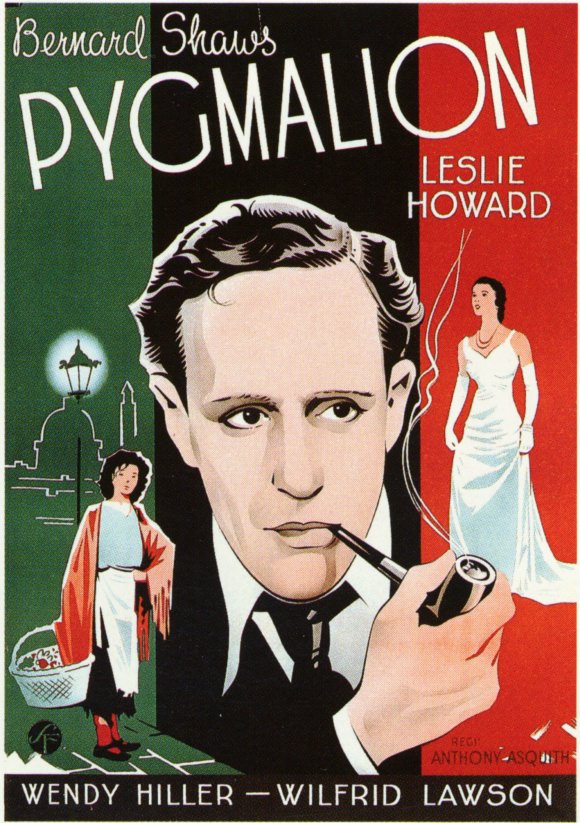
Interestingly, neither big screen version of Shaw’s most famous work features his intended ending. In both 1938’s Pygmalion (made with the approval and assistance of Shaw himself) and My Fair Lady (the famous musical version from 1964), Higgins and Doolittle are reunited in the film’s final scene. Yet despite the fact that much of the two films’ language is identical, Lerner and Loewe’s version manages to avoid the cheap and shallow finale, while Pygmalion, despite its undeniable charms and wonderful performances, is rooted in Shaw’s aforementioned “damnable” territory.
The most obvious reason for this dramatic difference is the contrast between the two actresses playing Eliza: Wendy Hiller and Audrey Hepburn. Both bring a wonderful vivacity and charm to the role; both are clearly at ease with Shaw’s nimble, sharp-edged dialogue; and both serve as the perfect foil to their respective Higginses. Yet the unique aspects of their performances are striking, dramatically altering the tone and focus of the two films.
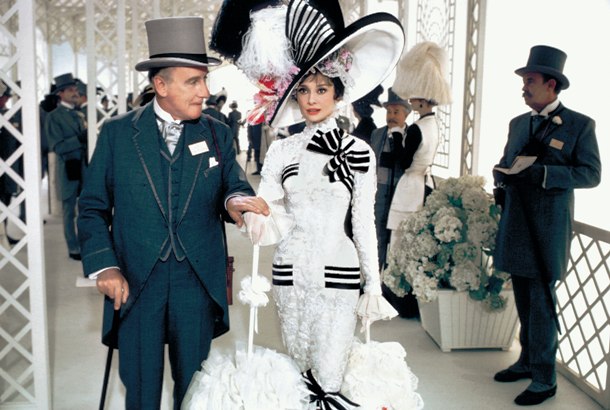
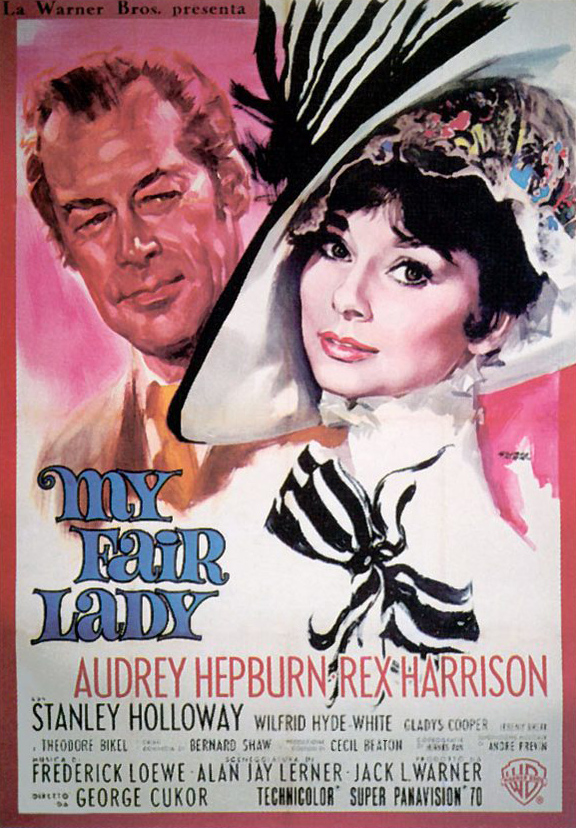 When Rex Harrison lobbied My Fair Lady’s producers to allow his stage co-star, Julie Andrews, to play Eliza, he suggested that Hepburn’s background—her mother was a Dutch baroness—made her unfit to play the early, draggle-tailed guttersnipe stages of the story’s heroine. And while Harrison subsequently recanted his view, proclaiming Hepburn to be his favorite leading lady, his reservations are at least partially born out: Hepburn belongs in the high society to which Professor Higgins elevates her. Her Eliza is a diamond-in-the-rough; Higgins’ relentless cutting and polishing brings out her full luster, producing a lady that would make any finishing school proud. Even the famous Ascot Race Track scene, where Eliza reveals herself to be unprepared for high society in the most spectacular fashion, underscores her grace and charm. In the midst of such an overwhelming, surreal display of British ostentatiousness, her slip is more amusing than it is damaging, and the audience finds itself easily overlooking the indelicate reminder of her low-class roots in the face of her undeniable magnetism.
Hiller, on the other hand, is a hard-working, undereducated-but-overachieving flower girl, not a diamond. Her Eliza is better suited to her original lowly condition than her “creator” realizes, and the professor’s efforts on her behalf feel much more like the construction of an elaborate facade than they do the revelatory polishing of a fine jewel. She does not belong in the world of bright lights, flowing gowns, and high society into which her Higgins (Leslie Howard) so self-indulgently places her, and when she arrives at her final triumphant test, the Embassy Ball, Heller radiates terror, not confidence. Her tearful appraisal that, “I sold flowers, I didn’t sell myself. Now you’ve made a lady of me, I’m not fit to sell anything else” rings true. Higgins has created a fish-out-of-water, a woman problematically altered by his efforts to reshape her in the latest socially-acceptable image rather than simply elevated and transformed.
In the “Tea with Mrs. Higgins” scene, with dialogue later used by Lerner and Loewe in the Ascot Race Track setting, Eliza is allowed to make a spectacle of herself in the very surroundings most unsuited to her. Rather than a charming young girl whose social faux pas are masked by the high-hatted spectacle of the race track, we have the inescapable simplicity of Mrs. Higgins’ parlor, where Eliza’s errors are far more obvious and Professor Higgins’ indifference to (and even amusement in) her discomfort far more damning.
 This, of course, brings us to the second (and most profound) difference between the 1938 version of Shaw’s masterpiece, and the 1964 musical: Henry Higgins himself.
Rex Harrison’s Higgins is prickly, bombastic, and self-centered, yet ultimately likable. His harshness toward Eliza grates at times, yet there is a sense that he is both more kind-hearted and more sincere in his efforts than he wishes to appear—a sense influenced more by the revelatory song “I’ve Grown Accustomed to Her Face” than any other moment in the film. His unenthusiastic efforts to convince himself that he will not miss Eliza after her departure, and his genuine fondness when remembering her charming mannerisms and the brightness she brought to his life convinces us that Higgins has honestly (and at least somewhat altruistically) sought to bring out the best in Eliza. And so, despite Shaw’s insistence that Higgins and Eliza must never be reconciled, we can forgive him a goodly bit of his boorishness and rejoice in their reunion. In the world of Lerner and Loewe, Eliza’s return serves as a paradigmatic example of the sorts of happy ending Hollywood thrives upon. But rather than simply tacking on a rose-colored finish that would have outraged Shaw yet again, My Fair Lady earns its happy finale by convincing its viewers that Higgins has been as positively changed by Eliza as she has by him.
Leslie Howard’s Higgins is manic, foppish, and considerably meaner than Harrison’s later interpretation. His driving harshness has none of My Fair Lady’s musical lyricism to soften its hard edges, and his character suffers greatly from the absence of an “I’ve Grown Accustomed” moment. His insistence on his own genius, his myopic obsession with achieving success no matter the human cost, and the implied insignificance of those around him are undiluted by self-awareness, self-understanding, or any notion of self-deprecating sarcasm. In Pygmalion’s final scene, Higgins turns his back on Eliza (and, most tellingly, on the audience) while demanding to know where she has put his slippers—a shot that stands in stark contrast to Harrison’s clearly chastened, tongue-in-cheek request for his slippers at the end of My Fair Lady.
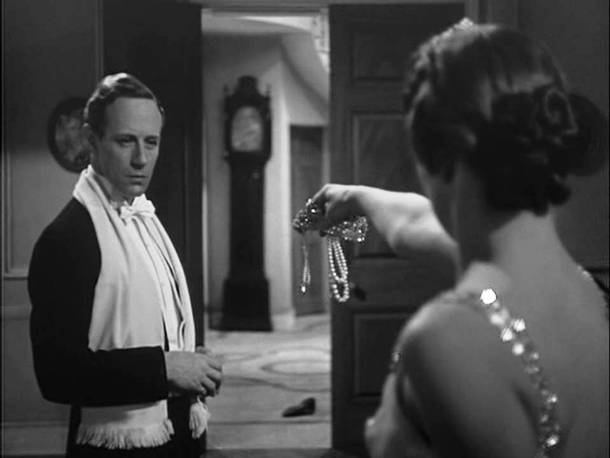
Shaw correctly objected to the “happy” ending producers mixed into the vinegar he intended for his audience when seeing that they were to imbibe it in this context. Without a clear and compelling sign of the professor’s change of heart, Eliza cannot return to Higgins. He simply does not deserve her, which makes his smug satisfaction at the unexpected return of his Galatea almost unspeakably galling. The prospect of Eliza embarking on a lifetime of servitude to a man who loves himself far more than he will ever love her is a difficult one to swallow.
Still, Pygmalion’s ill-fitting, unsettling ending has a silver lining, for it is when seeing Eliza as profoundly displaced (and Higgins as profoundly contemptible) that the true hero of Shaw’s biting little parable emerges: Colonel Hugh Pickering.
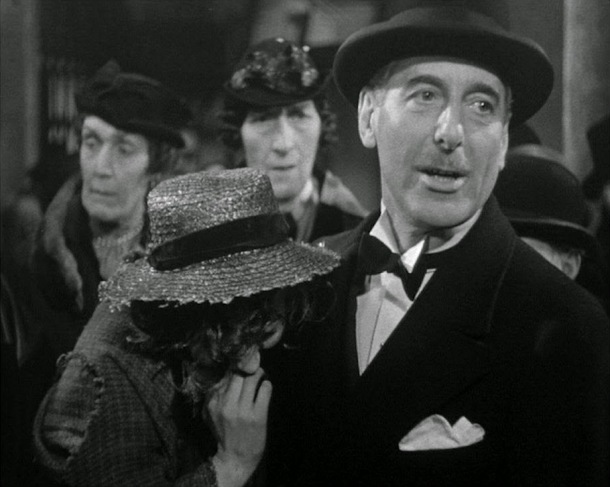 In My Fair Lady, where the need for redemption is less significant, Colonel Pickering plays a largely comedic role. But in the audience-frustrating Pygmalion, the nobility and gentleness of the colonel is absolutely essential. A kind-hearted and sincere man, he is far from perfect. At times, he allows Higgins to ride roughshod over his finer sensibilities. Mild-mannered and quiet, his excitement over their successful “experiment” overrides his gratitude toward Eliza and his appreciation for her role in the project. Yet from the very beginning of the story, Pickering behaves like a gentleman. Eliza credits the moment when he first addressed her as “Miss Doolittle” as the beginning of her transformation—”It was the beginning of self respect for me,” she says, going on to profess that “The difference between a lady and a flower girl isn’t how she behaves. It’s how she’s treated.”
Sadly, Higgins treats her like a guttersnipe even when she is dressed like a lady. But Pickering treats her like a lady even when she seems like nothing more than a poor, ignorant guttersnipe. He genuinely cares for her and her well-being—the perfect foil to Higgins’ calloused indifference and selfish motivations. And it is his behavior, not Higgins’ egomaniacal misbehavior, that shapes and guides Eliza along the path of self-improvement.
In a world where one’s status in society is linked ever more closely to one’s credentials, the Colonel reminds us that her innate human dignity is the only credential Eliza needs in order to be treated with courtesy and respect. He is the embodiment of Pope John Paul II’s assertion that “the inalienable dignity of every human being and the rights which flow from that dignity—in the first place the right to life and the defense of life—are at the heart of the Church’s message.”
Thank God for Colonel Pickering.
 Attribution(s): All posters, publicity images, and movie stills are the property of MGM Studios, Warner Brothers, and all other respective production studios and film distributors, and are intended for editorial use only.
Previous Post

January 21, 2011
Jumpstarting Grown-Up Wonder in Tarsem Singh's "The Fall"
Next Post

February 4, 2011 Trust and Doubt: Our Endless Dichotomy
Browse Our Archives
Select a Category Art Baseball Faith Family Lenten Music Movies Music No Commentary Necessary Parked By the Jukebox Photography Politics Quodlibets Streaming Video Suggestions Summa Short Films Television The Man Behind the Booth Through a Lens, Darkly
Select a Month December 2015 November 2015 October 2015 September 2015 August 2015 July 2015 June 2015 May 2015 April 2015 March 2015 February 2015 January 2015 December 2014 November 2014 October 2014 September 2014 August 2014 July 2014 June 2014 May 2014 April 2014 March 2014 February 2014 January 2014 December 2013 November 2013 October 2013 September 2013 August 2013 July 2013 June 2013 May 2013 April 2013 March 2013 February 2013 January 2013 December 2012 November 2012 July 2012 April 2012 March 2012 February 2012 November 2011 August 2011 July 2011 June 2011 May 2011 April 2011 March 2011 February 2011 January 2011 December 2010 November 2010 October 2010
Follow Us!
TAKE THE
Religious Wisdom Quiz
What Roman road was Paul traveling when he encountered Jesus?
Select your answer to see how you score.
Corinthian Way Roman Forum Road Damascus Road Jericho Road
Related posts from Summa This, Summa That




TRENDING AT PATHEOS Catholic

Rejecting Doom: Christian Hope And Human Action
Christianity is a religion of hope. We are to have hope and...

It’s What Comes From Within Which Matters
One of the most difficult things for us to understand is why...

Why I Choose the Eucharist Over the Sermon
Choose the Eucharist, Not the Sermon What are we supposed to get...

5 Design Elements Found in Spiritually Rooted Homes
Putting Spirituality Into Home Decor Our homes are more than our living...

Credo: A Story of God Told with the...
About 10 years ago, I began to imagine a personal "Credo" that...

The Anatomy of Divine Revelation in Catholic Thought
The claim that God has made Himself known to human beings is...
view all Catholic blogs
Ad-Free & Subscriber Log-In Subscription Support
- About Us
- 2026 Calendar
- Videos
- Podcasts
- Library of World Religions
- Faith In Media Tracker
- Advertise With Us
- Write for Us
- Privacy Policy
- Terms of Service
- Do Not Sell My Data
- Contact Us
- Radiant Digital
- Manage Newsletter Subscriptions
- Unsubscribe From Notifications
- Sitemap
Copyright 2008-2026, Patheos. All rights reserved.
Subscription Support Ad-Free & Subscriber Log-In
Follow Patheos