
BuddhistCatholicContemplativeEvangelicalGeneral ChristianHinduJewishLatter-day SaintMuslimNew VisionsProgressive Christian
Beliefs
- Buddhist
- Catholic
- Contemplative
- Evangelical
- General Christian
- Hindu
- Jewish
- Latter-day Saint
- More Voices
- Muslim
- New Visions
- Pagan
- Progressive Christian
Topics
- Religion News
- Food and Religion
- Sports and Religion
- Religious Art
- Religious Music and Entertainment
- Religious Events
- History and Religion
- Style and Religion
- Politics and Religion
- Women in Religion
- Recreation Outdoors and Religion
- Business Finance and Religion
- Careers Workplace and Religion
- Education and Religion
- Family Parenting and Religion
- Health Fitness and Religion
- Home and Religion
- Relationships and Religion
- Technology and Religion
- Travel and Religion
Columnists
- Buddhist Columnists
- Business Finance and Religion Columnists
- Careers Workplace and Religion Columnists
- Catholic Columnists
- Contemplative Columnists
- Education and Religion Columnists
- Evangelists Columnists
- Family Parenting and Religion Columnists
- General Christian Columnists
- Health Fitness and Religion Columnists
- Hindu Columnists
- History and Religion Columnists
- Home and Religion Columnists
- Jewish Columnists
- More Voices Columnists
- Latter Day Columnists
- Muslim Columnists
- New Visions Columnists
- Nonreligious Columnists
- Pagan Columnists
- Politics and Religion Columnists
- Progressive Columnists
- Recreation Outdoors and Religion Columnists
- Relationships and Religion Columnists
- Religion News Columnists
- Religious Art Columnists
- Religious Events Columnists
- Religious Music and Entertainment Columnists
- Sports and Religion Columnists
- Style and Religion Columnists
- Technology and Religion Columnists
- Travel and Religion Columnists
- Women in Religion Columnists
Resource Library
- 2026 Calendar
- Library of World Religions
- The 100 Most Holy Places on Earth
- Patheos Answers
- Podcasts
- Videos
- Faith Leaders Database
- Anglican Episcopalian
- Bahai
- Baptist
- Buddhism
- Christianity
- Confucianism
- Eastern Orthodoxy
- Hinduism
- Holiness and Pentecostal
- ISKCON
- Islam
- Judaism
- Lutheran
- Methodist
- The Church of Jesus Christ of Latter-day Saints
- New Age
- Paganism
- Presbytarian and Reformed
- Protestantism
- Religion Behind the Scenes
- Roman Catholic
- Scientology
- Shia Islam
- Sikhism
- Sufism
- Sunni Islam
- Taoism
- Zen
- See all religions
Research Tools
 Ad-Free & Subscriber Log-In Subscription Support
Ad-Free & Subscriber Log-In Subscription Support
Follow Patheos 

- Trending:
- Forgiveness
- |
- Marriage
- |
- Consciousness
- |
- Death Penalty
- |
- Election
- |
- Halloween
 Summa This, Summa That
- Home
- About
- Through a Lens, Darkly
- Streaming Video Suggestions (SVS)
- Summa Short Films (SSF)
- The Man Behind The Booth
- Home
- Catholic
- Death, Where Is Thy Sting?
Death, Where Is Thy Sting?
Last updated on: January 8, 2015 at 5:13 pm by Joseph Susanka
Death, Where Is Thy Sting? 2015-01-08T17:13:22-07:00 Joseph Susanka
Patheos Explore the world's faith through different perspectives on religion and spirituality! Patheos has the views of the prevalent religions and spiritualities of the world.
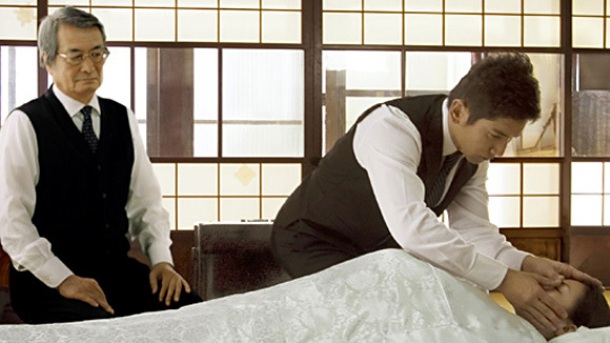
To say that death has become an unimportant part of our cinematic vocabulary would seem like the height of absurdity. The body count from Sly Stallone’s two latest features alone could easily populate a small country, and there are few plot points so frequently used as: “unexpected death of parent/sibling/lover throws protagonist into deep, expressive turmoil.” Yet shuffling off this mortal coil, while omnipresent, is rarely the focus of much cinematic attention; all too often, movie mortality finds itself cast in a limited supporting role. Death is primarily seen as either the intended-yet-incidental consequence of Our Hero’s latest spectacular feats of physical prowess and marvelously unbelievable bad-assitude, or as an important-but-rapidly-receding stepping-stone on the pathway to more emotionally resonant story elements.
This is not unusual. As a culture, we are mightily reluctant to dwell on death. The Grim Reaper walks among us with such alarming and inexorable regularity that we are inclined to pay him no more heed than necessary. The day of reckoning will come to all of us soon enough; why dwell on it before its terrifying arrival? Our films reflect our attitudes—the dreadful specter is ever-present, but we go to great lengths to avoid looking at him directly.
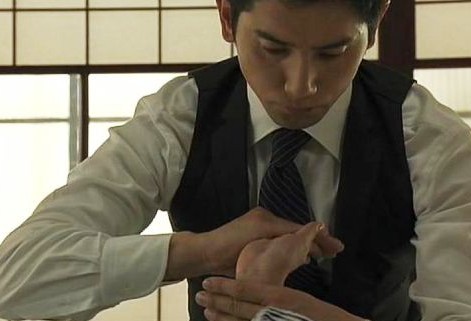
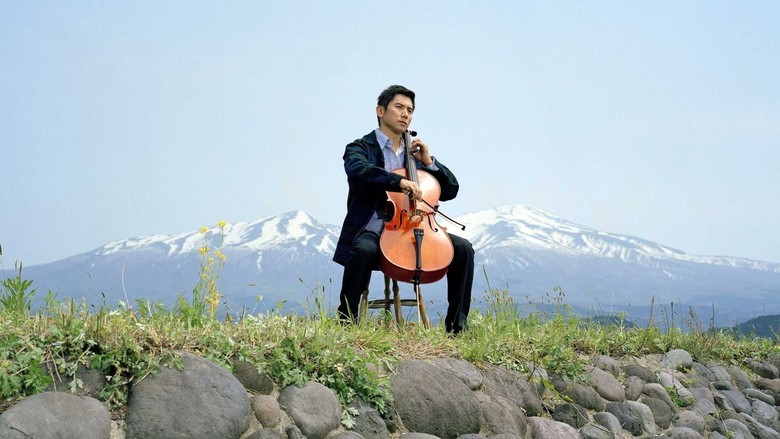
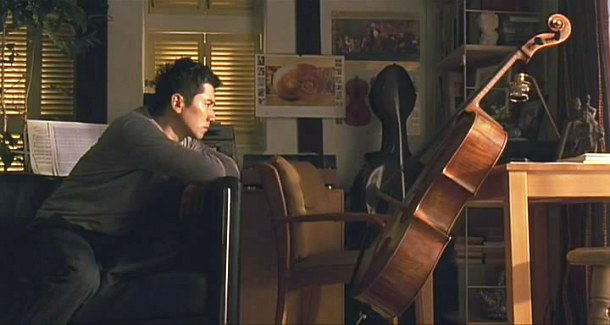 A wonderfully noteworthy exception to this understandable reticence is Japanese director Yôjirô Takita’s extraordinary and unexpectedly Oscar-winning film, Departures (Okuribito). It tells the story of young Daigo Kobayashi, an aspiring concert cellist, who finds himself forced to return to his birthplace when the mid-level orchestra which has employed him is dissolved. Accompanied by his wife, Daigo reluctantly searches for work, all too aware that his musical skill is insufficient for regular employment. Responding to a peculiar newspaper advertisement, he finds himself offered the job of a nokanshi (encoffiner)—someone who travels to the homes of the recently deceased to perform the ceremonial, ritualistic burial preparations in the presence of the departed one’s grieving family members.
Initially, Kobayashi is overwhelmed and horrified by his new calling. The first corpse he is summoned to encoffin is the body of an elderly woman who passed away a full two weeks before being discovered, and the physical and emotional toll of ministering to her mortal remains are almost too much for him to process. But as he watches the extraordinary work of his employer, Shōei, he grows to more fully appreciate the peace and comfort the cleansing ceremonies bring to those who see them. There is a beauty and artistry to the services he and his fellow nokanshi perform; as he takes a more active role in the business, the instances of grief and bitterness he experiences in the families to which he ministers are gradually replaced by moments of fond farewells and even quiet affection and joy. Unfortunately, his friends and family are less enthusiastic over his new-found work.
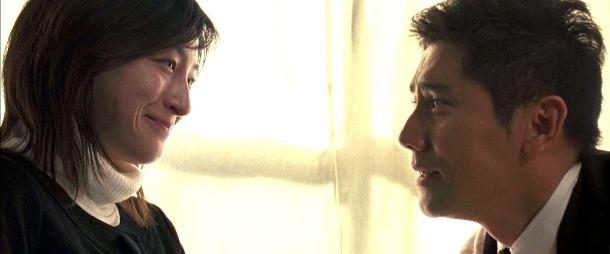
 Encoffining is looked upon by many as “unclean,” and those who perform its rituals are shunned. Daigo’s unwise decision to keep his wife, Mika, in the dark regarding his role as nokanshi soon leads to an emotional confrontation. Aghast when she discovers what he has been doing, Mika demands that he either give up his new-found role or risk losing her altogether. Torn between his love for his wife and his recognition of the good he is doing through his labors, Daigo hesitates over his decision, and Mika leaves him. Distraught, he seeks solace in his work, his newly-discovered usefulness, and (perhaps most importantly) his music.
But the separation is not to last. When Mika returns a few months later, filled to bursting with the good news that she is pregnant, she is confident that the impending arrival of his child will shame the father-to-be into accepting a more “normal” line of work. Kobayashi, who has harbored a deep-seated resentment against his own dead-beat father for many years, struggles to cope with his conflicting emotions as his personal life becomes even more closely intertwined with his professional activities.
In a resolution that is wonderfully apt (if perhaps a trifle too tidy for complete plausibility), the young couple becomes drawn more-closely together by the very ceremonies that previously pushed them apart. After a lifetime of anger and denial, the young comforter finds himself in need of comforting, and what has been nothing more than a ritualistic exercise in the past becomes deeply personal. In the striking final scene, life and death are brought together into a wonderful simultaneity, as both husband and wife are transformed through their grief and resignation.
The story is “spiritual, not religious.” Kobayashi participates in ceremonies for nearly every denomination, suggesting that his role as nokanshi is primarily a cultural one. But the film is also unashamed and uncompromising in its clear belief that death is far from the end of all things. As one character puts it, “Death is like a gateway. Dying doesn’t mean the end. You go through it, and on to the next thing.” For a society increasingly obsessed with extending life no matter the cost, the characters’ matter-of-fact, fearless acceptance of their wholly natural worldly demise is both refreshing and inspiring.
We humans, despite our best efforts to the contrary, struggle constantly against the notion that death is the conclusion of a story, rather than the gentle pause that comes at the end of a chapter. No wonder we are terrified and undone by its impending arrival. But as “Departures” reminds us so beautifully, it is the recognition of death as a single step along the endless path of life—an understanding that the span of our worldly days can only be properly understood in the context of a far greater work, penned by a far greater Writer than ourselves—that lies at the heart of our ability to accept it without fear.
May we all be granted the comforting grace of this understanding as we draw ever-nearer to that gate which awaits us all.
 Attribution(s): Publicity images and movie stills are the property of Regent Releasing and other respective production studios and distributors, and are intended for editorial use only.
Previous Post

December 26, 2010
Bedford Falls: The Post-Clarence Years
Next Post

January 14, 2011 Capes, Masks, and Ordinary Heroes
Browse Our Archives
Select a Category Art Baseball Faith Family Lenten Music Movies Music No Commentary Necessary Parked By the Jukebox Photography Politics Quodlibets Streaming Video Suggestions Summa Short Films Television The Man Behind the Booth Through a Lens, Darkly
Select a Month December 2015 November 2015 October 2015 September 2015 August 2015 July 2015 June 2015 May 2015 April 2015 March 2015 February 2015 January 2015 December 2014 November 2014 October 2014 September 2014 August 2014 July 2014 June 2014 May 2014 April 2014 March 2014 February 2014 January 2014 December 2013 November 2013 October 2013 September 2013 August 2013 July 2013 June 2013 May 2013 April 2013 March 2013 February 2013 January 2013 December 2012 November 2012 July 2012 April 2012 March 2012 February 2012 November 2011 August 2011 July 2011 June 2011 May 2011 April 2011 March 2011 February 2011 January 2011 December 2010 November 2010 October 2010
Follow Us!
TAKE THE
Religious Wisdom Quiz
Which Christian group is known for practicing strict nonviolence?
Select your answer to see how you score.
Methodists Presbyterians Mennonites Lutherans
Related posts from Summa This, Summa That




TRENDING AT PATHEOS Catholic

Rejecting Doom: Christian Hope And Human Action
Christianity is a religion of hope. We are to have hope and...

It’s What Comes From Within Which Matters
One of the most difficult things for us to understand is why...

Why I Choose the Eucharist Over the Sermon
Choose the Eucharist, Not the Sermon What are we supposed to get...

5 Design Elements Found in Spiritually Rooted Homes
Putting Spirituality Into Home Decor Our homes are more than our living...

Credo: A Story of God Told with the...
About 10 years ago, I began to imagine a personal "Credo" that...

The Anatomy of Divine Revelation in Catholic Thought
The claim that God has made Himself known to human beings is...
view all Catholic blogs
Ad-Free & Subscriber Log-In Subscription Support
- About Us
- 2026 Calendar
- Videos
- Podcasts
- Library of World Religions
- Faith In Media Tracker
- Advertise With Us
- Write for Us
- Privacy Policy
- Terms of Service
- Do Not Sell My Data
- Contact Us
- Radiant Digital
- Manage Newsletter Subscriptions
- Unsubscribe From Notifications
- Sitemap
Copyright 2008-2026, Patheos. All rights reserved.
Subscription Support Ad-Free & Subscriber Log-In
Follow Patheos