
BuddhistCatholicContemplativeEvangelicalGeneral ChristianHinduJewishLatter-day SaintMuslimNew VisionsProgressive Christian
Beliefs
- Buddhist
- Catholic
- Contemplative
- Evangelical
- General Christian
- Hindu
- Jewish
- Latter-day Saint
- More Voices
- Muslim
- New Visions
- Pagan
- Progressive Christian
Topics
- Religion News
- Food and Religion
- Sports and Religion
- Religious Art
- Religious Music and Entertainment
- Religious Events
- History and Religion
- Style and Religion
- Politics and Religion
- Women in Religion
- Recreation Outdoors and Religion
- Business Finance and Religion
- Careers Workplace and Religion
- Education and Religion
- Family Parenting and Religion
- Health Fitness and Religion
- Home and Religion
- Relationships and Religion
- Technology and Religion
- Travel and Religion
Columnists
- Buddhist Columnists
- Business Finance and Religion Columnists
- Careers Workplace and Religion Columnists
- Catholic Columnists
- Contemplative Columnists
- Education and Religion Columnists
- Evangelists Columnists
- Family Parenting and Religion Columnists
- General Christian Columnists
- Health Fitness and Religion Columnists
- Hindu Columnists
- History and Religion Columnists
- Home and Religion Columnists
- Jewish Columnists
- More Voices Columnists
- Latter Day Columnists
- Muslim Columnists
- New Visions Columnists
- Nonreligious Columnists
- Pagan Columnists
- Politics and Religion Columnists
- Progressive Columnists
- Recreation Outdoors and Religion Columnists
- Relationships and Religion Columnists
- Religion News Columnists
- Religious Art Columnists
- Religious Events Columnists
- Religious Music and Entertainment Columnists
- Sports and Religion Columnists
- Style and Religion Columnists
- Technology and Religion Columnists
- Travel and Religion Columnists
- Women in Religion Columnists
Resource Library
- 2026 Calendar
- Library of World Religions
- The 100 Most Holy Places on Earth
- Patheos Answers
- Podcasts
- Videos
- Faith Leaders Database
- Anglican Episcopalian
- Bahai
- Baptist
- Buddhism
- Christianity
- Confucianism
- Eastern Orthodoxy
- Hinduism
- Holiness and Pentecostal
- ISKCON
- Islam
- Judaism
- Lutheran
- Methodist
- The Church of Jesus Christ of Latter-day Saints
- New Age
- Paganism
- Presbytarian and Reformed
- Protestantism
- Religion Behind the Scenes
- Roman Catholic
- Scientology
- Shia Islam
- Sikhism
- Sufism
- Sunni Islam
- Taoism
- Zen
- See all religions
Research Tools
 Ad-Free & Subscriber Log-In Subscription Support
Ad-Free & Subscriber Log-In Subscription Support
Follow Patheos 

- Trending:
- Forgiveness
- |
- Marriage
- |
- Consciousness
- |
- Death Penalty
- |
- Election
- |
- Halloween
 Summa This, Summa That
- Home
- About
- Through a Lens, Darkly
- Streaming Video Suggestions (SVS)
- Summa Short Films (SSF)
- The Man Behind The Booth
- Home
- Catholic
- Paved-Over Grace Along “The Road to Perdition”
Paved-Over Grace Along “The Road to Perdition”
Last updated on: January 5, 2015 at 5:14 pm by Joseph Susanka
Paved-Over Grace Along “The Road to Perdition” 2015-01-05T17:14:41-07:00 Joseph Susanka
Patheos Explore the world's faith through different perspectives on religion and spirituality! Patheos has the views of the prevalent religions and spiritualities of the world.
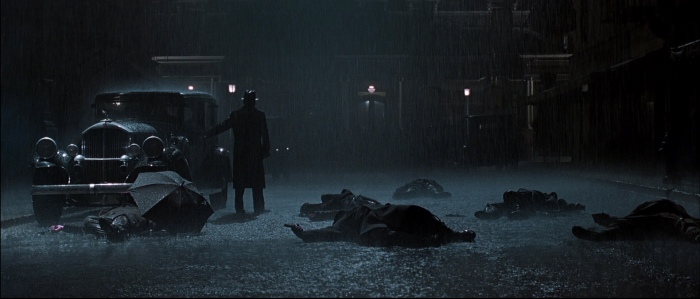
The artistic gulf between cinematic works and literary ones is so vast, I sometimes marvel that anyone is courageous enough to attempt to marry the two. Aside from the occasionally successful (if often bland) A&E or BBC miniseries, cinematic adaptations are forced by time constraints to simplify so drastically that there is little chance of accurately reflecting the topics and themes addressed in their source material. The necessity of using “cinematic shorthand” to compress story lines and distill dramatic elements often leaves screenwriters facing the unsettling question of whether or not their works are faithful representations of the very texts they love so dearly. In some particularly troubling cases, audiences are left to wonder if the creator’s intentions have been not only neglected, but even subverted by those most responsible for preserving them.
The critically-acclaimed Road to Perdition, an adaptation of Max Allan Collin’s graphic novel, is a fascinating example of this very dynamic. This brooding neo-noir, wonderfully realized by screenwriter David Self and director Sam Mendes, recounts the tale of a prohibition-era mob enforcer battling to protect his son and avenge the brutal murder of his family while avoiding capture (or worse) at the hands of the mob “heavies” determined to rub him out. The production values, acting, and cinematography are all top-notch, resulting in a work that is faithful both to the mood and storyline of the original in many respects, yet one which, through a small number of seemingly-innocuous variations, is not simply unfaithful to the original material — it is deeply and incontrovertibly opposed to it.
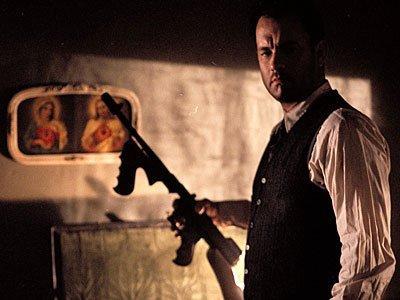 The film’s final lines, delivered by the young son, Michael Sullivan, Jr., underscore the message he learned during those grueling days on the road to Perdition, Illinois — days spent crisscrossing the countryside with his father, one step ahead of the hired guns hell-bent on their destruction: “When people ask me if Michael Sullivan was a good man, or if there was just no good in him at all, I always give the same answer. I just tell them: ‘He was my father.’” Sadly, this answer seems to taint the film’s final moments with the insipid, toxic strains of moral relativism, and combines with Junior’s previous revelation — “I saw then that my father’s only fear was that his son would follow the same road. And that was the last time I ever held a gun.” — to deliver the film’s final warning: the way of violence will always end in violence. A tired message copied directly from Hollywood’s well-thumbed handbook, “Moralizing 101”? To be sure — but still, one that cannot be said to be entirely without value.
To someone familiar with Collin’s graphic novel, however, this ending cannot help but come as a disappointment. While the message of non-violence is present in the literary Road, it is clearly of much less importance to Collins and his characters than the themes of repentance and redemption that permeate the original work — themes so severely downplayed in the film version that they sometimes seem entirely absent. (Mendes, the director, acknowledged that he was drawn to the script because it had “no moral absolutes” — a claim that makes the film’s final lines a bit more understandable, but one that makes repentance and redemption undeniably tricky topics, if not downright irrational ones.)
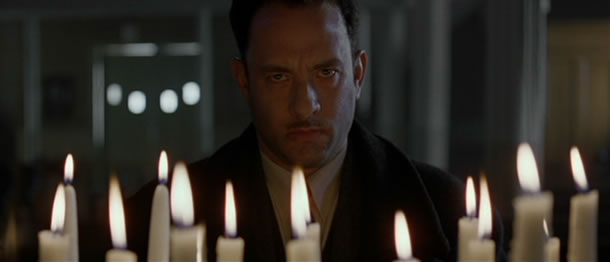 Almost as noteworthy in its absence is the striking way in which the themes of repentance and redemption are made most present in the book: Confession. At the completion of every bloody killing spree upon which the embattled killer Sullivan embarks, his first action is to search for a Catholic church, desperately seeking that one thing which all fallen humans so earnestly desire: forgiveness. And when, acting in defense of his father, the young Michael takes his first life, he too partakes gratefully in the peace-giving sacrament. It is during one of these visits that his father reveals his deep-seated (and hope-filled) belief that “we’re all sinners, son. That’s the way we enter this world. But we can leave it forgiven.” When Sullivan, known to friends and enemies alike as the Archangel of Death, finally meets his end, he orders his young son to find him a church. In the end, he is far more concerned for the health of his polluted soul then that of his broken, mortal body. And when he finally gives up his life in that very church, with no one but his young son and an unfamiliar priest to witness his passing, he does it as a man healed in the most important of ways — a man forgiven for the last time, going to that destination where his lifelong struggles with sin will be a sign of his perseverance, rather than his perversity.
It is at this moment that one can best recognize the profound difference between the film and novel — a difference that answers the question of whether or not this hellish road the Sullivans have traveled has produced anything but suffering and bloodshed. In the film, young Michael misses the most important lesson to be learned from his father’s life and death, and from their long journey to Perdition together. Instead, he rejects the notion of good and evil as meaningful barometers for understanding his father’s life, answering the film’s final question by saying, in essence, that their filial relationship trumps such old-school concerns. He has given up the way of the gun; what more fitting response could there be to his father’s lifetime of killing? Questions of virtue and vice should be left unanswered, or left to those of a less knowingly cynical nature. Why deal in such absolutes? “I just tell them ‘he was my father.’”
 In the book, however, young Michael is witness to much more than just his father’s violent and vengeful failings, seeing also his repeated repentance and his endless, driving desire to be forgiven. While in the midst of their journeys, he often wishes to grow up to be like his father, so struck is he by the man’s devotion and singleness of purpose. Ultimately, however, he is drawn toward the one calling that was able to give his father the peace he so desperately sought. Years after the night his father passed away in that cold, silent church, we learn that young Michael has become a priest. And in a moment of appropriateness and emotional power that its cinematic counterpart — willfully divorced from those very “old school concerns” that make such themes meaningful — could never possibly match, Father Michael Sullivan, Jr., clothed in his priestly vestments, closes the diary recounting his horrifying childhood adventures and steps directly into the confessional.
Young Michael starts out on the road to Perdition as a child, but he leaves it as a man — thoroughly rejecting his father’s violent methods and practices, but just as thoroughly embracing his father’s hopes and fears, his beliefs, principles, and the clear moral code that was more important to him than life itself. Could there be a more definitive, hopeful response to the question posed at the end of the film than that?
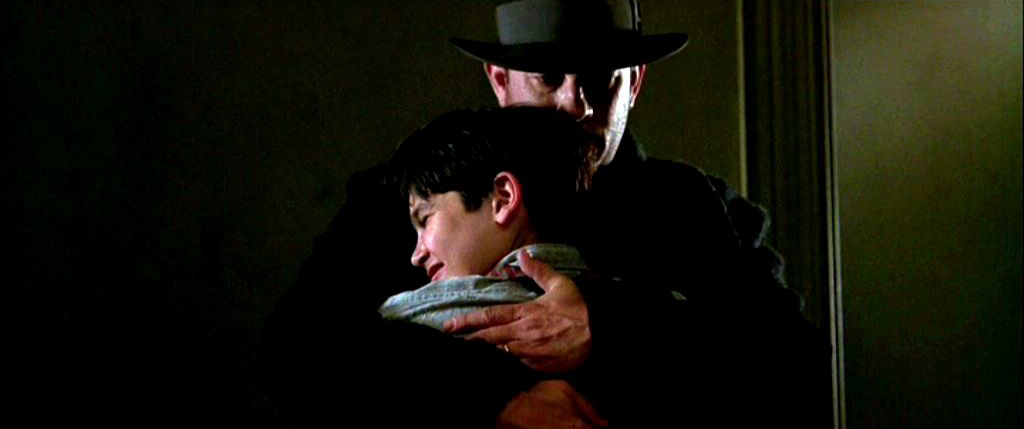 Attribution(s): Publicity images, and movie stills are the property of DreamWorks SKG, 20thCentury Fox, and other respective production studios and distributors, and are intended for editorial use only.
Previous Post
December 3, 2010
The Specter of Broken Fatherhood in the Films of Wes Anderson
Next Post

December 10, 2010 Seeing All the Colors of Paradise
Browse Our Archives
Select a Category Art Baseball Faith Family Lenten Music Movies Music No Commentary Necessary Parked By the Jukebox Photography Politics Quodlibets Streaming Video Suggestions Summa Short Films Television The Man Behind the Booth Through a Lens, Darkly
Select a Month December 2015 November 2015 October 2015 September 2015 August 2015 July 2015 June 2015 May 2015 April 2015 March 2015 February 2015 January 2015 December 2014 November 2014 October 2014 September 2014 August 2014 July 2014 June 2014 May 2014 April 2014 March 2014 February 2014 January 2014 December 2013 November 2013 October 2013 September 2013 August 2013 July 2013 June 2013 May 2013 April 2013 March 2013 February 2013 January 2013 December 2012 November 2012 July 2012 April 2012 March 2012 February 2012 November 2011 August 2011 July 2011 June 2011 May 2011 April 2011 March 2011 February 2011 January 2011 December 2010 November 2010 October 2010
Follow Us!
TAKE THE
Religious Wisdom Quiz
Who said, "Do you not know that your bodies are temples of the Holy Spirit"?
Select your answer to see how you score.
James Paul Peter Jesus
Related posts from Summa This, Summa That




TRENDING AT PATHEOS Catholic

Rejecting Doom: Christian Hope And Human Action
Christianity is a religion of hope. We are to have hope and...

It’s What Comes From Within Which Matters
One of the most difficult things for us to understand is why...

Why I Choose the Eucharist Over the Sermon
Choose the Eucharist, Not the Sermon What are we supposed to get...

5 Design Elements Found in Spiritually Rooted Homes
Putting Spirituality Into Home Decor Our homes are more than our living...

Credo: A Story of God Told with the...
About 10 years ago, I began to imagine a personal "Credo" that...

The Anatomy of Divine Revelation in Catholic Thought
The claim that God has made Himself known to human beings is...
view all Catholic blogs
Ad-Free & Subscriber Log-In Subscription Support
- About Us
- 2026 Calendar
- Videos
- Podcasts
- Library of World Religions
- Faith In Media Tracker
- Advertise With Us
- Write for Us
- Privacy Policy
- Terms of Service
- Do Not Sell My Data
- Contact Us
- Radiant Digital
- Manage Newsletter Subscriptions
- Unsubscribe From Notifications
- Sitemap
Copyright 2008-2026, Patheos. All rights reserved.
Subscription Support Ad-Free & Subscriber Log-In
Follow Patheos