
BuddhistCatholicContemplativeEvangelicalGeneral ChristianHinduJewishLatter-day SaintMuslimNew VisionsProgressive Christian
Beliefs
- Buddhist
- Catholic
- Contemplative
- Evangelical
- General Christian
- Hindu
- Jewish
- Latter-day Saint
- More Voices
- Muslim
- New Visions
- Pagan
- Progressive Christian
Topics
- Religion News
- Food and Religion
- Sports and Religion
- Religious Art
- Religious Music and Entertainment
- Religious Events
- History and Religion
- Style and Religion
- Politics and Religion
- Women in Religion
- Recreation Outdoors and Religion
- Business Finance and Religion
- Careers Workplace and Religion
- Education and Religion
- Family Parenting and Religion
- Health Fitness and Religion
- Home and Religion
- Relationships and Religion
- Technology and Religion
- Travel and Religion
Columnists
- Buddhist Columnists
- Business Finance and Religion Columnists
- Careers Workplace and Religion Columnists
- Catholic Columnists
- Contemplative Columnists
- Education and Religion Columnists
- Evangelists Columnists
- Family Parenting and Religion Columnists
- General Christian Columnists
- Health Fitness and Religion Columnists
- Hindu Columnists
- History and Religion Columnists
- Home and Religion Columnists
- Jewish Columnists
- More Voices Columnists
- Latter Day Columnists
- Muslim Columnists
- New Visions Columnists
- Nonreligious Columnists
- Pagan Columnists
- Politics and Religion Columnists
- Progressive Columnists
- Recreation Outdoors and Religion Columnists
- Relationships and Religion Columnists
- Religion News Columnists
- Religious Art Columnists
- Religious Events Columnists
- Religious Music and Entertainment Columnists
- Sports and Religion Columnists
- Style and Religion Columnists
- Technology and Religion Columnists
- Travel and Religion Columnists
- Women in Religion Columnists
Resource Library
- 2026 Calendar
- Library of World Religions
- The 100 Most Holy Places on Earth
- Patheos Answers
- Podcasts
- Videos
- Faith Leaders Database
- Anglican Episcopalian
- Bahai
- Baptist
- Buddhism
- Christianity
- Confucianism
- Eastern Orthodoxy
- Hinduism
- Holiness and Pentecostal
- ISKCON
- Islam
- Judaism
- Lutheran
- Methodist
- The Church of Jesus Christ of Latter-day Saints
- New Age
- Paganism
- Presbytarian and Reformed
- Protestantism
- Religion Behind the Scenes
- Roman Catholic
- Scientology
- Shia Islam
- Sikhism
- Sufism
- Sunni Islam
- Taoism
- Zen
- See all religions
Research Tools
 Ad-Free & Subscriber Log-In Subscription Support
Ad-Free & Subscriber Log-In Subscription Support
Follow Patheos 

- Trending:
- Forgiveness
- |
- Marriage
- |
- Consciousness
- |
- Death Penalty
- |
- Election
- |
- Halloween
 Summa This, Summa That
- Home
- About
- Through a Lens, Darkly
- Streaming Video Suggestions (SVS)
- Summa Short Films (SSF)
- The Man Behind The Booth
- Home
- Catholic
- “Bicycle Thieves” and the Victory of Our Fragility
“Bicycle Thieves” and the Victory of Our Fragility
Last updated on: January 6, 2015 at 1:43 pm by Joseph Susanka
“Bicycle Thieves” and the Victory of Our Fragility 2015-01-06T13:43:07-07:00 Joseph Susanka
Patheos Explore the world's faith through different perspectives on religion and spirituality! Patheos has the views of the prevalent religions and spiritualities of the world.
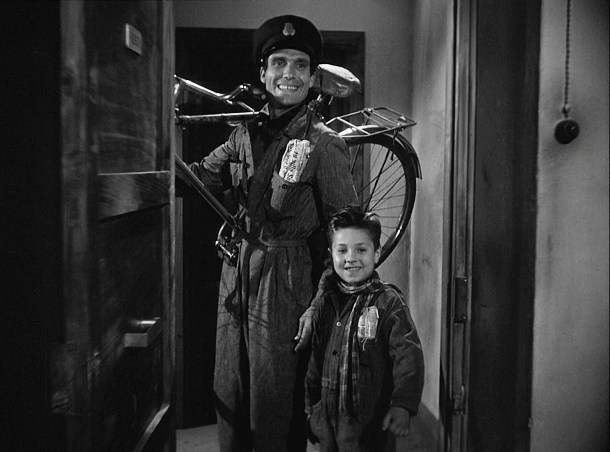
For a father, there are few moments filled with more deeply conflicting emotions than when he holds his newborn child for the first time. To that tiny little infant, mewing and squirming in his arms, he is the ultimate, a godlike power. In the coming years, this child will trust him absolutely, love him unreservedly, and rely on him completely for everything it needs. Yet at that same moment, rejoicing over this new, priceless life that has been given to him for safekeeping, the father knows all too well that he is not God, and that he never can be—that a time will come when the child realizes his father’s limitations; when the child is hurt and damaged by the father’s selfishness and lack of affection; when the fragile, inestimable trust he holds as gently in his hands as this newborn babe will be broken. Sadly, fallen human nature will invade this seemingly perfect scene, tainting it with harsh realities. And this precious moment, a microcosm of the extraordinary bond between father and child, will be lost forever.
It is exactly this moment—when fathers become human—that is examined with remarkable clarity and insight in Vittorio De Sica’s 1948 classic, Bicycle Thieves (Ladri di biciclette). A defining entry in the cinematic genre of Italian neo-realism, it has been justly praised for its extraordinary verisimilitude, its emotional power, and the force of its sociopolitical criticisms. Yet to label the film’s political and social admonitions as its ultimate message is to miss its subtler, more penetrating observations on the painfully rewarding dynamic between father and child—a dynamic which has rarely been shown with such terrifying accuracy or such hope.
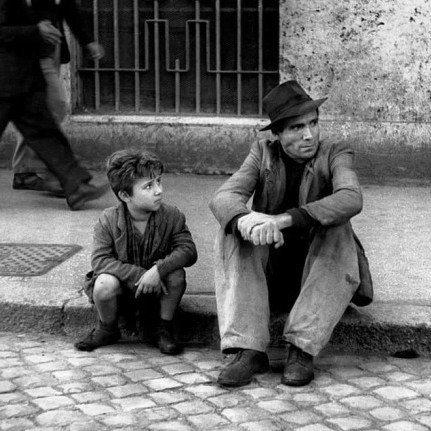 De Sica’s film tells the story of Antonio Ricci, a young Italian father struggling to support his family in the devastated economic wasteland of post-war Italy. After being hired to serve as a poster-hanger, Antonio convinces his wife to pawn away the last of their wedding gifts so that he can buy a bicycle—an essential tool in the accomplishment of his newfound employment. Hours after beginning this precious work, however, his bicycle is stolen away by a young man as desperate as he, and Antonio’s position deteriorates to one of even greater severity than before. Accompanied by Bruno, his young son, he takes to the streets of Rome in an ill-fated attempt to track down his assailant and reclaim his stolen property.
Many fruitless hours later, exhausted and increasingly despairing, Antonio begins to take his frustrations out upon young Bruno, who is confused and hurt by his father’s unfair attacks. Then, providentially, they happen upon the very man they have been seeking for so long, but their victory is short-lived as their excitement turns all too quickly to anguish. The thief, backed by his friends and family, refuses to admit his guilt, and the paralyzing disinterest of the policeman Bruno summons puts an end to any expectations Antonio might have had for a successful resolution to the chase. Their hopes dashed, father and son begin the long trek home. Along the way, they pass a football stadium surrounded by thousands of riderless bicycles. Antonio, confronted by this seemingly-painless solution to the overwhelming problem of supporting his family, succumbs to the temptation. As his son looks on in horror, he steals one of the unattended bicycles.
He is apprehended almost immediately, and is only spared from the vengeance of the spectators by the actions of his son, who charges into the angry group in an impassioned, tearful effort to rescue his father. The mob of onlookers, ashamed by the boy’s obvious distress, chooses to release Antonio, dismissing him with a stinging rebuke: “Nice thing you’re teaching your son.”
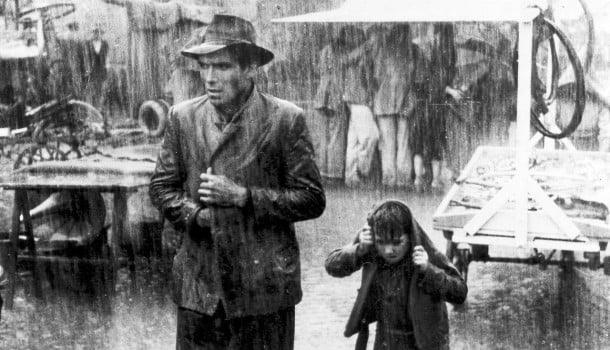
Ashamed and irretrievably damaged in his son’s eyes, Antonio stumbles away, a broken, defeated man. His son follows behind, rubbing at his tear-stained face with a grubby handkerchief. Slowly, sorrowfully, they make their way down the street, but as Bruno catches up to his father, he reaches up and quietly takes Antonio’s hand. Too overwhelmed to fully appreciate the magnanimity of his son’s gesture, Antonio grasps Bruno to him more and more tightly as they vanish into the surging crowds around them.
That small yet all-important gesture lies at the very heart of the transformation that takes place between father and son, brought about by their shared sufferings and trials during that day in Rome. Bruno is clearly shocked and horrified by his father’s actions, yet his willingness to provide comfort and support in spite of his father’s clear betrayal is a sign that he not only recognizes Antonio’s failings, but understands and forgives him for them. And while the film ends on an undeniably somber note when considering Antonio’s efforts to support his family, its view on the future relationship between he and Bruno is much more optimistic.
 A harsh and demanding struggle lies ahead, but Antonio no longer must face it alone; Bruno, now fully aware of his father’s failings, is capable of loving him even more, thanks to that awareness. From this moment forward, Bruno will be there by his father’s side: to encourage, to support, and to offer a comforting, helping hand when he falls.
The moment of ruinous revelation that draws inexorably closer to all parents from the day of their children’s birth—that moment when their children finally realize that they, too, are human, and subject to the same failings and weaknesses as the rest of humanity—is a terrifying one to consider. But as Bicycle Thieves clearly shows, there is something to be won in that moment, even as childlike confidence and absolute, unquestioning trust are lost. For it is at that moment that the hierarchical relationship of parent to child can begin to transform into that which all parents truly desire with their children: a deep and abiding friendship. And that friendship, like any truly profound friendship, can only begin once each sees the other as they truly are.
Perhaps that’s not such a terrifying thought after all.
 Attribution(s): Publicity images and movie stills are the property of Image Entertainment and other respective production studios and distributors, and are intended for editorial use only.
Previous Post
December 10, 2010
Seeing All the Colors of Paradise
Next Post

December 26, 2010 Bedford Falls: The Post-Clarence Years
Browse Our Archives
Select a Category Art Baseball Faith Family Lenten Music Movies Music No Commentary Necessary Parked By the Jukebox Photography Politics Quodlibets Streaming Video Suggestions Summa Short Films Television The Man Behind the Booth Through a Lens, Darkly
Select a Month December 2015 November 2015 October 2015 September 2015 August 2015 July 2015 June 2015 May 2015 April 2015 March 2015 February 2015 January 2015 December 2014 November 2014 October 2014 September 2014 August 2014 July 2014 June 2014 May 2014 April 2014 March 2014 February 2014 January 2014 December 2013 November 2013 October 2013 September 2013 August 2013 July 2013 June 2013 May 2013 April 2013 March 2013 February 2013 January 2013 December 2012 November 2012 July 2012 April 2012 March 2012 February 2012 November 2011 August 2011 July 2011 June 2011 May 2011 April 2011 March 2011 February 2011 January 2011 December 2010 November 2010 October 2010
Follow Us!
TAKE THE
Religious Wisdom Quiz
Who insulted and opposed David, then died after Abigail pleaded his case?
Select your answer to see how you score.
Amasa Joab Nabal Ahithophel
Related posts from Summa This, Summa That




TRENDING AT PATHEOS Catholic

Rejecting Doom: Christian Hope And Human Action
Christianity is a religion of hope. We are to have hope and...

It’s What Comes From Within Which Matters
One of the most difficult things for us to understand is why...

Why I Choose the Eucharist Over the Sermon
Choose the Eucharist, Not the Sermon What are we supposed to get...

5 Design Elements Found in Spiritually Rooted Homes
Putting Spirituality Into Home Decor Our homes are more than our living...

Credo: A Story of God Told with the...
About 10 years ago, I began to imagine a personal "Credo" that...

The Anatomy of Divine Revelation in Catholic Thought
The claim that God has made Himself known to human beings is...
view all Catholic blogs
Ad-Free & Subscriber Log-In Subscription Support
- About Us
- 2026 Calendar
- Videos
- Podcasts
- Library of World Religions
- Faith In Media Tracker
- Advertise With Us
- Write for Us
- Privacy Policy
- Terms of Service
- Do Not Sell My Data
- Contact Us
- Radiant Digital
- Manage Newsletter Subscriptions
- Unsubscribe From Notifications
- Sitemap
Copyright 2008-2026, Patheos. All rights reserved.
Subscription Support Ad-Free & Subscriber Log-In
Follow Patheos