
BuddhistCatholicContemplativeEvangelicalGeneral ChristianHinduJewishLatter-day SaintMuslimNew VisionsProgressive Christian
Beliefs
- Buddhist
- Catholic
- Contemplative
- Evangelical
- General Christian
- Hindu
- Jewish
- Latter-day Saint
- More Voices
- Muslim
- New Visions
- Pagan
- Progressive Christian
Topics
- Religion News
- Food and Religion
- Sports and Religion
- Religious Art
- Religious Music and Entertainment
- Religious Events
- History and Religion
- Style and Religion
- Politics and Religion
- Women in Religion
- Recreation Outdoors and Religion
- Business Finance and Religion
- Careers Workplace and Religion
- Education and Religion
- Family Parenting and Religion
- Health Fitness and Religion
- Home and Religion
- Relationships and Religion
- Technology and Religion
- Travel and Religion
Columnists
- Buddhist Columnists
- Business Finance and Religion Columnists
- Careers Workplace and Religion Columnists
- Catholic Columnists
- Contemplative Columnists
- Education and Religion Columnists
- Evangelists Columnists
- Family Parenting and Religion Columnists
- General Christian Columnists
- Health Fitness and Religion Columnists
- Hindu Columnists
- History and Religion Columnists
- Home and Religion Columnists
- Jewish Columnists
- More Voices Columnists
- Latter Day Columnists
- Muslim Columnists
- New Visions Columnists
- Nonreligious Columnists
- Pagan Columnists
- Politics and Religion Columnists
- Progressive Columnists
- Recreation Outdoors and Religion Columnists
- Relationships and Religion Columnists
- Religion News Columnists
- Religious Art Columnists
- Religious Events Columnists
- Religious Music and Entertainment Columnists
- Sports and Religion Columnists
- Style and Religion Columnists
- Technology and Religion Columnists
- Travel and Religion Columnists
- Women in Religion Columnists
Resource Library
- 2026 Calendar
- Library of World Religions
- The 100 Most Holy Places on Earth
- Patheos Answers
- Podcasts
- Videos
- Faith Leaders Database
- Anglican Episcopalian
- Bahai
- Baptist
- Buddhism
- Christianity
- Confucianism
- Eastern Orthodoxy
- Hinduism
- Holiness and Pentecostal
- ISKCON
- Islam
- Judaism
- Lutheran
- Methodist
- The Church of Jesus Christ of Latter-day Saints
- New Age
- Paganism
- Presbytarian and Reformed
- Protestantism
- Religion Behind the Scenes
- Roman Catholic
- Scientology
- Shia Islam
- Sikhism
- Sufism
- Sunni Islam
- Taoism
- Zen
- See all religions
Research Tools
 Ad-Free & Subscriber Log-In Subscription Support
Follow Patheos 

- Trending:
- Advent
- |
- Forgiveness
- |
- Thanksgiving
- |
- Election
- |
- Seasonal Holidays
- |
- Marriage

- Home
- Catholic
- Education and Religion
- Faith, Reason, and Transubstantiation
Faith, Reason, and Transubstantiation
Last updated on: November 29, 2026 at 10:26 am by David Schloss
Faith, Reason, and Transubstantiation 2026-11-29T10:26:23-05:00 David Schloss
Patheos Explore the world's faith through different perspectives on religion and spirituality! Patheos has the views of the prevalent religions and spiritualities of the world.
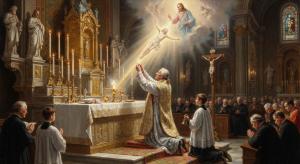
The Dogma of Transubstantiation.
“It would be easier for the world to survive without the sun than to do without Holy Mass.” – Saint Pio of Pietrelcina.
Properly defined as the celebration of the Eucharist, the Mass is what the Church calls the “source and summit of Christian life.” This is more than devotional poetry; in Catholic ecclesiology, the Eucharist is the peak toward which all Church activity is directed and the wellspring from which its grace flows.
Central to the Eucharist is the remarkable event called transubstantiation.
The Dogma Of Transubstantiation
For the purpose of this paper, I will utilize the definition of transubstantiation formulated by the Council of Trent (1545 to 1563).
“Because Christ our Redeemer said that it was truly his body that he was offering under the species of bread, it has always been the conviction of the Church of God, and this holy Council now declares again, that by the consecration of the bread and wine there takes place a change of the whole substance of the bread into the substance of the body of Christ our Lord and of the whole substance of the wine into the substance of his blood. This change the holy Catholic Church has fittingly and properly called transubstantiation.”
The Council calls upon Christ’s own words: “This is my body, which will be given for you; do this in memory of me.” And likewise the cup after they had eaten, saying, “This cup is the new covenant in my blood, which will be shed for you.”
While the Council of Trent provides the definitive definition of transubstantiation, the belief dates back to the earliest days of the faith.
Early Catholics grounded Eucharistic practice in the Last Supper narratives (“This is my body,” “This is my blood”), along with Saint Paul’s teaching on sharing in the body and blood of Christ.
In a letter to the Church at Corinth, Paul asks rhetorically, “The cup of blessing that we bless, is it not a participation in the blood of Christ? The bread that we break, is it not a participation in the body of Christ?” (1 Corinthians 10:16).
The concept can be summed up thus: As an article of faith, Catholicism asserts that the bread and wine used at Mass transform into the body and blood of Christ. This is a fantastical claim, to be sure. However, must it remain in the realm of faith, or can transubstantiation be made intelligible with philosophical arguments?
A Philosophical Defense
While the foundation of the dogma concerning transubstantiation is predicated on supernatural faith, it is possible to develop a philosophical framework for understanding transubstantiation. Doing so requires drawing on Aristotelian metaphysics. Specifically, it is necessary to understand two terms: substance and accidents.
A substance is the most fundamental kind of being. Rather than depending on or inhering in something else, a substance exists independently in itself. As such, we can say that a substance is what a thing is in its essence.
In turn, Aristotle identifies primary and secondary substances. A primary substance is an individual, concrete thing, such as a specific person or cat. A secondary substance refers to the species and genera to which individual substances belong (such as human or animal), which classify what a primary substance is.
Now, in the physical universe, most tangible substances are compound beings composed of matter and form.
Matter is that which exists in potentiality; stone as matter has the potential to be a statue. Form is the defining, actualizing principle of a thing; the soul is the form of the body, which is the matter of a living thing.
Because things are composite, a substance can undergo accidental changes (like gaining weight or changing location) while remaining the same individual thing.
Drawing on these metaphysical principles, Thomas Aquinas distinguishes between substance (what a thing is in its essence) and accidents (qualities and sensory appearances, such as taste, weight, and texture). He then applies them to the bread and wine offered at Mass.
At consecration, the whole substance of bread and wine becomes the body and blood of Christ. This happens not by mere alteration or natural change, and not by annihilation, which is to say that the essence of the bread and wine is removed and replaced by the body and blood of Christ. This is rather esoteric; to clarify, transubstantiation is the conversion of one substance into another.
This change to the substance of the bread and wine does not affect their accidental properties. Aquinas argues that God’s primary causality directly sustains the dimensive quantity (the physical dimensions) of the bread and wine.
Put differently, the physical appearances of bread and wine remain after consecration by divine power, allowing believers to receive the sacrament under familiar signs while exercising faith.
So, how does this change, this transubstantiation (literally “the change of one substance into another”), take place?
In following Aquinas, the Church teaches that only God’s infinite power can effect this conversion, which occurs instantaneously when the sacramental words are spoken over the elements. Unlike natural change, there is no underlying subject that persists from bread to Christ’s body; unlike creation ex nihilo, it starts from pre-existing matter rather than nothing.
Moreover, the consecrated bread and wine contain the substance of Christ – body, blood, soul, and divinity.
Finally, the presence of Christ is understood sacramentally. That is to say, Christ does not move from heaven to the altar. Rather, His body becomes present sacramentally through the conversion of substance while remaining in heaven.
Conclusion
Faith, properly construed, is never divorced from reason. Nevertheless, faith is an assent to a mystery that cannot be entirely explained or understood in this life. A crucial part of this mystery is the belief that God, in the person of Jesus, becomes truly present in the Catholic Mass.
This essay has sought to explain this grand mystery called transubstantiation. While the presence of Jesus in the Eucharist is an article of faith, I have sought to show that it is not devoid of a philosophical or rational explanation.
Education and Religion
History and Religion
Previous Post

November 22, 2026
If Baptism Washes Away Sin, Why Do Catholics Still Suffer?
Recent Comments
"While Unitarianism remains a small minority of believers, its influence on Christianity must not be ..."
A Catholic Critique of Biblical Unitarianism
"Science has proven that Homosapiens have walked this Earth for over 200,000 years. Did God ..."
A Catholic Critique of Biblical Unitarianism
"The universe, the planet we inhabit, and life itself need not exist.This is a claim. ..."
Creation, Preservation, and Teleology in Catholic ..."
"If you have sufficient evidence to support a belief you don't need faith. Despite what ..."
Is Faith Really Blind? What Skeptics ..."
Browse Our Archives
Select a Category Abortion Atheism Catholicism. Catholicism. God. Theophany. Christmas Eschatology Faith and Works. God. Holy Spirit Intelligent Design Jesus Christ Justice Law Politics Protestantism Religion Sabbath Salvation. Soteriology. The Bible Theology Uncategorized
Select a Month November 2026 October 2026 September 2026 August 2026 July 2026 June 2026 May 2026 April 2026 March 2026 February 2026 January 2026 December 2025 November 2025 October 2025 September 2025 August 2025 July 2025 June 2025 May 2025 April 2025 March 2025 February 2025 January 2025 December 2024 November 2024 October 2024 September 2024 August 2024 July 2024 June 2024 May 2024 April 2024 March 2024 February 2024 January 2024 December 2023 November 2023 October 2023 September 2023 August 2023 July 2023 June 2023 May 2023 April 2023 March 2023 February 2023 January 2023 December 2022 November 2022 October 2022 September 2022 August 2022 July 2022 June 2022 May 2022 April 2022 March 2022 February 2022 January 2022 December 2021
Follow Us!
TAKE THE
Religious Wisdom Quiz
James compares faith without works to what?
Select your answer to see how you score.
A body without spirit (dead) A lamp without oil A tree without fruit A house without foundation
Related posts from Summa Catholic

If Baptism Washes Away Sin, Why Do Catholics...
A Catholic Critique of Biblical Unitarianism
Is Catholicism The Fulfillment Of The Old Testament?
From Samaria to Sanctity: Analyzing The Woman At...
TRENDING AT PATHEOS Catholic
Faith, Reason, and Transubstantiation
“It would be easier for the world to survive without the sun...
When The Letter Of The Law Misses Its...
Jesus cared about people. He never ignored their needs, whether they were...

The Kingdom Of God In Ordinary Life And...
The kingdom of God is all around us; it is in us...
If Baptism Washes Away Sin, Why Do Catholics...
The seven sacraments stand as the foundation of Catholic ecclesial life. The...

The Power of Setting a Good Example
Remember last August when the Chicago White Sox hosted a "Pope Hat...

How Grandma Tourism Helps Grandparents Live Their Vocation
Grandma, The New Travel Influencer What started as a nostalgia-inspired social media...
view all Catholic blogs
What Are Your Thoughts?leave a comment
Ad-Free & Subscriber Log-In Subscription Support
- About Us
- 2026 Calendar
- Videos
- Podcasts
- Library of World Religions
- Faith In Media Tracker
- Advertise With Us
- Write for Us
- Privacy Policy
- Terms of Service
- Do Not Sell My Data
- Contact Us
- Radiant Digital
- Manage Newsletter Subscriptions
- Unsubscribe From Notifications
- Sitemap
Copyright 2008-2026, Patheos, part of the Radiant Digital network of media brands. All rights reserved.
Subscription Support Ad-Free & Subscriber Log-In
Follow Patheos