
BuddhistCatholicContemplativeEvangelicalGeneral ChristianHinduJewishLatter-day SaintMuslimNew VisionsProgressive Christian
Beliefs
- Buddhist
- Catholic
- Contemplative
- Evangelical
- General Christian
- Hindu
- Jewish
- Latter-day Saint
- More Voices
- Muslim
- New Visions
- Pagan
- Progressive Christian
Topics
- Religion News
- Food and Religion
- Sports and Religion
- Religious Art
- Religious Music and Entertainment
- Religious Events
- History and Religion
- Style and Religion
- Politics and Religion
- Women in Religion
- Recreation Outdoors and Religion
- Business Finance and Religion
- Careers Workplace and Religion
- Education and Religion
- Family Parenting and Religion
- Health Fitness and Religion
- Home and Religion
- Relationships and Religion
- Technology and Religion
- Travel and Religion
Columnists
- Buddhist Columnists
- Business Finance and Religion Columnists
- Careers Workplace and Religion Columnists
- Catholic Columnists
- Contemplative Columnists
- Education and Religion Columnists
- Evangelists Columnists
- Family Parenting and Religion Columnists
- General Christian Columnists
- Health Fitness and Religion Columnists
- Hindu Columnists
- History and Religion Columnists
- Home and Religion Columnists
- Jewish Columnists
- More Voices Columnists
- Latter Day Columnists
- Muslim Columnists
- New Visions Columnists
- Nonreligious Columnists
- Pagan Columnists
- Politics and Religion Columnists
- Progressive Columnists
- Recreation Outdoors and Religion Columnists
- Relationships and Religion Columnists
- Religion News Columnists
- Religious Art Columnists
- Religious Events Columnists
- Religious Music and Entertainment Columnists
- Sports and Religion Columnists
- Style and Religion Columnists
- Technology and Religion Columnists
- Travel and Religion Columnists
- Women in Religion Columnists
Resource Library
- 2026 Calendar
- Library of World Religions
- The 100 Most Holy Places on Earth
- Patheos Answers
- Podcasts
- Videos
- Faith Leaders Database
- Anglican Episcopalian
- Bahai
- Baptist
- Buddhism
- Christianity
- Confucianism
- Eastern Orthodoxy
- Hinduism
- Holiness and Pentecostal
- ISKCON
- Islam
- Judaism
- Lutheran
- Methodist
- The Church of Jesus Christ of Latter-day Saints
- New Age
- Paganism
- Presbytarian and Reformed
- Protestantism
- Religion Behind the Scenes
- Roman Catholic
- Scientology
- Shia Islam
- Sikhism
- Sufism
- Sunni Islam
- Taoism
- Zen
- See all religions
Research Tools
 Ad-Free & Subscriber Log-In Subscription Support
Ad-Free & Subscriber Log-In Subscription Support
Follow Patheos 

- Trending:
- Forgiveness
- |
- Marriage
- |
- Consciousness
- |
- Death Penalty
- |
- Election
- |
- Halloween

- Home
- Catholic
- Education and Religion
- Creation, Preservation, and Teleology in Catholic Theology
Creation, Preservation, and Teleology in Catholic Theology
Last updated on: October 18, 2026 at 10:42 am by David Schloss
Creation, Preservation, and Teleology in Catholic Theology 2026-10-18T10:42:29-04:00 David Schloss
Patheos Explore the world's faith through different perspectives on religion and spirituality! Patheos has the views of the prevalent religions and spiritualities of the world.
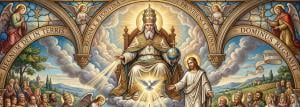
God’s Governance.
As I write this, it is very early Monday morning. Like millions of others, I will begin working soon. Can we (analogically) apply the concept of work to God?
In this paper, I will suggest and examine the three kinds of work God engages in. We begin with the one most associated with God.
Creation
Almost without question, the work or activity most associated with God is that of creation. Since the Bible begins with God creating the world, this is not surprising.
Catholicism teaches that God created the universe out of nothing (ex nihilo) with order, purpose, and inherent goodness. The concept of creation ex nihilo holds that God brought all matter, time, and spiritual realms into existence without preexisting material.
In Genesis, we are told God “speaks” creation into existence. This is to claim that God’s word (Logos) is a living, active force that brings physical and spiritual realities into existence through spoken command. The creation narratives convey three core truths about creation and human origins.
First, God is the definitive origin of the cosmos and time (ab initio temporis). Second, God created humanity directly in His own image and likeness, with an immortal soul. And third, original sin entered the world through a real historical turning point (the Fall of our first parents), creating the need for a Redeemer.
While Scripture declares creation good, Catholic theology holds that all that is created requires conservation and preservation.
Preservation
In 1624, Lord Edward Herbert of Cherbury published a series of articles entitled De Veritate (On Truth). His work gave birth to a theological concept called deism. Deism emerged from an attempt to inject strict rationalism into religious belief. Deism asserts that God is a benevolent but distant Creator who is known through nature and human reason.
Catholicism does not deny that God is benevolent or that nature and human reason are vehicles by which God makes Himself known to human beings. However, unlike deism, the God of the Bible is a personal being deeply concerned with the affairs of His creation.
Of particular consideration to Catholic theology is that God is not only the cause of the universe, but sustains all of creation in its existence, moment to moment. In following Thomas Aquinas’s metaphysics (most notably articulated in the Summa Theologiae), this sustaining of the created realm is called divine preservation or conservation.
This concept has several aspects. First, as noted above, God does not create the universe and leave it alone; He continually sustains its existence and being. As such, every creature relies completely on God at every single moment for its very existence and power to act.
Additionally, preservation is the first foundational step of Divine Providence. God’s preservation and governance guide creation toward its ultimate end. This matter is discussed in the next section.
Finally, God utilizes secondary causes. That is, God acts as the primary “first cause” sustaining all things, while allowing created beings to act as free “secondary causes” within His plan. Still, we must explore why creation requires this kind of care.
Catholic philosophy asserts that conservation is necessary because created things do not contain within themselves the sufficient reason for their continued existence. Moreover, creation is not a one-time historical event, but an ongoing relation of dependency between creature and Creator.
Thomas Aquinas grounds this necessity in three core metaphysical claims. We begin with the foundational distinction between essence and existence. Put simply, essence refers to what something is. This is often synonymous with a thing’s nature. Existence refers to that something is; it is present in reality. Such a distinction allows for the analysis of a thing’s essence (e.g., human nature) apart from a thing’s existence (e.g., a specific person).
When we apply this concept to God, Catholicism holds that God is Actus Purus (Pure Act) and Ipsum Esse Subsistens (Substantive Being Itself). This means God’s essence is identical with His existence. In contrast, the essence and existence of created things are distinct.
This is a significant point. Because God’s nature is to exist (since they are identical in Him), God is a necessary being; He cannot not exist. Obviously, this is not true of created entities, whose essence and existence are distinct.
Now, a creature’s essence defines what kind of thing it is, but that essence does not guarantee or require its existence. Moreover, because existence is not part of a creature’s nature, an external cause must communicate it to the creature.
Therefore, a creature can exist only as long as it receives existence from the entity whose very essence is existence: God. An analogy may clarify this concept.
The sun illuminates the air. Light in the air depends entirely on the sun’s continuous action. If the sun sets or is blocked, the light immediately vanishes, because the air does not possess light by its own nature.
Because God is the cause of being as such (not merely the cause of a change or reordering of preexisting matter), creatures relate to God as air relates to light. Were God to withdraw His sustaining power, all creatures would immediately lapse into non-being.
Finally, preservation is not a secondary action distinct from creation. Rather, preservation is simply the continuation of creation. God sustains all things because being is an effect that belongs exclusively to God’s proper nature.
To speak of governing and sustaining a thing is also to speak of a purpose or teleology for its presence.
Teleology
The universe, the planet we inhabit, and life itself need not exist. The fact that they do suggests not only a transcendent cause but also a purpose for their existence. After all, if a thing need not exist, it must have been created for a purpose. This position is essentially a derivative of Leibniz’s “principle of sufficient reason.”
This principle suggests that everything that is created is created for a purpose. This also lets us explain things, actions, or natural events by their final purpose or goal rather than only their physical causes. This concept is called teleology.
Drawing from Aristotle and synthesized by theologians like Saint Thomas Aquinas, Catholic philosophy teaches that everything in nature is created for and directed toward specific ends. For humans, this purpose is rooted in both our created nature and our relationship with the Divine.
In light of this, we can identify four principles of human teleology from a biblical perspective.
First, the universe exhibits signs of contingency (it does not contain the cause of its own existence) and design (it possesses an internal and inherent nature that precludes chance).
Second, because human beings are made in God’s image, they possess intellect and free will. This allows humans to consciously understand and choose to align (or not, as the case may be) their actions with God’s will.
Third, and relatedly, human beings are intended to participate in natural law. In turn, natural law is the mind of God made manifest by His creation. For this reason, humans have access to an objective moral standard grounded in God’s will.
Finally, human existence has an ultimate purpose: communion with God. Human flourishing, happiness, and true freedom are achieved only when human faculties and free will are directed toward their final transcendent end: to know, love, and serve God.
Conclusion
This paper has suggested that God has three “jobs”: Creator, sustainer, and end of creation. To some extent, such a description is a misnomer. A job suggests (although not necessarily) some kind of compulsion, as if God is required to do these things. Obviously, that is not the case.
Additionally, we should not think of the three “jobs” as being entirely separate. Rather, God as creator, preserver, and end (summum bonum) are all part of God’s nature.
Education and Religion
History and Religion
Previous Post

October 4, 2026
The Anatomy of Divine Revelation in Catholic Thought
Recent Comments
"Why would it matter if atheism is wrong? The fact that Catholic and Protestant scholars ..."
Beyond the Absence of Belief: The ..."
"Kaiser Member Service Proponents often compare atheism to not collecting stamps—it is the lack of ..."
Beyond the Absence of Belief: The ..."
""these dual denials (objective truth and objective meaning)"This is not accurate. Post-modern thought does not ..."
Defending the Faith in a Post-Truth ..."
"The theologians still haven't received the memo. Your opposition are no longer atheists, but they ..."
Defending the Faith in a Post-Truth ..."
Browse Our Archives
Select a Category Abortion Atheism Catholicism. Catholicism. God. Theophany. Christmas Eschatology Faith and Works. God. Holy Spirit Intelligent Design Jesus Christ Justice Law Politics Protestantism Religion Sabbath Salvation. Soteriology. The Bible Theology Uncategorized
Select a Month October 2026 September 2026 August 2026 July 2026 June 2026 May 2026 April 2026 March 2026 February 2026 January 2026 December 2025 November 2025 October 2025 September 2025 August 2025 July 2025 June 2025 May 2025 April 2025 March 2025 February 2025 January 2025 December 2024 November 2024 October 2024 September 2024 August 2024 July 2024 June 2024 May 2024 April 2024 March 2024 February 2024 January 2024 December 2023 November 2023 October 2023 September 2023 August 2023 July 2023 June 2023 May 2023 April 2023 March 2023 February 2023 January 2023 December 2022 November 2022 October 2022 September 2022 August 2022 July 2022 June 2022 May 2022 April 2022 March 2022 February 2022 January 2022 December 2021
Follow Us!
TAKE THE
Religious Wisdom Quiz
"Let your ________ before men, that they may see your good deeds and praise your Father in heaven."
Select your answer to see how you score.
Face Shine Voice Be Raised Light So Shine Conscience Be Clear
Related posts from Summa Catholic

The Anatomy of Divine Revelation in Catholic Thought

Beyond the Absence of Belief: The Implications of...

Can Catholic Apologetics Survive a Postmodern World?

From Samaria to Sanctity: Analyzing The Woman At...
TRENDING AT PATHEOS Catholic

Creation, Preservation, and Teleology in Catholic Theology
As I write this, it is very early Monday morning. Like millions...

The Parable Of The Sower And The Word...
One of Christ’s most famous parables is that of the sower who...

Rejecting Doom: Christian Hope And Human Action
Christianity is a religion of hope. We are to have hope and...

Why I Choose the Eucharist Over the Sermon
Choose the Eucharist, Not the Sermon What are we supposed to get...

5 Design Elements Found in Spiritually Rooted Homes
Putting Spirituality Into Home Decor Our homes are more than our living...

Credo: A Story of God Told with the...
About 10 years ago, I began to imagine a personal "Credo" that...
view all Catholic blogs
What Are Your Thoughts?leave a comment
Ad-Free & Subscriber Log-In Subscription Support
- About Us
- 2026 Calendar
- Videos
- Podcasts
- Library of World Religions
- Faith In Media Tracker
- Advertise With Us
- Write for Us
- Privacy Policy
- Terms of Service
- Do Not Sell My Data
- Contact Us
- Radiant Digital
- Manage Newsletter Subscriptions
- Unsubscribe From Notifications
- Sitemap
Copyright 2008-2026, Patheos. All rights reserved.
Subscription Support Ad-Free & Subscriber Log-In
Follow Patheos