
BuddhistCatholicContemplativeEvangelicalGeneral ChristianHinduJewishLatter-day SaintMuslimNew VisionsProgressive Christian
Beliefs
- Buddhist
- Catholic
- Contemplative
- Evangelical
- General Christian
- Hindu
- Jewish
- Latter-day Saint
- More Voices
- Muslim
- New Visions
- Pagan
- Progressive Christian
Topics
- Religion News
- Food and Religion
- Sports and Religion
- Religious Art
- Religious Music and Entertainment
- Religious Events
- History and Religion
- Style and Religion
- Politics and Religion
- Women in Religion
- Recreation Outdoors and Religion
- Business Finance and Religion
- Careers Workplace and Religion
- Education and Religion
- Family Parenting and Religion
- Health Fitness and Religion
- Home and Religion
- Relationships and Religion
- Technology and Religion
- Travel and Religion
Columnists
- Buddhist Columnists
- Business Finance and Religion Columnists
- Careers Workplace and Religion Columnists
- Catholic Columnists
- Contemplative Columnists
- Education and Religion Columnists
- Evangelists Columnists
- Family Parenting and Religion Columnists
- General Christian Columnists
- Health Fitness and Religion Columnists
- Hindu Columnists
- History and Religion Columnists
- Home and Religion Columnists
- Jewish Columnists
- More Voices Columnists
- Latter Day Columnists
- Muslim Columnists
- New Visions Columnists
- Nonreligious Columnists
- Pagan Columnists
- Politics and Religion Columnists
- Progressive Columnists
- Recreation Outdoors and Religion Columnists
- Relationships and Religion Columnists
- Religion News Columnists
- Religious Art Columnists
- Religious Events Columnists
- Religious Music and Entertainment Columnists
- Sports and Religion Columnists
- Style and Religion Columnists
- Technology and Religion Columnists
- Travel and Religion Columnists
- Women in Religion Columnists
Resource Library
- 2026 Calendar
- Library of World Religions
- The 100 Most Holy Places on Earth
- Patheos Answers
- Podcasts
- Videos
- Faith Leaders Database
- Anglican Episcopalian
- Bahai
- Baptist
- Buddhism
- Christianity
- Confucianism
- Eastern Orthodoxy
- Hinduism
- Holiness and Pentecostal
- ISKCON
- Islam
- Judaism
- Lutheran
- Methodist
- The Church of Jesus Christ of Latter-day Saints
- New Age
- Paganism
- Presbytarian and Reformed
- Protestantism
- Religion Behind the Scenes
- Roman Catholic
- Scientology
- Shia Islam
- Sikhism
- Sufism
- Sunni Islam
- Taoism
- Zen
- See all religions
Research Tools
 Ad-Free & Subscriber Log-In Subscription Support
Follow Patheos 

- Trending:
- Advent
- |
- Forgiveness
- |
- Thanksgiving
- |
- Election
- |
- Seasonal Holidays
- |
- Marriage

- Home
- Catholic
- Education and Religion
- Understanding the Beatitudes: Catholic Guide to Happiness
Understanding the Beatitudes: Catholic Guide to Happiness
Last updated on: August 2, 2026 at 10:07 am by David Schloss
Understanding the Beatitudes: Catholic Guide to Happiness 2026-08-02T10:07:18-04:00 David Schloss
Patheos Explore the world's faith through different perspectives on religion and spirituality! Patheos has the views of the prevalent religions and spiritualities of the world.
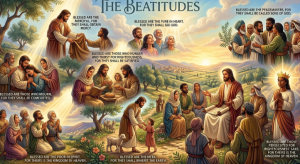
The Beatitudes.
The belief that “right” living or living ethically leads one to happiness has a long history in Western philosophy. Not surprisingly, the Bible teaches that our greatest happiness lies in communion with God.
To that end, the Sermon on the Mount, known as the beatitudes, a term connoting a state of supreme blessedness, happiness, or grace, is of great significance to Catholic ethical teaching.
Each of the beatitudes begins with the Greek word makarios, which is often translated “blessed” or “happy.” It follows, therefore, that the core concern of the Sermon on the Mount is human happiness or flourishing. Through an inversion of worldly values, the Beatitudes outline an inner reordering of the human soul necessary for true eudaimonia (literally a “good spirit”).
In order to understand why this is the case, it is necessary and proper to examine the Sermon on the Mount in some detail.
An Analysis Of The Sermon On The Mount
In Matthew’s Gospel, Christ enumerates eight seemingly paradoxical beatitudes.
The first beatitude is traditionally tied to humility. “Blessed are the poor in spirit, for theirs is the Kingdom of Heaven.” To be poor in spirit is to be humble, and because humility entails confronting our broken and sinful state, it is considered the bedrock of the spiritual life.
This recognition of our need for a Savior, combined with knowledge of God’s infinite mercy, is what makes sanctity possible. The reason is that accepting our fallen state without having trust in God’s mercy leads to despair. Ignoring our brokenness while focusing only on God’s mercy leads to presumption.
“Blessed are those who mourn, for they shall be comforted.” The second beatitude is concerned with sorrow over one’s sins. Here we can distinguish two types of sorrow as exemplified by Peter and Judas.
Both men betrayed Jesus, but they differ in what happened afterward. In the face of Peter’s betrayal, he experiences the “healing tears” of repentance, while Judas falls into tragic despair.
In Peter’s case, the mourning occasioned by the shattering encounter with truth leads him to undergo even deeper conversion and to strengthen his resolve to resist evil. This mourning heals because it teaches us to hope and to love again.
However, in Judas’s case, the mourning symbolizes one who has lost hope and has become mistrustful of love and of truth.
Understood this way, we may link the first two beatitudes by observing that in seeing our poverty of spirit, we “mourn” over the reality of our sin. However, in confidence we turn to God for healing and transformation, and in so doing, we find true comfort (Matthew 5:4).
The third beatitude tells us that “blessed are the meek, for they shall inherit the earth.” The phrasing echoes Psalm 37:11, where the “meek shall inherit the land” (the words used in both the Hebrew and Greek original texts mean “land” and “earth”).
The English word “meek” generally has negative connotations. However, the Hebrew term for “meek” here is anawim, which refers to the faithful and humble of ancient Israel. In this sense, Mary quintessentially embodies the anawim, as is manifest in her Magnificat (Luke 1:46-55). Christ is, of course, referred to as “gentle” and “lowly” (Matthew 11:29).
The inheritance of the meek is the earth. That is to say that they will inherit the “new earth” in God’s Kingdom. (Revelation 21).
The fourth beatitude blesses those who hunger and thirst for righteousness (or justice). Hunger, whether in the physical or spiritual sense of the word, reveals the contingent nature of the one who hungers. Whether that need is a steak or God, it is clear that we need things outside of ourselves.
Taking this concept further, we all worship something. We need only look at how we spend our time, money, and mental and emotional energy. Those things which we consider to be the highest value are objects of worship.
This particular beatitude beckons us to discern the movements of our heart and foster a deep yearning for what truly matters. Only by rightly ordering our desires at the deepest level will we ever truly be “satisfied” (Matthew 5:6).
Blessed are the merciful, for they shall obtain mercy, says the fifth beatitude. Within the spiritual realm, there is a unique economy: the more one gives something away, the more one receives. This principle is true with grace, and it is true with mercy.
Mercy is frequently the result of one being cognizant of one’s faults and spiritual failings. After coming to grips with our weakness and deep need for grace, we now have a posture of love and mercy toward others. Mercy pushes aside condemnation.
In being conformed to the image of God, the forgiven sinner becomes an icon of divine mercy for others. In fact, this seems to be a condition for full entrance into the kingdom: “Forgive us our trespasses as we have forgiven those who trespass against us.” (Matthew 6:9-12).
The sixth beatitude proclaims “Blessed are the pure in heart, for they shall see God.” In modern nomenclature, heart refers to one’s emotional center. However, in the world of the Bible, the heart refers to the will and the “center” of the person.
To be pure of heart refers to being unified in one’s thoughts, choices, and desires. In this sense, a pure heart means that one’s thoughts match one’s actions. In turn, a person with a pure heart grows in love for God and neighbor, uses one’s sexuality in a holy and unified way, and accepts the truths of the faith.
The seventh beatitude involves peace. “Blessed are the peacemakers, for they are the children of God.” Peace is not necessarily the absence of conflict. Rather, it is what Saint Augustine called the “tranquility of order.” Peace, in this sense, follows the unity seen in the sixth beatitude by becoming the fruit of an undivided life, devoid of duplicity.
Additionally, the peacemakers are those who not only live in peace with others but work to preserve peace and friendship among individuals and between God and man, and to restore it when it has been disturbed.
Doing so is, as Saint Gregory of Nyssa observes, an imitation of God’s love of human beings, which makes one “children of your Father who is in heaven” (Matthew 5:45).
Eighth and last, “Blessed are those who are persecuted for righteousness’ sake, for theirs is the kingdom of heaven.”
To be a follower of Christ has historically been a difficult and violent path to tread. Of the twelve original apostles, eleven were murdered for their faith. Nor is this an historical curiosity. According to groups such as Genocide Watch and Open Doors, over 50,000 Africans have been murdered for being Christians. That is a conservative estimate. This is to say nothing of those discriminated against for acting on their faith.
Suffice to say that following God’s will can bring suffering and persecution, but Jesus’ death and resurrection show us that the cross is the path to salvation. Those who endure hardships for their faith are promised the reward of eternal life.
Conclusion
The Beatitudes are the roadmap for spiritual growth, teaching us to live with humility, seek holiness, and show mercy and peace. Together, they guide us to a life deeply blessed with the promise of everlasting joy.
General Christian
Education and Religion
History and Religion
Previous Post
July 26, 2026
The Incarnation: Why Only Christ Took Human Form
Next Post
August 9, 2026 Does Heaven Exist? Examining the Arguments.
Recent Comments
"While Unitarianism remains a small minority of believers, its influence on Christianity must not be ..."
A Catholic Critique of Biblical Unitarianism
"Science has proven that Homosapiens have walked this Earth for over 200,000 years. Did God ..."
A Catholic Critique of Biblical Unitarianism
"The universe, the planet we inhabit, and life itself need not exist.This is a claim. ..."
Creation, Preservation, and Teleology in Catholic ..."
"If you have sufficient evidence to support a belief you don't need faith. Despite what ..."
Is Faith Really Blind? What Skeptics ..."
Browse Our Archives
Select a Category Abortion Atheism Catholicism. Catholicism. God. Theophany. Christmas Eschatology Faith and Works. God. Holy Spirit Intelligent Design Jesus Christ Justice Law Politics Protestantism Religion Sabbath Salvation. Soteriology. The Bible Theology Uncategorized
Select a Month November 2026 October 2026 September 2026 August 2026 July 2026 June 2026 May 2026 April 2026 March 2026 February 2026 January 2026 December 2025 November 2025 October 2025 September 2025 August 2025 July 2025 June 2025 May 2025 April 2025 March 2025 February 2025 January 2025 December 2024 November 2024 October 2024 September 2024 August 2024 July 2024 June 2024 May 2024 April 2024 March 2024 February 2024 January 2024 December 2023 November 2023 October 2023 September 2023 August 2023 July 2023 June 2023 May 2023 April 2023 March 2023 February 2023 January 2023 December 2022 November 2022 October 2022 September 2022 August 2022 July 2022 June 2022 May 2022 April 2022 March 2022 February 2022 January 2022 December 2021
Follow Us!
TAKE THE
Religious Wisdom Quiz
Who was Jonathan's son, crippled as a child, whom David showed kindness?
Select your answer to see how you score.
Mephibosheth Siba Jedidiah Abinadab
Related posts from Summa Catholic

If Baptism Washes Away Sin, Why Do Catholics...
Is Catholicism The Fulfillment Of The Old Testament?
Why Is Catholicism Centered on an Instrument of...
Is Faith Really Blind? What Skeptics Get Wrong
TRENDING AT PATHEOS Catholic

Bad Survey Questions Distort Eucharistic Theology
It seems to be the newest thing: someone conducts a bad survey...

If Baptism Washes Away Sin, Why Do Catholics...
The seven sacraments stand as the foundation of Catholic ecclesial life. The...

Far from promoting indifference, inaction, or quietism, Paul consistently tells us to...

The Power of Setting a Good Example
Remember last August when the Chicago White Sox hosted a "Pope Hat...

A Catholic Critique of Biblical Unitarianism
If the statistics are to be believed, Unitarianism is rising worldwide. Although...

How Grandma Tourism Helps Grandparents Live Their Vocation
Grandma, The New Travel Influencer What started as a nostalgia-inspired social media...
view all Catholic blogs
What Are Your Thoughts?leave a comment
Ad-Free & Subscriber Log-In Subscription Support
- About Us
- 2026 Calendar
- Videos
- Podcasts
- Library of World Religions
- Faith In Media Tracker
- Advertise With Us
- Write for Us
- Privacy Policy
- Terms of Service
- Do Not Sell My Data
- Contact Us
- Radiant Digital
- Manage Newsletter Subscriptions
- Unsubscribe From Notifications
- Sitemap
Copyright 2008-2026, Patheos, part of the Radiant Digital network of media brands. All rights reserved.
Subscription Support Ad-Free & Subscriber Log-In
Follow Patheos