
BuddhistCatholicContemplativeEvangelicalGeneral ChristianHinduJewishLatter-day SaintMuslimNew VisionsProgressive Christian
Beliefs
- Buddhist
- Catholic
- Contemplative
- Evangelical
- General Christian
- Hindu
- Jewish
- Latter-day Saint
- More Voices
- Muslim
- New Visions
- Pagan
- Progressive Christian
Topics
- Religion News
- Food and Religion
- Sports and Religion
- Religious Art
- Religious Music and Entertainment
- Religious Events
- History and Religion
- Style and Religion
- Politics and Religion
- Women in Religion
- Recreation Outdoors and Religion
- Business Finance and Religion
- Careers Workplace and Religion
- Education and Religion
- Family Parenting and Religion
- Health Fitness and Religion
- Home and Religion
- Relationships and Religion
- Technology and Religion
- Travel and Religion
Columnists
- Buddhist Columnists
- Business Finance and Religion Columnists
- Careers Workplace and Religion Columnists
- Catholic Columnists
- Contemplative Columnists
- Education and Religion Columnists
- Evangelists Columnists
- Family Parenting and Religion Columnists
- General Christian Columnists
- Health Fitness and Religion Columnists
- Hindu Columnists
- History and Religion Columnists
- Home and Religion Columnists
- Jewish Columnists
- More Voices Columnists
- Latter Day Columnists
- Muslim Columnists
- New Visions Columnists
- Nonreligious Columnists
- Pagan Columnists
- Politics and Religion Columnists
- Progressive Columnists
- Recreation Outdoors and Religion Columnists
- Relationships and Religion Columnists
- Religion News Columnists
- Religious Art Columnists
- Religious Events Columnists
- Religious Music and Entertainment Columnists
- Sports and Religion Columnists
- Style and Religion Columnists
- Technology and Religion Columnists
- Travel and Religion Columnists
- Women in Religion Columnists
Resource Library
- 2026 Calendar
- Library of World Religions
- The 100 Most Holy Places on Earth
- Patheos Answers
- Podcasts
- Videos
- Faith Leaders Database
- Anglican Episcopalian
- Bahai
- Baptist
- Buddhism
- Christianity
- Confucianism
- Eastern Orthodoxy
- Hinduism
- Holiness and Pentecostal
- ISKCON
- Islam
- Judaism
- Lutheran
- Methodist
- The Church of Jesus Christ of Latter-day Saints
- New Age
- Paganism
- Presbytarian and Reformed
- Protestantism
- Religion Behind the Scenes
- Roman Catholic
- Scientology
- Shia Islam
- Sikhism
- Sufism
- Sunni Islam
- Taoism
- Zen
- See all religions
Research Tools
 Ad-Free & Subscriber Log-In Subscription Support
Ad-Free & Subscriber Log-In Subscription Support
Follow Patheos 

- Trending:
- Forgiveness
- |
- Marriage
- |
- Consciousness
- |
- Death Penalty
- |
- Election
- |
- Halloween

- Home
- Catholic
- History and Religion
- Five Pillars of the Human Person in Catholic Thought
Five Pillars of the Human Person in Catholic Thought
Last updated on: August 16, 2026 at 12:13 pm by David Schloss
Five Pillars of the Human Person in Catholic Thought 2026-08-16T12:13:36-04:00 David Schloss
Patheos Explore the world's faith through different perspectives on religion and spirituality! Patheos has the views of the prevalent religions and spiritualities of the world.
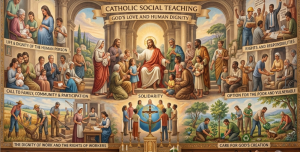
A Holistic Catholicism.
While Catholicism is first and foremost a religion designed to engage in right worship of God, it is also holistic in its teachings. That is, Catholicism is concerned with the body and soul equally.
The concerns of the body encompass what it means to be human and to live in a community. The concerns of the soul include meaning and revelation. Finally, philosophy concerns itself with both the soul and body.
These five dimensions – humanity, community, the search for meaning, responsiveness to revelation, and philosophical inquiry – form the focus of this paper.
Catholic Anthropology
Anthropology (study of humans) is a remarkably wide-ranging discipline. It encompasses topics as diverse as biology, evolutionary history, society, language, and culture. When anthropology is placed within a Catholic framework, it yields significant insights. Two principles are fundamental: the imago Dei and teleology.
To grasp theological anthropology, it must be stated that Catholicism asserts that human beings are made in the image of God (imago Dei). This, in turn, leads to two concepts. First, the human being possesses a rational nature.
To be rational is to be able to engage in abstract and logical thinking, as well as to have free will. These characteristics mirror (albeit in a significantly reduced way) the Holy Trinity.
The second concept is teleology. In philosophy, teleology refers to the idea that a thing can be explained by its final purpose, goal, or end. Applied to anthropology, a teleological approach argues that humans are made for a specific purpose: to seek truth, beauty, and goodness.
Human beings are not compelled to seek these things by anything extrinsic to their nature. Said differently, God does not force man toward his end, but gives him the freedom to cooperate with the grace that guides man toward his ultimate end.
Nevertheless, true freedom is not defined as the ability to do whatever one wants, but as the capacity to choose the good and align oneself with God’s design. The ultimate destiny of the human person is the beatific vision (union with God in Heaven).
Of course, this is not done in complete isolation, because human beings are social creatures.
Community
Human beings are sacred as well as social. This social nature begins at the level of the family. As such, Catholicism asserts the primacy of the family unit. This means the institution of the family is the central social unit and the “first school of love.”
If the family is the building block of society, then individuals have both a right and a duty to participate in society. Of course, one must always be cognizant of seeking the well-being of all rather than just personal interests.
Catholic social teaching, therefore, emphasizes two principles: solidarity and subsidiarity. Solidarity refers to the individual’s commitment to the common good and the recognition of all people as one family. As such, solidarity serves as the bond that unites, reminding individuals of their duty to care for the vulnerable and counteracting purely selfish individualism.
A complementary principle of solidarity is subsidiarity. This tenet of Catholic social teaching dictates that larger institutions or governments should not take over what smaller local communities or individuals can do for themselves.
On Meaning
The question of meaning is important when considering the Catholic religion, as it reflects the innate human need for meaning. Owing to our rational natures, it is insufficient and unsatisfactory to know only the what of a thing. We must also know why.
Following Thomas Aquinas, Catholic teaching asserts that the ultimate meaning of life is to know, love, and serve God in this world so that one may enjoy the beatific vision in Heaven.
As intimated above, meaning is rooted in the belief that human beings are created in the image and likeness of God and are designed to find their complete fulfillment in Him. The need for purpose reveals several theological principles.
Catholic theology teaches that human beings are not only made by God (as the efficient cause) but also made for God (as the final cause). Moreover, joy is the product of one acting in accordance with one’s nature. If human beings are made for God, then ultimate meaning and happiness can come only when one is in communion with God.
Finally, life’s meaning is directly connected to the love of God and neighbor. Love of God is manifested by worship, prayer, and the partaking of the sacraments. It is in charity and fellowship that one practices love of neighbor.
Revelation
One way to understand religion is to view it as the human response to divine revelation. In turn, revelation is the manner in which God communicates with humanity. History, therefore, can be seen as the slow (by human standards) process of God revealing Himself to humanity.
This divine communication can entail education, or what is known as divine pedagogy. Put simply, in the course of “unveiling Himself” (the meaning of the word revelation), God teaches humanity. Examples include moral precepts, such as the Ten Commandments, or details about who God is, such as the Holy Trinity. As such, revelation may take the form of sacred scriptures, historical events, and personal visions.
Of course, from a Catholic vantage point, the culmination of divine revelation is Christ, who is God incarnate. Because of this, Catholic theology states that public revelation ended with the death of the last Apostle. Private revelations (like approved apparitions of Mary) may happen, but Catholics are not required to believe in them.
Philosophy
Proper faith is never deracinated from reason. Rather, it is the fulfillment of rationality; an assent at the far side of reason. The preceding two sentences are philosophical claims.
Philosophy provides the tools and logic to analyze faith. One can think of philosophy as the eyes that allow faith to see. We may define philosophy (love of wisdom) as the systematic study of fundamental questions about the nature of existence, knowledge, values, reason, mind, and language.
In pressing this definition further, Catholic philosophy utilizes human reason to understand truth, existence, morality, and the nature of God.
By using philosophy, Catholicism can demonstrate the existence of God (e.g., Aquinas’s Five Ways), ontological realism (Aristotle’s Moderate Realism), and the existence of an objective moral standard (Natural Law and the Mind of God).
By doing so, philosophy provides the foundation for a correct reading of the Bible.
Conclusion
If Catholicism is the proper response of human beings to the revelation of God, it must take into account the whole of the human person, both body and soul.
In this essay, I have suggested that such a holistic anthropology entails five aspects of Catholic theology: humanity, community, meaning, revelation, and philosophy.
History and Religion
Education and Religion
Previous Post
August 9, 2026
Does Heaven Exist? Examining the Arguments.
Next Post

August 23, 2026 Why Didn’t God Just Destroy Satan? A Theological Explanation
Recent Comments
"Why would it matter if atheism is wrong? The fact that Catholic and Protestant scholars ..."
Beyond the Absence of Belief: The ..."
"Kaiser Member Service Proponents often compare atheism to not collecting stamps—it is the lack of ..."
Beyond the Absence of Belief: The ..."
""these dual denials (objective truth and objective meaning)"This is not accurate. Post-modern thought does not ..."
Defending the Faith in a Post-Truth ..."
"The theologians still haven't received the memo. Your opposition are no longer atheists, but they ..."
Defending the Faith in a Post-Truth ..."
Browse Our Archives
Select a Category Abortion Atheism Catholicism. Catholicism. God. Theophany. Christmas Eschatology Faith and Works. God. Holy Spirit Intelligent Design Jesus Christ Justice Law Politics Protestantism Religion Sabbath Salvation. Soteriology. The Bible Theology Uncategorized
Select a Month October 2026 September 2026 August 2026 July 2026 June 2026 May 2026 April 2026 March 2026 February 2026 January 2026 December 2025 November 2025 October 2025 September 2025 August 2025 July 2025 June 2025 May 2025 April 2025 March 2025 February 2025 January 2025 December 2024 November 2024 October 2024 September 2024 August 2024 July 2024 June 2024 May 2024 April 2024 March 2024 February 2024 January 2024 December 2023 November 2023 October 2023 September 2023 August 2023 July 2023 June 2023 May 2023 April 2023 March 2023 February 2023 January 2023 December 2022 November 2022 October 2022 September 2022 August 2022 July 2022 June 2022 May 2022 April 2022 March 2022 February 2022 January 2022 December 2021
Follow Us!
TAKE THE
Religious Wisdom Quiz
Who said, "The Lord said to my Lord, ‘Sit at my right hand’"?
Select your answer to see how you score.
Moses David Isaiah Solomon
Related posts from Summa Catholic

The Anatomy of Divine Revelation in Catholic Thought

Beyond the Absence of Belief: The Implications of...

Can Catholic Apologetics Survive a Postmodern World?

From Samaria to Sanctity: Analyzing The Woman At...
TRENDING AT PATHEOS Catholic

The Parable Of The Sower And The Word...
One of Christ’s most famous parables is that of the sower who...

Rejecting Doom: Christian Hope And Human Action
Christianity is a religion of hope. We are to have hope and...

Why I Choose the Eucharist Over the Sermon
Choose the Eucharist, Not the Sermon What are we supposed to get...

5 Design Elements Found in Spiritually Rooted Homes
Putting Spirituality Into Home Decor Our homes are more than our living...

Credo: A Story of God Told with the...
About 10 years ago, I began to imagine a personal "Credo" that...

The Anatomy of Divine Revelation in Catholic Thought
The claim that God has made Himself known to human beings is...
view all Catholic blogs
What Are Your Thoughts?leave a comment
Ad-Free & Subscriber Log-In Subscription Support
- About Us
- 2026 Calendar
- Videos
- Podcasts
- Library of World Religions
- Faith In Media Tracker
- Advertise With Us
- Write for Us
- Privacy Policy
- Terms of Service
- Do Not Sell My Data
- Contact Us
- Radiant Digital
- Manage Newsletter Subscriptions
- Unsubscribe From Notifications
- Sitemap
Copyright 2008-2026, Patheos. All rights reserved.
Subscription Support Ad-Free & Subscriber Log-In
Follow Patheos