
BuddhistCatholicContemplativeEvangelicalGeneral ChristianHinduJewishLatter-day SaintMuslimNew VisionsProgressive Christian
Beliefs
- Buddhist
- Catholic
- Contemplative
- Evangelical
- General Christian
- Hindu
- Jewish
- Latter-day Saint
- More Voices
- Muslim
- New Visions
- Pagan
- Progressive Christian
Topics
- Religion News
- Food and Religion
- Sports and Religion
- Religious Art
- Religious Music and Entertainment
- Religious Events
- History and Religion
- Style and Religion
- Politics and Religion
- Women in Religion
- Recreation Outdoors and Religion
- Business Finance and Religion
- Careers Workplace and Religion
- Education and Religion
- Family Parenting and Religion
- Health Fitness and Religion
- Home and Religion
- Relationships and Religion
- Technology and Religion
- Travel and Religion
Columnists
- Buddhist Columnists
- Business Finance and Religion Columnists
- Careers Workplace and Religion Columnists
- Catholic Columnists
- Contemplative Columnists
- Education and Religion Columnists
- Evangelists Columnists
- Family Parenting and Religion Columnists
- General Christian Columnists
- Health Fitness and Religion Columnists
- Hindu Columnists
- History and Religion Columnists
- Home and Religion Columnists
- Jewish Columnists
- More Voices Columnists
- Latter Day Columnists
- Muslim Columnists
- New Visions Columnists
- Nonreligious Columnists
- Pagan Columnists
- Politics and Religion Columnists
- Progressive Columnists
- Recreation Outdoors and Religion Columnists
- Relationships and Religion Columnists
- Religion News Columnists
- Religious Art Columnists
- Religious Events Columnists
- Religious Music and Entertainment Columnists
- Sports and Religion Columnists
- Style and Religion Columnists
- Technology and Religion Columnists
- Travel and Religion Columnists
- Women in Religion Columnists
Resource Library
- 2026 Calendar
- Library of World Religions
- The 100 Most Holy Places on Earth
- Patheos Answers
- Podcasts
- Videos
- Faith Leaders Database
- Anglican Episcopalian
- Bahai
- Baptist
- Buddhism
- Christianity
- Confucianism
- Eastern Orthodoxy
- Hinduism
- Holiness and Pentecostal
- ISKCON
- Islam
- Judaism
- Lutheran
- Methodist
- The Church of Jesus Christ of Latter-day Saints
- New Age
- Paganism
- Presbytarian and Reformed
- Protestantism
- Religion Behind the Scenes
- Roman Catholic
- Scientology
- Shia Islam
- Sikhism
- Sufism
- Sunni Islam
- Taoism
- Zen
- See all religions
Research Tools
 Ad-Free & Subscriber Log-In Subscription Support
Follow Patheos 

- Trending:
- Advent
- |
- Forgiveness
- |
- Thanksgiving
- |
- Election
- |
- Seasonal Holidays
- |
- Marriage

- Home
- Catholic
- History and Religion
- Conceptualizing the Trinity
Conceptualizing the Trinity
Last updated on: July 1, 2026 at 5:45 pm by David Schloss
Conceptualizing the Trinity 2026-07-01T17:45:19-04:00 David Schloss
Patheos Explore the world's faith through different perspectives on religion and spirituality! Patheos has the views of the prevalent religions and spiritualities of the world.
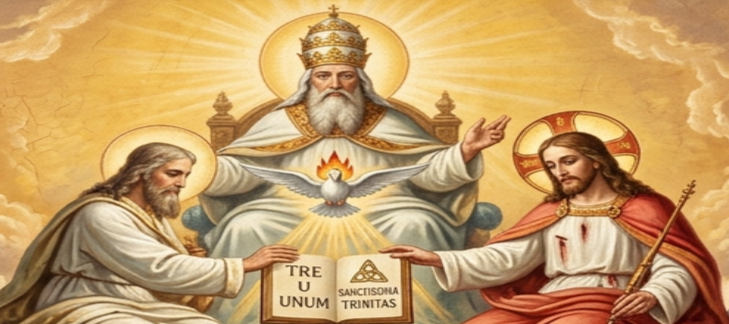
The Holy Trinity
Essential to the Catholic faith is the belief in a triune God. This belief is also one of the most difficult and complex aspects of Catholic theology.
In this essay, I will endeavor to explain two fundamental questions concerning the Trinity. First, how did Catholic theology develop a trinitarian doctrine, and second, how can this doctrine be conceptualized?
The Trinity – Development And Definition
At the outset, it must be admitted that the term ‘Trinity’ appears nowhere in the Bible. Rather, Catholic theology rests on biblical verses that depict Jesus identifying as the Son of God, claiming divinity, referring to God the Father, and promising the Holy Spirit. (See Matthew 28:19 and Luke 3:21-22).
Early theologians like Tertullian (c. 160–225 AD) were among the first to use the Latin term Trinitas to describe God as one essence with three distinct persons.
Nevertheless, the doctrine of the Trinity in Catholicism developed over several centuries from the biblical revelation of God as Father, Son, and Holy Spirit. In many ways, the doctrine of the Trinity was the work of various Church Councils, themselves convened to defend against heresies.
The Council of Nicaea (325 AD) affirmed that the Son is of the same substance as the Father. Nicea sought to counter the Arian heresy that argued that Jesus was a created being and not fully God. Nicea also condemned Sabellianism, which reduced the Trinity to a single God operating under different modes.
In 381 AD, the Council of Constantinople expanded the creed to explicitly define the Holy Spirit as fully divine and coequal with the Father and the Son, establishing the classic orthodox formula of one God in three divine persons.
Of the theologians who built on the work of the Councils, none had more influence in developing an understanding of the Trinity than Saint Augustine.
In his work ‘De Trinitate,’ Augustine posits that God is one divine essence (substance) in three distinct, coequal, and coeternal persons: the Father, the Son, and the Holy Spirit.
Augustine’s theology emphasized that God is not three distinct gods, but one God. The Father is God, the Son is God, and the Holy Spirit is God, sharing identical divine attributes like omnipotence and eternality.
By incorporating Aristotelian philosophy, medieval scholasticism refined the creeds into the definitive theological framework recognized today.
Specifically, Thomas Aquinas drew on Aristotelian philosophy to expand on Augustine. He famously explained the Trinity in terms of relations of origin: The Father eternally begets the Son, the Son is begotten, and the Holy Spirit eternally proceeds from both.
Owing to the complexity of developing a doctrine of the Trinity and explaining the nature of a transcendent God, numerous efforts have been made to create a framework for conceptualizing God.
The Interplay Of Three – Conceptualizing The Trinity
Any attempt to develop a conceptual framework for the Trinity is likely to use metaphors. For his part, Saint Augustine sought clues to the Trinity in creation, focusing heavily on the human mind as the “image of God”. Perhaps Augustine’s most famous attempt at this is to use the mind as an analogy for the Holy Trinity.
Augustine observed that the human mind has three aspects: memory, understanding, and will. Memory is the capacity of the mind to observe itself over time. Understanding or comprehension is the mind’s ability to know itself. Finally, the will is the mind’s ability to love itself.
While these three aspects are distinct, they constitute one single mind. Analogously, the Trinity is composed of God the Father, who (as memory) is the repository of the mind’s contents, containing innate knowledge and identity.
God the Son is the understanding or the active awareness that arises when the mind reflects upon its memory, generating knowledge or a mental “word” (Logos).
Lastly, the Holy Spirit is the will or desire that connects memory to understanding, driving the mind to love itself and its knowledge.
Expanding upon Augustine’s psychological analogy, the Trinity can also be conceptualized through the lens of modern philosophy of mind as a triad of consciousness, articulation, and relational will.
Identifying God the Father as consciousness allows one to understand the Father as the unoriginate and ultimate ground of being. In both theology and philosophy, He represents the boundless, unmanifest awareness from which all existence originates.
As such, God the Father is pure awareness, the subjective “I Am” before any specific thought is formed. It is the infinite horizon that holds all potential.
God the Son is the Logos (that is, the reason or understanding of God). In this sense, God the Son (Christ) represents the divine wisdom, form, and order. He is the expression of the Father’s mind made manifest in the universe.
To see why this is the case, it is necessary to understand that consciousness (the Father) cannot remain merely latent; it naturally reflects upon itself. The Son is the perfect image, the total and complete comprehension of the Father. As such, reason, or Logos, is consciousness made articulate. It is the Word that speaks the reality of the Father back to Himself.
As the bond between Father and Son, the Holy Spirit is the dynamic, active presence of God. The Spirit should be understood as the eternal, mutual love shared between the Father and the Son.
When ultimate consciousness (the Father) looks upon its perfect self-understanding (the Son), the immediate, necessary response is a recognition of total beauty and truth. That recognition is an outpouring of delight – the relational bond of love flowing between God the Father as knower and the Son as the known, and this bond of love is the Holy Spirit.
A point about language regarding the Trinity: it is easy, and occasionally even necessary, to employ language that suggests a temporal progression. (I am guilty of this). It is essential, however, to stress that there is no such temporal progression among the persons of the Trinity. The Father, Son, and Holy Spirit have existed eternally, and the progression spoken above is from all eternity.
Conclusion
Owing to the radical transcendence of God, any human effort to formulate a theological or philosophical understanding of God is going to be inadequate. This fact should not deter us from seeking the face of God even in the midst of such an intractable mystery.
In this essay, I have explored ways in which mankind has sought to conceptualize this ineffable mystery.
General Christian
History and Religion
Education and Religion
Previous Post
June 21, 2026
The Problem of Evil: The Theodicies of Augustine and Lewis
Next Post
July 5, 2026 Can Catholic Dogma Be Proven?
Recent Comments
"While Unitarianism remains a small minority of believers, its influence on Christianity must not be ..."
A Catholic Critique of Biblical Unitarianism
"Science has proven that Homosapiens have walked this Earth for over 200,000 years. Did God ..."
A Catholic Critique of Biblical Unitarianism
"The universe, the planet we inhabit, and life itself need not exist.This is a claim. ..."
Creation, Preservation, and Teleology in Catholic ..."
"If you have sufficient evidence to support a belief you don't need faith. Despite what ..."
Is Faith Really Blind? What Skeptics ..."
Browse Our Archives
Select a Category Abortion Atheism Catholicism. Catholicism. God. Theophany. Christmas Eschatology Faith and Works. God. Holy Spirit Intelligent Design Jesus Christ Justice Law Politics Protestantism Religion Sabbath Salvation. Soteriology. The Bible Theology Uncategorized
Select a Month November 2026 October 2026 September 2026 August 2026 July 2026 June 2026 May 2026 April 2026 March 2026 February 2026 January 2026 December 2025 November 2025 October 2025 September 2025 August 2025 July 2025 June 2025 May 2025 April 2025 March 2025 February 2025 January 2025 December 2024 November 2024 October 2024 September 2024 August 2024 July 2024 June 2024 May 2024 April 2024 March 2024 February 2024 January 2024 December 2023 November 2023 October 2023 September 2023 August 2023 July 2023 June 2023 May 2023 April 2023 March 2023 February 2023 January 2023 December 2022 November 2022 October 2022 September 2022 August 2022 July 2022 June 2022 May 2022 April 2022 March 2022 February 2022 January 2022 December 2021
Follow Us!
TAKE THE
Religious Wisdom Quiz
Who was cast into a pit by his brothers?
Select your answer to see how you score.
Moses Jacob Daniel Joseph
Related posts from Summa Catholic

If Baptism Washes Away Sin, Why Do Catholics...
A Catholic Critique of Biblical Unitarianism
Is Catholicism The Fulfillment Of The Old Testament?
Why Is Catholicism Centered on an Instrument of...
TRENDING AT PATHEOS Catholic

The Kingdom Of God In Ordinary Life And...
The kingdom of God is all around us; it is in us...

How Discretion Guides Us Away From Extremes
Prudence is an important virtue for all of us. While we should...

If Baptism Washes Away Sin, Why Do Catholics...
The seven sacraments stand as the foundation of Catholic ecclesial life. The...

The Power of Setting a Good Example
Remember last August when the Chicago White Sox hosted a "Pope Hat...

A Catholic Critique of Biblical Unitarianism
If the statistics are to be believed, Unitarianism is rising worldwide. Although...

How Grandma Tourism Helps Grandparents Live Their Vocation
Grandma, The New Travel Influencer What started as a nostalgia-inspired social media...
view all Catholic blogs
What Are Your Thoughts?leave a comment
Ad-Free & Subscriber Log-In Subscription Support
- About Us
- 2026 Calendar
- Videos
- Podcasts
- Library of World Religions
- Faith In Media Tracker
- Advertise With Us
- Write for Us
- Privacy Policy
- Terms of Service
- Do Not Sell My Data
- Contact Us
- Radiant Digital
- Manage Newsletter Subscriptions
- Unsubscribe From Notifications
- Sitemap
Copyright 2008-2026, Patheos, part of the Radiant Digital network of media brands. All rights reserved.
Subscription Support Ad-Free & Subscriber Log-In
Follow Patheos