
BuddhistCatholicContemplativeEvangelicalGeneral ChristianHinduJewishLatter-day SaintMuslimNew VisionsProgressive Christian
Beliefs
- Buddhist
- Catholic
- Contemplative
- Evangelical
- General Christian
- Hindu
- Jewish
- Latter-day Saint
- More Voices
- Muslim
- New Visions
- Pagan
- Progressive Christian
Topics
- Religion News
- Food and Religion
- Sports and Religion
- Religious Art
- Religious Music and Entertainment
- Religious Events
- History and Religion
- Style and Religion
- Politics and Religion
- Women in Religion
- Recreation Outdoors and Religion
- Business Finance and Religion
- Careers Workplace and Religion
- Education and Religion
- Family Parenting and Religion
- Health Fitness and Religion
- Home and Religion
- Relationships and Religion
- Technology and Religion
- Travel and Religion
Columnists
- Buddhist Columnists
- Business Finance and Religion Columnists
- Careers Workplace and Religion Columnists
- Catholic Columnists
- Contemplative Columnists
- Education and Religion Columnists
- Evangelists Columnists
- Family Parenting and Religion Columnists
- General Christian Columnists
- Health Fitness and Religion Columnists
- Hindu Columnists
- History and Religion Columnists
- Home and Religion Columnists
- Jewish Columnists
- More Voices Columnists
- Latter Day Columnists
- Muslim Columnists
- New Visions Columnists
- Nonreligious Columnists
- Pagan Columnists
- Politics and Religion Columnists
- Progressive Columnists
- Recreation Outdoors and Religion Columnists
- Relationships and Religion Columnists
- Religion News Columnists
- Religious Art Columnists
- Religious Events Columnists
- Religious Music and Entertainment Columnists
- Sports and Religion Columnists
- Style and Religion Columnists
- Technology and Religion Columnists
- Travel and Religion Columnists
- Women in Religion Columnists
Resource Library
- 2026 Calendar
- Library of World Religions
- The 100 Most Holy Places on Earth
- Patheos Answers
- Podcasts
- Videos
- Faith Leaders Database
- Anglican Episcopalian
- Bahai
- Baptist
- Buddhism
- Christianity
- Confucianism
- Eastern Orthodoxy
- Hinduism
- Holiness and Pentecostal
- ISKCON
- Islam
- Judaism
- Lutheran
- Methodist
- The Church of Jesus Christ of Latter-day Saints
- New Age
- Paganism
- Presbytarian and Reformed
- Protestantism
- Religion Behind the Scenes
- Roman Catholic
- Scientology
- Shia Islam
- Sikhism
- Sufism
- Sunni Islam
- Taoism
- Zen
- See all religions
Research Tools
 Ad-Free & Subscriber Log-In Subscription Support
Follow Patheos 

- Trending:
- Advent
- |
- Forgiveness
- |
- Thanksgiving
- |
- Election
- |
- Seasonal Holidays
- |
- Marriage

- Home
- Catholic
- Education and Religion
- What Are the Transcendentals? A Catholic Guide to Reality
What Are the Transcendentals? A Catholic Guide to Reality
Last updated on: May 24, 2026 at 10:21 am by David Schloss
What Are the Transcendentals? A Catholic Guide to Reality 2026-05-24T10:21:26-04:00 David Schloss
Patheos Explore the world's faith through different perspectives on religion and spirituality! Patheos has the views of the prevalent religions and spiritualities of the world.
The Transcendentals
Are there qualities or ideals of reality that are universal? If so, what are they, and how should they be understood?
For most of the past two thousand years, philosophy and theology have almost with one voice answered yes to the first question and offered the transcendentals as the framework for answering the second.
In this paper, I will explore the concept of transcendentals within a Catholic framework. Specifically, I will show the significance of transcendentals for intellectual and religious life, and the danger posed by denying these properties of reality.
The Transcendentals
A transcendental is usually considered or defined as an ultimate property of being. Since being is not limited to the body or matter, transcendentals both include and transcend the material, physical world. As such, they are the ultimate, universal properties of being that apply to all things simply by virtue of existing.
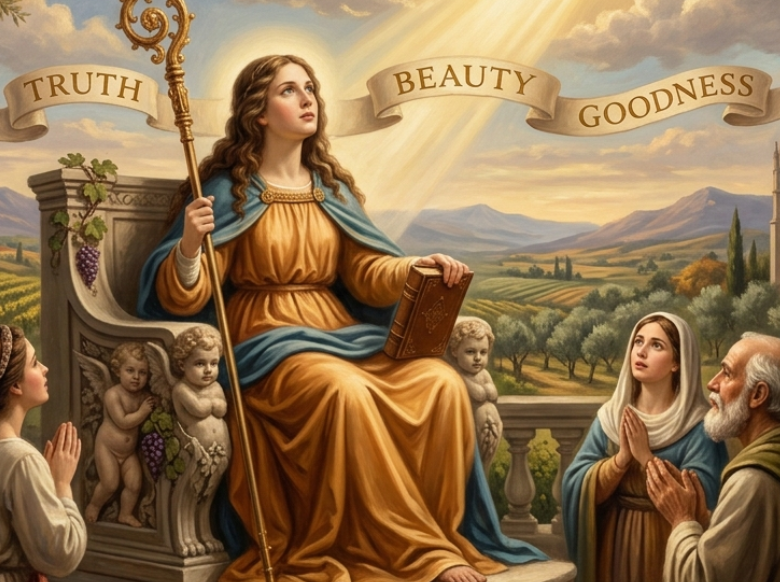
How many transcendentals are there? The number varies depending on the source and interpretation; however, Catholic philosophy usually asserts that there are four. They are the one, the true, the good, and the beautiful.
Everything that exists, everything that has being is one (distinct from others), true (conforms or is intelligible to its creator), is good (by virtue of existing), and beautiful (because whatever exists points to a divine or ultimate reality).
To some extent, Plato’s “Forms” laid the foundation for the development of the transcendentals in the Middle Ages. Platonic philosophy posited that concepts like absolute Truth, Beauty, and Goodness existed as ultimate, unchanging realities in a transcendent realm.
Plato viewed these qualities, which he called the Forms, not merely as properties or ideas but as possessing subsistent existence.
Unlike Plato’s Forms, however, transcendentals are not subsistent things but rather properties of being itself. Additionally, as we will see below, the transcendentals are interchangeable. That is not the case with Plato’s Forms.
Understanding the transcendentals as intrinsic properties of existence – rather than isolated, distant ideals – reveals why Catholic theology places such immense weight on them.
Significance Of Transcendentals
Beginning with Augustine and Aquinas, the transcendentals are understood as properties or attributes that exist perfectly in God and are reflected in creation. Said differently, the transcendentals are the ultimate, universal properties of being that transcend all boundaries of time, space, and culture.
The significance lies in the belief that the transcendentals are not inventions of the human mind but rather divine attributes. Because God is absolute Unity, Truth, Beauty, and Goodness, any encounter with these qualities in creation acts as a cosmic magnet, drawing the human soul back to its source.
God is one in His being, but moreover, God is being itself. Because God is an absolute Being, He is also an absolute Unity. The transcendental unity of God contains no multitude, parts, or composition, making divine unity radically pure and perfect.
As a philosophical concept, truth is defined as the correspondence of the mind to reality. In Catholicism, truth is not merely a concept, but the Person of Jesus Christ (John 14:6).
From the Catholic perspective, beauty is the majesty of truth. Since God is the embodiment of truth, He is also the pinnacle of beauty.
Finally, God is the summum bonum or highest good. We can understand this concept by recognizing that the world we inhabit possesses many goods. We experience love, and pleasure, and food, and a sundry other things we may deem “good.” However, all those things are temporal and fleeting, whereas everything good exists eternally and perpetually in God.
Whatever exists, whatever is true, whatever is beautiful, whatever is good finds its highest form or fulfillment in God.
If both Catholicism and most of Western philosophy emphasize the transcendentals, what do we lose if they are not emphasized in modern society?
Rejection And Result
Owing in part to William of Ockham’s Nominalism and Immanuel Kant’s rejection of metaphysics (the study of the fundamental nature of reality), the study of the transcendentals has fallen out of favor in modern philosophical thought.
From a Catholic vantage point, I think there are four detrimental effects associated with this repudiation of the transcendentals.
The first effect is to aid in the secularization of our culture. As the Catholic philosopher Peter Kreeft noted, the transcendentals act as a bridge between the physical and spiritual realms. Denying the transcendentals destroys that bridge.
Second, it does damage to the human person. The reason for this is that the transcendentals perfectly correspond to three core faculties of the human soul. The intellect seeks to know the truth, the will desires the good, and the emotions are drawn to and moved by beauty.
The third detrimental effect of the bracketing of the transcendentals has a moral component. Catholic philosophy has long held that the transcendentals are convertible, where one is present, the others are inherently present, as well.
A genuinely good act possesses moral beauty and aligns with objective truth. Because the transcendentals reflect God, they are universally true and beautiful regardless of culture or personal ideology.
When God is positioned as the highest good, it reshapes a person’s priorities. It implies that aligning one’s life, morals, and love with God gives everything else its proper and healthy order.
It is no wonder, therefore, that by denying the transcendentals, modernity struggles with matters of truth, goodness, and beauty.
Lastly, the Catholic Church relies on the transcendentals as primary avenues for evangelization and teaching. In an increasingly secular world, introducing non-believers to the beauty of Catholic art, music, and architecture, or to the intellectual truth of Catholic philosophy, can serve as “stepping stones” that lead people to the fullness of faith in God.
Schematically, the rejection of truth yields moral relativism. The rejection of goodness leads to a fractured sense of human dignity and egoism. The rejection of beauty explains the utilitarian, often bleak landscape of modern architecture and art. Lastly, the rejection of unity feeds the hyper-individualism and cultural polarization we see today.
Conclusion
Of the transcendentals, we may say that they are attributes of the divine nature that are reflected in God’s creation. Moreover, they are aspects of our consciousness that make us aware of, and have a desire for, the One, the True, the Beautiful, and the Good.
By adopting a Kantian position on metaphysics, which is to say the rejection of metaphysics, modern secularism has sought to deny the transcendentals. This rejection, in my opinion, has damaged our capacity for a critical and comprehensive understanding of reality.
General Christian
Education and Religion
History and Religion
Previous Post

May 17, 2026
Cooperating with the Divine: An Analysis of Grace
Next Post

May 31, 2026 Why Faith Demands Both Dogma and Relationship
Recent Comments
"While Unitarianism remains a small minority of believers, its influence on Christianity must not be ..."
A Catholic Critique of Biblical Unitarianism
"Science has proven that Homosapiens have walked this Earth for over 200,000 years. Did God ..."
A Catholic Critique of Biblical Unitarianism
"The universe, the planet we inhabit, and life itself need not exist.This is a claim. ..."
Creation, Preservation, and Teleology in Catholic ..."
"If you have sufficient evidence to support a belief you don't need faith. Despite what ..."
Is Faith Really Blind? What Skeptics ..."
Browse Our Archives
Select a Category Abortion Atheism Catholicism. Catholicism. God. Theophany. Christmas Eschatology Faith and Works. God. Holy Spirit Intelligent Design Jesus Christ Justice Law Politics Protestantism Religion Sabbath Salvation. Soteriology. The Bible Theology Uncategorized
Select a Month November 2026 October 2026 September 2026 August 2026 July 2026 June 2026 May 2026 April 2026 March 2026 February 2026 January 2026 December 2025 November 2025 October 2025 September 2025 August 2025 July 2025 June 2025 May 2025 April 2025 March 2025 February 2025 January 2025 December 2024 November 2024 October 2024 September 2024 August 2024 July 2024 June 2024 May 2024 April 2024 March 2024 February 2024 January 2024 December 2023 November 2023 October 2023 September 2023 August 2023 July 2023 June 2023 May 2023 April 2023 March 2023 February 2023 January 2023 December 2022 November 2022 October 2022 September 2022 August 2022 July 2022 June 2022 May 2022 April 2022 March 2022 February 2022 January 2022 December 2021
Follow Us!
TAKE THE
Religious Wisdom Quiz
What is the term for the 40 days Jesus spent in the wilderness, remembered by Christians in Lent?
Select your answer to see how you score.
Temptation of Christ Crucifixion Transfiguration Sermon on the Mount
Related posts from Summa Catholic

If Baptism Washes Away Sin, Why Do Catholics...

A Catholic Critique of Biblical Unitarianism
Why Is Catholicism Centered on an Instrument of...

Is Faith Really Blind? What Skeptics Get Wrong
TRENDING AT PATHEOS Catholic

Bad Survey Questions Distort Eucharistic Theology
It seems to be the newest thing: someone conducts a bad survey...

If Baptism Washes Away Sin, Why Do Catholics...
The seven sacraments stand as the foundation of Catholic ecclesial life. The...

Far from promoting indifference, inaction, or quietism, Paul consistently tells us to...

The Power of Setting a Good Example
Remember last August when the Chicago White Sox hosted a "Pope Hat...

A Catholic Critique of Biblical Unitarianism
If the statistics are to be believed, Unitarianism is rising worldwide. Although...

How Grandma Tourism Helps Grandparents Live Their Vocation
Grandma, The New Travel Influencer What started as a nostalgia-inspired social media...
view all Catholic blogs
What Are Your Thoughts?leave a comment
Ad-Free & Subscriber Log-In Subscription Support
- About Us
- 2026 Calendar
- Videos
- Podcasts
- Library of World Religions
- Faith In Media Tracker
- Advertise With Us
- Write for Us
- Privacy Policy
- Terms of Service
- Do Not Sell My Data
- Contact Us
- Radiant Digital
- Manage Newsletter Subscriptions
- Unsubscribe From Notifications
- Sitemap
Copyright 2008-2026, Patheos, part of the Radiant Digital network of media brands. All rights reserved.
Subscription Support Ad-Free & Subscriber Log-In
Follow Patheos