
BuddhistCatholicContemplativeEvangelicalGeneral ChristianHinduJewishLatter-day SaintMuslimNew VisionsProgressive Christian
Beliefs
- Buddhist
- Catholic
- Contemplative
- Evangelical
- General Christian
- Hindu
- Jewish
- Latter-day Saint
- More Voices
- Muslim
- New Visions
- Pagan
- Progressive Christian
Topics
- Religion News
- Food and Religion
- Sports and Religion
- Religious Art
- Religious Music and Entertainment
- Religious Events
- History and Religion
- Style and Religion
- Politics and Religion
- Women in Religion
- Recreation Outdoors and Religion
- Business Finance and Religion
- Careers Workplace and Religion
- Education and Religion
- Family Parenting and Religion
- Health Fitness and Religion
- Home and Religion
- Relationships and Religion
- Technology and Religion
- Travel and Religion
Columnists
- Buddhist Columnists
- Business Finance and Religion Columnists
- Careers Workplace and Religion Columnists
- Catholic Columnists
- Contemplative Columnists
- Education and Religion Columnists
- Evangelists Columnists
- Family Parenting and Religion Columnists
- General Christian Columnists
- Health Fitness and Religion Columnists
- Hindu Columnists
- History and Religion Columnists
- Home and Religion Columnists
- Jewish Columnists
- More Voices Columnists
- Latter Day Columnists
- Muslim Columnists
- New Visions Columnists
- Nonreligious Columnists
- Pagan Columnists
- Politics and Religion Columnists
- Progressive Columnists
- Recreation Outdoors and Religion Columnists
- Relationships and Religion Columnists
- Religion News Columnists
- Religious Art Columnists
- Religious Events Columnists
- Religious Music and Entertainment Columnists
- Sports and Religion Columnists
- Style and Religion Columnists
- Technology and Religion Columnists
- Travel and Religion Columnists
- Women in Religion Columnists
Resource Library
- 2026 Calendar
- Library of World Religions
- The 100 Most Holy Places on Earth
- Patheos Answers
- Podcasts
- Videos
- Faith Leaders Database
- Anglican Episcopalian
- Bahai
- Baptist
- Buddhism
- Christianity
- Confucianism
- Eastern Orthodoxy
- Hinduism
- Holiness and Pentecostal
- ISKCON
- Islam
- Judaism
- Lutheran
- Methodist
- The Church of Jesus Christ of Latter-day Saints
- New Age
- Paganism
- Presbytarian and Reformed
- Protestantism
- Religion Behind the Scenes
- Roman Catholic
- Scientology
- Shia Islam
- Sikhism
- Sufism
- Sunni Islam
- Taoism
- Zen
- See all religions
Research Tools
 Ad-Free & Subscriber Log-In Subscription Support
Ad-Free & Subscriber Log-In Subscription Support
Follow Patheos 

- Trending:
- Forgiveness
- |
- Marriage
- |
- Consciousness
- |
- Death Penalty
- |
- Election
- |
- Halloween

- Home
- Catholic
- Education and Religion
- Brute Facts and the Existence of God
Brute Facts and the Existence of God
Last updated on: May 10, 2026 at 11:28 am by David Schloss
Brute Facts and the Existence of God 2026-05-10T11:28:16-04:00 David Schloss
Patheos Explore the world's faith through different perspectives on religion and spirituality! Patheos has the views of the prevalent religions and spiritualities of the world.
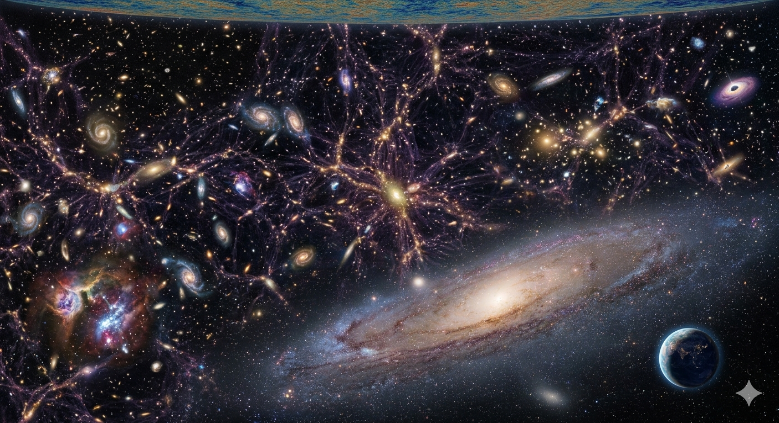
A Created Universe
“I should say that the universe is just there, and that is all.” – Bertrand Russell.
One of the most fundamental questions of philosophy involves the existence and nature of the universe. Questions such as whether the universe is eternal or identical to God have stirred philosophical curiosity for millennia.
In this paper, I will review the philosophical position known as a brute-fact universe. I will then compare it with a theological counterpart, a necessary God hypothesis.
A Brute-Fact Universe
A brute-fact hypothesis is any fact that requires no explanation; it simply is that way.
In the case of the universe, a brute-fact universe is a universe that just is. It is not caused nor is it necessarily eternal; it just exists, and science should not enquire any further. As such, the brute-fact universe becomes the starting point for science and philosophy.
To understand this claim, it is necessary to place it in opposition to the principle of sufficient reason. Developed by Gottfried Leibniz, the principle of sufficient reason states that no fact or statement can exist unless there is a sufficient reason why it is so and not otherwise. Said simply, everything has a reason.
Not surprisingly, there are several problems and criticisms of the brute-fact universe.
By violating the principle of sufficient reason, a brute-fact universe undermines the rationality of science. If the existence of the universe itself is a brute fact with no explanation, it creates an arbitrary stopping point that could, in principle, be applied to any scientific mystery, potentially halting scientific inquiry.
Additionally, a brute-fact universe contradicts empirical observations. The universe appears to be composed of contingent parts. If everything in the universe is reliant on something else for its existence, it is inconsistent to assume the universe itself is not.
Of course, the brute-fact universe stands in direct conflict with the biblical and Catholic teachings on the origin and nature of the universe, as well. A Catholic understanding of the universe requires that it be created and sustained by God.
In view of both the scientific and religious objections to a brute-fact universe, it is obvious that Catholics must reject the hypothesis.
One may ask, however, if Catholicism is not being hypocritical in this regard. After all, does not Catholicism assert that God “just exists?” That is to say, is the God of the Bible a brute-fact God?
A Brute-Fact God?
Is Catholic theology and philosophy guilty of essentially advocating for the existence of a brute-fact God? Is God something that Catholics accept as “just there, and that is all?”
The answer is no. Catholic theology and philosophy assert that God is existence itself. As such, God exists necessarily. In this view, God is not a brute fact, but the wellspring or ground of existence itself. If God does not exist, there are no facts, brute or otherwise.
Nevertheless, it must be admitted that both positions, a brute-fact universe and a God that exists necessarily, are seeking to address the fundamental philosophical and scientific question of existence. As such, the brute fact approach is, ontologically speaking, a metaphysical stop sign.
Regardless of whether the hypothesis is applied to the universe or God, it suggests that at the foundation of reality lies a truth that has no further explanation, no preceding cause, and no deeper “why.”
From what has been said thus far, it appears that the two theories cancel each other out. To break this stalemate, it is necessary to determine which theory has the strongest explanatory power about reality.
The Brute-Fact Conflict
Between these two theories, which one provides the most explanatory power for the reality we face?
Admittedly, the brute-fact universe is simplistic. The universe “just is,” and there is no question of why it exists. However, as with most things in the atheistic-materialistic worldview, it fails to satisfy intuitively and persuade logically.
If the universe “just is,” then so is everything else, including humans. There is no meaning or purpose to be understood. Under these circumstances, life is, as the atheist Jean-Paul Sartre observed, absurd.
The alternative, a God that exists necessarily, provides the explanatory power that cannot be obtained in a universe that just is. I want to suggest several reasons why the existence of God provides greater explanatory power than a brute-fact universe.
The first argument is based on the contingency of the world. Like everything else in the created order, the universe came into existence at a specific time (approximately 14 billion years ago). Is it possible that the universe just “popped” into existence for no reason?
The Oxford University mathematical physicist Roger Penrose determined the odds of the universe randomly coming into existence are “1 part in 10 to the power of 10 to the power of 123, that is 1 followed by 10 to the 123rd power zeros.” In essence, it is mathematically impossible for the universe, or anything else for that matter, to cause itself to come into existence (which is, in itself, logically impossible).
Put simply, mathematics, logic, and the principle of sufficient reason dictate that the universe has a cause. One may argue that the cause of the universe could have been another universe (the multiverse theory) or an eternal quantum field that led to the Big Bang. These theories run afoul of another problem: complexity.
The remarkable complexity and design of the universe is the second reason why the existence of God provides much greater explanatory power than a brute-fact universe.
There are essentially two levels of complexity that I want to touch upon. The first are the physical constants. These are laws of the universe without which life could not be possible.
Examples include the fact that the universe’s initial entropy was extremely low, estimated to be within 1 part in 10^{10^{123} of the available phase space, which was necessary for a structure-filled universe. The result would have been a universe that dies rapidly from heat death (all of the heat and energy of the universe would have been spread so thinly that nothing could form). Another example of these fine-tuning constants is the strong nuclear force.
If the strong nuclear force were slightly weaker, multi-proton nuclei would not hold together. The result would have been that all complex matter, including stars, planets, and life, would never have formed. If it were stronger, all protons would have combined into heavier elements, leaving no hydrogen for water or fuel for stars.
As an aside, two prominent scientists, Fred Hoyle and N. Chandra Wickramasinghe, calculated the odds of life arising by natural processes (abiogenesis). They estimated that the probability of life originating by chance is less than 1 in 10^40,000 (essentially mathematically impossible).
This leads to the second level of complexity: that of life itself. It is not necessary to linger long here. However, it is worth noting that DNA functions as a digital linguistic code, containing an estimated 6.2 billion bits of information. Owing to the level of complexity, the mathematical probability of human DNA forming by chance is zero.
Not only do we live in an information-laden universe, but our very bodies are driven by information. A brute-fact universe can explain none of this.
Conclusion
Many will find the concept of a universe that just exists without cause or reason unsatisfactory. That dissatisfaction only intensifies when we become aware that a brute-fact universe cannot account for reality. The metaphysical stop sign imposed by a brute-fact universe is misplaced.
This essay has sought to show that the existence of God has much greater explanatory power than the hypothesis of a brute-fact universe.
General Christian
Education and Religion
Technology and Religion
Previous Post
May 3, 2026
Talking Donkeys and Myth: How Catholics Read the Bible
Next Post

May 17, 2026 Cooperating with the Divine: An Analysis of Grace
Recent Comments
"Why would it matter if atheism is wrong? The fact that Catholic and Protestant scholars ..."
Beyond the Absence of Belief: The ..."
"Kaiser Member Service Proponents often compare atheism to not collecting stamps—it is the lack of ..."
Beyond the Absence of Belief: The ..."
""these dual denials (objective truth and objective meaning)"This is not accurate. Post-modern thought does not ..."
Defending the Faith in a Post-Truth ..."
"The theologians still haven't received the memo. Your opposition are no longer atheists, but they ..."
Defending the Faith in a Post-Truth ..."
Browse Our Archives
Select a Category Abortion Atheism Catholicism. Catholicism. God. Theophany. Christmas Eschatology Faith and Works. God. Holy Spirit Intelligent Design Jesus Christ Justice Law Politics Protestantism Religion Sabbath Salvation. Soteriology. The Bible Theology Uncategorized
Select a Month October 2026 September 2026 August 2026 July 2026 June 2026 May 2026 April 2026 March 2026 February 2026 January 2026 December 2025 November 2025 October 2025 September 2025 August 2025 July 2025 June 2025 May 2025 April 2025 March 2025 February 2025 January 2025 December 2024 November 2024 October 2024 September 2024 August 2024 July 2024 June 2024 May 2024 April 2024 March 2024 February 2024 January 2024 December 2023 November 2023 October 2023 September 2023 August 2023 July 2023 June 2023 May 2023 April 2023 March 2023 February 2023 January 2023 December 2022 November 2022 October 2022 September 2022 August 2022 July 2022 June 2022 May 2022 April 2022 March 2022 February 2022 January 2022 December 2021
Follow Us!
TAKE THE
Religious Wisdom Quiz
Who was Ruth's second husband?
Select your answer to see how you score.
Boaz Elimelech Chilion Mahlon
Related posts from Summa Catholic
Creation, Preservation, and Teleology in Catholic Theology

The Anatomy of Divine Revelation in Catholic Thought

Beyond the Absence of Belief: The Implications of...

Can Catholic Apologetics Survive a Postmodern World?
TRENDING AT PATHEOS Catholic

Creation, Preservation, and Teleology in Catholic Theology
As I write this, it is very early Monday morning. Like millions...

The Parable Of The Sower And The Word...
One of Christ’s most famous parables is that of the sower who...

Rejecting Doom: Christian Hope And Human Action
Christianity is a religion of hope. We are to have hope and...

Why I Choose the Eucharist Over the Sermon
Choose the Eucharist, Not the Sermon What are we supposed to get...

5 Design Elements Found in Spiritually Rooted Homes
Putting Spirituality Into Home Decor Our homes are more than our living...

Credo: A Story of God Told with the...
About 10 years ago, I began to imagine a personal "Credo" that...
view all Catholic blogs
What Are Your Thoughts?leave a comment
Ad-Free & Subscriber Log-In Subscription Support
- About Us
- 2026 Calendar
- Videos
- Podcasts
- Library of World Religions
- Faith In Media Tracker
- Advertise With Us
- Write for Us
- Privacy Policy
- Terms of Service
- Do Not Sell My Data
- Contact Us
- Radiant Digital
- Manage Newsletter Subscriptions
- Unsubscribe From Notifications
- Sitemap
Copyright 2008-2026, Patheos. All rights reserved.
Subscription Support Ad-Free & Subscriber Log-In
Follow Patheos