
BuddhistCatholicContemplativeEvangelicalGeneral ChristianHinduJewishLatter-day SaintMuslimNew VisionsProgressive Christian
Beliefs
- Buddhist
- Catholic
- Contemplative
- Evangelical
- General Christian
- Hindu
- Jewish
- Latter-day Saint
- More Voices
- Muslim
- New Visions
- Pagan
- Progressive Christian
Topics
- Religion News
- Food and Religion
- Sports and Religion
- Religious Art
- Religious Music and Entertainment
- Religious Events
- History and Religion
- Style and Religion
- Politics and Religion
- Women in Religion
- Recreation Outdoors and Religion
- Business Finance and Religion
- Careers Workplace and Religion
- Education and Religion
- Family Parenting and Religion
- Health Fitness and Religion
- Home and Religion
- Relationships and Religion
- Technology and Religion
- Travel and Religion
Columnists
- Buddhist Columnists
- Business Finance and Religion Columnists
- Careers Workplace and Religion Columnists
- Catholic Columnists
- Contemplative Columnists
- Education and Religion Columnists
- Evangelists Columnists
- Family Parenting and Religion Columnists
- General Christian Columnists
- Health Fitness and Religion Columnists
- Hindu Columnists
- History and Religion Columnists
- Home and Religion Columnists
- Jewish Columnists
- More Voices Columnists
- Latter Day Columnists
- Muslim Columnists
- New Visions Columnists
- Nonreligious Columnists
- Pagan Columnists
- Politics and Religion Columnists
- Progressive Columnists
- Recreation Outdoors and Religion Columnists
- Relationships and Religion Columnists
- Religion News Columnists
- Religious Art Columnists
- Religious Events Columnists
- Religious Music and Entertainment Columnists
- Sports and Religion Columnists
- Style and Religion Columnists
- Technology and Religion Columnists
- Travel and Religion Columnists
- Women in Religion Columnists
Resource Library
- 2026 Calendar
- Library of World Religions
- The 100 Most Holy Places on Earth
- Patheos Answers
- Podcasts
- Videos
- Faith Leaders Database
- Anglican Episcopalian
- Bahai
- Baptist
- Buddhism
- Christianity
- Confucianism
- Eastern Orthodoxy
- Hinduism
- Holiness and Pentecostal
- ISKCON
- Islam
- Judaism
- Lutheran
- Methodist
- The Church of Jesus Christ of Latter-day Saints
- New Age
- Paganism
- Presbytarian and Reformed
- Protestantism
- Religion Behind the Scenes
- Roman Catholic
- Scientology
- Shia Islam
- Sikhism
- Sufism
- Sunni Islam
- Taoism
- Zen
- See all religions
Research Tools
 Ad-Free & Subscriber Log-In Subscription Support
Follow Patheos 

- Trending:
- Advent
- |
- Forgiveness
- |
- Thanksgiving
- |
- Election
- |
- Seasonal Holidays
- |
- Marriage

- Home
- Catholic
- Education and Religion
- Temptation and Theology – A Catholic Perspective
Temptation and Theology – A Catholic Perspective
Last updated on: April 26, 2026 at 10:07 am by David Schloss
Temptation and Theology – A Catholic Perspective 2026-04-26T10:07:24-04:00 David Schloss
Patheos Explore the world's faith through different perspectives on religion and spirituality! Patheos has the views of the prevalent religions and spiritualities of the world.
From a biblical perspective, the story of mankind begins with temptation. The Book of Genesis depicts how the serpent (i.e., Satan) tempts Eve, who in turn tempts Adam. Of course, temptation is not unknown in the New Testament, where the Apostle John writes of a triple temptation (1 John 2:16).
From an individual perspective, when one considers the spiritual life, it is not long before one comes in contact with and does battle with temptation.
In this essay, I will examine and compare how the “first man,” Adam, and the “last man,” Christ, experienced temptation and how they dealt with it. First, however, we must explore what temptation is in a Catholic sense.
Temptation And Theology
Before examining the temptations of both Adam and Christ, we must answer a basic question: What is temptation?
Used informally, temptation usually refers to a desire to do something that may not be prudent. A theological perspective expands on this concept by defining temptation as being enticed or solicited to act against the will of God.
In this context, it follows that temptation presupposes free will and a developed reason that allows one to accept the existence of God. Furthermore, temptation, as an act against the will of God, necessitates that one know God’s will.
There are two ways in which sentient creatures can come to know the will of God. In the first way, one experiences the beatific vision, which is to see God in His very essence. This way is not possible for human beings while still alive.
The second way is through a thing’s nature. Human nature is so construed as to be able to comprehend the will of God through the intellect and conscience. Of course, human nature is also capable of free will, which makes it susceptible to temptation. Said differently, the intellect knows the will of God through natural law, but the will does not always choose to act on that knowledge.
The Tempting Of Adam And Eve
“The woman saw that the tree was good for food and pleasing to the eyes, and the tree was desirable for gaining wisdom. So she took some of its fruit and ate it; and she also gave some to her husband, who was with her, and he ate it.” – Genesis 3:6.
Regardless of whether one subscribes to a literal or a spiritual interpretation of Genesis, I want to suggest that there are three distinct motivations or temptations present in Genesis 3:6.
Eve saw that the tree was good for food, representing the first temptation: pleasure. Second, the text tells us that the food on the tree was pleasing to the eye. This temptation corresponds to obtaining many possessions for oneself and to possessing worldly power. Finally, the fruits of the tree were offered to make her wise. This final temptation corresponds to pride.
Of course, these three temptations taken in isolation are not inherently bad or sinful. In fact, temptation itself is not necessarily bad, given the fact that we live in a fallen world. Pleasure, power, and pride do become problematic when they are disordered and contrary to God’s will.
The Tempting Of Christ
Within the Catholic tradition, Christ is considered the “new” Adam. In his epistle to the Romans, Saint Paul writes, “For just as through the disobedience of one person [Adam] the many were made sinners, so through the obedience of one [Christ] the many will be made righteous.” (Romans 5:19).
We can also draw parallels to how they experienced temptation. Before exploring how Christ dealt with being tempted, it is necessary to address an apparent contradiction.
The Catholic-biblical tradition asserts that God cannot be tempted (James 1:13). Yet that same tradition asserts that Christ is God. So, how can we intelligibly speak of Christ being tempted?
The answer lies in the hypostatic union. Because Christ possesses both a divine and a human nature, He can experience temptation in His human nature, as we do, without it affecting His divine nature. Having provided the theological foundation, we can now explore the biblical narrative of Christ’s temptation.
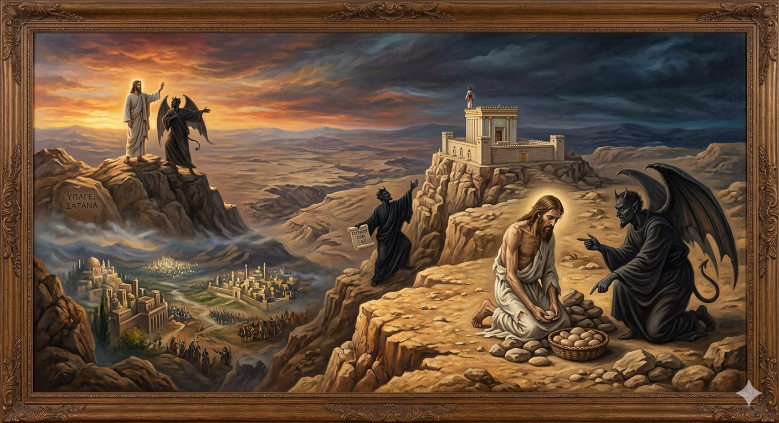
Following His baptism, Christ spends forty days in the desert. During this time, He is tempted by the Devil. As with Adam and Eve, it is possible to discern three different temptations. For brevity, I have abridged the text from Matthew’s Gospel describing Christ’s time in the desert.
**“**The tempter [Satan] approached and said to him, ‘If you are the Son of God, command that these stones become loaves of bread.’ Then the Devil took him to the holy city and made him stand on the parapet of the Temple and said to him, ‘If you are the Son of God, throw yourself down.’ For it is written: ‘He will command his angels concerning you and with their hands they will support you, lest you dash your foot against a stone.’ Then the Devil took him up to a very high mountain, and showed him all the kingdoms of the world in their magnificence, and he said to him, ‘All these I shall give to you, if you will prostrate yourself and worship me.” (Matthew 4:1-11).
First, Jesus is tempted to turn stones into bread to satisfy his hunger. This was a temptation to use Christ’s divine power for selfish, immediate gratification rather than trusting God. It also correlates to the temptation of pleasure.
The second temptation is the Devil’s attempt to have Christ give in to pride. By jumping from the Temple and being saved by angels, Christ would gain public recognition as the Son of God.
The third and final temptation of Christ corresponds to power. Here, Christ is given the option of ultimate worldly power without the suffering He is destined for on the Cross.
I have thus far delineated and compared how Adam and Christ experienced temptation. It goes almost without saying that where Adam failed to overcome these tests, Christ prevailed. I will conclude this essay by examining the tools Christ used to overcome temptation.
The Solution To Temptation
The great Catholic tradition has long recognized three spiritual disciplines necessary in combating temptation. They are fasting, almsgiving, and prayer.
Fasting is used to curb excessive desires and helps to weaken the appetite for pleasure. Additionally, fasting masters the body’s cravings for food and comfort.
Almsgiving, which can be defined as a kind of charity, works by breaking the temptation of greed and consumerism (worldly attachment) by fostering detachment from possessions and promoting love for one’s neighbor.
Finally, prayer combats pride by highlighting one’s dependence on God, which, in turn, fosters humility and strengthens spiritual connection to resist evil.
Conclusion
Temptation is ubiquitous in this world, and it is certainly not unknown to the Bible. In this essay, I have noted the similarities of temptations experienced by Adam and Christ. I have also enumerated the three spiritual disciplines traditionally utilized to overcome these tests.
If the downfall of humankind came about because of its inability to overcome temptation, then surely restoration of the human person required a triumph where the first man faltered – a total redirection of the will toward the divine.
Education and Religion
History and Religion
Previous Post
April 19, 2026
A Catholic Critique of Utilitarianism
Next Post
May 3, 2026 Talking Donkeys and Myth: How Catholics Read the Bible
Recent Comments
"While Unitarianism remains a small minority of believers, its influence on Christianity must not be ..."
A Catholic Critique of Biblical Unitarianism
"Science has proven that Homosapiens have walked this Earth for over 200,000 years. Did God ..."
A Catholic Critique of Biblical Unitarianism
"The universe, the planet we inhabit, and life itself need not exist.This is a claim. ..."
Creation, Preservation, and Teleology in Catholic ..."
"If you have sufficient evidence to support a belief you don't need faith. Despite what ..."
Is Faith Really Blind? What Skeptics ..."
Browse Our Archives
Select a Category Abortion Atheism Catholicism. Catholicism. God. Theophany. Christmas Eschatology Faith and Works. God. Holy Spirit Intelligent Design Jesus Christ Justice Law Politics Protestantism Religion Sabbath Salvation. Soteriology. The Bible Theology Uncategorized
Select a Month November 2026 October 2026 September 2026 August 2026 July 2026 June 2026 May 2026 April 2026 March 2026 February 2026 January 2026 December 2025 November 2025 October 2025 September 2025 August 2025 July 2025 June 2025 May 2025 April 2025 March 2025 February 2025 January 2025 December 2024 November 2024 October 2024 September 2024 August 2024 July 2024 June 2024 May 2024 April 2024 March 2024 February 2024 January 2024 December 2023 November 2023 October 2023 September 2023 August 2023 July 2023 June 2023 May 2023 April 2023 March 2023 February 2023 January 2023 December 2022 November 2022 October 2022 September 2022 August 2022 July 2022 June 2022 May 2022 April 2022 March 2022 February 2022 January 2022 December 2021
Follow Us!
TAKE THE
Religious Wisdom Quiz
What small part of the body does James say is a restless evil, full of deadly poison?
Select your answer to see how you score.
The tongue The hand The eye The heart
Related posts from Summa Catholic

If Baptism Washes Away Sin, Why Do Catholics...

A Catholic Critique of Biblical Unitarianism
Why Is Catholicism Centered on an Instrument of...

Is Faith Really Blind? What Skeptics Get Wrong
TRENDING AT PATHEOS Catholic

The Kingdom Of God In Ordinary Life And...
The kingdom of God is all around us; it is in us...

How Discretion Guides Us Away From Extremes
Prudence is an important virtue for all of us. While we should...

If Baptism Washes Away Sin, Why Do Catholics...
The seven sacraments stand as the foundation of Catholic ecclesial life. The...

The Power of Setting a Good Example
Remember last August when the Chicago White Sox hosted a "Pope Hat...

A Catholic Critique of Biblical Unitarianism
If the statistics are to be believed, Unitarianism is rising worldwide. Although...

How Grandma Tourism Helps Grandparents Live Their Vocation
Grandma, The New Travel Influencer What started as a nostalgia-inspired social media...
view all Catholic blogs
What Are Your Thoughts?leave a comment
Ad-Free & Subscriber Log-In Subscription Support
- About Us
- 2026 Calendar
- Videos
- Podcasts
- Library of World Religions
- Faith In Media Tracker
- Advertise With Us
- Write for Us
- Privacy Policy
- Terms of Service
- Do Not Sell My Data
- Contact Us
- Radiant Digital
- Manage Newsletter Subscriptions
- Unsubscribe From Notifications
- Sitemap
Copyright 2008-2026, Patheos, part of the Radiant Digital network of media brands. All rights reserved.
Subscription Support Ad-Free & Subscriber Log-In
Follow Patheos