
BuddhistCatholicContemplativeEvangelicalGeneral ChristianHinduJewishLatter-day SaintMuslimNew VisionsProgressive Christian
Beliefs
- Buddhist
- Catholic
- Contemplative
- Evangelical
- General Christian
- Hindu
- Jewish
- Latter-day Saint
- More Voices
- Muslim
- New Visions
- Pagan
- Progressive Christian
Topics
- Religion News
- Food and Religion
- Sports and Religion
- Religious Art
- Religious Music and Entertainment
- Religious Events
- History and Religion
- Style and Religion
- Politics and Religion
- Women in Religion
- Recreation Outdoors and Religion
- Business Finance and Religion
- Careers Workplace and Religion
- Education and Religion
- Family Parenting and Religion
- Health Fitness and Religion
- Home and Religion
- Relationships and Religion
- Technology and Religion
- Travel and Religion
Columnists
- Buddhist Columnists
- Business Finance and Religion Columnists
- Careers Workplace and Religion Columnists
- Catholic Columnists
- Contemplative Columnists
- Education and Religion Columnists
- Evangelists Columnists
- Family Parenting and Religion Columnists
- General Christian Columnists
- Health Fitness and Religion Columnists
- Hindu Columnists
- History and Religion Columnists
- Home and Religion Columnists
- Jewish Columnists
- More Voices Columnists
- Latter Day Columnists
- Muslim Columnists
- New Visions Columnists
- Nonreligious Columnists
- Pagan Columnists
- Politics and Religion Columnists
- Progressive Columnists
- Recreation Outdoors and Religion Columnists
- Relationships and Religion Columnists
- Religion News Columnists
- Religious Art Columnists
- Religious Events Columnists
- Religious Music and Entertainment Columnists
- Sports and Religion Columnists
- Style and Religion Columnists
- Technology and Religion Columnists
- Travel and Religion Columnists
- Women in Religion Columnists
Resource Library
- 2026 Calendar
- Library of World Religions
- The 100 Most Holy Places on Earth
- Patheos Answers
- Podcasts
- Videos
- Faith Leaders Database
- Anglican Episcopalian
- Bahai
- Baptist
- Buddhism
- Christianity
- Confucianism
- Eastern Orthodoxy
- Hinduism
- Holiness and Pentecostal
- ISKCON
- Islam
- Judaism
- Lutheran
- Methodist
- The Church of Jesus Christ of Latter-day Saints
- New Age
- Paganism
- Presbytarian and Reformed
- Protestantism
- Religion Behind the Scenes
- Roman Catholic
- Scientology
- Shia Islam
- Sikhism
- Sufism
- Sunni Islam
- Taoism
- Zen
- See all religions
Research Tools
 Ad-Free & Subscriber Log-In Subscription Support
Follow Patheos 

- Trending:
- Advent
- |
- Forgiveness
- |
- Thanksgiving
- |
- Election
- |
- Seasonal Holidays
- |
- Marriage

- Home
- Catholic
- Education and Religion
- Catholic Sacramental Theology Explained
Catholic Sacramental Theology Explained
Last updated on: March 29, 2026 at 11:26 am by David Schloss
Catholic Sacramental Theology Explained 2026-03-29T11:26:08-04:00 David Schloss
Patheos Explore the world's faith through different perspectives on religion and spirituality! Patheos has the views of the prevalent religions and spiritualities of the world.
Sacramental Theology
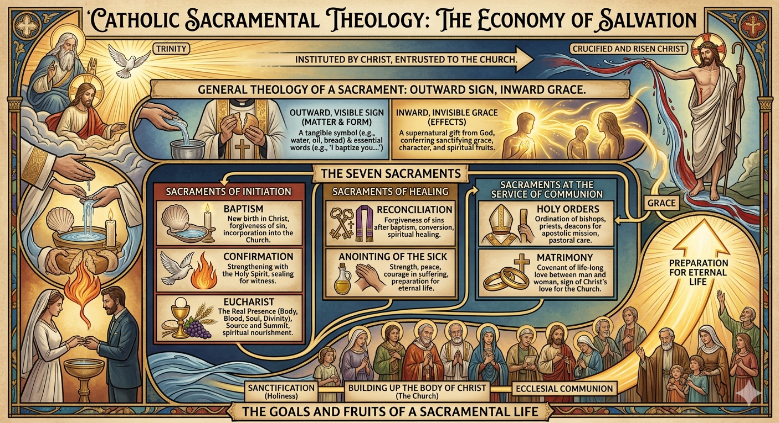
It may be impossible to overstate the significance of sacraments both theologically and doctrinally. Theologically, sacraments are signs and means by which God makes His grace available. From a doctrinal standpoint, sacraments serve as physical signs of invisible spiritual realities.
In this paper, I will examine the sacraments from both aspects by placing them in dialogue with the sacramental theology developed by Saints Augustine and Aquinas.
What Is A Sacrament?
Following Saint Augustine, the Catholic Church defines the sacraments as visible signs of invisible grace, instituted by Christ through which divine life is dispensed to believers. That is to say, sacraments are outward and visible signs of an inward and invisible grace.
Baptism exemplifies this doctrine. The visible signs include water, the sign of the cross, a white robe, candles, and chrism. The necessity of these physical things to confer spiritual grace is predicated on the fact that human beings are composed of a physical body as well as a spiritual soul. The physical signs satisfy the corporeal aspect of the person, while the invisible grace perfects the spiritual nature.
The signs are physical representations of metaphysical and spiritual truths. It is for this reason that the Church refers to these things as efficacious signs; they are visible manifestations of the invisible grace that the sacraments convey.
Sacramental Theology
Sacramental theology is a branch of Catholic theology that studies the nature, significance, and function of the sacraments in the life of the Church. More specifically, sacramental theology is the study of how God communicates His grace to human beings through his creation.
The Church teaches that divine grace can be encountered through specific, visible signs. These signs are ritual actions and elements that the Church identifies as instituted by Christ and as essential to the spiritual life. (Catechism of the Catholic Church, paragraph 1131).
As such, sacramental theology seeks to explain how material elements, such as water, bread, and oil, as well as prayers, can mediate divine reality and why these rites are considered necessary in Catholic practice.
In following Scripture, the Catholic Church recognises seven sacraments. They are Baptism, Eucharist, Confirmation, Penance, Anointing of the Sick, Holy Orders, and Matrimony. The sacraments are divided into categories: initiation, healing, and vocation. Sacramental theology provides the rationale for this structure.
The sacraments of initiation lay the foundations of the Christian life, mirroring the stages of natural life (birth, growth, nourishment).
The sacraments of healing recognize that the new life in Christ can be weakened or lost through sin or sickness. These sacraments exist to restore and strengthen the spiritual life.
The sacrament of Holy Orders is directed toward the salvation of others, while the sacrament of Matrimony helps build up the Church.
These divisions draw from Scripture, the Church Fathers, scholastic theology, and ongoing magisterial interpretation. While the sacraments themselves are based on Scripture (for example, baptism in Matthew 28:19), the seven sacraments were definitively established only at the Council of Trent (1545-1563).
Regardless, the underlying claim is that sacraments are not merely symbolic representations of grace, but actual means by which grace is communicated.
Sign And Reality
Within the broader horizon of sacramental theology, one can take a wide-angle approach to the sacraments. Doing so allows one to recognize that the sacraments serve ecclesial and commemorative purposes. That is, they build up the Church (the body of Christ), unite believers in worship, and serve as a memorial of Christ’s saving sacrifice on the cross.
We can also say four specific things about sacraments in general.
First, all of the sacraments have been instituted by Christ. This is to say that the sacraments are rooted in Christ’s commands and actions, continuing his work. Second, sacraments are visible signs of grace, making invisible spiritual realities tangible by illustrating God’s work of cleansing, nourishing, and renewing the soul. Third, and relatedly, the sacraments are not solely symbolic. Rather, they are efficacious signs that actually dispense the divine life and grace they signify. Finally, sacraments can be seen as seals of the New Covenant. This implies that the sacraments confirm and ratify God’s promises, marking believers as belonging to Christ.
Aquinas’s Three Dimensions
While Saint Augustine establishes the definition of the sign, Thomas Aquinas provides the metaphysical framework to understand how that sign functions internally.
Turning from an Augustinian to a Thomistic theology allows the sacraments to be viewed from three distinct yet related dimensions.
The first dimension is called the sacramentum tantum or the sign alone. This perspective is the external, visible rite, including the sacramental matter (e.g., water) and the form (words) used by the minister. It is the sign only that is considered in this dimension.
Res et sacramentum (reality and sign) doubles the data, so to speak. In addition to the sign, this perspective adds the reality of the sacrament. That is to say that it is both the sign of the sacrament and the reality or the intermediate, abiding effect of the sacrament. It is “reality” because it is a spiritual effect, but “sign” because it is a physical manifestation that points to the final grace.
The final dimension is called res tantum or reality alone. This perspective refers to the ultimate, interior, and spiritual fruit or grace of the sacrament. It is the “reality only” because it is not itself a sign of something else.
Owing to the rather abstract nature of sacramentum tantum, res et sacramentum, and res tantum, it is beneficial to include an example.
Beginning with baptism, the use of water and the stating of the trinitarian formula represent the sacramentum tantum (sign alone). The res et sacramentum (reality and sign) includes the baptismal character, which is the indelible mark upon the soul. Finally, the reality alone or rest tantum includes grace and the forgiveness of sins.
Conclusion
Sacramental theology outlines a vision of God’s grace as tangible and mediated, encountered not only through prayer or personal experience, but through ritual action performed under specific conditions.
To speak of the seven sacraments is to speak of the vehicles by which the ethereal, transcendent God communicates His grace to the corporeal, finite human being. For this reason, the Catholic Church teaches that the sacraments are not optional; they are necessary means of salvation.
By navigating the dimensions of sign and reality, one sees that the sacraments are more than mere rituals; they are the intersection of the corporeal and the divine, ensuring that the invisible grace of Augustine finds its perfected reality in the Thomistic soul.
General Christian
Education and Religion
History and Religion
Previous Post
March 22, 2026
Schools Of Thought In Catholic Theology
Next Post

April 5, 2026 The Problem Of Divine Hiddenness
Recent Comments
"While Unitarianism remains a small minority of believers, its influence on Christianity must not be ..."
A Catholic Critique of Biblical Unitarianism
"Science has proven that Homosapiens have walked this Earth for over 200,000 years. Did God ..."
A Catholic Critique of Biblical Unitarianism
"The universe, the planet we inhabit, and life itself need not exist.This is a claim. ..."
Creation, Preservation, and Teleology in Catholic ..."
"If you have sufficient evidence to support a belief you don't need faith. Despite what ..."
Is Faith Really Blind? What Skeptics ..."
Browse Our Archives
Select a Category Abortion Atheism Catholicism. Catholicism. God. Theophany. Christmas Eschatology Faith and Works. God. Holy Spirit Intelligent Design Jesus Christ Justice Law Politics Protestantism Religion Sabbath Salvation. Soteriology. The Bible Theology Uncategorized
Select a Month November 2026 October 2026 September 2026 August 2026 July 2026 June 2026 May 2026 April 2026 March 2026 February 2026 January 2026 December 2025 November 2025 October 2025 September 2025 August 2025 July 2025 June 2025 May 2025 April 2025 March 2025 February 2025 January 2025 December 2024 November 2024 October 2024 September 2024 August 2024 July 2024 June 2024 May 2024 April 2024 March 2024 February 2024 January 2024 December 2023 November 2023 October 2023 September 2023 August 2023 July 2023 June 2023 May 2023 April 2023 March 2023 February 2023 January 2023 December 2022 November 2022 October 2022 September 2022 August 2022 July 2022 June 2022 May 2022 April 2022 March 2022 February 2022 January 2022 December 2021
Follow Us!
TAKE THE
Religious Wisdom Quiz
Jesus' earthly father, who was a carpenter, was named what?
Select your answer to see how you score.
Zechariah Joseph Jacob Jonathan
Related posts from Summa Catholic

If Baptism Washes Away Sin, Why Do Catholics...
Why Is Catholicism Centered on an Instrument of...
Is Faith Really Blind? What Skeptics Get Wrong
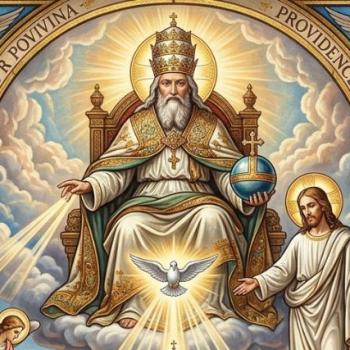
Creation, Preservation, and Teleology in Catholic Theology
TRENDING AT PATHEOS Catholic

Bad Survey Questions Distort Eucharistic Theology
It seems to be the newest thing: someone conducts a bad survey...

If Baptism Washes Away Sin, Why Do Catholics...
The seven sacraments stand as the foundation of Catholic ecclesial life. The...

Far from promoting indifference, inaction, or quietism, Paul consistently tells us to...

The Power of Setting a Good Example
Remember last August when the Chicago White Sox hosted a "Pope Hat...

A Catholic Critique of Biblical Unitarianism
If the statistics are to be believed, Unitarianism is rising worldwide. Although...

How Grandma Tourism Helps Grandparents Live Their Vocation
Grandma, The New Travel Influencer What started as a nostalgia-inspired social media...
view all Catholic blogs
What Are Your Thoughts?leave a comment
Ad-Free & Subscriber Log-In Subscription Support
- About Us
- 2026 Calendar
- Videos
- Podcasts
- Library of World Religions
- Faith In Media Tracker
- Advertise With Us
- Write for Us
- Privacy Policy
- Terms of Service
- Do Not Sell My Data
- Contact Us
- Radiant Digital
- Manage Newsletter Subscriptions
- Unsubscribe From Notifications
- Sitemap
Copyright 2008-2026, Patheos, part of the Radiant Digital network of media brands. All rights reserved.
Subscription Support Ad-Free & Subscriber Log-In
Follow Patheos