
BuddhistCatholicContemplativeEvangelicalGeneral ChristianHinduJewishLatter-day SaintMuslimNew VisionsProgressive Christian
Beliefs
- Buddhist
- Catholic
- Contemplative
- Evangelical
- General Christian
- Hindu
- Jewish
- Latter-day Saint
- More Voices
- Muslim
- New Visions
- Pagan
- Progressive Christian
Topics
- Religion News
- Food and Religion
- Sports and Religion
- Religious Art
- Religious Music and Entertainment
- Religious Events
- History and Religion
- Style and Religion
- Politics and Religion
- Women in Religion
- Recreation Outdoors and Religion
- Business Finance and Religion
- Careers Workplace and Religion
- Education and Religion
- Family Parenting and Religion
- Health Fitness and Religion
- Home and Religion
- Relationships and Religion
- Technology and Religion
- Travel and Religion
Columnists
- Buddhist Columnists
- Business Finance and Religion Columnists
- Careers Workplace and Religion Columnists
- Catholic Columnists
- Contemplative Columnists
- Education and Religion Columnists
- Evangelists Columnists
- Family Parenting and Religion Columnists
- General Christian Columnists
- Health Fitness and Religion Columnists
- Hindu Columnists
- History and Religion Columnists
- Home and Religion Columnists
- Jewish Columnists
- More Voices Columnists
- Latter Day Columnists
- Muslim Columnists
- New Visions Columnists
- Nonreligious Columnists
- Pagan Columnists
- Politics and Religion Columnists
- Progressive Columnists
- Recreation Outdoors and Religion Columnists
- Relationships and Religion Columnists
- Religion News Columnists
- Religious Art Columnists
- Religious Events Columnists
- Religious Music and Entertainment Columnists
- Sports and Religion Columnists
- Style and Religion Columnists
- Technology and Religion Columnists
- Travel and Religion Columnists
- Women in Religion Columnists
Resource Library
- 2026 Calendar
- Library of World Religions
- The 100 Most Holy Places on Earth
- Patheos Answers
- Podcasts
- Videos
- Faith Leaders Database
- Anglican Episcopalian
- Bahai
- Baptist
- Buddhism
- Christianity
- Confucianism
- Eastern Orthodoxy
- Hinduism
- Holiness and Pentecostal
- ISKCON
- Islam
- Judaism
- Lutheran
- Methodist
- The Church of Jesus Christ of Latter-day Saints
- New Age
- Paganism
- Presbytarian and Reformed
- Protestantism
- Religion Behind the Scenes
- Roman Catholic
- Scientology
- Shia Islam
- Sikhism
- Sufism
- Sunni Islam
- Taoism
- Zen
- See all religions
Research Tools
 Ad-Free & Subscriber Log-In Subscription Support
Ad-Free & Subscriber Log-In Subscription Support
Follow Patheos 

- Trending:
- Forgiveness
- |
- Marriage
- |
- Consciousness
- |
- Death Penalty
- |
- Election
- |
- Halloween

- Home
- Catholic
- History and Religion
- Who Made God?
Who Made God?
Last updated on: November 24, 2025 at 3:08 am by David Schloss
Who Made God? 2025-11-24T03:08:44-05:00 David Schloss
Patheos Explore the world's faith through different perspectives on religion and spirituality! Patheos has the views of the prevalent religions and spiritualities of the world.
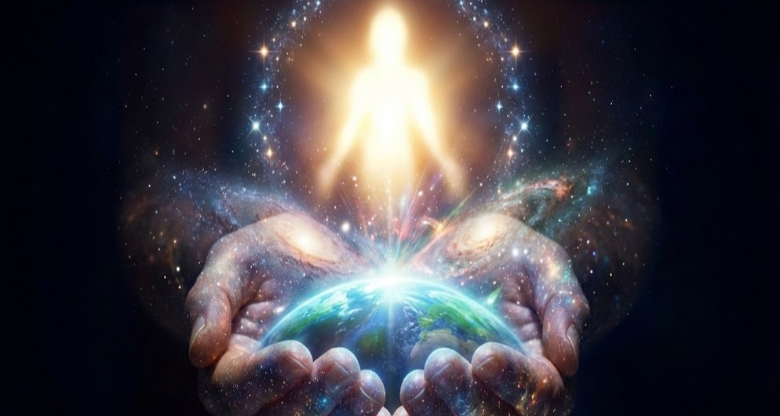
Creator of the universe.
The question “Who made God?” is a frequent retort to arguments for theism. On the surface, it appears to be a reasonable, perhaps even unanswerable, counterargument to God as Creator.
However, upon closer inspection, the objection collapses. This paper aims to demonstrate that the question “Who made God?” rests on a fundamental misunderstanding of the philosophical definition of God.
Who Made God?
The question of who made God is not a new one (though it is often thought so by atheists). The most recent and most cogent formulation of the question comes from the British philosopher Bertrand Russell.
Drawing extensively from another English philosopher, John Stuart Mill, Russell writes, “I may say that when I was a young man and was debating these questions [the existence of God] very seriously in my mind, I for a long time accepted the argument of the First Cause, until one day, at the age of eighteen, I read John Stuart Mill’s Autobiography, and I there found this sentence: ‘My father taught me that the question, “Who made me?” cannot be answered, since it immediately suggests the further question, “Who made God?” ’ That very simple sentence showed me, as I still think, the fallacy in the argument of the First Cause. If everything must have a cause, then God must have a cause.” (Russell, Bertrand. Why I Am Not a Christian. Simon and Schuster, 1957).
Bertrand Russell’s reference to the “argument of the First Cause” requires an explanation. The first cause argument is one of the oldest and most prominent philosophical arguments for the existence of God, formulated by both Aristotle and Thomas Aquinas.
It can be summarized as follows: Within the order of contingent things, everything requires an efficient cause to bring it into being. Furthermore, it is impossible for a thing to be its own efficient cause, as this would mean that it existed before itself. Therefore, for anything to exist, there must be a first cause that is not itself caused. This, by definition, would be a necessary cause which Catholicism asserts is God.
Still, to properly address Bertrand Russell’s “Who made God?” objection, it is necessary to explain what Catholic theology means by the term God.
What Is God?
Pope Benedict once wrote that the God of Catholicism is the God of philosophy. (Ratzinger, Joseph. Introduction to Christianity. Ignatius Press, 2004). The Pope’s observation is an excellent point of departure for answering the question of who or what God is.
Over three hundred years before the advent of Christianity, the Greek philosopher Aristotle conceived of God as a being independent of the universe, as the final cause of all motion (for Aristotle, motion is equivalent to change) in Nature, as Prime Mover and Unmoved Mover of the universe (the cause of change in the universe). Building on Aristotle’s formulation, Saint Anselm and Saint Thomas Aquinas defined God as “that than which nothing greater can be conceived.”
Synthesizing these formulations, God is the uncaused cause of being and existence itself. In turn, God is pure spirit (John 4:24), infinite, eternal, and unchangeable (Catechism of the Catholic Church, Paragraph 202).
Nevertheless, it should be noted that since human beings do not fully understand the essence or nature of God, and since a definition limits its subject, which cannot be done of an infinite being, an essential definition of God is, in objective fact, impossible.
Having sought to explain what Catholicism means by God, I endeavor to show why the question, “Who made God?” is a product of faulty reasoning.
Why Russell’s Argument Fails
At first glance, the question “Who made God?” seems reasonable. If everything requires a cause, then asking who made God is a legitimate question. After all, it is true that everything within the order of contingent things requires a cause. It is here, however, that Russell’s objection fails.
God, by definition, is not a created or contingent being. In fact, God is not within the order of beings at all; He is utterly transcendent. That is to say that God is ipsum esse subsistens or subsistent being itself. As such, God stands outside of or independent from His creation and, if follows, from any causal chain.
However, because Bertrand Russell misunderstands the first cause argument, he begins with the mistaken assumption that everything, including God, requires an efficient cause. This conclusion is neither logically possible nor is it the claim made in the first cause argument.
The reason why Russell’s conclusion is illogical is that if everything, including God, required an efficient cause, there would be an infinite regress of such causes. The result of an infinite regress would be that no secondary or subsequent causes could exist. A train car analogy is often used to illustrate the impossibility of infinite regress. Imagine an infinite number of train cars coupled together, each pulling the next car. Without a locomotive, the train, no matter how long, cannot move.
For this reason, the first cause argument posits that everything in the created order requires a cause. Put simply, if something came into existence at a certain point in time – had a beginning – then there needs to be a cause or explanation for why it came to be. (This aligns with Leibniz’s principle of sufficient reason.) However, since God (by definition) exists eternally, it is illogical to speak of a cause of God’s existence. It is for this reason that the first cause argument applies only to those things that are created.
Conclusion
It is self-evident that if something does not have to exist, there must be an explanation for why it does exist. However, if something must exist – if it is a necessary being, like God – then it does not need further explanation. The things we perceive in the universe, including space and time themselves, appear to have had a beginning, and so they need a cause; a reason why they began in the first place.
In the same way, each particular thing (including humans) in the universe does not seem to be necessary. Each could not exist. Therefore, we need an explanation for why each exists.
Catholicism asserts that God is that explanation. Additionally, as a necessary being that exists outside of time, the question “Who created God?” is nonsensical, because it amounts to asking “Who created an uncreated being?”
General Christian
History and Religion
Education and Religion
Previous Post
November 16, 2025
The Trouble With Mary
Next Post
November 30, 2025 The Space Between Heaven And Hell
Recent Comments
"Why would it matter if atheism is wrong? The fact that Catholic and Protestant scholars ..."
Beyond the Absence of Belief: The ..."
"Kaiser Member Service Proponents often compare atheism to not collecting stamps—it is the lack of ..."
Beyond the Absence of Belief: The ..."
""these dual denials (objective truth and objective meaning)"This is not accurate. Post-modern thought does not ..."
Defending the Faith in a Post-Truth ..."
"The theologians still haven't received the memo. Your opposition are no longer atheists, but they ..."
Defending the Faith in a Post-Truth ..."
Browse Our Archives
Select a Category Abortion Atheism Catholicism. Catholicism. God. Theophany. Christmas Eschatology Faith and Works. God. Holy Spirit Intelligent Design Jesus Christ Justice Law Politics Protestantism Religion Sabbath Salvation. Soteriology. The Bible Theology Uncategorized
Select a Month October 2026 September 2026 August 2026 July 2026 June 2026 May 2026 April 2026 March 2026 February 2026 January 2026 December 2025 November 2025 October 2025 September 2025 August 2025 July 2025 June 2025 May 2025 April 2025 March 2025 February 2025 January 2025 December 2024 November 2024 October 2024 September 2024 August 2024 July 2024 June 2024 May 2024 April 2024 March 2024 February 2024 January 2024 December 2023 November 2023 October 2023 September 2023 August 2023 July 2023 June 2023 May 2023 April 2023 March 2023 February 2023 January 2023 December 2022 November 2022 October 2022 September 2022 August 2022 July 2022 June 2022 May 2022 April 2022 March 2022 February 2022 January 2022 December 2021
Follow Us!
TAKE THE
Religious Wisdom Quiz
Who sat at the Beautiful Gate begging before Peter healed him?
Select your answer to see how you score.
A lame man A blind man A rich ruler A Roman centurion
Related posts from Summa Catholic

The Anatomy of Divine Revelation in Catholic Thought

Beyond the Absence of Belief: The Implications of...

Can Catholic Apologetics Survive a Postmodern World?

From Samaria to Sanctity: Analyzing The Woman At...
TRENDING AT PATHEOS Catholic

Rejecting Doom: Christian Hope And Human Action
Christianity is a religion of hope. We are to have hope and...

It’s What Comes From Within Which Matters
One of the most difficult things for us to understand is why...

Why I Choose the Eucharist Over the Sermon
Choose the Eucharist, Not the Sermon What are we supposed to get...

5 Design Elements Found in Spiritually Rooted Homes
Putting Spirituality Into Home Decor Our homes are more than our living...

Credo: A Story of God Told with the...
About 10 years ago, I began to imagine a personal "Credo" that...

The Anatomy of Divine Revelation in Catholic Thought
The claim that God has made Himself known to human beings is...
view all Catholic blogs
What Are Your Thoughts?leave a comment
Ad-Free & Subscriber Log-In Subscription Support
- About Us
- 2026 Calendar
- Videos
- Podcasts
- Library of World Religions
- Faith In Media Tracker
- Advertise With Us
- Write for Us
- Privacy Policy
- Terms of Service
- Do Not Sell My Data
- Contact Us
- Radiant Digital
- Manage Newsletter Subscriptions
- Unsubscribe From Notifications
- Sitemap
Copyright 2008-2026, Patheos. All rights reserved.
Subscription Support Ad-Free & Subscriber Log-In
Follow Patheos