
BuddhistCatholicContemplativeEvangelicalGeneral ChristianHinduJewishLatter-day SaintMuslimNew VisionsProgressive Christian
Beliefs
- Buddhist
- Catholic
- Contemplative
- Evangelical
- General Christian
- Hindu
- Jewish
- Latter-day Saint
- More Voices
- Muslim
- New Visions
- Pagan
- Progressive Christian
Topics
- Religion News
- Food and Religion
- Sports and Religion
- Religious Art
- Religious Music and Entertainment
- Religious Events
- History and Religion
- Style and Religion
- Politics and Religion
- Women in Religion
- Recreation Outdoors and Religion
- Business Finance and Religion
- Careers Workplace and Religion
- Education and Religion
- Family Parenting and Religion
- Health Fitness and Religion
- Home and Religion
- Relationships and Religion
- Technology and Religion
- Travel and Religion
Columnists
- Buddhist Columnists
- Business Finance and Religion Columnists
- Careers Workplace and Religion Columnists
- Catholic Columnists
- Contemplative Columnists
- Education and Religion Columnists
- Evangelists Columnists
- Family Parenting and Religion Columnists
- General Christian Columnists
- Health Fitness and Religion Columnists
- Hindu Columnists
- History and Religion Columnists
- Home and Religion Columnists
- Jewish Columnists
- More Voices Columnists
- Latter Day Columnists
- Muslim Columnists
- New Visions Columnists
- Nonreligious Columnists
- Pagan Columnists
- Politics and Religion Columnists
- Progressive Columnists
- Recreation Outdoors and Religion Columnists
- Relationships and Religion Columnists
- Religion News Columnists
- Religious Art Columnists
- Religious Events Columnists
- Religious Music and Entertainment Columnists
- Sports and Religion Columnists
- Style and Religion Columnists
- Technology and Religion Columnists
- Travel and Religion Columnists
- Women in Religion Columnists
Resource Library
- 2026 Calendar
- Library of World Religions
- The 100 Most Holy Places on Earth
- Patheos Answers
- Podcasts
- Videos
- Faith Leaders Database
- Anglican Episcopalian
- Bahai
- Baptist
- Buddhism
- Christianity
- Confucianism
- Eastern Orthodoxy
- Hinduism
- Holiness and Pentecostal
- ISKCON
- Islam
- Judaism
- Lutheran
- Methodist
- The Church of Jesus Christ of Latter-day Saints
- New Age
- Paganism
- Presbytarian and Reformed
- Protestantism
- Religion Behind the Scenes
- Roman Catholic
- Scientology
- Shia Islam
- Sikhism
- Sufism
- Sunni Islam
- Taoism
- Zen
- See all religions
Research Tools
 Ad-Free & Subscriber Log-In Subscription Support
Ad-Free & Subscriber Log-In Subscription Support
Follow Patheos 

- Trending:
- Forgiveness
- |
- Marriage
- |
- Consciousness
- |
- Death Penalty
- |
- Election
- |
- Halloween

- Home
- Catholic
- Education and Religion
- The Trouble With Mary
The Trouble With Mary
Last updated on: November 16, 2025 at 11:17 am by David Schloss
The Trouble With Mary 2025-11-16T11:17:44-05:00 David Schloss
Patheos Explore the world's faith through different perspectives on religion and spirituality! Patheos has the views of the prevalent religions and spiritualities of the world.
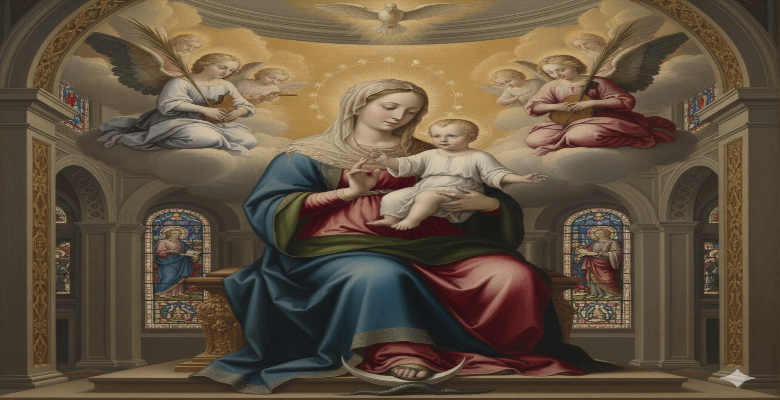
Mary, Mother of God
It should come as no surprise that the Catholic Church’s two-thousand-year history has seen many controversies. Some of these controversies have been of genuine significance; others have been mere tempests in teapots. The Church’s issuing of a doctrinal note regarding Mary appears to be the latter.
Nevertheless, this document, entitled Mater Populi Fidelis, has confused Catholics and has been the source of derision from Protestants. It is, therefore, beneficial to examine this document and explain its significance.
The Mother of the Faithful People of God
On November 4, 2025, the Dicastery for the Doctrine of the Faith issued Mater Populi Fidelis (Mother of the Faithful People of God). Among its duties, the Dicastery is responsible for disseminating Catholic doctrine and defending those points of Catholic tradition that appear to be in danger due to new and unacceptable doctrines. It is, I think, possible to distill the teachings of Mater Populi Fidelis into three points.
First, the document seeks to strongly affirm that Jesus Christ is the one and only Mediator between God and humanity, as well as the sole Redeemer. As such, it must be recognized that all grace flows from Him. Any understanding of Mary’s role must be subordinate and secondary to Christ’s unique saving work.
Second, Mater Populi Fidelis couches Mary’s relationship with Catholics as one of maternal cooperation and intercession. In this sense, Mary’s maternal nature is seen as that of a mother who intercedes for her children, always directing them back to her Son, Jesus Christ.
To that end, the document inculcates that Mary is the Mother of the Faithful People of God, our Spiritual Mother, and the Mother of Believers. As evidence of these claims is Mary’s cooperation at the Annunciation (fiat), and her presence at the Cross of Christ.
Ultimately, Mater Populi Fidelis seeks to purify and orient Marian devotion, ensuring it remains Christ-centered and fosters the harmony of the Catholic message as a whole. It seeks to encourage genuine Marian devotion while avoiding expressions that lead to a mistaken understanding of her role or sow theological confusion.
It is these expressions or titles associated with Mary that have drawn the most attention.
Theological Scrutiny Of The Titles
No saint in the history of the Catholic Church has more titles than Mary. It is estimated that there are hundreds of such titles; however, only six are considered doctrinally approved. They are Blessed Virgin Mary, Mother of God, Our Lady, Queen of Heaven, Immaculate Conception, and the Assumption.
Mater Populi Fidelis concerns itself with discouraging Catholics from using two titles. The reason for this is the sense that these titles are theologically problematic and risk obscuring the fundamental truth of Christ’s unique role in salvation.
The first title deemed improper by the Church is that of Co-Redemptrix. Such a title suggests that Mary’s role is parallel to or equal to Christ in the work of Redemption. For this reason, the Church states the term does not “help extol Mary as the first and foremost collaborator” and risks eclipsing the exclusive role of Jesus Christ.
The term Redemptrix (Redeemer) appeared as early as the 10th century. (The term appears in a French hymn called “Sancta Redemptrix, ora pro nobis”). It was also used by some saints and popes (like St. John Paul II, on a few occasions), but was never formally defined as dogma**.**
At least part of the problem is in the translation from Latin to English. The prefix “co” (from Latin cum, meaning “with”) is the main stumbling block. While theologians intended the term to suggest Mary as a co-operator in a subordinate way, it can easily be interpreted to suggest equality or a parallel role with Christ when translated into English. This interpretation has the potential of eclipsing the exclusive role of Jesus Christ as the single source of salvation (Acts 4:12). Mater Populi Fidelis, therefore, stresses that Christ’s work alone is sufficient for Redemption.
It should be noted that, in this sense, Mater Populi Fidelis is not tilling new ground. Vatican Two deliberately refrained from using the title Co-Redemptrix in the document on the Church (Lumen Gentium), opting instead for more cautious language like “truly Mother of God and Mother of the Redeemer.”
The second title of Mary that concerned the Church is that of Mediatrix of All Graces. While Mary’s subordinate and participatory intercessory role is affirmed and encouraged, the specific title “Mediatrix of All Graces” suggests a universal dispensing of graces: a role that belongs only to God.
Mater Populi Fidelis also observes the logical contradiction in such a title. Since the Church holds that Mary was the first person saved by God’s grace (albeit preemptory), Mary can not also be the mediatrix of that grace. That is to say that she can not be both the cause of grace and the recipient of it.
The concept of Mary as an intercessor has a long-standing tradition. The specific title “Mediatrix of All Graces” gained traction in the late 19th and early 20th centuries, with some advocating for its dogmatic definition. The term Mediatrix itself is acceptable when understood in the subordinate sense of intercession (as are all the saints). The problem lies with the addition of “of All Graces” to that title.
Supporters of Mary as “Mediatrix of All Graces” argue that since Mary is the means by which Christ, the source of all grace, came into the world, it is fitting to believe she mediates the distribution of the graces won by Christ. (Lyons, Irenaeus St. Irenaeus. Against Heresies. 2018).
Mater Populi Fidelis’s rejection of the title Mediatrix of All Graces is founded on a fundamental truth of Catholicism: Christ is the sole mediator between God and humanity. As such, Mary’s mediation is entirely dependent on Christ. For this reason, Vatican Two’s Lumen Gentium refers to Mary as “Mediatrix” only once, clarifying that her role “neither takes away from the dignity and efficacy of Christ the one Mediator, nor adds anything to them.” The Council provided a framework that affirms her maternal intercession while strictly safeguarding the unique mediation of Christ, which is the exact point Mater Populi Fidelis reinforces.
Conclusion
The controversy surrounding “Co-Redemptrix” and “Mediatrix of All Graces” stems from an effort over the centuries to articulate Mary’s unique cooperation in Christ’s saving work. However, this effort often led to theologically problematic language.
To address this issue, Mater Populi Fidelis emphasizes Mary’s immense beauty and unique role as a perfect example of God’s grace, while establishing firm boundaries on the theological language used to describe her, thereby safeguarding the central dogma of Christ’s sole mediation.
Education and Religion
History and Religion
Previous Post
November 9, 2025
Teleology, Providence, and Morality in Catholic Thought
Next Post

November 23, 2025 Who Made God?
Recent Comments
"Why would it matter if atheism is wrong? The fact that Catholic and Protestant scholars ..."
Beyond the Absence of Belief: The ..."
"Kaiser Member Service Proponents often compare atheism to not collecting stamps—it is the lack of ..."
Beyond the Absence of Belief: The ..."
""these dual denials (objective truth and objective meaning)"This is not accurate. Post-modern thought does not ..."
Defending the Faith in a Post-Truth ..."
"The theologians still haven't received the memo. Your opposition are no longer atheists, but they ..."
Defending the Faith in a Post-Truth ..."
Browse Our Archives
Select a Category Abortion Atheism Catholicism. Catholicism. God. Theophany. Christmas Eschatology Faith and Works. God. Holy Spirit Intelligent Design Jesus Christ Justice Law Politics Protestantism Religion Sabbath Salvation. Soteriology. The Bible Theology Uncategorized
Select a Month October 2026 September 2026 August 2026 July 2026 June 2026 May 2026 April 2026 March 2026 February 2026 January 2026 December 2025 November 2025 October 2025 September 2025 August 2025 July 2025 June 2025 May 2025 April 2025 March 2025 February 2025 January 2025 December 2024 November 2024 October 2024 September 2024 August 2024 July 2024 June 2024 May 2024 April 2024 March 2024 February 2024 January 2024 December 2023 November 2023 October 2023 September 2023 August 2023 July 2023 June 2023 May 2023 April 2023 March 2023 February 2023 January 2023 December 2022 November 2022 October 2022 September 2022 August 2022 July 2022 June 2022 May 2022 April 2022 March 2022 February 2022 January 2022 December 2021
Follow Us!
TAKE THE
Religious Wisdom Quiz
Which branch of Christianity traces its leadership back to the Apostle Peter?
Select your answer to see how you score.
Roman Catholic Lutheran Eastern Orthodox United Church of Christ
Related posts from Summa Catholic

The Anatomy of Divine Revelation in Catholic Thought

Beyond the Absence of Belief: The Implications of...

Can Catholic Apologetics Survive a Postmodern World?

From Samaria to Sanctity: Analyzing The Woman At...
TRENDING AT PATHEOS Catholic

Rejecting Doom: Christian Hope And Human Action
Christianity is a religion of hope. We are to have hope and...

It’s What Comes From Within Which Matters
One of the most difficult things for us to understand is why...

Why I Choose the Eucharist Over the Sermon
Choose the Eucharist, Not the Sermon What are we supposed to get...

5 Design Elements Found in Spiritually Rooted Homes
Putting Spirituality Into Home Decor Our homes are more than our living...

Credo: A Story of God Told with the...
About 10 years ago, I began to imagine a personal "Credo" that...

The Anatomy of Divine Revelation in Catholic Thought
The claim that God has made Himself known to human beings is...
view all Catholic blogs
What Are Your Thoughts?leave a comment
Ad-Free & Subscriber Log-In Subscription Support
- About Us
- 2026 Calendar
- Videos
- Podcasts
- Library of World Religions
- Faith In Media Tracker
- Advertise With Us
- Write for Us
- Privacy Policy
- Terms of Service
- Do Not Sell My Data
- Contact Us
- Radiant Digital
- Manage Newsletter Subscriptions
- Unsubscribe From Notifications
- Sitemap
Copyright 2008-2026, Patheos. All rights reserved.
Subscription Support Ad-Free & Subscriber Log-In
Follow Patheos