
BuddhistCatholicContemplativeEvangelicalGeneral ChristianHinduJewishLatter-day SaintMuslimNew VisionsProgressive Christian
Beliefs
- Buddhist
- Catholic
- Contemplative
- Evangelical
- General Christian
- Hindu
- Jewish
- Latter-day Saint
- More Voices
- Muslim
- New Visions
- Pagan
- Progressive Christian
Topics
- Religion News
- Food and Religion
- Sports and Religion
- Religious Art
- Religious Music and Entertainment
- Religious Events
- History and Religion
- Style and Religion
- Politics and Religion
- Women in Religion
- Recreation Outdoors and Religion
- Business Finance and Religion
- Careers Workplace and Religion
- Education and Religion
- Family Parenting and Religion
- Health Fitness and Religion
- Home and Religion
- Relationships and Religion
- Technology and Religion
- Travel and Religion
Columnists
- Buddhist Columnists
- Business Finance and Religion Columnists
- Careers Workplace and Religion Columnists
- Catholic Columnists
- Contemplative Columnists
- Education and Religion Columnists
- Evangelists Columnists
- Family Parenting and Religion Columnists
- General Christian Columnists
- Health Fitness and Religion Columnists
- Hindu Columnists
- History and Religion Columnists
- Home and Religion Columnists
- Jewish Columnists
- More Voices Columnists
- Latter Day Columnists
- Muslim Columnists
- New Visions Columnists
- Nonreligious Columnists
- Pagan Columnists
- Politics and Religion Columnists
- Progressive Columnists
- Recreation Outdoors and Religion Columnists
- Relationships and Religion Columnists
- Religion News Columnists
- Religious Art Columnists
- Religious Events Columnists
- Religious Music and Entertainment Columnists
- Sports and Religion Columnists
- Style and Religion Columnists
- Technology and Religion Columnists
- Travel and Religion Columnists
- Women in Religion Columnists
Resource Library
- 2026 Calendar
- Library of World Religions
- The 100 Most Holy Places on Earth
- Patheos Answers
- Podcasts
- Videos
- Faith Leaders Database
- Anglican Episcopalian
- Bahai
- Baptist
- Buddhism
- Christianity
- Confucianism
- Eastern Orthodoxy
- Hinduism
- Holiness and Pentecostal
- ISKCON
- Islam
- Judaism
- Lutheran
- Methodist
- The Church of Jesus Christ of Latter-day Saints
- New Age
- Paganism
- Presbytarian and Reformed
- Protestantism
- Religion Behind the Scenes
- Roman Catholic
- Scientology
- Shia Islam
- Sikhism
- Sufism
- Sunni Islam
- Taoism
- Zen
- See all religions
Research Tools
 Ad-Free & Subscriber Log-In Subscription Support
Ad-Free & Subscriber Log-In Subscription Support
Follow Patheos 

- Trending:
- Forgiveness
- |
- Marriage
- |
- Consciousness
- |
- Death Penalty
- |
- Election
- |
- Halloween

- Home
- Catholic
- Education and Religion
- A History Of Three: How We Got A Trinity
A History Of Three: How We Got A Trinity
Last updated on: October 12, 2025 at 12:06 pm by David Schloss
A History Of Three: How We Got A Trinity 2025-10-12T12:06:18-04:00 David Schloss
Patheos Explore the world's faith through different perspectives on religion and spirituality! Patheos has the views of the prevalent religions and spiritualities of the world.
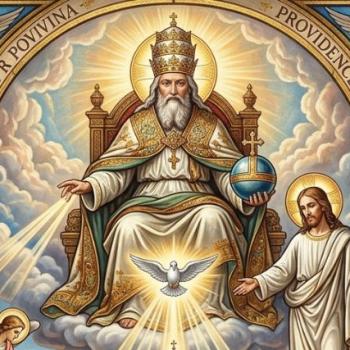
Art By John Hain.
The belief in a trinitarian God stands at the very center of the Catholic faith. Nevertheless, one may ask, how did we get here? After all, the claim that God is one, yet three persons, is not readily accessible to human reason. It goes without saying, but the development of the trinitarian doctrine within Catholicism is an extensive subject, which cannot be adequately treated here.
Nevertheless, I will endeavor to provide an outline or summary of the Catholic belief in the Holy Trinity, arguing that the doctrine emerged as the necessary and divinely guided interpretation of Scriptural data through the action of popes and the Church Councils.
To begin, however, we must ask, what is the Holy Trinity?
The Mystery Of Three
The use of the word mystery in the subheading is very intentional. Owing to its object, faith is considered suprarational. Religious faith is suprarational in that it transcends human reason without negating it. It is an intellectual leap at the far side of reason.
The Holy Trinity is an excellent example of this principle. When Catholicism speaks of the Holy Trinity, it refers to a profound mystery at the center of which is God. Mystery in a theological sense is a divinely revealed truth whose very possibility cannot be rationally conceived before it is revealed and, after revelation, whose inner essence cannot be fully understood by the finite mind.
The incomprehensibility of revealed mysteries derives from the fact that they are manifestations of God, who is infinite and therefore beyond the complete grasp of a created intellect. Nevertheless, though incomprehensible, mysteries are intelligible.
Any comprehension of the Trinity requires that we distinguish between essence and existence. Essence is what a particular thing is, its very nature. Existence is that a thing is. For example, we can speak of human nature (the rational animal) independently of the approximately 8 billion people who possess it.
If this concept is applied to God, we can assert that there is one divine essence (what God is) existing in three persons (who God is: Father, Son, and Holy Spirit). This understanding of God as three persons sharing a single divine essence is a uniquely Christian concept.
The Many And The None
It is a theological oddity, but belief in one God has historically been a minority position. For most of human history, beliefs about the transcendent were polytheistic. That is, most believed in the existence of many gods.
Polytheism in various forms is depicted throughout the Old Testament. Almost without exception, every nation or group of people that the ancient Israelites encountered worshipped a pantheon of gods.
Another ancient (and currently popular) theological position asserts that the universe is God. Strictly speaking, pantheism asserts that God and the universe are really identical, or that there is ultimately no fundamental distinction between God and what believers in creation call the world.
However, these concepts of God (or gods) conflict with the God depicted in the Bible. The God of the Bible is one (Deuteronomy 6:4-5 and 1 Corinthians 8:6) and other from creation (Ephesians 1:4).
Therefore, regardless of whether it is polytheism or pantheism that is asserted, it is evident from the biblical data that the God of Catholicism is one and transcendent. This oneness, however, must be viewed through the lens of the subsequent New Testament revelation that details God’s three-personal existence.
Is The Trinity Biblical?
In a sense, the Catholic doctrine of the Trinity can be described as the Church’s interpretation of Scripture. While the term “Holy Trinity” is not explicitly present in the Bible, scriptural inferences and allusions about the Trinity are found in specific passages of the Old and New Testaments.
The first implied statement of a trinitarian Godhead occurs at the outset of the Bible. In Genesis 1, the text uses the plural pronoun “us” to refer to God. (See Genesis 1:26).
More explicit examples of trinitarian concepts occur in the depiction of Jesus’ baptism. “It happened in those days that Jesus came from Nazareth of Galilee and was baptized in the Jordan by John. On coming up out of the water, he saw the heavens being torn open and the Spirit, like a dove, descending upon him. And a voice came from the heavens, ‘You are my beloved Son; with you I am well pleased.” (Mark 1:9-11).
Perhaps the most explicit reference to the Holy Trinity appears in the “great commission.” “Go, therefore, and make disciples of all nations, baptizing them in the name of the Father, and of the Son, and of the holy Spirit.” (Matthew 28:19).
It is the Bible that provides the data and point of departure for the theological process that ultimately develops the doctrine of the Trinity.
The Trinitarian Doctrine Of The Catholic Church
The history of the Church’s doctrine on the Trinity reaches back to the earliest days of Christianity. Within two hundred years after the Crucifixion, the theologian Tertullian used the term “Trinitas” (Trinity) to describe this concept. In 259 AD, Pope Saint Dionysius issued a public letter to Bishop Dionysius of Alexandria in which he condemned the trinitarian errors of Sabellius and Marcion. Of particular significance is that the letter paved the way for the Church’s later teaching, notably in the councils that addressed the person of Christ.
While it is worth noting that the popes led the way in defending the Trinity and explaining its meaning, it was the work of several councils that developed and explained the doctrine of the Trinity.
At the Council of Nicea (325 AD), the second person (Christ) was declared to be consubstantial with the Father. Of particular significance was the Council’s use of the Greek term homoousios. Homoousios means that two or more things share the same nature or essence. Within the context of the Trinity, this meant that the Son is of the same substance as the Father. Unfortunately, the Council of Nicea was far from the last word when it came to trinitarian doctrine.
Due to the persistent errors being promulgated about the Trinity, Pope Damasus called a council (382 AD) to summarize the errors up to that time and to clarify again that the Church’s teaching is that if anyone denies that the Father is eternal, that the Son is eternal, and that the Holy Spirit is eternal, he is a heretic.
The most extensive declaration of the Church’s teaching on the Trinity was made at the Eleventh Synod of Toledo in Spain (675 AD). It is a mosaic of texts drawn from all the preceding doctrines of the Church. Its purpose was to assemble as complete a list of doctrinal statements as possible, in view of the still prevalent errors in nominally Christian circles, and in response to Islamic opposition.
The Fourth Lateran Council and the Council of Florence formulated the Trinity in specific creeds (Niceno-Constantinopolitan Creed and the Nicene Creed).
Conclusion
Because faith transcends reason, there will always be an element of mystery to it. Perhaps the greatest of these mysteries is the nature of God.
In this essay, I have endeavored to examine the mystery at the heart of Catholicism, the Holy Trinity. Specifically, I have tried to summarize the development of the doctrine of the Trinity.
Education and Religion
History and Religion
Previous Post
October 5, 2025
Are Catholics Born Again?
Next Post

October 19, 2025 A Catholic Perspective On Humanism
Recent Comments
"Why would it matter if atheism is wrong? The fact that Catholic and Protestant scholars ..."
Beyond the Absence of Belief: The ..."
"Kaiser Member Service Proponents often compare atheism to not collecting stamps—it is the lack of ..."
Beyond the Absence of Belief: The ..."
""these dual denials (objective truth and objective meaning)"This is not accurate. Post-modern thought does not ..."
Defending the Faith in a Post-Truth ..."
"The theologians still haven't received the memo. Your opposition are no longer atheists, but they ..."
Defending the Faith in a Post-Truth ..."
Browse Our Archives
Select a Category Abortion Atheism Catholicism. Catholicism. God. Theophany. Christmas Eschatology Faith and Works. God. Holy Spirit Intelligent Design Jesus Christ Justice Law Politics Protestantism Religion Sabbath Salvation. Soteriology. The Bible Theology Uncategorized
Select a Month October 2026 September 2026 August 2026 July 2026 June 2026 May 2026 April 2026 March 2026 February 2026 January 2026 December 2025 November 2025 October 2025 September 2025 August 2025 July 2025 June 2025 May 2025 April 2025 March 2025 February 2025 January 2025 December 2024 November 2024 October 2024 September 2024 August 2024 July 2024 June 2024 May 2024 April 2024 March 2024 February 2024 January 2024 December 2023 November 2023 October 2023 September 2023 August 2023 July 2023 June 2023 May 2023 April 2023 March 2023 February 2023 January 2023 December 2022 November 2022 October 2022 September 2022 August 2022 July 2022 June 2022 May 2022 April 2022 March 2022 February 2022 January 2022 December 2021
Follow Us!
TAKE THE
Religious Wisdom Quiz
True or False: According to 1 John, God is love, and whoever abides in love abides in God.
Select your answer to see how you score.
FALSE TRUE
Related posts from Summa Catholic
Creation, Preservation, and Teleology in Catholic Theology

The Anatomy of Divine Revelation in Catholic Thought

Beyond the Absence of Belief: The Implications of...

Can Catholic Apologetics Survive a Postmodern World?
TRENDING AT PATHEOS Catholic

Creation, Preservation, and Teleology in Catholic Theology
As I write this, it is very early Monday morning. Like millions...

The Parable Of The Sower And The Word...
One of Christ’s most famous parables is that of the sower who...

Rejecting Doom: Christian Hope And Human Action
Christianity is a religion of hope. We are to have hope and...

Why I Choose the Eucharist Over the Sermon
Choose the Eucharist, Not the Sermon What are we supposed to get...

5 Design Elements Found in Spiritually Rooted Homes
Putting Spirituality Into Home Decor Our homes are more than our living...

Credo: A Story of God Told with the...
About 10 years ago, I began to imagine a personal "Credo" that...
view all Catholic blogs
What Are Your Thoughts?leave a comment
Ad-Free & Subscriber Log-In Subscription Support
- About Us
- 2026 Calendar
- Videos
- Podcasts
- Library of World Religions
- Faith In Media Tracker
- Advertise With Us
- Write for Us
- Privacy Policy
- Terms of Service
- Do Not Sell My Data
- Contact Us
- Radiant Digital
- Manage Newsletter Subscriptions
- Unsubscribe From Notifications
- Sitemap
Copyright 2008-2026, Patheos. All rights reserved.
Subscription Support Ad-Free & Subscriber Log-In
Follow Patheos