
BuddhistCatholicContemplativeEvangelicalGeneral ChristianHinduJewishLatter-day SaintMuslimNew VisionsProgressive Christian
Beliefs
- Buddhist
- Catholic
- Contemplative
- Evangelical
- General Christian
- Hindu
- Jewish
- Latter-day Saint
- More Voices
- Muslim
- New Visions
- Pagan
- Progressive Christian
Topics
- Religion News
- Food and Religion
- Sports and Religion
- Religious Art
- Religious Music and Entertainment
- Religious Events
- History and Religion
- Style and Religion
- Politics and Religion
- Women in Religion
- Recreation Outdoors and Religion
- Business Finance and Religion
- Careers Workplace and Religion
- Education and Religion
- Family Parenting and Religion
- Health Fitness and Religion
- Home and Religion
- Relationships and Religion
- Technology and Religion
- Travel and Religion
Columnists
- Buddhist Columnists
- Business Finance and Religion Columnists
- Careers Workplace and Religion Columnists
- Catholic Columnists
- Contemplative Columnists
- Education and Religion Columnists
- Evangelists Columnists
- Family Parenting and Religion Columnists
- General Christian Columnists
- Health Fitness and Religion Columnists
- Hindu Columnists
- History and Religion Columnists
- Home and Religion Columnists
- Jewish Columnists
- More Voices Columnists
- Latter Day Columnists
- Muslim Columnists
- New Visions Columnists
- Nonreligious Columnists
- Pagan Columnists
- Politics and Religion Columnists
- Progressive Columnists
- Recreation Outdoors and Religion Columnists
- Relationships and Religion Columnists
- Religion News Columnists
- Religious Art Columnists
- Religious Events Columnists
- Religious Music and Entertainment Columnists
- Sports and Religion Columnists
- Style and Religion Columnists
- Technology and Religion Columnists
- Travel and Religion Columnists
- Women in Religion Columnists
Resource Library
- 2026 Calendar
- Library of World Religions
- The 100 Most Holy Places on Earth
- Patheos Answers
- Podcasts
- Videos
- Faith Leaders Database
- Anglican Episcopalian
- Bahai
- Baptist
- Buddhism
- Christianity
- Confucianism
- Eastern Orthodoxy
- Hinduism
- Holiness and Pentecostal
- ISKCON
- Islam
- Judaism
- Lutheran
- Methodist
- The Church of Jesus Christ of Latter-day Saints
- New Age
- Paganism
- Presbytarian and Reformed
- Protestantism
- Religion Behind the Scenes
- Roman Catholic
- Scientology
- Shia Islam
- Sikhism
- Sufism
- Sunni Islam
- Taoism
- Zen
- See all religions
Research Tools
 Ad-Free & Subscriber Log-In Subscription Support
Ad-Free & Subscriber Log-In Subscription Support
Follow Patheos 

- Trending:
- Forgiveness
- |
- Marriage
- |
- Consciousness
- |
- Death Penalty
- |
- Election
- |
- Halloween

- Home
- Catholic
- History and Religion
- Is Everyone Equal In Heaven?
Is Everyone Equal In Heaven?
Last updated on: September 8, 2025 at 12:50 am by David Schloss
Is Everyone Equal In Heaven? 2025-09-08T00:50:45-04:00 David Schloss
Patheos Explore the world's faith through different perspectives on religion and spirituality! Patheos has the views of the prevalent religions and spiritualities of the world.
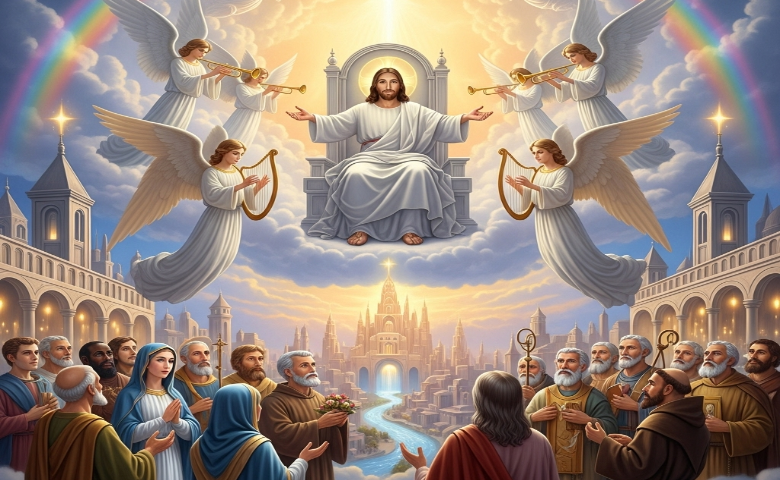
Heaven
Our time does not look kindly on hierarchies and judgments. The modern mind “feels” that such things are forms of discrimination. There are two problems with such a position.
First, we commit a category error when we mistake emotion and reason. Emotions do not make judgments, or at least do not adequately make judgments, necessary for critical thought.
Second, we automatically and even subconsiously view the term discrimination as wrong or evil. This conclusion is not without merit when the term discrimination is used to make unfair and improper determinations of specific properties, such as race or sex. However, the term discrimination can also be used to connote a recognition and understanding of differences. We can even discriminate between good and evil.
In this paper, I will explore whether God created a hierarchical universe and whether Catholic theology believes that there is equality in heaven.
A Universe That Is Not Equal
Drawing on the long history of philosophy, Catholicism claims that the universe is composed of a hierarchy of being. Following Thomas Aquinas, we can envision the hierarchy of being as a ladder. (Aquinas, Saint Thomas, The Summa Contra Gentiles. Aeterna Press.)
At the apex of the ladder of being is God, a purely spiritual being from which all existence springs. Below God, but still within the spiritual realm, are angels. Like God, angels are pure spirits; unlike God, their existence is contingent.
The ladder of being descends from the purely spiritual realm and enters into the domain of those creatures who are composed of both spirit and matter. At this level of the hierarchy, a two-fold distinction exists between humans and animals.
The next rung of the ladder is plants. While plants have a soul, it is believed that the vegetative soul is composed of matter, and not spirit. The last rung to the ladder of being is minerals and inanimate matter that are foundational for life.
The concept of a hierarchy of being, as well as our own experiences, makes it evident that the universe we inhabit is not structurally equal. As Catholics, we must ask why it is that God has created a universe built on subordinate relationships.
The Necessity Of Hierarchy
From a Catholic perspective, the existence of a hierarchy of being in the universe serves the greater purpose of reflecting God’s governance and goodness more perfectly. God is the first and universal cause of all being, but He uses His created things to execute His plan. These secondary causes are arranged in such a way that the higher-level causes have a more profound impact than the lower-level causes.
As evidence of this, God has created a universe where “higher” things govern the “lower” ones. For example, God created angels as part of the divine plan to govern the cosmos. Similarly, God has given human beings dominion over other animals (Genesis 1:26-28). While it is true that we must speculate as to why God has created such diversity, it does seem that this mosaic of God’s creation reflects the majesty and goodness of God in a way that a homogenous universe would not.
It is logical, therefore, to ask if God has created a diverse and hierarchical universe; is the heavenly realm also so ordered?
Inhabitants Of Heaven
In order to address the question of equality in heaven, we must first ascertain who the inhabitants of heaven are and will be.
It must be admitted that heaven is not a physical place, but rather a state where the blessed enjoy a “perfect life with the Most Holy Trinity — this communion of life and love with the Trinity, with the Virgin Mary, and the angels.” (Catechism of the Catholic Church, Paragraph 1024).
As to the question of who is in heaven, we can begin with the obvious: God, Mary, angels, and the saints. Broadly defined, a saint is anyone God has deemed sufficiently holy to be united eternally with Him. As such, everyone in heaven (God excepted) is a saint. Additionally, Catholicism asserts that those in purgatory will eventually obtain entrance into heaven. These are souls who have died in God’s grace but require purification before joining the heavenly community.
Among those who are deemed saints, is there an order of glory or greatness, or are all considered equal?
Is There Equality In Heaven?
The answer, it seems, is that there is indeed a hierarchy of status among saints. Several reasons support this conclusion.
Where the hierarchy of being manifests God’s goodness, the order in heaven is predicated on the relationship between grace and nature. Catholic theology asserts that grace perfects human nature, without destroying it. Now, human nature incorporates free will, and the degree to which one’s nature is perfected by grace is influenced by the extent to which one freely cooperates with that grace. How well one has utilized their gifts and talents influences their position in heaven.
Important too is the diversity of individual capacities. This point is best made by the parable of talents.
The parable (Matthew 25:14-30) tells of a man about to go on a journey. He entrusts his servants with differing amounts of wealth. Some of the servants were industrious and built on what was given them, while others “buried their talents.” When the master returned, he rewarded those who made good use of their talents and punished those who did not.
The parable should not be restricted to the concept of wealth, but rather to the spiritual gifts each has been given. Ultimately, “Much will be required of the person entrusted with much, and still more will be demanded of the person entrusted with more.” (Luke 12:48).
We should not make the mistake that the status hierarchy of this world is perfectly analogous to that in the spiritual world, however. In fact, the teachings of Christ suggest that it is precisely the opposite.
Conclusion
The concept of equality is highly valued in our time, and indeed, there is much to recommend it. However, the universe that we inhabit and the heavenly home we seek to obtain are ordered and hierarchical.
Still, the ultimate criterion within the heavenly hierarchy is love. Jesus tells us that “If anyone wishes to be first, he shall be the last of all and the servant of all.” (Mark 9:35. See also Mark 10:43). Or, as Saint John of the Cross put it, “In the evening of life, we will be judged on love alone.”
To be Catholic is, after all, to follow Christ who came not to be served, but to serve others. (Matthew 20:28).
General Christian
History and Religion
Education and Religion
Previous Post
August 31, 2025
Do We Inherit Salvation?
Next Post
September 14, 2025 The Problem Of A Good God
Recent Comments
"Why would it matter if atheism is wrong? The fact that Catholic and Protestant scholars ..."
Beyond the Absence of Belief: The ..."
"Kaiser Member Service Proponents often compare atheism to not collecting stamps—it is the lack of ..."
Beyond the Absence of Belief: The ..."
""these dual denials (objective truth and objective meaning)"This is not accurate. Post-modern thought does not ..."
Defending the Faith in a Post-Truth ..."
"The theologians still haven't received the memo. Your opposition are no longer atheists, but they ..."
Defending the Faith in a Post-Truth ..."
Browse Our Archives
Select a Category Abortion Atheism Catholicism. Catholicism. God. Theophany. Christmas Eschatology Faith and Works. God. Holy Spirit Intelligent Design Jesus Christ Justice Law Politics Protestantism Religion Sabbath Salvation. Soteriology. The Bible Theology Uncategorized
Select a Month October 2026 September 2026 August 2026 July 2026 June 2026 May 2026 April 2026 March 2026 February 2026 January 2026 December 2025 November 2025 October 2025 September 2025 August 2025 July 2025 June 2025 May 2025 April 2025 March 2025 February 2025 January 2025 December 2024 November 2024 October 2024 September 2024 August 2024 July 2024 June 2024 May 2024 April 2024 March 2024 February 2024 January 2024 December 2023 November 2023 October 2023 September 2023 August 2023 July 2023 June 2023 May 2023 April 2023 March 2023 February 2023 January 2023 December 2022 November 2022 October 2022 September 2022 August 2022 July 2022 June 2022 May 2022 April 2022 March 2022 February 2022 January 2022 December 2021
Follow Us!
TAKE THE
Religious Wisdom Quiz
What foreign power destroyed Jerusalem, ending the kingdom of Judah?
Select your answer to see how you score.
Babylon Assyria Egypt Persia
Related posts from Summa Catholic

The Anatomy of Divine Revelation in Catholic Thought

Beyond the Absence of Belief: The Implications of...

Can Catholic Apologetics Survive a Postmodern World?

From Samaria to Sanctity: Analyzing The Woman At...
TRENDING AT PATHEOS Catholic

Rejecting Doom: Christian Hope And Human Action
Christianity is a religion of hope. We are to have hope and...

It’s What Comes From Within Which Matters
One of the most difficult things for us to understand is why...

Why I Choose the Eucharist Over the Sermon
Choose the Eucharist, Not the Sermon What are we supposed to get...

5 Design Elements Found in Spiritually Rooted Homes
Putting Spirituality Into Home Decor Our homes are more than our living...

Credo: A Story of God Told with the...
About 10 years ago, I began to imagine a personal "Credo" that...

The Anatomy of Divine Revelation in Catholic Thought
The claim that God has made Himself known to human beings is...
view all Catholic blogs
What Are Your Thoughts?leave a comment
Ad-Free & Subscriber Log-In Subscription Support
- About Us
- 2026 Calendar
- Videos
- Podcasts
- Library of World Religions
- Faith In Media Tracker
- Advertise With Us
- Write for Us
- Privacy Policy
- Terms of Service
- Do Not Sell My Data
- Contact Us
- Radiant Digital
- Manage Newsletter Subscriptions
- Unsubscribe From Notifications
- Sitemap
Copyright 2008-2026, Patheos. All rights reserved.
Subscription Support Ad-Free & Subscriber Log-In
Follow Patheos