
BuddhistCatholicContemplativeEvangelicalGeneral ChristianHinduJewishLatter-day SaintMuslimNew VisionsProgressive Christian
Beliefs
- Buddhist
- Catholic
- Contemplative
- Evangelical
- General Christian
- Hindu
- Jewish
- Latter-day Saint
- More Voices
- Muslim
- New Visions
- Pagan
- Progressive Christian
Topics
- Religion News
- Food and Religion
- Sports and Religion
- Religious Art
- Religious Music and Entertainment
- Religious Events
- History and Religion
- Style and Religion
- Politics and Religion
- Women in Religion
- Recreation Outdoors and Religion
- Business Finance and Religion
- Careers Workplace and Religion
- Education and Religion
- Family Parenting and Religion
- Health Fitness and Religion
- Home and Religion
- Relationships and Religion
- Technology and Religion
- Travel and Religion
Columnists
- Buddhist Columnists
- Business Finance and Religion Columnists
- Careers Workplace and Religion Columnists
- Catholic Columnists
- Contemplative Columnists
- Education and Religion Columnists
- Evangelists Columnists
- Family Parenting and Religion Columnists
- General Christian Columnists
- Health Fitness and Religion Columnists
- Hindu Columnists
- History and Religion Columnists
- Home and Religion Columnists
- Jewish Columnists
- More Voices Columnists
- Latter Day Columnists
- Muslim Columnists
- New Visions Columnists
- Nonreligious Columnists
- Pagan Columnists
- Politics and Religion Columnists
- Progressive Columnists
- Recreation Outdoors and Religion Columnists
- Relationships and Religion Columnists
- Religion News Columnists
- Religious Art Columnists
- Religious Events Columnists
- Religious Music and Entertainment Columnists
- Sports and Religion Columnists
- Style and Religion Columnists
- Technology and Religion Columnists
- Travel and Religion Columnists
- Women in Religion Columnists
Resource Library
- 2026 Calendar
- Library of World Religions
- The 100 Most Holy Places on Earth
- Patheos Answers
- Podcasts
- Videos
- Faith Leaders Database
- Anglican Episcopalian
- Bahai
- Baptist
- Buddhism
- Christianity
- Confucianism
- Eastern Orthodoxy
- Hinduism
- Holiness and Pentecostal
- ISKCON
- Islam
- Judaism
- Lutheran
- Methodist
- The Church of Jesus Christ of Latter-day Saints
- New Age
- Paganism
- Presbytarian and Reformed
- Protestantism
- Religion Behind the Scenes
- Roman Catholic
- Scientology
- Shia Islam
- Sikhism
- Sufism
- Sunni Islam
- Taoism
- Zen
- See all religions
Research Tools
 Ad-Free & Subscriber Log-In Subscription Support
Ad-Free & Subscriber Log-In Subscription Support
Follow Patheos 

- Trending:
- Forgiveness
- |
- Marriage
- |
- Consciousness
- |
- Death Penalty
- |
- Election
- |
- Halloween

- Home
- Catholic
- Education and Religion
- The Three Occupations Of God
The Three Occupations Of God
Last updated on: August 3, 2025 at 11:50 am by David Schloss
The Three Occupations Of God 2025-08-03T11:50:49-04:00 David Schloss
Patheos Explore the world's faith through different perspectives on religion and spirituality! Patheos has the views of the prevalent religions and spiritualities of the world.
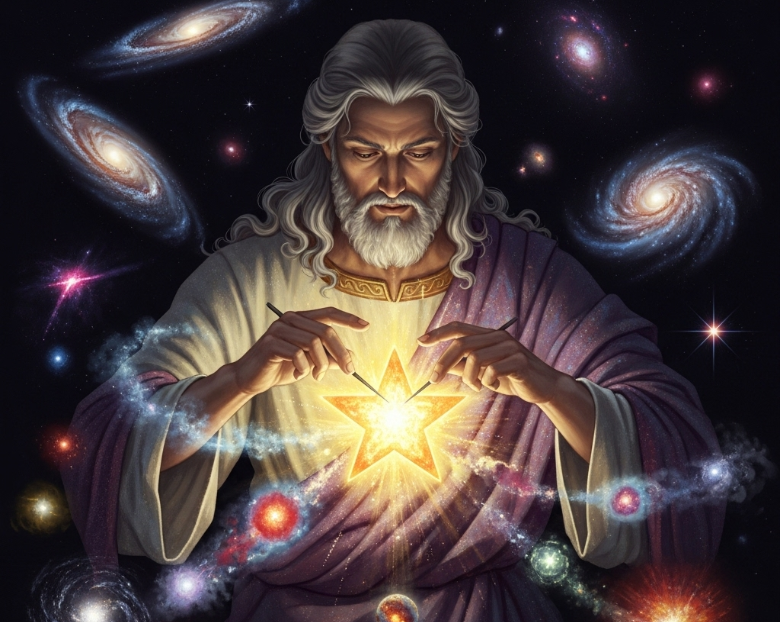
Owing to the object of theology (viz, God), those of us who seek to write on matters related to the Divine must make much use of analogies and metaphors. Therefore, when trying to understand God, a helpful approach is to consider three of God’s fundamental actions as a kind of “occupation.”
In this paper, I will use the analogy of occupations to describe three fundamental actions of God as one who creates, sustains, and is the desired end of all things.
Creator Of The Universe
When one thinks of God, it is frequently within this context. It is God, as creator, that is usually associated with the concept of God, and indeed, the Bible begins with creation.
Genesis, the first book of the Bible, is a Greek word meaning “origin” or “generation,” and this sense of God as the cause of all that is predominates in the biblical tradition. The belief in a God that is the source of creation may seem evident to Catholics and fundamental to our understanding of the universe. However, the belief that the universe needed a creator, or that there can only be one cause of creation, was not (and, for some, is not) accepted.
The ancient Greek tradition taught that the primordial universe (chaos) spawned Gaia (Earth), Tartarus (Underworld), Eros (Desire), Erebus (Darkness), and Nyx (Night). These various forces or gods then created the rest of the primordial beings, such as Hemera (Day), Uranus (Sky or Heavens), and Pontus (Sea).
An eternal universe that gave rise to the various characteristics of the current universe may seem fantastical or even silly. However, this is the default position for the rare atheist who actually contemplates cosmology and was widely held in the scientific community when a static state universe was the accepted theory. Albert Einstein would consider his original support for a static state universe to be his biggest mistake.
For its part, Catholic cosmology is predicated on the concept of creatio ex nihilo or creation out of nothing. To some extent, this concept can be misleading, for nothing comes from nothing (ex nihilo nihil fit). Rather, God is existence itself, and everything finds its ultimate origin in God.
It is true that human beings (and some of the “lower” animals) possess a capacity to create. However, it is the human ability to reason and create that reflects the image of God. Nevertheless, both our rationality and creative powers are dwarfed by God. Indeed, God’s power to create exists as an act of the Divine will. This fact leads to the second key component of God as creator: the Logos.
The term Logos can have different connotations; however, within a theological context, Logos (frequently translated from the Greek as “word”) is the creative reason and power that permeates the universe. It is also a reference to Christ, as is evident in the prologue to John’s Gospel, “In the beginning was the Word, and the Word was with God, and the Word was God. He was in the beginning with God. All things came to be through him, and without him nothing came to be.”
Nevertheless, “what came to be” must also be cared for.
That Which Sustains
It is true that one rarely considers God as that principle which sustains existence; however, the Bible considers God, among other things, as the one “who sustains all things by his mighty word [logos]” (Hebrews 1:3). This aspect of God may be considered in several ways.
Thermodynamics considers our universe an isolated system. An isolated system is one that neither shares nor obtains mass or energy from another system. It is also a universe that is subject to the laws of physics, and these laws, like most of science, are fundamentally descriptive. Put simply, science describes and utilizes existing laws that govern the universe. From a biblical perspective, these various laws that govern and sustain our universe are derived from the mind of God. (Colossians 1:17).
At a more personal level, God sustains life as its principle and efficient cause. For the most part, these terms, principal and efficient cause, are synonymous. However, for this paper, I want to stipulate a difference.
Philosophically, to speak of God as the efficient cause (an Aristotelian term) is to contend that God is the ultimate or first cause of existence. Without a first cause, there could be no subsequent causes and, therefore, nothing would exist. To consider God under the aspect of the principle cause, however, is to take a very biblical approach, which can be viewed under two separate aspects.
The will of God that created the universe continues to will the universe’s existence. Because Catholicism asserts that God is both personal and immanent, it is believed that God has not left the universe to its own devices but rather, He continues to uphold it. (Catechism of the Catholic Church, Paragraph 301).
In the second sense, God provides sustenance to His creation. This conclusion is supported biblically, particularly in the Psalms. “God is present as my helper; the Lord sustains my life.” Simply put, God acts in and through things to maintain their existence.
Thomas Aquinas’s analogy is helpful in understanding this concept of God as preserving His creation in its existence. Aquinas likens God to a musician who starts (creates) the music and then sustains the music throughout its entirety by continuing to play.
Of course, even the music must end.
The Good All Seek
All things tend toward their good. That is to say that they seek their own perfection. Accepting the existence of God, this highest good or perfection is God, for God is the source of goodness and the icon of perfection.
The concept can be understood by once more drawing from Aristotle’s four causes. Specifically, the final cause, which is defined as the purpose or reason a thing exists. The final cause of a seed is to become a plant, and the final cause for human beings is, from a biblical perspective, communion with God.
Indeed, Heaven is nothing other than a “perfect life with the Most Holy Trinity, this communion of life and love with the Trinity, with the Virgin Mary, the angels, and all the blessed is called ‘Heaven’. Heaven is the ultimate end and fulfilment of the deepest human longings, the state of supreme, definitive happiness.” (Catechism of the Catholic Church, Paragraph 1024).
This third “occupation” of God cannot be divorced from the other two. God has created human beings, sustains them in their existence, and, if they are willing, guides them to their highest and best good, which is communion with Himself.
Conclusion
The idea that God has jobs may seem incompatible with the Bible and Catholic theology. Part of the reason is owing to the non-contingent nature of God as well as the necessity to use analogies when describing God.
Nevertheless, in this essay, I have sought to suggest that the three “occupations” of God are creator, sustainer, and destination.
General Christian
Education and Religion
History and Religion
Previous Post
July 27, 2025
Of Spirit And Flesh
Next Post
August 10, 2025 Human Knowledge And The Existence Of God
Recent Comments
"Why would it matter if atheism is wrong? The fact that Catholic and Protestant scholars ..."
Beyond the Absence of Belief: The ..."
"Kaiser Member Service Proponents often compare atheism to not collecting stamps—it is the lack of ..."
Beyond the Absence of Belief: The ..."
""these dual denials (objective truth and objective meaning)"This is not accurate. Post-modern thought does not ..."
Defending the Faith in a Post-Truth ..."
"The theologians still haven't received the memo. Your opposition are no longer atheists, but they ..."
Defending the Faith in a Post-Truth ..."
Browse Our Archives
Select a Category Abortion Atheism Catholicism. Catholicism. God. Theophany. Christmas Eschatology Faith and Works. God. Holy Spirit Intelligent Design Jesus Christ Justice Law Politics Protestantism Religion Sabbath Salvation. Soteriology. The Bible Theology Uncategorized
Select a Month October 2026 September 2026 August 2026 July 2026 June 2026 May 2026 April 2026 March 2026 February 2026 January 2026 December 2025 November 2025 October 2025 September 2025 August 2025 July 2025 June 2025 May 2025 April 2025 March 2025 February 2025 January 2025 December 2024 November 2024 October 2024 September 2024 August 2024 July 2024 June 2024 May 2024 April 2024 March 2024 February 2024 January 2024 December 2023 November 2023 October 2023 September 2023 August 2023 July 2023 June 2023 May 2023 April 2023 March 2023 February 2023 January 2023 December 2022 November 2022 October 2022 September 2022 August 2022 July 2022 June 2022 May 2022 April 2022 March 2022 February 2022 January 2022 December 2021
Follow Us!
TAKE THE
Religious Wisdom Quiz
True or False: All Scripture is God-breathed and is useful for teaching, rebuking, correcting and training in righteousness.
Select your answer to see how you score.
TRUE FALSE
Related posts from Summa Catholic

The Anatomy of Divine Revelation in Catholic Thought

Beyond the Absence of Belief: The Implications of...

Can Catholic Apologetics Survive a Postmodern World?

From Samaria to Sanctity: Analyzing The Woman At...
TRENDING AT PATHEOS Catholic

Rejecting Doom: Christian Hope And Human Action
Christianity is a religion of hope. We are to have hope and...

It’s What Comes From Within Which Matters
One of the most difficult things for us to understand is why...

Why I Choose the Eucharist Over the Sermon
Choose the Eucharist, Not the Sermon What are we supposed to get...

5 Design Elements Found in Spiritually Rooted Homes
Putting Spirituality Into Home Decor Our homes are more than our living...

Credo: A Story of God Told with the...
About 10 years ago, I began to imagine a personal "Credo" that...

The Anatomy of Divine Revelation in Catholic Thought
The claim that God has made Himself known to human beings is...
view all Catholic blogs
What Are Your Thoughts?leave a comment
Ad-Free & Subscriber Log-In Subscription Support
- About Us
- 2026 Calendar
- Videos
- Podcasts
- Library of World Religions
- Faith In Media Tracker
- Advertise With Us
- Write for Us
- Privacy Policy
- Terms of Service
- Do Not Sell My Data
- Contact Us
- Radiant Digital
- Manage Newsletter Subscriptions
- Unsubscribe From Notifications
- Sitemap
Copyright 2008-2026, Patheos. All rights reserved.
Subscription Support Ad-Free & Subscriber Log-In
Follow Patheos