
BuddhistCatholicContemplativeEvangelicalGeneral ChristianHinduJewishLatter-day SaintMuslimNew VisionsProgressive Christian
Beliefs
- Buddhist
- Catholic
- Contemplative
- Evangelical
- General Christian
- Hindu
- Jewish
- Latter-day Saint
- More Voices
- Muslim
- New Visions
- Pagan
- Progressive Christian
Topics
- Religion News
- Food and Religion
- Sports and Religion
- Religious Art
- Religious Music and Entertainment
- Religious Events
- History and Religion
- Style and Religion
- Politics and Religion
- Women in Religion
- Recreation Outdoors and Religion
- Business Finance and Religion
- Careers Workplace and Religion
- Education and Religion
- Family Parenting and Religion
- Health Fitness and Religion
- Home and Religion
- Relationships and Religion
- Technology and Religion
- Travel and Religion
Columnists
- Buddhist Columnists
- Business Finance and Religion Columnists
- Careers Workplace and Religion Columnists
- Catholic Columnists
- Contemplative Columnists
- Education and Religion Columnists
- Evangelists Columnists
- Family Parenting and Religion Columnists
- General Christian Columnists
- Health Fitness and Religion Columnists
- Hindu Columnists
- History and Religion Columnists
- Home and Religion Columnists
- Jewish Columnists
- More Voices Columnists
- Latter Day Columnists
- Muslim Columnists
- New Visions Columnists
- Nonreligious Columnists
- Pagan Columnists
- Politics and Religion Columnists
- Progressive Columnists
- Recreation Outdoors and Religion Columnists
- Relationships and Religion Columnists
- Religion News Columnists
- Religious Art Columnists
- Religious Events Columnists
- Religious Music and Entertainment Columnists
- Sports and Religion Columnists
- Style and Religion Columnists
- Technology and Religion Columnists
- Travel and Religion Columnists
- Women in Religion Columnists
Resource Library
- 2026 Calendar
- Library of World Religions
- The 100 Most Holy Places on Earth
- Patheos Answers
- Podcasts
- Videos
- Faith Leaders Database
- Anglican Episcopalian
- Bahai
- Baptist
- Buddhism
- Christianity
- Confucianism
- Eastern Orthodoxy
- Hinduism
- Holiness and Pentecostal
- ISKCON
- Islam
- Judaism
- Lutheran
- Methodist
- The Church of Jesus Christ of Latter-day Saints
- New Age
- Paganism
- Presbytarian and Reformed
- Protestantism
- Religion Behind the Scenes
- Roman Catholic
- Scientology
- Shia Islam
- Sikhism
- Sufism
- Sunni Islam
- Taoism
- Zen
- See all religions
Research Tools
 Ad-Free & Subscriber Log-In Subscription Support
Ad-Free & Subscriber Log-In Subscription Support
Follow Patheos 

- Trending:
- Forgiveness
- |
- Marriage
- |
- Consciousness
- |
- Death Penalty
- |
- Election
- |
- Halloween

- Home
- Catholic
- Education and Religion
- Catholicism Within the Christian Tradition
Catholicism Within the Christian Tradition
Last updated on: July 20, 2025 at 12:09 pm by David Schloss
Catholicism Within the Christian Tradition 2025-07-20T12:09:46-04:00 David Schloss
Patheos Explore the world's faith through different perspectives on religion and spirituality! Patheos has the views of the prevalent religions and spiritualities of the world.
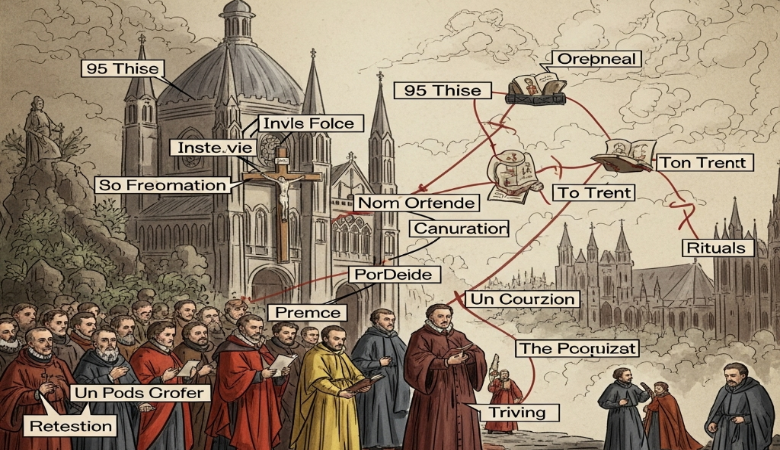
The Catholic-Protestant divide is a tragedy that has led to many misunderstandings and a significant amount of violence. This paper seeks to clarify this misunderstanding by demonstrating why Catholics are, indeed, fundamentally Christian.
There are a myriad of reasons that fuel the Catholic-Protestant conflict. Foundational to the various issues dividing Catholicism and Protestantism is the question of what it means to be Christian and who qualifies as such. This paper will address the frequently repeated charge that Catholics are not Christians.
Catholic Or Christian?
To proceed, it is necessary to address two fundamental questions. First, is it accurate to claim that Catholicism is essentially Christian in its theology and doctrine? If so, then we must ask whether Catholicism is a denomination within the larger Christian religion or whether Christianity is a denomination within the broader Catholic faith.
Theology (theos-logos) is literally the study or science of God. The foundation of Catholic theology is the belief in a trinitarian God who became incarnate in the person of Jesus of Nazareth. The Creeds, such as the Apostles Creed, provide a shared theological statement of faith and a source of Christian doctrine for Catholics and Protestants alike. However, as will be shown below, it is Catholicism that created the canon from which all Christian theology is based. Nevertheless, it cannot be seriously denied that Catholic theology is Christian theology, nor that Catholicism is inherently Christian.
Unfortunately, the issue is simplified so as to create a dichotomy: One is asked whether one is a Catholic or a Christian. Formulating it in this way creates two problems.
First, it is framed in a way that suggests a complex question fallacy (e.g., “Have you stopped beating your wife?”). If one answers yes to being a Catholic, one is answering no to being a Christian, and if one admits to being a Christian, it excludes one from being Catholic. This leads to the second problem, a false dichotomy.
To ask whether one is Catholic or a Christian assumes that one cannot be both. There is also something of a category error in the premise that Catholicism and Christianity exclude each other.
To adequately address the problem, it is necessary to define the relevant terms.
Catholicism, Christianity, And Canon
A basic definition of a Christian is one who follows Christ. What does that entail? What does it mean to follow Christ?
Obviously, following Christ excludes a physical definition. Instead, a Christian is one who follows the teachings of Christ. Consequently, there are two aspects of this definition. First, one must come to know the teachings of Christ, and second, one must adhere to those teachings.
Since Scripture and Sacred tradition provide the foundation for Christ’s teachings, the Bible is the most comprehensive and authoritative source of Christ’s teachings. After all, the Bible is itself the result of a primarily oral tradition. Furthermore, the Bible itself is a product. While it is true that Scripture is divinely inspired, the biblical canon is a product of the Catholic Church. Indeed, it is the work of the Church Councils that provides much of the biblical canon (e.g., the Synod of Rome in 382 AD, the Council of Hippo in 393 AD, and the Council of Carthage in 397 AD).
Therefore, if a Christian is one who follows Christ’s teachings, and the Catholic Church compiles those teachings, it seems to follow that to be a Christian is in no small sense to be Catholic.
Making A Distinction
A common way to categorize Catholicism is to consider it a denomination within the broader Christian tradition. Initially, this appears to be a logical construction. There is Christianity, and under this term, various denominations exist, such as Methodism and Catholicism. However, as indicated above, to be a Christian means following the teaching of Christ as enumerated by the Bible, which in turn is a Catholic book.
Moreover, since Catholicism means according to the whole, I would like to suggest an alternative way of categorizing the faith: to view Catholicism as the genus, and the numerous Christian denominations as the species contained within that genus.
A note about language: genus refers to a general class that encompasses specific members. For example, the genus “animal” includes human beings. Species refers to a particular category within a larger classification. For example, humans are a species within the genus animal.
Moreover, since a species (in this case, the numerous Christian denominations) cannot exist without a genus (Catholicism), it is necessary to show that Christianity cannot exist independently of the Catholic Church.
The Necessity Of The Catholic Church
If being a Christian entails following the teachings of Christ, and if those teachings are enumerated in the Bible, then it is manifest that one cannot deny the necessity of the Catholic Church while at the same time accepting the necessity and infallibility of the Bible, which is a product of that Church.
Now, suppose the Bible is the proximate cause of the various Christian denominations, and the Catholic Church is the proximate cause of the Bible. In that case, it is evident that the Catholic Church is the ultimate cause of the various Christian denominations in the same manner that a genus is the cause of the species contained within it.
Lastly, it must be admitted that Jesus created a Church (Matthew 16:18) for the purpose of teaching in His name (Matthew 16:19). This fact leads to the matter of apostolic succession. As many of the Church Fathers (Clement of Rome, Irenaeus, Tertullian) have argued, the true Church must be apostolic if it is to communicate the teachings of Christ.
Apostolic succession refers to an unbroken line of bishops from the present day to the original twelve apostles. Only the Catholic Church can make this claim of apostolic succession.
The significance of apostolic succession lies in the fact that it allows the Catholic Church to trace its history to God incarnate, Jesus Christ. This is a claim no other Christian denomination can make. To paraphrase Saint Ignatius of Antioch, where the bishop is, there is the Church.
Conclusion
In this essay, I have endeavored to argue that the position that the Catholic religion is not intrinsically Christian is both theologically and logically incoherent. Moreover, I have sought to show that it is only Catholicism that possesses the fullness of the Christian faith.
General Christian
Education and Religion
History and Religion
Previous Post
July 9, 2025
Why Media Keeps Getting Faith Wrong—And What Needs to Change
Next Post
July 27, 2025 Of Spirit And Flesh
Recent Comments
"Why would it matter if atheism is wrong? The fact that Catholic and Protestant scholars ..."
Beyond the Absence of Belief: The ..."
"Kaiser Member Service Proponents often compare atheism to not collecting stamps—it is the lack of ..."
Beyond the Absence of Belief: The ..."
""these dual denials (objective truth and objective meaning)"This is not accurate. Post-modern thought does not ..."
Defending the Faith in a Post-Truth ..."
"The theologians still haven't received the memo. Your opposition are no longer atheists, but they ..."
Defending the Faith in a Post-Truth ..."
Browse Our Archives
Select a Category Abortion Atheism Catholicism. Catholicism. God. Theophany. Christmas Eschatology Faith and Works. God. Holy Spirit Intelligent Design Jesus Christ Justice Law Politics Protestantism Religion Sabbath Salvation. Soteriology. The Bible Theology Uncategorized
Select a Month October 2026 September 2026 August 2026 July 2026 June 2026 May 2026 April 2026 March 2026 February 2026 January 2026 December 2025 November 2025 October 2025 September 2025 August 2025 July 2025 June 2025 May 2025 April 2025 March 2025 February 2025 January 2025 December 2024 November 2024 October 2024 September 2024 August 2024 July 2024 June 2024 May 2024 April 2024 March 2024 February 2024 January 2024 December 2023 November 2023 October 2023 September 2023 August 2023 July 2023 June 2023 May 2023 April 2023 March 2023 February 2023 January 2023 December 2022 November 2022 October 2022 September 2022 August 2022 July 2022 June 2022 May 2022 April 2022 March 2022 February 2022 January 2022 December 2021
Follow Us!
TAKE THE
Religious Wisdom Quiz
Which king of Babylon saw the handwriting on the wall?
Select your answer to see how you score.
Cyrus Darius Nebuchadnezzar Belshazzar
Related posts from Summa Catholic

The Anatomy of Divine Revelation in Catholic Thought

Beyond the Absence of Belief: The Implications of...

Can Catholic Apologetics Survive a Postmodern World?

From Samaria to Sanctity: Analyzing The Woman At...
TRENDING AT PATHEOS Catholic

The Parable Of The Sower And The Word...
One of Christ’s most famous parables is that of the sower who...

Rejecting Doom: Christian Hope And Human Action
Christianity is a religion of hope. We are to have hope and...

Why I Choose the Eucharist Over the Sermon
Choose the Eucharist, Not the Sermon What are we supposed to get...

5 Design Elements Found in Spiritually Rooted Homes
Putting Spirituality Into Home Decor Our homes are more than our living...

Credo: A Story of God Told with the...
About 10 years ago, I began to imagine a personal "Credo" that...

The Anatomy of Divine Revelation in Catholic Thought
The claim that God has made Himself known to human beings is...
view all Catholic blogs
What Are Your Thoughts?leave a comment
Ad-Free & Subscriber Log-In Subscription Support
- About Us
- 2026 Calendar
- Videos
- Podcasts
- Library of World Religions
- Faith In Media Tracker
- Advertise With Us
- Write for Us
- Privacy Policy
- Terms of Service
- Do Not Sell My Data
- Contact Us
- Radiant Digital
- Manage Newsletter Subscriptions
- Unsubscribe From Notifications
- Sitemap
Copyright 2008-2026, Patheos. All rights reserved.
Subscription Support Ad-Free & Subscriber Log-In
Follow Patheos