
BuddhistCatholicContemplativeEvangelicalGeneral ChristianHinduJewishLatter-day SaintMuslimNew VisionsProgressive Christian
Beliefs
- Buddhist
- Catholic
- Contemplative
- Evangelical
- General Christian
- Hindu
- Jewish
- Latter-day Saint
- More Voices
- Muslim
- New Visions
- Pagan
- Progressive Christian
Topics
- Religion News
- Food and Religion
- Sports and Religion
- Religious Art
- Religious Music and Entertainment
- Religious Events
- History and Religion
- Style and Religion
- Politics and Religion
- Women in Religion
- Recreation Outdoors and Religion
- Business Finance and Religion
- Careers Workplace and Religion
- Education and Religion
- Family Parenting and Religion
- Health Fitness and Religion
- Home and Religion
- Relationships and Religion
- Technology and Religion
- Travel and Religion
Columnists
- Buddhist Columnists
- Business Finance and Religion Columnists
- Careers Workplace and Religion Columnists
- Catholic Columnists
- Contemplative Columnists
- Education and Religion Columnists
- Evangelists Columnists
- Family Parenting and Religion Columnists
- General Christian Columnists
- Health Fitness and Religion Columnists
- Hindu Columnists
- History and Religion Columnists
- Home and Religion Columnists
- Jewish Columnists
- More Voices Columnists
- Latter Day Columnists
- Muslim Columnists
- New Visions Columnists
- Nonreligious Columnists
- Pagan Columnists
- Politics and Religion Columnists
- Progressive Columnists
- Recreation Outdoors and Religion Columnists
- Relationships and Religion Columnists
- Religion News Columnists
- Religious Art Columnists
- Religious Events Columnists
- Religious Music and Entertainment Columnists
- Sports and Religion Columnists
- Style and Religion Columnists
- Technology and Religion Columnists
- Travel and Religion Columnists
- Women in Religion Columnists
Resource Library
- 2026 Calendar
- Library of World Religions
- The 100 Most Holy Places on Earth
- Patheos Answers
- Podcasts
- Videos
- Faith Leaders Database
- Anglican Episcopalian
- Bahai
- Baptist
- Buddhism
- Christianity
- Confucianism
- Eastern Orthodoxy
- Hinduism
- Holiness and Pentecostal
- ISKCON
- Islam
- Judaism
- Lutheran
- Methodist
- The Church of Jesus Christ of Latter-day Saints
- New Age
- Paganism
- Presbytarian and Reformed
- Protestantism
- Religion Behind the Scenes
- Roman Catholic
- Scientology
- Shia Islam
- Sikhism
- Sufism
- Sunni Islam
- Taoism
- Zen
- See all religions
Research Tools
 Ad-Free & Subscriber Log-In Subscription Support
Ad-Free & Subscriber Log-In Subscription Support
Follow Patheos 

- Trending:
- Forgiveness
- |
- Marriage
- |
- Consciousness
- |
- Death Penalty
- |
- Election
- |
- Halloween

- Home
- Catholic
- Education and Religion
- Can God Be Seen?
Can God Be Seen?
Last updated on: June 15, 2025 at 11:42 am by David Schloss
Can God Be Seen? 2025-06-15T11:42:15-04:00 David Schloss
Patheos Explore the world's faith through different perspectives on religion and spirituality! Patheos has the views of the prevalent religions and spiritualities of the world.

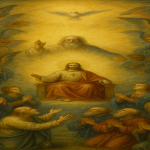
Art By Chil Vera.
The Bible can be complicated at times and even appear to contradict itself. One such area of apparent contradiction centers on whether human beings can “see” God. Some verses seem to suggest that God cannot be seen, while others claim He can (and has been) seen by human beings.
This essay will examine this problem and suggest that the apparent conflict can be resolved by distinguishing between two forms of seeing. In the first instance, seeing can refer to encountering God’s unmediated, essential glory. In the second manner, seeing can be understood as perceiving a mediated manifestation or theophany.
First, however, reviewing the relevant Scripture verses is in order.
To See Is To Die
It was widely accepted in the ancient world that no one could see God and live. This belief appears to be supported by several biblical verses.
In Genesis 32:25-32, Jacob “wrestles” with God and is surprised that he lived despite “seeing the face of God.” During the exodus from Egypt, the Israelites feared any direct contact with God (see Exodus 20:19). This belief that any kind of direct contact with God was fatal for human beings is reiterated in Deuteronomy and again in the Book of Judges.
Why is this the case? Why does the sight of God lead to death?
There are two fundamental ways to approach these particular biblical passages. The first is literal. Simply put, the infinite and transcendent nature of God is such that a mortal being cannot experience God without being overwhelmed and dying. For a person to see God’s full glory and live would, presumably, require that person to experience the beatific vision, an event that fallen humans cannot experience while alive.
It is important to note that death seems to be the dividing line, so to speak. To see God while one is alive in the flesh is to die. However, from the Catholic perspective, blessed are those who experience the beatific vision in Heaven. That is to see God as He truly is.
The second way of interpreting the biblical passages is spiritually or metaphorically. In this sense, seeing God does not mean a physical death, but rather a radical transformation of the individual in such a way that he “dies” to his old self.
Perhaps there is a third way of understanding these passages. What if seeing God does not result in death of any kind?
See God And Live?
It is not necessary to dwell long here. The theme of the Gospels, if not the whole of the New Testament, is that “The Word [Christ] became flesh and made his dwelling among us, and we saw his glory, the glory as of the Father’s only Son, full of grace and truth.” (John 1:14).
If a fundamental claim of the Old Testament is that seeing God led to death, then a basic truism of the New Testament is that God became one of us and was seen by many. Obviously, there is a fundamental contradiction between these two claims.
A core belief and tenet of the Catholic faith is that God became a human being in the person of Jesus Christ. If Jesus is God, and if many saw Jesus and lived, it must be false that seeing God is deadly. Said differently, how do we reconcile the biblical texts that indicate that humans cannot see God and live with the New Testament canon that clearly depicts people seeing Jesus and living?
To reconcile this problem requires a little logic, specifically the law of noncontradiction, which states that something cannot be true and untrue simultaneously and in the same respect. Moreover, for a contradiction to occur in a statement, the predicate must refer to a different aspect of the subject. How does this help?
It can be argued that the contradictory verses about the sight of God causing death refer to different aspects of God. To elucidate this claim, I will reference two apparently contradictory verses.
In Exodus 33:20, God tells Moses that it is impossible for Moses to see His face and live. However, in John 1:18, we read, “No one has ever seen God. It is the only Son, God, who is at the Father’s side, who has made him known.” If no one has seen God, surely no one has died from encountering Him. To avoid the contradiction inherent in these two statements, I suggest viewing them as referring to different aspects of God.
As God is a spirit, He cannot be seen by those still in the physical body. For a human being to see God as He is, in His essential nature, would require that the person be a spirit, as well. That is, one would have to be dead. Therefore, when the Bible states that one cannot see God and live, it refers to a human being’s incapacity to see God’s essential nature. This seems to be what God tells Moses in the Exodus 33:20 passage mentioned above.
Conversely, human beings can and have seen God in various mediated ways. Natural theology studies the ways we can see God through His effects. An example of this is the teleological argument, which argues that the universe’s apparent features and design infer a divine designer’s existence.
Moreover, Catholicism and the Bible teach that one can see God through the mediator, Jesus Christ. Christ’s role as the mediator has several aspects associated with it; however, for the purpose of this essay, to say that Christ is the mediator is to suggest that Christ is the link between humanity and God the Father. Because Christ is both human and divine, He provides the link that allows human beings to not only “see” God and live but to have life abundantly. (See John 10:10).
Conclusion
Does the Bible contradict itself by claiming that no one can see God and live while also claiming that God “dwelt among us”? The answer is, of course, no.
Owing to our physical and spiritual limitations, it is impossible for human beings to see (that is, to know God’s essence) and live. However, in becoming a human being, God, in the person of Jesus Christ, became the “lens” through which we may yet see God.
General Christian
Education and Religion
History and Religion
Previous Post
June 8, 2025
Did Jesus Possess The Beatific Vision?
Next Post

June 22, 2025 How Old Is The World?
Recent Comments
"Why would it matter if atheism is wrong? The fact that Catholic and Protestant scholars ..."
Beyond the Absence of Belief: The ..."
"Kaiser Member Service Proponents often compare atheism to not collecting stamps—it is the lack of ..."
Beyond the Absence of Belief: The ..."
""these dual denials (objective truth and objective meaning)"This is not accurate. Post-modern thought does not ..."
Defending the Faith in a Post-Truth ..."
"The theologians still haven't received the memo. Your opposition are no longer atheists, but they ..."
Defending the Faith in a Post-Truth ..."
Browse Our Archives
Select a Category Abortion Atheism Catholicism. Catholicism. God. Theophany. Christmas Eschatology Faith and Works. God. Holy Spirit Intelligent Design Jesus Christ Justice Law Politics Protestantism Religion Sabbath Salvation. Soteriology. The Bible Theology Uncategorized
Select a Month October 2026 September 2026 August 2026 July 2026 June 2026 May 2026 April 2026 March 2026 February 2026 January 2026 December 2025 November 2025 October 2025 September 2025 August 2025 July 2025 June 2025 May 2025 April 2025 March 2025 February 2025 January 2025 December 2024 November 2024 October 2024 September 2024 August 2024 July 2024 June 2024 May 2024 April 2024 March 2024 February 2024 January 2024 December 2023 November 2023 October 2023 September 2023 August 2023 July 2023 June 2023 May 2023 April 2023 March 2023 February 2023 January 2023 December 2022 November 2022 October 2022 September 2022 August 2022 July 2022 June 2022 May 2022 April 2022 March 2022 February 2022 January 2022 December 2021
Follow Us!
TAKE THE
Religious Wisdom Quiz
What did Jesus use to heal deaf man?
Select your answer to see how you score.
Fingers in ears Oil Mud Water
Related posts from Summa Catholic

The Anatomy of Divine Revelation in Catholic Thought

Beyond the Absence of Belief: The Implications of...

Reclaiming Objective Faith in an Individualistic World

Why Didn’t God Just Destroy Satan? A Theological...
TRENDING AT PATHEOS Catholic

Rejecting Doom: Christian Hope And Human Action
Christianity is a religion of hope. We are to have hope and...

It’s What Comes From Within Which Matters
One of the most difficult things for us to understand is why...

Why I Choose the Eucharist Over the Sermon
Choose the Eucharist, Not the Sermon What are we supposed to get...

5 Design Elements Found in Spiritually Rooted Homes
Putting Spirituality Into Home Decor Our homes are more than our living...

Credo: A Story of God Told with the...
About 10 years ago, I began to imagine a personal "Credo" that...

The Anatomy of Divine Revelation in Catholic Thought
The claim that God has made Himself known to human beings is...
view all Catholic blogs
What Are Your Thoughts?leave a comment
Ad-Free & Subscriber Log-In Subscription Support
- About Us
- 2026 Calendar
- Videos
- Podcasts
- Library of World Religions
- Faith In Media Tracker
- Advertise With Us
- Write for Us
- Privacy Policy
- Terms of Service
- Do Not Sell My Data
- Contact Us
- Radiant Digital
- Manage Newsletter Subscriptions
- Unsubscribe From Notifications
- Sitemap
Copyright 2008-2026, Patheos. All rights reserved.
Subscription Support Ad-Free & Subscriber Log-In
Follow Patheos