
BuddhistCatholicContemplativeEvangelicalGeneral ChristianHinduJewishLatter-day SaintMuslimNew VisionsProgressive Christian
Beliefs
- Buddhist
- Catholic
- Contemplative
- Evangelical
- General Christian
- Hindu
- Jewish
- Latter-day Saint
- More Voices
- Muslim
- New Visions
- Pagan
- Progressive Christian
Topics
- Religion News
- Food and Religion
- Sports and Religion
- Religious Art
- Religious Music and Entertainment
- Religious Events
- History and Religion
- Style and Religion
- Politics and Religion
- Women in Religion
- Recreation Outdoors and Religion
- Business Finance and Religion
- Careers Workplace and Religion
- Education and Religion
- Family Parenting and Religion
- Health Fitness and Religion
- Home and Religion
- Relationships and Religion
- Technology and Religion
- Travel and Religion
Columnists
- Buddhist Columnists
- Business Finance and Religion Columnists
- Careers Workplace and Religion Columnists
- Catholic Columnists
- Contemplative Columnists
- Education and Religion Columnists
- Evangelists Columnists
- Family Parenting and Religion Columnists
- General Christian Columnists
- Health Fitness and Religion Columnists
- Hindu Columnists
- History and Religion Columnists
- Home and Religion Columnists
- Jewish Columnists
- More Voices Columnists
- Latter Day Columnists
- Muslim Columnists
- New Visions Columnists
- Nonreligious Columnists
- Pagan Columnists
- Politics and Religion Columnists
- Progressive Columnists
- Recreation Outdoors and Religion Columnists
- Relationships and Religion Columnists
- Religion News Columnists
- Religious Art Columnists
- Religious Events Columnists
- Religious Music and Entertainment Columnists
- Sports and Religion Columnists
- Style and Religion Columnists
- Technology and Religion Columnists
- Travel and Religion Columnists
- Women in Religion Columnists
Resource Library
- 2026 Calendar
- Library of World Religions
- The 100 Most Holy Places on Earth
- Patheos Answers
- Podcasts
- Videos
- Faith Leaders Database
- Anglican Episcopalian
- Bahai
- Baptist
- Buddhism
- Christianity
- Confucianism
- Eastern Orthodoxy
- Hinduism
- Holiness and Pentecostal
- ISKCON
- Islam
- Judaism
- Lutheran
- Methodist
- The Church of Jesus Christ of Latter-day Saints
- New Age
- Paganism
- Presbytarian and Reformed
- Protestantism
- Religion Behind the Scenes
- Roman Catholic
- Scientology
- Shia Islam
- Sikhism
- Sufism
- Sunni Islam
- Taoism
- Zen
- See all religions
Research Tools
 Ad-Free & Subscriber Log-In Subscription Support
Follow Patheos 

- Trending:
- Advent
- |
- Forgiveness
- |
- Thanksgiving
- |
- Election
- |
- Seasonal Holidays
- |
- Marriage

- Home
- Catholic
- Education and Religion
- Do We Need A Conscience?
Do We Need A Conscience?
Last updated on: May 25, 2025 at 12:28 pm by David Schloss
Do We Need A Conscience? 2025-05-25T12:28:45-04:00 David Schloss
Patheos Explore the world's faith through different perspectives on religion and spirituality! Patheos has the views of the prevalent religions and spiritualities of the world.
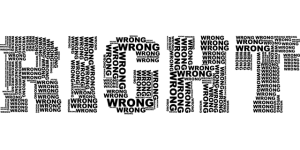
Art By Gordon Johnson
What does it mean to be moral, and what is the role of the conscience in being a “good” person? These are some of the questions that moral theology addresses.
In this paper, I will examine Catholic moral theology, the Catholic concept of the conscience, and the three pillars upon which morality rests.
Moral Theology
Moral theology is the branch of Catholic theology that focuses on the human response to divine revelation. More specifically, moral theology is concerned with human actions and behavior in light of God’s revelation and the Church’s teachings.
It is helpful to recognize two aspects of moral theology. The first is descriptive, drawing on what God has prescribed for human beings through scripture and tradition. The Ten Commandments and the Sermon on the Mount are examples of descriptive morality.
The second aspect of moral theology is applied, focusing on how to live a morally good life as a Catholic. In this sense, moral theology is concerned with the “acting out” of descriptive morality. Examples of this aspect include care for the poor and marginalized. (Matthew 25:34-40; corporal works of mercy).
Putting the two aspects of moral theology – the descriptive and the applied – together entails an internalization, a writing of the law on our hearts. This internal sense of morality is generally called the conscience.
Conscience
John Henry Newman famously referred to the conscience as “the aboriginal vicar of Christ in the soul” (Newman, John Henry. An Essay in Aid of a Grammar of Assent. 2018). Newman’s statement is intended to imply that the conscience is not the voice of the individual himself but rather the voice of God, who exercises sovereign authority, makes demands, and furnishes both reward and punishment.
A more general and perhaps philosophical definition would be that the conscience is a judgment of the intellect that draws from the general principles of faith and reason to determine the virtue or sinfulness of a particular action.
In a perfect world – one that is not subject to the damage of original sin – the voice of God in our souls would be crystal clear. Since this is not the case, the conscience must be formed correctly. Indeed, a properly formed conscience is part of the three legs of morality.
Succinctly put, “A well-formed conscience is upright and truthful. It formulates its judgments according to reason, in conformity with the true good willed by the wisdom of the Creator.” (Catechism of the Catholic Church, Paragraph 1783). There are various ways in which the conscience is well-formed. These include prayer, Scripture reading, and utilizing the teachings of the Church.
We are now better positioned to examine the foundational pillars of moral theology in more detail.
The Three Legs Of Morality
A fundamental precept of Catholic moral theology teaches that God is the ground of objective morality. This is a reasonably simple yet critical aspect of Catholic moral teaching and is the first pillar of morality.
We can observe that our world possesses numerous and varied goods. Moreover, these goods are hierarchical. Money is good, but inferior to what we use it for, to obtain, for example, food or shelter. It is manifest that whatever exists in a hierarchical form must have that which is considered the highest good. Catholicism asserts that the highest good is God. Perhaps more accurately (and platonically), God is goodness itself. (See Mark 10:18).
Contrasting this concept with its alternative position is helpful in bringing this concept into clear view. If God does not exist or is not the source of morality, then the responsibility falls to human beings. Morality becomes subjective and relative. In a sense, it is the eating of the tree of good and evil, arrogating for ourselves that which belongs to God alone.
Of course, subjective morality is not the position of the Catholic Church, nor does it align with our experience of reality. Principles of right and wrong are independent of human beings. However, it is necessary to make correct judgments about these moral principles. Such is the responsibility of the second leg of morality: the conscience.
Conscience must not be confused with feelings or even the will. Rather, as an operation of the intellect, conscience seeks to conform the mind to the objective principles that ground morality. These principles are presupposed as known to the mind, either from the light of natural reason reflecting on the data of creation or from divine faith which responds to God’s supernatural revelation.
Conscience is not the source of these moral principles. Instead, it uses objective moral principles as the premises from which to conclude whether something should be done because it is good or should not be done because it is bad. Its conclusions also apply to situations when the mind decides something is permissible or preferable but not obligatory. (See Hardon, John. Catholic Dictionary. 2013).
The final leg of morality is free will. A basic definition of free will is the capacity of a rational being to act or not to act, to do this or that, and so to perform deliberate actions on one’s own responsibility. (Catechism of the Catholic Church, Paragraph 1731).
Living things all seek that which they deem to be good. Free will can be defined as the power, free from coercion, to choose among several goods and the means to obtain them. Accordingly, free will allows humans to conform or not to the principles of objective morality.
As implied above, the study of morality (or moral theology) provides the framework by which human beings understand and make decisions about right and wrong. Unfortunately, due to the effects of original sin, the capacity of human beings to make moral decisions has been damaged. For this reason, the Catholic Church teaches that the conscience must be “well-formed” (Catechism of the Catholic Church, Paragraph 1783).
Conclusion
In many ways, morality sits at the center of the human experience and is critical to living in a society. From a Catholic perspective, to be moral is to align oneself with the mind of God.
In this essay, I have sought to touch upon the depth and significance of morality by articulating three pillars that make it possible.
Education and Religion
History and Religion
Previous Post
May 18, 2025
Why do Catholics Believe In The Biblical God?
Next Post
June 1, 2025 The Evolution Of Papal Authority
Recent Comments
"While Unitarianism remains a small minority of believers, its influence on Christianity must not be ..."
A Catholic Critique of Biblical Unitarianism
"Science has proven that Homosapiens have walked this Earth for over 200,000 years. Did God ..."
A Catholic Critique of Biblical Unitarianism
"The universe, the planet we inhabit, and life itself need not exist.This is a claim. ..."
Creation, Preservation, and Teleology in Catholic ..."
"If you have sufficient evidence to support a belief you don't need faith. Despite what ..."
Is Faith Really Blind? What Skeptics ..."
Browse Our Archives
Select a Category Abortion Atheism Catholicism. Catholicism. God. Theophany. Christmas Eschatology Faith and Works. God. Holy Spirit Intelligent Design Jesus Christ Justice Law Politics Protestantism Religion Sabbath Salvation. Soteriology. The Bible Theology Uncategorized
Select a Month November 2026 October 2026 September 2026 August 2026 July 2026 June 2026 May 2026 April 2026 March 2026 February 2026 January 2026 December 2025 November 2025 October 2025 September 2025 August 2025 July 2025 June 2025 May 2025 April 2025 March 2025 February 2025 January 2025 December 2024 November 2024 October 2024 September 2024 August 2024 July 2024 June 2024 May 2024 April 2024 March 2024 February 2024 January 2024 December 2023 November 2023 October 2023 September 2023 August 2023 July 2023 June 2023 May 2023 April 2023 March 2023 February 2023 January 2023 December 2022 November 2022 October 2022 September 2022 August 2022 July 2022 June 2022 May 2022 April 2022 March 2022 February 2022 January 2022 December 2021
Follow Us!
TAKE THE
Religious Wisdom Quiz
Where did God tell Moses to remove his shoes because it was holy ground?
Select your answer to see how you score.
Egyptian palace At the burning bush Red Sea Mount Sinai
Related posts from Summa Catholic
If Baptism Washes Away Sin, Why Do Catholics...
Is Catholicism The Fulfillment Of The Old Testament?
Why Is Catholicism Centered on an Instrument of...

Is Faith Really Blind? What Skeptics Get Wrong
TRENDING AT PATHEOS Catholic
When The Letter Of The Law Misses Its...
Jesus cared about people. He never ignored their needs, whether they were...

The Kingdom Of God In Ordinary Life And...
The kingdom of God is all around us; it is in us...

If Baptism Washes Away Sin, Why Do Catholics...
The seven sacraments stand as the foundation of Catholic ecclesial life. The...

The Power of Setting a Good Example
Remember last August when the Chicago White Sox hosted a "Pope Hat...

A Catholic Critique of Biblical Unitarianism
If the statistics are to be believed, Unitarianism is rising worldwide. Although...

How Grandma Tourism Helps Grandparents Live Their Vocation
Grandma, The New Travel Influencer What started as a nostalgia-inspired social media...
view all Catholic blogs
What Are Your Thoughts?leave a comment
Ad-Free & Subscriber Log-In Subscription Support
- About Us
- 2026 Calendar
- Videos
- Podcasts
- Library of World Religions
- Faith In Media Tracker
- Advertise With Us
- Write for Us
- Privacy Policy
- Terms of Service
- Do Not Sell My Data
- Contact Us
- Radiant Digital
- Manage Newsletter Subscriptions
- Unsubscribe From Notifications
- Sitemap
Copyright 2008-2026, Patheos, part of the Radiant Digital network of media brands. All rights reserved.
Subscription Support Ad-Free & Subscriber Log-In
Follow Patheos