
BuddhistCatholicContemplativeEvangelicalGeneral ChristianHinduJewishLatter-day SaintMuslimNew VisionsProgressive Christian
Beliefs
- Buddhist
- Catholic
- Contemplative
- Evangelical
- General Christian
- Hindu
- Jewish
- Latter-day Saint
- More Voices
- Muslim
- New Visions
- Pagan
- Progressive Christian
Topics
- Religion News
- Food and Religion
- Sports and Religion
- Religious Art
- Religious Music and Entertainment
- Religious Events
- History and Religion
- Style and Religion
- Politics and Religion
- Women in Religion
- Recreation Outdoors and Religion
- Business Finance and Religion
- Careers Workplace and Religion
- Education and Religion
- Family Parenting and Religion
- Health Fitness and Religion
- Home and Religion
- Relationships and Religion
- Technology and Religion
- Travel and Religion
Columnists
- Buddhist Columnists
- Business Finance and Religion Columnists
- Careers Workplace and Religion Columnists
- Catholic Columnists
- Contemplative Columnists
- Education and Religion Columnists
- Evangelists Columnists
- Family Parenting and Religion Columnists
- General Christian Columnists
- Health Fitness and Religion Columnists
- Hindu Columnists
- History and Religion Columnists
- Home and Religion Columnists
- Jewish Columnists
- More Voices Columnists
- Latter Day Columnists
- Muslim Columnists
- New Visions Columnists
- Nonreligious Columnists
- Pagan Columnists
- Politics and Religion Columnists
- Progressive Columnists
- Recreation Outdoors and Religion Columnists
- Relationships and Religion Columnists
- Religion News Columnists
- Religious Art Columnists
- Religious Events Columnists
- Religious Music and Entertainment Columnists
- Sports and Religion Columnists
- Style and Religion Columnists
- Technology and Religion Columnists
- Travel and Religion Columnists
- Women in Religion Columnists
Resource Library
- 2026 Calendar
- Library of World Religions
- The 100 Most Holy Places on Earth
- Patheos Answers
- Podcasts
- Videos
- Faith Leaders Database
- Anglican Episcopalian
- Bahai
- Baptist
- Buddhism
- Christianity
- Confucianism
- Eastern Orthodoxy
- Hinduism
- Holiness and Pentecostal
- ISKCON
- Islam
- Judaism
- Lutheran
- Methodist
- The Church of Jesus Christ of Latter-day Saints
- New Age
- Paganism
- Presbytarian and Reformed
- Protestantism
- Religion Behind the Scenes
- Roman Catholic
- Scientology
- Shia Islam
- Sikhism
- Sufism
- Sunni Islam
- Taoism
- Zen
- See all religions
Research Tools
 Ad-Free & Subscriber Log-In Subscription Support
Follow Patheos 

- Trending:
- Advent
- |
- Forgiveness
- |
- Thanksgiving
- |
- Election
- |
- Seasonal Holidays
- |
- Marriage

- Home
- Catholic
- Education and Religion
- Scrolls to Scripture: Dead Sea Scrolls and Catholic Theology
Scrolls to Scripture: Dead Sea Scrolls and Catholic Theology
Last updated on: March 23, 2025 at 12:01 pm by David Schloss
Scrolls to Scripture: Dead Sea Scrolls and Catholic Theology 2025-03-23T12:01:32-04:00 David Schloss
Patheos Explore the world's faith through different perspectives on religion and spirituality! Patheos has the views of the prevalent religions and spiritualities of the world.

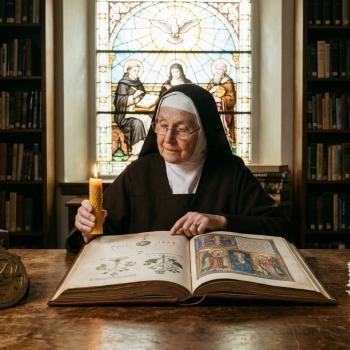
Art By Ivana Tomášková.
In the Judean Desert, not far from the Dead Sea, there is a series of caverns known as the Qumran Caves. Except for the occasional visit by Bedouin nomads, these caves held little interest to the outside world. That would all change in the middle of the twentieth century.
Between 1947 and 1956, thousands of writing fragments were discovered in these caves. These “manuscripts” would become known as the Dead Sea Scrolls. In this paper, I want to examine the significance of these Scrolls, particularly as they relate to Catholicism.
Before beginning, I want to provide information about the sources cited. In the article, I refer to “Scroll numbers.” The numbers and the links in the text have been provided by the Israel Antiquities Authority.
What Are The Dead Sea Scrolls?
The Scrolls themselves are written on leather, papyrus, and copper and are written predominantly in Hebrew, with some in Aramaic and others in Greek.
The dating of ancient texts is far from an exact science, and this is also true of the Dead Sea Scrolls. Nevertheless, scholars have determined they were likely written between the third century B.C. and the second century A.D.
It is believed that the authors of the Scrolls were a Jewish sect known as the Essenes. The Essenes were one of four distinct Jewish groups living in Judaea before and during the Roman era (approximately 6 A.D. to 135 A.D.).
Archaeological evidence from Qumran, including the remains of Jewish ritual baths, appears to support this hypothesis. Nevertheless, some scholars have also suggested that other groups, such as early Christians and Jews from Jerusalem fleeing the Romans, may have contributed to the production of the scrolls found at Qumran.
Remarkably, the Scrolls include fragments composed of much of the Old Testament. Additionally, they provide insight into theological conflicts within Judaism as well as references to the burgeoning Christian religion.
Theological And Religious Significance
The Scrolls supply a wealth of data that influences theology and the Catholic faith. This data includes previously unavailable Hebrew Bible manuscripts, allowing scholars to compare and refine existing texts. Such information sheds light on the accuracy of biblical transmission and variations in ancient texts.
They have also provided insights into the relationship between the Masoretic Text (the standard Hebrew version of the Bible) and the Septuagint (the Greek translation). This information is of great interest to Catholicism as the Catholic Church utilizes the Septuagint and the Vulgate (the Latin translation of the Bible). The Dead Sea Scrolls help show the validity of those versions of the Bible.
The Scrolls also illuminate the cultural and religious milieu in which the Gospels were written, providing unique insights into Jewish life and religious beliefs before and during Jesus’s time. This helps contextualize the New Testament and the origins of Christianity.
Concepts and language within the Scrolls mirror those found within the biblical text, including the New Testament. The Scrolls include ideas, language, and concepts of messianism, eschatology (the study of the end times), and community life. Owing to this, some scholars have suggested a relationship between the Qumran community (associated with the Scrolls) and early Christianity. This is significant in that it confirms that the Gospels were written within the time period in which they claim to be written.
Finally, the Dead Sea Scrolls provide data about the development of the biblical canon, particularly the Old Testament. They provide evidence of the diversity of texts that were considered important in ancient Judaism. From a Catholic perspective, this is useful in understanding the history of the deuterocanonical books.
Insight Into The World Of Jesus
The Scrolls provide valuable data regarding what people thought of Christ as well as clarifying Christ’s own words. For example, one Scroll refers to the coming of the “Son of God,” a “Son of the Most High” who will be “great” and reign forever. (See Scroll Number 4Q246). The language echoes the Annunciation narrative found in Luke.
Another scroll speaks of the appearance of one who acts in the manner of God, having the power to forgive sins and defeat Satan. (Scroll Number 11Q13).
Significantly, the Scrolls can provide unique insights into some difficult New Testament verses. For example, one Scroll shows that Jesus did, in fact, proclaim himself as the Messiah. This provides additional evidence countering those who claim Jesus never claimed to be the Messiah.
An example of this is seen in Matthew’s Gospel. In the text, Jesus responds to the imprisoned John the Baptist’s question of whether He was the Messiah. For many, Jesus’s response is not seen as confirming His Messiahship. “Go and tell John what you hear and see: the blind regain their sight, the lame walk, lepers are cleansed, the deaf hear, the dead are raised, and the poor have the good news proclaimed to them. And blessed is the one who takes no offense at me.” (Matthew 11:4-6).
Jesus’s response to John the Baptist refers to the prophet Isaiah (See Isaiah 35:5-6 and 61:1-3). This is not lost on the authors of the Scrolls. “For the heavens and the earth will listen to his Messiah…For he will honor the devout upon the throne of eternal royalty, freeing prisoners, giving sight to the blind, straightening out the twisted…and the Lord will perform marvelous acts…for he will heal the badly wounded and will make the dead live, he will proclaim good news to the meek, give lavishly to the needy, lead the exiled, and enrich the hungry.” (Scroll Number 4Q521).
Conclusion
The Dead Sea Scrolls are undoubtedly one of the most significant finds in archeological history. They are also of significant importance to theologians and biblical scholars.
The Dead Sea Scrolls have deepened our understanding of the historical, religious, and textual backgrounds of Judaism and Christianity. Additionally, they provide valuable context for interpreting the Bible and the origins of the Catholic faith.
General Christian
Education and Religion
History and Religion
Previous Post
March 16, 2025
Does God Intervene in Human Affairs?
Next Post
March 30, 2025 Bridging The Chasm Between God And Human
Recent Comments
"While Unitarianism remains a small minority of believers, its influence on Christianity must not be ..."
A Catholic Critique of Biblical Unitarianism
"Science has proven that Homosapiens have walked this Earth for over 200,000 years. Did God ..."
A Catholic Critique of Biblical Unitarianism
"The universe, the planet we inhabit, and life itself need not exist.This is a claim. ..."
Creation, Preservation, and Teleology in Catholic ..."
"If you have sufficient evidence to support a belief you don't need faith. Despite what ..."
Is Faith Really Blind? What Skeptics ..."
Browse Our Archives
Select a Category Abortion Atheism Catholicism. Catholicism. God. Theophany. Christmas Eschatology Faith and Works. God. Holy Spirit Intelligent Design Jesus Christ Justice Law Politics Protestantism Religion Sabbath Salvation. Soteriology. The Bible Theology Uncategorized
Select a Month November 2026 October 2026 September 2026 August 2026 July 2026 June 2026 May 2026 April 2026 March 2026 February 2026 January 2026 December 2025 November 2025 October 2025 September 2025 August 2025 July 2025 June 2025 May 2025 April 2025 March 2025 February 2025 January 2025 December 2024 November 2024 October 2024 September 2024 August 2024 July 2024 June 2024 May 2024 April 2024 March 2024 February 2024 January 2024 December 2023 November 2023 October 2023 September 2023 August 2023 July 2023 June 2023 May 2023 April 2023 March 2023 February 2023 January 2023 December 2022 November 2022 October 2022 September 2022 August 2022 July 2022 June 2022 May 2022 April 2022 March 2022 February 2022 January 2022 December 2021
Follow Us!
TAKE THE
Religious Wisdom Quiz
Though commanded to prophesy, I could not speak or warn the people until God opened my mouth. What affliction kept me silent?
Select your answer to see how you score.
Muteness Paralysis A disease Fear
Related posts from Summa Catholic

If Baptism Washes Away Sin, Why Do Catholics...
Is Catholicism The Fulfillment Of The Old Testament?
Why Is Catholicism Centered on an Instrument of...
Is Faith Really Blind? What Skeptics Get Wrong
TRENDING AT PATHEOS Catholic

The Kingdom Of God In Ordinary Life And...
The kingdom of God is all around us; it is in us...

How Discretion Guides Us Away From Extremes
Prudence is an important virtue for all of us. While we should...

If Baptism Washes Away Sin, Why Do Catholics...
The seven sacraments stand as the foundation of Catholic ecclesial life. The...

The Power of Setting a Good Example
Remember last August when the Chicago White Sox hosted a "Pope Hat...

A Catholic Critique of Biblical Unitarianism
If the statistics are to be believed, Unitarianism is rising worldwide. Although...

How Grandma Tourism Helps Grandparents Live Their Vocation
Grandma, The New Travel Influencer What started as a nostalgia-inspired social media...
view all Catholic blogs
What Are Your Thoughts?leave a comment
Ad-Free & Subscriber Log-In Subscription Support
- About Us
- 2026 Calendar
- Videos
- Podcasts
- Library of World Religions
- Faith In Media Tracker
- Advertise With Us
- Write for Us
- Privacy Policy
- Terms of Service
- Do Not Sell My Data
- Contact Us
- Radiant Digital
- Manage Newsletter Subscriptions
- Unsubscribe From Notifications
- Sitemap
Copyright 2008-2026, Patheos, part of the Radiant Digital network of media brands. All rights reserved.
Subscription Support Ad-Free & Subscriber Log-In
Follow Patheos