
BuddhistCatholicContemplativeEvangelicalGeneral ChristianHinduJewishLatter-day SaintMuslimNew VisionsProgressive Christian
Beliefs
- Buddhist
- Catholic
- Contemplative
- Evangelical
- General Christian
- Hindu
- Jewish
- Latter-day Saint
- More Voices
- Muslim
- New Visions
- Pagan
- Progressive Christian
Topics
- Religion News
- Food and Religion
- Sports and Religion
- Religious Art
- Religious Music and Entertainment
- Religious Events
- History and Religion
- Style and Religion
- Politics and Religion
- Women in Religion
- Recreation Outdoors and Religion
- Business Finance and Religion
- Careers Workplace and Religion
- Education and Religion
- Family Parenting and Religion
- Health Fitness and Religion
- Home and Religion
- Relationships and Religion
- Technology and Religion
- Travel and Religion
Columnists
- Buddhist Columnists
- Business Finance and Religion Columnists
- Careers Workplace and Religion Columnists
- Catholic Columnists
- Contemplative Columnists
- Education and Religion Columnists
- Evangelists Columnists
- Family Parenting and Religion Columnists
- General Christian Columnists
- Health Fitness and Religion Columnists
- Hindu Columnists
- History and Religion Columnists
- Home and Religion Columnists
- Jewish Columnists
- More Voices Columnists
- Latter Day Columnists
- Muslim Columnists
- New Visions Columnists
- Nonreligious Columnists
- Pagan Columnists
- Politics and Religion Columnists
- Progressive Columnists
- Recreation Outdoors and Religion Columnists
- Relationships and Religion Columnists
- Religion News Columnists
- Religious Art Columnists
- Religious Events Columnists
- Religious Music and Entertainment Columnists
- Sports and Religion Columnists
- Style and Religion Columnists
- Technology and Religion Columnists
- Travel and Religion Columnists
- Women in Religion Columnists
Resource Library
- 2026 Calendar
- Library of World Religions
- The 100 Most Holy Places on Earth
- Patheos Answers
- Podcasts
- Videos
- Faith Leaders Database
- Anglican Episcopalian
- Bahai
- Baptist
- Buddhism
- Christianity
- Confucianism
- Eastern Orthodoxy
- Hinduism
- Holiness and Pentecostal
- ISKCON
- Islam
- Judaism
- Lutheran
- Methodist
- The Church of Jesus Christ of Latter-day Saints
- New Age
- Paganism
- Presbytarian and Reformed
- Protestantism
- Religion Behind the Scenes
- Roman Catholic
- Scientology
- Shia Islam
- Sikhism
- Sufism
- Sunni Islam
- Taoism
- Zen
- See all religions
Research Tools
 Ad-Free & Subscriber Log-In Subscription Support
Follow Patheos 

- Trending:
- Advent
- |
- Forgiveness
- |
- Thanksgiving
- |
- Election
- |
- Seasonal Holidays
- |
- Marriage

- Home
- Catholic
- Education and Religion
- The Intersection of Nihilism, Atheism, and Catholicism
The Intersection of Nihilism, Atheism, and Catholicism
Last updated on: January 5, 2025 at 12:20 pm by David Schloss
The Intersection of Nihilism, Atheism, and Catholicism 2025-01-05T12:20:17-05:00 David Schloss
Patheos Explore the world's faith through different perspectives on religion and spirituality! Patheos has the views of the prevalent religions and spiritualities of the world.
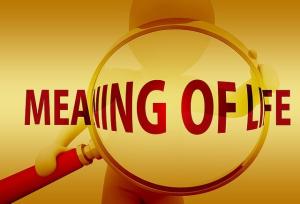
Art By Gerd Altmann.
It is a basic tenet of psychology that we are “meaning making machines.” This claim is frequently validated by children, for they are incessantly asking “why”? It is insufficient to simply know what a thing is; human beings must assign it meaning in order to make sense of our world. Simply put, human beings want to know not only what something is but why.
In this paper, I will argue that much of our dysfunction and unhappiness is a product of our secular culture’s inability to adequately address the very human need for ultimate meaning. I hope to do this by first providing a definition of meaning. I will briefly argue that the two pillars of secularism – atheism and nihilism – are insufficient for the task. Finally, I will suggest that we can only find the meaning we seek by being in a proper relationship with God.
What Is Meaning?
This search for meaning has implications beyond psychology. To ask what is to begin a scientific exploration; to ask why is to commence a philosophical or even spiritual endeavor.
Generally speaking, meaning denotes an individual’s sense of understanding events in which he is engaged. Since human beings are rational creatures and since rationality entails understanding or comprehending, meaning provides a kind of epistemological compass. At an even deeper level, meaning connotes purpose. What does it mean to be, to exist? What is our intended end? Moreover, what is the source of the meaning that we seek?
These are metaphysical questions, and different philosophical positions will answer these questions in accordance with those positions. For the purposes of this paper, I will examine the metaphysical positions of atheism, nihilism, and Catholicism.
Atheism And Nihilism
On the surface, atheism and nihilism appear almost synonymous. Such a view is not entirely without merit, and the two positions (atheism and nihilism) frequently do overlap. However, atheism and nihilism are really answers to two different questions. Atheism is a response to whether God (or perhaps gods) exists. For the atheist, the answer is no.
The question nihilism is responding to is whether life has any meaning. For the nihilist, the answer is that life has no objective meaning. I say objective meaning because, for some nihilists such as Jean-Paul Sartre, existence precedes essence. That is a fancy way of saying that human beings create their own meaning.
One reason that Catholics may see little difference between atheism and nihilism is that, for Catholics, the question of meaning cannot be sundered from the existence of God.
Only God
In direct contradiction to atheism, Catholicism posits the existence of an eternal and personal God. In direct contradiction to nihilism, Catholicism asserts the principle of sufficient reason, “For everything that exists, there is a sufficient reason why it exists, either within itself or outside itself.”
To say that the reason for a thing’s existence is within itself is to say that a thing exists necessarily. That which exists necessarily cannot not exist. Therefore, such a being is eternal. This is what Catholics mean by God (at least ontologically).
Regarding meaning, if a thing does not exist necessarily, it must have a cause external to itself. Here, the principle of sufficient reason kicks in and reminds us that such a thing must have a reason for its existence. The reason why a thing was created also contains its meaning.
In this context, reason, meaning, and purpose are inexplicably intertwined. A thing is created for a particular purpose, and for that purpose, a thing has its meaning.
So, from a Catholic perspective, meaning and purpose are derived from the belief that all creation was made intentionally by God. Moreover, the belief that God has made human beings for Himself endows us with infinite dignity and meaning. Indeed, Catholicism asserts that God has created and maintains that creation out of an abundance of love.
Therefore, the ultimate purpose of life is a relationship with God. Since the soul is the essence of a living thing, only a soul is capable of that relationship. If true, then all living things endowed with a soul are called to be in relation or communion with God.
The Catholic tradition asserts that humans are made by God for God. So, what happens to those individuals who deny the existence of God and reject a relationship with Him?
Meaninglessness and Madness
Because human nature encompasses rationality, humans have a need for meaning and purpose. When this meaning and purpose are lacking, as they are in a secular environment, the consequences can be dire.
At the level of the individual, the psychological cost of a nihilistic worldview can be very high. As Dr. Charles Harper Webb observes, “An increase in nihilism plays havoc with mental health.” Nihilism can also be a side effect of psychotic depression. (See The American Journal of Geriatric Psychiatry, Volume 27, Issue 3, Supplement, March 2019, Pages 148-149).
As stated above, atheism does not necessarily entail nihilism. Nevertheless, several studies have concluded that atheists are more likely to suffer depression than religious people.
I do not want to give the impression that every single atheist or nihilist is depressed or suffers from mental illness. I am suggesting, however, that humans are made for communion with God and that a lack of that communion is detrimental to human nature. That detriment can be seen in many of the maladies of modern society.
Conclusion
We want to know what, but we also want to know why. We want, nay, we need meaning. This search for meaning and purpose cannot be satisfied without God. “You have made us for yourself, O Lord, and our heart is restless until it rests in you.” – Saint Augustine.
General Christian
Education and Religion
History and Religion
Previous Post

December 29, 2024
No Such Thing As Judeo-Christian?
Next Post

January 12, 2025 What Role Does Catholicism Play in Shakespeare's Works?
Recent Comments
"While Unitarianism remains a small minority of believers, its influence on Christianity must not be ..."
A Catholic Critique of Biblical Unitarianism
"Science has proven that Homosapiens have walked this Earth for over 200,000 years. Did God ..."
A Catholic Critique of Biblical Unitarianism
"The universe, the planet we inhabit, and life itself need not exist.This is a claim. ..."
Creation, Preservation, and Teleology in Catholic ..."
"If you have sufficient evidence to support a belief you don't need faith. Despite what ..."
Is Faith Really Blind? What Skeptics ..."
Browse Our Archives
Select a Category Abortion Atheism Catholicism. Catholicism. God. Theophany. Christmas Eschatology Faith and Works. God. Holy Spirit Intelligent Design Jesus Christ Justice Law Politics Protestantism Religion Sabbath Salvation. Soteriology. The Bible Theology Uncategorized
Select a Month November 2026 October 2026 September 2026 August 2026 July 2026 June 2026 May 2026 April 2026 March 2026 February 2026 January 2026 December 2025 November 2025 October 2025 September 2025 August 2025 July 2025 June 2025 May 2025 April 2025 March 2025 February 2025 January 2025 December 2024 November 2024 October 2024 September 2024 August 2024 July 2024 June 2024 May 2024 April 2024 March 2024 February 2024 January 2024 December 2023 November 2023 October 2023 September 2023 August 2023 July 2023 June 2023 May 2023 April 2023 March 2023 February 2023 January 2023 December 2022 November 2022 October 2022 September 2022 August 2022 July 2022 June 2022 May 2022 April 2022 March 2022 February 2022 January 2022 December 2021
Follow Us!
TAKE THE
Religious Wisdom Quiz
Who said to Jesus, "Remember me when you come into your kingdom"?
Select your answer to see how you score.
Thomas The thief on the cross Peter Mary Magdalene
Related posts from Summa Catholic

If Baptism Washes Away Sin, Why Do Catholics...
Is Catholicism The Fulfillment Of The Old Testament?
Why Is Catholicism Centered on an Instrument of...

Is Faith Really Blind? What Skeptics Get Wrong
TRENDING AT PATHEOS Catholic

The Kingdom Of God In Ordinary Life And...
The kingdom of God is all around us; it is in us...

How Discretion Guides Us Away From Extremes
Prudence is an important virtue for all of us. While we should...

If Baptism Washes Away Sin, Why Do Catholics...
The seven sacraments stand as the foundation of Catholic ecclesial life. The...

The Power of Setting a Good Example
Remember last August when the Chicago White Sox hosted a "Pope Hat...

A Catholic Critique of Biblical Unitarianism
If the statistics are to be believed, Unitarianism is rising worldwide. Although...

How Grandma Tourism Helps Grandparents Live Their Vocation
Grandma, The New Travel Influencer What started as a nostalgia-inspired social media...
view all Catholic blogs
What Are Your Thoughts?leave a comment
Ad-Free & Subscriber Log-In Subscription Support
- About Us
- 2026 Calendar
- Videos
- Podcasts
- Library of World Religions
- Faith In Media Tracker
- Advertise With Us
- Write for Us
- Privacy Policy
- Terms of Service
- Do Not Sell My Data
- Contact Us
- Radiant Digital
- Manage Newsletter Subscriptions
- Unsubscribe From Notifications
- Sitemap
Copyright 2008-2026, Patheos, part of the Radiant Digital network of media brands. All rights reserved.
Subscription Support Ad-Free & Subscriber Log-In
Follow Patheos