
BuddhistCatholicContemplativeEvangelicalGeneral ChristianHinduJewishLatter-day SaintMuslimNew VisionsProgressive Christian
Beliefs
- Buddhist
- Catholic
- Contemplative
- Evangelical
- General Christian
- Hindu
- Jewish
- Latter-day Saint
- More Voices
- Muslim
- New Visions
- Pagan
- Progressive Christian
Topics
- Religion News
- Food and Religion
- Sports and Religion
- Religious Art
- Religious Music and Entertainment
- Religious Events
- History and Religion
- Style and Religion
- Politics and Religion
- Women in Religion
- Recreation Outdoors and Religion
- Business Finance and Religion
- Careers Workplace and Religion
- Education and Religion
- Family Parenting and Religion
- Health Fitness and Religion
- Home and Religion
- Relationships and Religion
- Technology and Religion
- Travel and Religion
Columnists
- Buddhist Columnists
- Business Finance and Religion Columnists
- Careers Workplace and Religion Columnists
- Catholic Columnists
- Contemplative Columnists
- Education and Religion Columnists
- Evangelists Columnists
- Family Parenting and Religion Columnists
- General Christian Columnists
- Health Fitness and Religion Columnists
- Hindu Columnists
- History and Religion Columnists
- Home and Religion Columnists
- Jewish Columnists
- More Voices Columnists
- Latter Day Columnists
- Muslim Columnists
- New Visions Columnists
- Nonreligious Columnists
- Pagan Columnists
- Politics and Religion Columnists
- Progressive Columnists
- Recreation Outdoors and Religion Columnists
- Relationships and Religion Columnists
- Religion News Columnists
- Religious Art Columnists
- Religious Events Columnists
- Religious Music and Entertainment Columnists
- Sports and Religion Columnists
- Style and Religion Columnists
- Technology and Religion Columnists
- Travel and Religion Columnists
- Women in Religion Columnists
Resource Library
- 2026 Calendar
- Library of World Religions
- The 100 Most Holy Places on Earth
- Patheos Answers
- Podcasts
- Videos
- Faith Leaders Database
- Anglican Episcopalian
- Bahai
- Baptist
- Buddhism
- Christianity
- Confucianism
- Eastern Orthodoxy
- Hinduism
- Holiness and Pentecostal
- ISKCON
- Islam
- Judaism
- Lutheran
- Methodist
- The Church of Jesus Christ of Latter-day Saints
- New Age
- Paganism
- Presbytarian and Reformed
- Protestantism
- Religion Behind the Scenes
- Roman Catholic
- Scientology
- Shia Islam
- Sikhism
- Sufism
- Sunni Islam
- Taoism
- Zen
- See all religions
Research Tools
 Ad-Free & Subscriber Log-In Subscription Support
Ad-Free & Subscriber Log-In Subscription Support
Follow Patheos 

- Trending:
- Forgiveness
- |
- Marriage
- |
- Consciousness
- |
- Death Penalty
- |
- Election
- |
- Halloween

- Home
- Catholic
- History and Religion
- The Intersection of Tradition and Change in Catholicism
The Intersection of Tradition and Change in Catholicism
Last updated on: September 8, 2024 at 12:34 pm by David Schloss
The Intersection of Tradition and Change in Catholicism 2024-09-08T12:34:24-04:00 David Schloss
Patheos Explore the world's faith through different perspectives on religion and spirituality! Patheos has the views of the prevalent religions and spiritualities of the world.
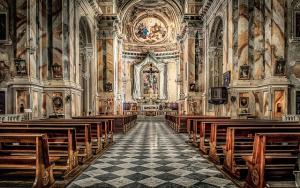
Art By Viersen.
“He who marries the spirit of the times will soon find himself a widower.” — G.K. Chesterton.
Everything changes. Empires rise and fall. People come and go. Fades vanish as quickly as they appear. What about Catholicism? Are the teachings of the Catholic Church as fixed as the stars, or are they subject to the change that engulfs our lives?
A Changing Church?
It can be reasonably argued that the Catholic Church is a result of change. While the Church (or at least the earthly Church) was founded by the incarnate God some two thousand years ago, it would be inaccurate to suggest that the teachings of Christ came out of nowhere.
Much of Christ’s teaching was based on the Old Testament: “Do not think that I have come to abolish the law or the prophets. I have come not to abolish but to fulfill.” The “law” spoken of is the Torah.
Even more so, the Bible evidences that Christ changed—one may say lifted up—various teachings associated with the Old Testament. In Matthew’s Gospel, Christ departs from Moses’ teaching regarding divorce. (See Matthew 19:8). Another example involves adultery. God commanded the Israelites to put to death anyone caught in the act of adultery (see Leviticus 20:10). However, Christ saves a woman from being stoned for adultery (see John 8:7).
All of this is to say nothing of the change wrought by the councils of the Church.
Church Councils
In the preceding two thousand years, the Catholic Church has convened some twenty-one ecumenical councils. Without fail, all of these councils sought to clarify and occasionally condemn various teachings.
In the first Nicean council, the Church condemned Arianism, defined the consubstantiality of the Father and the Son, fixed the date for Easter, and began the formulation of the Nicene-Constantinopolitan Creed.
In the following years, the Catholic Church convened councils that condemned Macedonianism, Nestorianism, and Pelagianism, ordered the annual reception of penance and the Eucharist, and developed the term “transubstantiation” to explain the Real Presence of Christ in the Eucharist.
Suffice it to say that the teachings of the Catholic Church have evolved and been refined. This leads to two questions. First, are the teachings of Catholicism and God malleable and, therefore, subject to change? Second, by what authority does the Church make such changes or refinements as one sees in the ecumenical councils?
Perennial Truth
The Bible is composed of seventy-three books. One approach to reading Scripture is to read all the books in the light of the last book, Revelation. This is known as the canonical method of interpretation.
One advantage of using the canonical method is that it allows the reader to apprehend a kind of evolution or refinement of divine pedagogy—an increase, if you will, of the level of sophistication. Divine pedagogy is intimately connected to divine revelation or how God chooses to reveal Himself to human beings. Specifically, divine pedagogy refers to the manner in which God teaches humanity.
We saw above an example of this refinement concerning the question of divorce. Another example involves ritual sacrifice. A common practice in the ancient world was human sacrifice to appease the gods. Particularly in the Old Testament, one discerns a weaning off or gradual move away from human sacrifice. This involved replacing human sacrifice with animal sacrifice and, eventually, the sacrificing of plants or symbols. (See Isaiah 1:11).
The point is that the refinement or evolution in divine pedagogy speaks not to changes in God but rather an effort to “soften the hearts” of human beings. We similarly teach each other. One does not learn to read by studying Shakespeare before learning the alphabet.
If God is teaching certain perennial and objective truths, does the Catholic Church have a right to alter that teaching?
The Church As The Body Of Christ
The answer is no. However, the Catholic Church is the mystical body of Christ and, like all bodies, grows and adapts. This is what one sees when looking at Catholic doctrine.
The numinous truths are always true and unchanging. However, how those truths are understood and presented can and does change. Was God always three divine persons and one divine nature? Yes. Has how theology understood and developed the doctrine of the Holy Trinity changed over time? Without question.
The concept of an unchanging Catholic Church will make many modern people uncomfortable. We live in a time that greatly emphasizes personal freedom and subjective truth. Catholics have not escaped this trend. One way in which this phenomenon is manifested is called cafeteria Catholicism.
The Cafeteria Catholic
The term cafeteria Catholic refers to individual Catholics who selectively decide what teachings of the Church they accept and what teachings they reject.
Examples of Catholics deciding for themselves what teachings to accept and what teachings to reject include matters such as abortion and euthanasia. Euthanasia is widely defined as permitting or even killing an individual with a serious (usually fatal) disease or injury. This is done ostensibly to relieve suffering. Even though the Catholic Church teaches that euthanasia is morally wrong and contrary to the love of God, seventy percent of Catholics think euthanasia should be allowed (according to a study conducted by Dr. Ryan Burge at Eastern Illinois University).
In cafeteria Catholicism, one finds the echo of original sin. At a theological level, original sin involves human beings arrogating for themselves that which belongs to God alone (i.e., objective morality). Similarly, cafeteria Catholics decide for themselves which teachings of the Catholic Church (which is informed by the Holy Spirit) they wish to adhere to.
Conclusion
I will conclude by quoting an excellent explanation of the dynamic between change and the objective truth that God teaches. It comes from the Second Vatican Council.
“Sacred tradition and Sacred Scripture form one sacred deposit of the word of God, committed to the Church. Holding fast to this deposit, the entire holy people united with their shepherds remain always steadfast in the teaching of the Apostles, in the common life, in the breaking of the bread, and in prayers (see Acts 2), so that holding to, practicing and professing the heritage of the faith, it becomes on the part of the bishops and faithful a single common effort.
But the task of authentically interpreting the word of God, whether written or handed on, has been entrusted exclusively to the living teaching office of the Church, whose authority is exercised in the name of Jesus Christ. This teaching office is not above the word of God but serves it, teaching only what has been handed on, listening to it devoutly, guarding it scrupulously, and explaining it faithfully in accord with a divine commission and with the help of the Holy Spirit, it draws from this one deposit of faith everything which it presents for belief as divinely revealed.”
——————————————————————————————————————————————————————————————-
- I would greatly appreciate the reader’s comments.
General Christian
History and Religion
Education and Religion
Previous Post

September 1, 2024
This Is How The World Ends
Next Post
September 15, 2024 A Conversion Story
Recent Comments
"Why would it matter if atheism is wrong? The fact that Catholic and Protestant scholars ..."
Beyond the Absence of Belief: The ..."
"Kaiser Member Service Proponents often compare atheism to not collecting stamps—it is the lack of ..."
Beyond the Absence of Belief: The ..."
""these dual denials (objective truth and objective meaning)"This is not accurate. Post-modern thought does not ..."
Defending the Faith in a Post-Truth ..."
"The theologians still haven't received the memo. Your opposition are no longer atheists, but they ..."
Defending the Faith in a Post-Truth ..."
Browse Our Archives
Select a Category Abortion Atheism Catholicism. Catholicism. God. Theophany. Christmas Eschatology Faith and Works. God. Holy Spirit Intelligent Design Jesus Christ Justice Law Politics Protestantism Religion Sabbath Salvation. Soteriology. The Bible Theology Uncategorized
Select a Month October 2026 September 2026 August 2026 July 2026 June 2026 May 2026 April 2026 March 2026 February 2026 January 2026 December 2025 November 2025 October 2025 September 2025 August 2025 July 2025 June 2025 May 2025 April 2025 March 2025 February 2025 January 2025 December 2024 November 2024 October 2024 September 2024 August 2024 July 2024 June 2024 May 2024 April 2024 March 2024 February 2024 January 2024 December 2023 November 2023 October 2023 September 2023 August 2023 July 2023 June 2023 May 2023 April 2023 March 2023 February 2023 January 2023 December 2022 November 2022 October 2022 September 2022 August 2022 July 2022 June 2022 May 2022 April 2022 March 2022 February 2022 January 2022 December 2021
Follow Us!
TAKE THE
Religious Wisdom Quiz
My beloved is mine and I am his; he browses among these flowers. What flowers represent purity and beauty?
Select your answer to see how you score.
Roses Lilies Wildflowers Crocus
Related posts from Summa Catholic

The Anatomy of Divine Revelation in Catholic Thought

Beyond the Absence of Belief: The Implications of...

Can Catholic Apologetics Survive a Postmodern World?

From Samaria to Sanctity: Analyzing The Woman At...
TRENDING AT PATHEOS Catholic

Rejecting Doom: Christian Hope And Human Action
Christianity is a religion of hope. We are to have hope and...

It’s What Comes From Within Which Matters
One of the most difficult things for us to understand is why...

Why I Choose the Eucharist Over the Sermon
Choose the Eucharist, Not the Sermon What are we supposed to get...

5 Design Elements Found in Spiritually Rooted Homes
Putting Spirituality Into Home Decor Our homes are more than our living...

Credo: A Story of God Told with the...
About 10 years ago, I began to imagine a personal "Credo" that...

The Anatomy of Divine Revelation in Catholic Thought
The claim that God has made Himself known to human beings is...
view all Catholic blogs
What Are Your Thoughts?leave a comment
Ad-Free & Subscriber Log-In Subscription Support
- About Us
- 2026 Calendar
- Videos
- Podcasts
- Library of World Religions
- Faith In Media Tracker
- Advertise With Us
- Write for Us
- Privacy Policy
- Terms of Service
- Do Not Sell My Data
- Contact Us
- Radiant Digital
- Manage Newsletter Subscriptions
- Unsubscribe From Notifications
- Sitemap
Copyright 2008-2026, Patheos. All rights reserved.
Subscription Support Ad-Free & Subscriber Log-In
Follow Patheos