
BuddhistCatholicContemplativeEvangelicalGeneral ChristianHinduJewishLatter-day SaintMuslimNew VisionsProgressive Christian
Beliefs
- Buddhist
- Catholic
- Contemplative
- Evangelical
- General Christian
- Hindu
- Jewish
- Latter-day Saint
- More Voices
- Muslim
- New Visions
- Pagan
- Progressive Christian
Topics
- Religion News
- Food and Religion
- Sports and Religion
- Religious Art
- Religious Music and Entertainment
- Religious Events
- History and Religion
- Style and Religion
- Politics and Religion
- Women in Religion
- Recreation Outdoors and Religion
- Business Finance and Religion
- Careers Workplace and Religion
- Education and Religion
- Family Parenting and Religion
- Health Fitness and Religion
- Home and Religion
- Relationships and Religion
- Technology and Religion
- Travel and Religion
Columnists
- Buddhist Columnists
- Business Finance and Religion Columnists
- Careers Workplace and Religion Columnists
- Catholic Columnists
- Contemplative Columnists
- Education and Religion Columnists
- Evangelists Columnists
- Family Parenting and Religion Columnists
- General Christian Columnists
- Health Fitness and Religion Columnists
- Hindu Columnists
- History and Religion Columnists
- Home and Religion Columnists
- Jewish Columnists
- More Voices Columnists
- Latter Day Columnists
- Muslim Columnists
- New Visions Columnists
- Nonreligious Columnists
- Pagan Columnists
- Politics and Religion Columnists
- Progressive Columnists
- Recreation Outdoors and Religion Columnists
- Relationships and Religion Columnists
- Religion News Columnists
- Religious Art Columnists
- Religious Events Columnists
- Religious Music and Entertainment Columnists
- Sports and Religion Columnists
- Style and Religion Columnists
- Technology and Religion Columnists
- Travel and Religion Columnists
- Women in Religion Columnists
Resource Library
- 2026 Calendar
- Library of World Religions
- The 100 Most Holy Places on Earth
- Patheos Answers
- Podcasts
- Videos
- Faith Leaders Database
- Anglican Episcopalian
- Bahai
- Baptist
- Buddhism
- Christianity
- Confucianism
- Eastern Orthodoxy
- Hinduism
- Holiness and Pentecostal
- ISKCON
- Islam
- Judaism
- Lutheran
- Methodist
- The Church of Jesus Christ of Latter-day Saints
- New Age
- Paganism
- Presbytarian and Reformed
- Protestantism
- Religion Behind the Scenes
- Roman Catholic
- Scientology
- Shia Islam
- Sikhism
- Sufism
- Sunni Islam
- Taoism
- Zen
- See all religions
Research Tools
 Ad-Free & Subscriber Log-In Subscription Support
Ad-Free & Subscriber Log-In Subscription Support
Follow Patheos 

- Trending:
- Forgiveness
- |
- Marriage
- |
- Consciousness
- |
- Death Penalty
- |
- Election
- |
- Halloween

- Home
- Catholic
- Mary: A Journey Through Her Life
Mary: A Journey Through Her Life
Last updated on: September 28, 2024 at 12:05 pm by David Schloss
Mary: A Journey Through Her Life 2024-09-28T12:05:11-04:00 David Schloss
Patheos Explore the world's faith through different perspectives on religion and spirituality! Patheos has the views of the prevalent religions and spiritualities of the world.
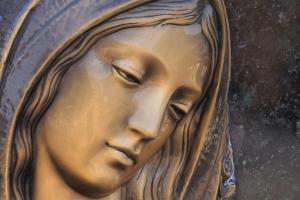
Art By Goran Horvat.
Excepting Jesus, there is no more influential figure in the Catholic tradition than Mary. Millions pray to her, miracles have been attributed to her, and the Church celebrates as many as eighteen feast days in her honor.
In this paper, I briefly examine the extraordinary life of Mary, a figure whose influence has been the cause of comfort and controversy. I will delve into her life and explore the profound theological implications of her role as the mother of God.
Born Of Saints
Scripture is all but silent on Mary’s birth. Much of what we know is drawn from the Protoevangelium of James. While the Protoevangelium of James is apocryphal, it does provide some useful historical data. Additional information has been provided by biblical scholars such as Raymond E. Brown, John P. Meier, and Elizabeth A. Johnson.
Mary’s parents are identified as Joachim and Anne, both of whom would eventually be canonized as saints by the Church. Though elderly, their piety and ardent desire for a child are eventually rewarded by God with the miraculous birth of Mary. In what is almost a foreshadowing of the birth of Jesus, tradition tells us that an angel appears to Joachim and Anne separately to announce that they will conceive a child.
A Short History Of Mary
Mary’s birth name was Myriam (in Hebrew) or Maryam (in Aramaic). It is believed that she was born into a devoutly Jewish family in Nazareth (present-day Israel). In keeping with the customs of the time, Mary likely became engaged as a teenager. Her betrothed, Joseph, was likely in his early twenties. It was during this engagement period that Scripture tells us of Mary being visited by the angel Gabriel and the subsequent Immaculate Conception. (See Luke 1:26-38).
It appears that shortly after becoming married, but prior to consummating it, Joseph became aware that Mary was pregnant. Joseph is prevented from obtaining a divorce when an angel informs him of what has occurred in a dream. (See Matthew 1:20-25). While modern readers are likely to be incredulous at this point, it is worth noting that Scripture frequently depicts God communicating to people through the medium of dreams.
In Matthew’s Gospel, we are told that Mary and Joseph raised Jesus along with His “brothers” and “sisters.” This appears to be in direct contradiction to the Church’s teaching that Mary remained a virgin. This problem is solved, however, when one realizes that, in the ancient world, the terms “brother” and “sister” often include extended family members such as cousins and nephews. Church tradition teaches that Mary was assumed bodily into Heaven at the end of her life.
The Theological Importance Of Mary
Catholicism places great importance on Mary, both as a model of what a Catholic should be as well as for theological insight. Both of these aspects are present in what is called The Annunciation of Mary. The Annunciation refers to events depicted in Luke’s Gospel.
In Luke, we read of how the angel Gabriel visits Mary to inform her that she will “bear a son, and you shall name him Jesus.” In addition, Gabriel tells Mary that her cousin, Elizabeth, is pregnant (with John the Baptist) despite being considered infertile. Mary responds famously, “Behold, I am the handmaid of the Lord. May it be done to me according to your word.” Mary’s openness to the transcendent and willingness to defer to the will of God epitomize discipleship.
When Mary’s cousin Elizabeth praised Mary for her faith, Mary gave a speech that became known as the Magnificat. It is recorded in Luke 1:46-55. “My soul proclaims the greatness of the Lord; my spirit rejoices in God, my savior. For he has looked upon his handmaid’s lowliness; behold, from now on, all ages will call me blessed. The Mighty One has done great things for me, and holy is his name. His mercy is from age to age to those who fear him. He has shown might with his arm, dispersed the arrogant of mind and heart. He has thrown down the rulers from their thrones but lifted up the lowly. The hungry he has filled with good things; the rich he has sent away empty. He has helped Israel his servant, remembering his mercy, according to his promise to our fathers, to Abraham, and to his descendants forever.”
Theotokos
One aspect of Mary that has been the cause of confusion and controversy is her title as Theotokos, a Greek word translated as God-bearer or mother of God.
There are three fundamental objections to Mary being called the mother of God. The first correctly points out that the phrase “mother of God” appears nowhere in the Bible. However, neither does the term Holy Trinity, yet the belief in a trinitarian God is almost universal in the Christian tradition. We cannot limit ourselves to the Bible alone.
The second argument is in response to the Catholic position that the basis for referring to Mary as the mother of God is Luke 1:43. “And how does this happen to me [Elizabeth, the cousin of Mary] that the mother of my Lord should come to me?” Opponents argue that the word Lord can be used to refer to both God and people. This is true. It was not uncommon in the ancient world (and in modern British nobility) to refer to someone as Lord.
However, the context in which Elizabeth asks the question and the likelihood that she paraphrased the words spoken by David in 2 Samuel 6:9, “How can the ark of the Lord ever come to me?” suggests that Elizabeth used the term Lord to refer to God. Moreover, it is nonsensical for Elizabeth to refer to an unborn child as Lord unless she is assuming that the child is God.
The third and final argument against Mary being considered the mother of God involves the Holy Trinity. If Mary is the mother of God and if God is three persons, does that not entail that Mary is the mother of the Holy Trinity and, therefore, eternal herself? After all, if Jesus is eternal, and Mary is the mother of Jesus, then Mary must be eternal too.
To address this, we must first observe that Catholicism claims only that Mary is the mother of the incarnate Jesus and not the Father or the Holy Spirit. The basis for this claim is in understanding that Mary is not the source of the divine (and, therefore, eternal) nature of Jesus.
Saint Cyril points out that a mother gives birth to a person, not a nature. Mary gave birth to Jesus Christ, who was and is a divine person. Although Mary did not generate God, she did bear Him in her womb and give birth to Him and is, in this sense, the mother of God.
Conclusion
We must not lose sight of the rather remarkable fact that a Jewish teenager in first-century Israel has become, for Catholics, the exemplar of discipleship. Indeed, if Jesus has brought the fullness of salvation, Mary is its dawning.
Previous Post
September 15, 2024
A Conversion Story
Next Post
September 29, 2024 Do All Religions Lead to God? Examining Pope Francis' Claim
Recent Comments
"Why would it matter if atheism is wrong? The fact that Catholic and Protestant scholars ..."
Beyond the Absence of Belief: The ..."
"Kaiser Member Service Proponents often compare atheism to not collecting stamps—it is the lack of ..."
Beyond the Absence of Belief: The ..."
""these dual denials (objective truth and objective meaning)"This is not accurate. Post-modern thought does not ..."
Defending the Faith in a Post-Truth ..."
"The theologians still haven't received the memo. Your opposition are no longer atheists, but they ..."
Defending the Faith in a Post-Truth ..."
Browse Our Archives
Select a Category Abortion Atheism Catholicism. Catholicism. God. Theophany. Christmas Eschatology Faith and Works. God. Holy Spirit Intelligent Design Jesus Christ Justice Law Politics Protestantism Religion Sabbath Salvation. Soteriology. The Bible Theology Uncategorized
Select a Month October 2026 September 2026 August 2026 July 2026 June 2026 May 2026 April 2026 March 2026 February 2026 January 2026 December 2025 November 2025 October 2025 September 2025 August 2025 July 2025 June 2025 May 2025 April 2025 March 2025 February 2025 January 2025 December 2024 November 2024 October 2024 September 2024 August 2024 July 2024 June 2024 May 2024 April 2024 March 2024 February 2024 January 2024 December 2023 November 2023 October 2023 September 2023 August 2023 July 2023 June 2023 May 2023 April 2023 March 2023 February 2023 January 2023 December 2022 November 2022 October 2022 September 2022 August 2022 July 2022 June 2022 May 2022 April 2022 March 2022 February 2022 January 2022 December 2021
Follow Us!
TAKE THE
Religious Wisdom Quiz
In what city was Paul shipwrecked?
Select your answer to see how you score.
Crete Rhodes Cyprus Malta
Related posts from Summa Catholic

The Anatomy of Divine Revelation in Catholic Thought

Beyond the Absence of Belief: The Implications of...

Can Catholic Apologetics Survive a Postmodern World?

From Samaria to Sanctity: Analyzing The Woman At...
TRENDING AT PATHEOS Catholic

Rejecting Doom: Christian Hope And Human Action
Christianity is a religion of hope. We are to have hope and...

It’s What Comes From Within Which Matters
One of the most difficult things for us to understand is why...

Why I Choose the Eucharist Over the Sermon
Choose the Eucharist, Not the Sermon What are we supposed to get...

5 Design Elements Found in Spiritually Rooted Homes
Putting Spirituality Into Home Decor Our homes are more than our living...

Credo: A Story of God Told with the...
About 10 years ago, I began to imagine a personal "Credo" that...

The Anatomy of Divine Revelation in Catholic Thought
The claim that God has made Himself known to human beings is...
view all Catholic blogs
What Are Your Thoughts?leave a comment
Ad-Free & Subscriber Log-In Subscription Support
- About Us
- 2026 Calendar
- Videos
- Podcasts
- Library of World Religions
- Faith In Media Tracker
- Advertise With Us
- Write for Us
- Privacy Policy
- Terms of Service
- Do Not Sell My Data
- Contact Us
- Radiant Digital
- Manage Newsletter Subscriptions
- Unsubscribe From Notifications
- Sitemap
Copyright 2008-2026, Patheos. All rights reserved.
Subscription Support Ad-Free & Subscriber Log-In
Follow Patheos