
BuddhistCatholicContemplativeEvangelicalGeneral ChristianHinduJewishLatter-day SaintMuslimNew VisionsProgressive Christian
Beliefs
- Buddhist
- Catholic
- Contemplative
- Evangelical
- General Christian
- Hindu
- Jewish
- Latter-day Saint
- More Voices
- Muslim
- New Visions
- Pagan
- Progressive Christian
Topics
- Religion News
- Food and Religion
- Sports and Religion
- Religious Art
- Religious Music and Entertainment
- Religious Events
- History and Religion
- Style and Religion
- Politics and Religion
- Women in Religion
- Recreation Outdoors and Religion
- Business Finance and Religion
- Careers Workplace and Religion
- Education and Religion
- Family Parenting and Religion
- Health Fitness and Religion
- Home and Religion
- Relationships and Religion
- Technology and Religion
- Travel and Religion
Columnists
- Buddhist Columnists
- Business Finance and Religion Columnists
- Careers Workplace and Religion Columnists
- Catholic Columnists
- Contemplative Columnists
- Education and Religion Columnists
- Evangelists Columnists
- Family Parenting and Religion Columnists
- General Christian Columnists
- Health Fitness and Religion Columnists
- Hindu Columnists
- History and Religion Columnists
- Home and Religion Columnists
- Jewish Columnists
- More Voices Columnists
- Latter Day Columnists
- Muslim Columnists
- New Visions Columnists
- Nonreligious Columnists
- Pagan Columnists
- Politics and Religion Columnists
- Progressive Columnists
- Recreation Outdoors and Religion Columnists
- Relationships and Religion Columnists
- Religion News Columnists
- Religious Art Columnists
- Religious Events Columnists
- Religious Music and Entertainment Columnists
- Sports and Religion Columnists
- Style and Religion Columnists
- Technology and Religion Columnists
- Travel and Religion Columnists
- Women in Religion Columnists
Resource Library
- 2026 Calendar
- Library of World Religions
- The 100 Most Holy Places on Earth
- Patheos Answers
- Podcasts
- Videos
- Faith Leaders Database
- Anglican Episcopalian
- Bahai
- Baptist
- Buddhism
- Christianity
- Confucianism
- Eastern Orthodoxy
- Hinduism
- Holiness and Pentecostal
- ISKCON
- Islam
- Judaism
- Lutheran
- Methodist
- The Church of Jesus Christ of Latter-day Saints
- New Age
- Paganism
- Presbytarian and Reformed
- Protestantism
- Religion Behind the Scenes
- Roman Catholic
- Scientology
- Shia Islam
- Sikhism
- Sufism
- Sunni Islam
- Taoism
- Zen
- See all religions
Research Tools
 Ad-Free & Subscriber Log-In Subscription Support
Ad-Free & Subscriber Log-In Subscription Support
Follow Patheos 

- Trending:
- Forgiveness
- |
- Marriage
- |
- Consciousness
- |
- Death Penalty
- |
- Election
- |
- Halloween

- Home
- Catholic
- A Conversion Story
A Conversion Story
Last updated on: September 15, 2024 at 10:13 am by David Schloss
A Conversion Story 2024-09-15T10:13:56-04:00 David Schloss
Patheos Explore the world's faith through different perspectives on religion and spirituality! Patheos has the views of the prevalent religions and spiritualities of the world.
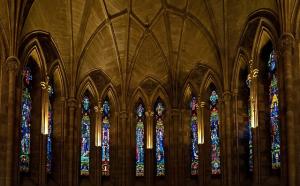
It is said that the third child is affectionate and uncomplicated. However, I can make no such claims about my personality despite having been preceded into this world by two sisters. My parents were immigrants; my father was of German descent, and my mother was French. Both had been deeply affected by World War Two, if for no other reason than the fact that my parents were Jewish.
My childhood could not be considered typical. We moved quite often, meaning I was frequently the new kid in school every year. Eventually, my family settled down in a suburb of Los Angeles called Studio City.
Childhood was an unhappy and stressful time. My parents did not get along well. I suspect that the animosity that my parents shared was likely aggravated by having children. I believe that, on some level, both my parents viewed their children as a burden. For my father, children were a responsibility he did not want; for my mother, children were the prison that trapped her in her marriage. Of course, this affected their relationship with their children as much as it affected their marriage. My sisters and I were often spectators to the violent arguments that my parents would have.
As I entered my teenage years, I came to understand two things. First, my parents hated each other with as much relish as they hated their children, and second, I was an atheist.
Part of the cause of my atheism was attributable to anger and insolence common to the young and, as such, was more a superficial and emotional response than any intellectual argument against the existence of God. The influence of my family added to my atheistic leanings. The subject of God was rarely discussed and religion was an afterthought in my family.
As a child, my family “observed” the major Jewish holidays, such as fasting on Yom Kippur and occasionally going to synagogue. It was evident that religion had little meaning to my parents or older sisters and, thus, was even less important to me. I was Jewish because my mother was Jewish, and Judaism is matrilineal.
Perhaps because spiritual matters are rarely contemplated in youth, I would remain in a spiritual desert for my teenage years and into early adulthood. Yet, even in this desert, I was often beset by the notion that there must be something beyond just the material world, which seemed so dry to me.
While my family seemed interested only in the material things of life, I sought something deeper, something more meaningful. My search would lead me to an interest in Eastern religion and philosophy. Eastern religion, or at least Eastern religious philosophy, was rather popular in Los Angeles at the time, so it seemed a natural evolution for me to investigate it.
Unfortunately, Buddhism’s focus on self-actualization, almost to the exclusion of the transcendent, did not appeal to me. Over time, it became clear to me that Buddhism and the other Eastern religions did not provide me with the truth that I sought.
My academic life would lead me to encounter Christianity more and more. These encounters would occasionally occur through conversations with Christians, but the most significant influence was the literature and the art.
The literature mainly consisted of Biblical passages that intrigued me. John 14:6 (I am the way and the truth and the life. No one comes to the Father except through me) and John 6:51 (I am the living bread that came down from heaven. Whoever eats this bread will live forever. This bread is my flesh, which I will give for the life of the world) fired my imagination. The art, too, beckoned me. I was drawn to depictions of the Crucifixion and the images of Mary, which would induce a sense of both sadness and wonder. Only later in life did I realize that God’s Grace was present to me even in this time of spiritual turbulence.
This Grace, defined as “favor, the free and undeserved help that God gives us to respond to his call to become children of God, adoptive sons, partakers of the divine nature and eternal life,” would manifest itself in two ways, first, by engendering a curiosity about what theologians call “first things,” in particular the subject of ontology. It was this curiosity that would lead me to question both my “atheism” and Judaism. The second way I came to believe that Grace manifested itself to me was to cause me to develop an affinity for Jesus Christ.
I recall a conversation with my mother when I was a teenager. Though I do not recall the context of the conversation, I do remember my mother saying that we (i.e., Jews) do not believe that Jesus is God, only that He was a good person. Putting aside the questionable theological aspect of her statement, I remember thinking I did not believe that. At that time, I suspected Jesus was much more than just a “good person.” This sense, which I could not adequately explain, combined with a propensity to ask spiritual and philosophical questions, fueled my interest in religion and God.
After college, my family moved back to New York City, and my interest in religion increased even more. I was becoming increasingly drawn to Christianity and, in particular, Catholicism. This interest would eventually lead me to read the Bible.
The result of this quest was that I began to feel like an inhabitant of two worlds. The first one, the one that I was born into, was the secular world. It seemed arid and empty, and its relativistic views on morality and inferred nihilism were repulsive. The second world, this new world, intrigued me. It was alive and mysterious, and it felt like the truth. It provided the answers to questions that had bedeviled me in my youth.
This “two world view” found a voice when I read Saint Augustine’s “City of God.” In particular, Augustine’s observation that “two cities have been formed by two loves” resonated with me.
The “City of the Flesh” was the secular world that I had been brought up in. It was a world where men sought to appease their base desires. This second “city,” this “City of God,” drew me. The claim that man was made for God was confirmed biblically. It also answered why so many are unhappy with the purely materialistic and sensual life of the “City of the Flesh.” If man were meant for God, anything less than God would ultimately be unsatisfying.
I began to research Christianity. As this process proceeded, it became clear to me that Catholicism most clearly represents the teachings of Christ. I started attending Mass at Saints Simon and Jude Church in Brooklyn. While I did not completely understand the process of the Mass, I felt very much at home.
It was at this time that I met someone who would have a profound impact on my life. Her name is Sara Nespoli. At the time, she was the Director of Faith Formation at Simon and Jude and the epitome of what a Catholic should be. Smart, sarcastic, and fiercely faithful, Sara would shepherd me through the Right of Christian Initiation for Adults (RCIA) program at the age of forty-two. I was baptized as a Catholic on that Easter Vigil in the Spring of 2012. I do not believe that I was ever happier or ever more content than I was at that time. The journey, which began in youth and endured through tribulations, is complete. I am home.
Previous Post
September 8, 2024
The Intersection of Tradition and Change in Catholicism
Next Post
September 22, 2024 Mary: A Journey Through Her Life
Recent Comments
"Why would it matter if atheism is wrong? The fact that Catholic and Protestant scholars ..."
Beyond the Absence of Belief: The ..."
"Kaiser Member Service Proponents often compare atheism to not collecting stamps—it is the lack of ..."
Beyond the Absence of Belief: The ..."
""these dual denials (objective truth and objective meaning)"This is not accurate. Post-modern thought does not ..."
Defending the Faith in a Post-Truth ..."
"The theologians still haven't received the memo. Your opposition are no longer atheists, but they ..."
Defending the Faith in a Post-Truth ..."
Browse Our Archives
Select a Category Abortion Atheism Catholicism. Catholicism. God. Theophany. Christmas Eschatology Faith and Works. God. Holy Spirit Intelligent Design Jesus Christ Justice Law Politics Protestantism Religion Sabbath Salvation. Soteriology. The Bible Theology Uncategorized
Select a Month October 2026 September 2026 August 2026 July 2026 June 2026 May 2026 April 2026 March 2026 February 2026 January 2026 December 2025 November 2025 October 2025 September 2025 August 2025 July 2025 June 2025 May 2025 April 2025 March 2025 February 2025 January 2025 December 2024 November 2024 October 2024 September 2024 August 2024 July 2024 June 2024 May 2024 April 2024 March 2024 February 2024 January 2024 December 2023 November 2023 October 2023 September 2023 August 2023 July 2023 June 2023 May 2023 April 2023 March 2023 February 2023 January 2023 December 2022 November 2022 October 2022 September 2022 August 2022 July 2022 June 2022 May 2022 April 2022 March 2022 February 2022 January 2022 December 2021
Follow Us!
TAKE THE
Religious Wisdom Quiz
Who was the first high priest of Israel?
Select your answer to see how you score.
Aaron Caleb Joshua Moses
Related posts from Summa Catholic

The Anatomy of Divine Revelation in Catholic Thought

Beyond the Absence of Belief: The Implications of...

Can Catholic Apologetics Survive a Postmodern World?

From Samaria to Sanctity: Analyzing The Woman At...
TRENDING AT PATHEOS Catholic

The Parable Of The Sower And The Word...
One of Christ’s most famous parables is that of the sower who...

Rejecting Doom: Christian Hope And Human Action
Christianity is a religion of hope. We are to have hope and...

Why I Choose the Eucharist Over the Sermon
Choose the Eucharist, Not the Sermon What are we supposed to get...

5 Design Elements Found in Spiritually Rooted Homes
Putting Spirituality Into Home Decor Our homes are more than our living...

Credo: A Story of God Told with the...
About 10 years ago, I began to imagine a personal "Credo" that...

The Anatomy of Divine Revelation in Catholic Thought
The claim that God has made Himself known to human beings is...
view all Catholic blogs
What Are Your Thoughts?leave a comment
Ad-Free & Subscriber Log-In Subscription Support
- About Us
- 2026 Calendar
- Videos
- Podcasts
- Library of World Religions
- Faith In Media Tracker
- Advertise With Us
- Write for Us
- Privacy Policy
- Terms of Service
- Do Not Sell My Data
- Contact Us
- Radiant Digital
- Manage Newsletter Subscriptions
- Unsubscribe From Notifications
- Sitemap
Copyright 2008-2026, Patheos. All rights reserved.
Subscription Support Ad-Free & Subscriber Log-In
Follow Patheos