
BuddhistCatholicContemplativeEvangelicalGeneral ChristianHinduJewishLatter-day SaintMuslimNew VisionsProgressive Christian
Beliefs
- Buddhist
- Catholic
- Contemplative
- Evangelical
- General Christian
- Hindu
- Jewish
- Latter-day Saint
- More Voices
- Muslim
- New Visions
- Pagan
- Progressive Christian
Topics
- Religion News
- Food and Religion
- Sports and Religion
- Religious Art
- Religious Music and Entertainment
- Religious Events
- History and Religion
- Style and Religion
- Politics and Religion
- Women in Religion
- Recreation Outdoors and Religion
- Business Finance and Religion
- Careers Workplace and Religion
- Education and Religion
- Family Parenting and Religion
- Health Fitness and Religion
- Home and Religion
- Relationships and Religion
- Technology and Religion
- Travel and Religion
Columnists
- Buddhist Columnists
- Business Finance and Religion Columnists
- Careers Workplace and Religion Columnists
- Catholic Columnists
- Contemplative Columnists
- Education and Religion Columnists
- Evangelists Columnists
- Family Parenting and Religion Columnists
- General Christian Columnists
- Health Fitness and Religion Columnists
- Hindu Columnists
- History and Religion Columnists
- Home and Religion Columnists
- Jewish Columnists
- More Voices Columnists
- Latter Day Columnists
- Muslim Columnists
- New Visions Columnists
- Nonreligious Columnists
- Pagan Columnists
- Politics and Religion Columnists
- Progressive Columnists
- Recreation Outdoors and Religion Columnists
- Relationships and Religion Columnists
- Religion News Columnists
- Religious Art Columnists
- Religious Events Columnists
- Religious Music and Entertainment Columnists
- Sports and Religion Columnists
- Style and Religion Columnists
- Technology and Religion Columnists
- Travel and Religion Columnists
- Women in Religion Columnists
Resource Library
- 2026 Calendar
- Library of World Religions
- The 100 Most Holy Places on Earth
- Patheos Answers
- Podcasts
- Videos
- Faith Leaders Database
- Anglican Episcopalian
- Bahai
- Baptist
- Buddhism
- Christianity
- Confucianism
- Eastern Orthodoxy
- Hinduism
- Holiness and Pentecostal
- ISKCON
- Islam
- Judaism
- Lutheran
- Methodist
- The Church of Jesus Christ of Latter-day Saints
- New Age
- Paganism
- Presbytarian and Reformed
- Protestantism
- Religion Behind the Scenes
- Roman Catholic
- Scientology
- Shia Islam
- Sikhism
- Sufism
- Sunni Islam
- Taoism
- Zen
- See all religions
Research Tools
 Ad-Free & Subscriber Log-In Subscription Support
Ad-Free & Subscriber Log-In Subscription Support
Follow Patheos 

- Trending:
- Forgiveness
- |
- Marriage
- |
- Consciousness
- |
- Death Penalty
- |
- Election
- |
- Halloween

- Home
- Catholic
- Education and Religion
- Sin And Volition
Sin And Volition
Last updated on: August 25, 2024 at 11:25 am by David Schloss
Sin And Volition 2024-08-25T11:25:57-04:00 David Schloss
Patheos Explore the world's faith through different perspectives on religion and spirituality! Patheos has the views of the prevalent religions and spiritualities of the world.
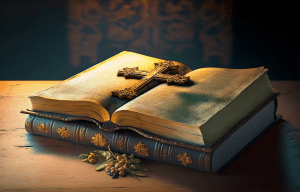
Art By Ronald Sandino.
I recently came across a post on X (formerly Twitter) showing a woman wearing a t-shirt with the words, “I’ve had 21 abortions!” There has been much ink spilled on the topic of abortion, and I will not add much more in this essay. Rather, I want to use the subject of abortion as a point of departure and place it into the broader context of original sin and human volition.
I will commence by examining will in a philosophical sense and the need for a well-formed conscience. Lastly, I will endeavor to show the connection between human will and original sin.
The Human Will
All living creatures seek that which they deem to be good. The will is the efficient cause of the intellect in that its appetitive powers move the intellect. The intellect is the final cause of the will in that the will seeks the good which is known by the intellect.
In a practical sense, therefore, the will desires a good; the intellect determines the validity of the good sought by the will, prioritizes among various goods, and develops a course for obtaining the good.
In returning to the woman who had twenty-one abortions, we can deduce that her will desired the perceived good of not bringing a child to term, and her intellect deemed that an abortion was the best course for achieving that goal. This also illuminates the difference between the advantageous and the noble: the advantageous seeks its own good, and the noble seeks the good of others.
We can begin to see that this process is entirely subjective. That is, the good perceived relates only to the individual. As such, there is no effort to appeal to an objective moral standard. Despite this, human beings possess a facility that allows them to access objective criteria for morality. This power is known as conscience.
God And Conscience
Conscience is the capacity of the intellect to make judgments regarding right and wrong actions. These judgments are based on an appeal to an objective moral standard. From the Catholic perspective, this standard is the mind of God, knowable through natural law. For this reason, John Henry Newman referred to the conscience as the “aboriginal vicar of Christ in the soul.”
Conscience is a specific act of the mind applying knowledge to a concrete moral situation. Put differently, conscience seeks to apply objective moral truths to particular circumstances. Therefore, it follows that judgments of right and wrong are not based on what the individual feels but on the judgment of a well-formed conscience.
A word about the term “well-formed.” Owing to the damage done by original sin, the conscience does not operate as it ought but rather requires it to be informed and its moral judgment enlightened, with the goal being that the conscience is upright and truthful.
The Word of God is the light for our path in forming our conscience. We must assimilate it in faith and prayer and put it into practice. Assisted by the Holy Spirit and the teaching of the Church, we must examine our conscience in the context of an objective moral order.
Original Sin And The Will To Power
If one frequently does what God does, one becomes as God is. Or so goes the first lie of the Devil. “God knows well that when you eat of it [the tree of good and evil], your eyes will be opened, and you will be like gods, who know good and evil.” So saith the serpent to Eve in the Garden of Eden. (See Genesis 3:5).
The human desire to appropriate for itself those things that properly belong to God alone is the basis for original sin. Specifically, human beings have sought to arrogate morality. This is most easily done by denying the existence of God or – and this is what one sees in the Genesis account of original sin – by subordinating the will of God to one’s own will.
In today’s culture, elements of both ways of subverting God’s will are present. Atheism denies God’s existence to allow the individual to be free from any objective moral judgment. Alternatively, how frequently do we believers seek to do our will even when it contradicts God? Indeed, this is a basic definition of sin.
Regardless of the approach, volition—the human will—precipitates. The sophisticated atheist realizes this and, therefore, raises the will above the conscience. Consciously or not, one sees the influence of Friedrich Nietzsche’s concept of “will to power” in much of modernity’s thinking.
In once again returning to the women who had twenty-one abortions, one sees the celebration of the will with no appeal to the conscience or objective morality. In such instances, the desires of the individual become the sole determinant of morality.
The Catholic, too, engages in this struggle between conscience and will. The Catholic, too, struggles with following the dictates of his conscience or submitting to the base desires of the will.
It is precisely because Catholics are engaged in this struggle that the Church emphasizes the formation of the conscience and the use of the sacraments, particularly confession.
Conclusion
In a very real sense, the spiritual life involves a battle of wills. Often, this conflict appears as the ultimate good of God versus the subjective desires of the individual. As Catholics, we are called to “deny ourselves,” deny our desires so as to seek the will of God.
Perhaps a better way of framing the conflict is to see our work as Catholics as an effort to conform our desires to God’s will. To that end, Saint Maximilian Kolbe writes, “Christian perfection consists in the union of our will with the will of God.”
Education and Religion
History and Religion
Previous Post
August 18, 2024
Sabbath And The Spirit Of The Law
Next Post

September 1, 2024 This Is How The World Ends
Recent Comments
"Why would it matter if atheism is wrong? The fact that Catholic and Protestant scholars ..."
Beyond the Absence of Belief: The ..."
"Kaiser Member Service Proponents often compare atheism to not collecting stamps—it is the lack of ..."
Beyond the Absence of Belief: The ..."
""these dual denials (objective truth and objective meaning)"This is not accurate. Post-modern thought does not ..."
Defending the Faith in a Post-Truth ..."
"The theologians still haven't received the memo. Your opposition are no longer atheists, but they ..."
Defending the Faith in a Post-Truth ..."
Browse Our Archives
Select a Category Abortion Atheism Catholicism. Catholicism. God. Theophany. Christmas Eschatology Faith and Works. God. Holy Spirit Intelligent Design Jesus Christ Justice Law Politics Protestantism Religion Sabbath Salvation. Soteriology. The Bible Theology Uncategorized
Select a Month October 2026 September 2026 August 2026 July 2026 June 2026 May 2026 April 2026 March 2026 February 2026 January 2026 December 2025 November 2025 October 2025 September 2025 August 2025 July 2025 June 2025 May 2025 April 2025 March 2025 February 2025 January 2025 December 2024 November 2024 October 2024 September 2024 August 2024 July 2024 June 2024 May 2024 April 2024 March 2024 February 2024 January 2024 December 2023 November 2023 October 2023 September 2023 August 2023 July 2023 June 2023 May 2023 April 2023 March 2023 February 2023 January 2023 December 2022 November 2022 October 2022 September 2022 August 2022 July 2022 June 2022 May 2022 April 2022 March 2022 February 2022 January 2022 December 2021
Follow Us!
TAKE THE
Religious Wisdom Quiz
Who said, "The Lord said to my Lord, ‘Sit at my right hand’"?
Select your answer to see how you score.
Moses Solomon David Isaiah
Related posts from Summa Catholic

The Anatomy of Divine Revelation in Catholic Thought

Beyond the Absence of Belief: The Implications of...

Can Catholic Apologetics Survive a Postmodern World?

From Samaria to Sanctity: Analyzing The Woman At...
TRENDING AT PATHEOS Catholic

Rejecting Doom: Christian Hope And Human Action
Christianity is a religion of hope. We are to have hope and...

It’s What Comes From Within Which Matters
One of the most difficult things for us to understand is why...

Why I Choose the Eucharist Over the Sermon
Choose the Eucharist, Not the Sermon What are we supposed to get...

5 Design Elements Found in Spiritually Rooted Homes
Putting Spirituality Into Home Decor Our homes are more than our living...

Credo: A Story of God Told with the...
About 10 years ago, I began to imagine a personal "Credo" that...

The Anatomy of Divine Revelation in Catholic Thought
The claim that God has made Himself known to human beings is...
view all Catholic blogs
What Are Your Thoughts?leave a comment
Ad-Free & Subscriber Log-In Subscription Support
- About Us
- 2026 Calendar
- Videos
- Podcasts
- Library of World Religions
- Faith In Media Tracker
- Advertise With Us
- Write for Us
- Privacy Policy
- Terms of Service
- Do Not Sell My Data
- Contact Us
- Radiant Digital
- Manage Newsletter Subscriptions
- Unsubscribe From Notifications
- Sitemap
Copyright 2008-2026, Patheos. All rights reserved.
Subscription Support Ad-Free & Subscriber Log-In
Follow Patheos