
BuddhistCatholicContemplativeEvangelicalGeneral ChristianHinduJewishLatter-day SaintMuslimNew VisionsProgressive Christian
Beliefs
- Buddhist
- Catholic
- Contemplative
- Evangelical
- General Christian
- Hindu
- Jewish
- Latter-day Saint
- More Voices
- Muslim
- New Visions
- Pagan
- Progressive Christian
Topics
- Religion News
- Food and Religion
- Sports and Religion
- Religious Art
- Religious Music and Entertainment
- Religious Events
- History and Religion
- Style and Religion
- Politics and Religion
- Women in Religion
- Recreation Outdoors and Religion
- Business Finance and Religion
- Careers Workplace and Religion
- Education and Religion
- Family Parenting and Religion
- Health Fitness and Religion
- Home and Religion
- Relationships and Religion
- Technology and Religion
- Travel and Religion
Columnists
- Buddhist Columnists
- Business Finance and Religion Columnists
- Careers Workplace and Religion Columnists
- Catholic Columnists
- Contemplative Columnists
- Education and Religion Columnists
- Evangelists Columnists
- Family Parenting and Religion Columnists
- General Christian Columnists
- Health Fitness and Religion Columnists
- Hindu Columnists
- History and Religion Columnists
- Home and Religion Columnists
- Jewish Columnists
- More Voices Columnists
- Latter Day Columnists
- Muslim Columnists
- New Visions Columnists
- Nonreligious Columnists
- Pagan Columnists
- Politics and Religion Columnists
- Progressive Columnists
- Recreation Outdoors and Religion Columnists
- Relationships and Religion Columnists
- Religion News Columnists
- Religious Art Columnists
- Religious Events Columnists
- Religious Music and Entertainment Columnists
- Sports and Religion Columnists
- Style and Religion Columnists
- Technology and Religion Columnists
- Travel and Religion Columnists
- Women in Religion Columnists
Resource Library
- 2026 Calendar
- Library of World Religions
- The 100 Most Holy Places on Earth
- Patheos Answers
- Podcasts
- Videos
- Faith Leaders Database
- Anglican Episcopalian
- Bahai
- Baptist
- Buddhism
- Christianity
- Confucianism
- Eastern Orthodoxy
- Hinduism
- Holiness and Pentecostal
- ISKCON
- Islam
- Judaism
- Lutheran
- Methodist
- The Church of Jesus Christ of Latter-day Saints
- New Age
- Paganism
- Presbytarian and Reformed
- Protestantism
- Religion Behind the Scenes
- Roman Catholic
- Scientology
- Shia Islam
- Sikhism
- Sufism
- Sunni Islam
- Taoism
- Zen
- See all religions
Research Tools
 Ad-Free & Subscriber Log-In Subscription Support
Ad-Free & Subscriber Log-In Subscription Support
Follow Patheos 

- Trending:
- Forgiveness
- |
- Marriage
- |
- Consciousness
- |
- Death Penalty
- |
- Election
- |
- Halloween

- Home
- Catholic
- Education and Religion
- A Beginner’s Guide to Classical Apologetics
A Beginner’s Guide to Classical Apologetics
Last updated on: August 15, 2024 at 10:19 am by David Schloss
A Beginner’s Guide to Classical Apologetics 2024-08-15T10:19:26-04:00 David Schloss
Patheos Explore the world's faith through different perspectives on religion and spirituality! Patheos has the views of the prevalent religions and spiritualities of the world.
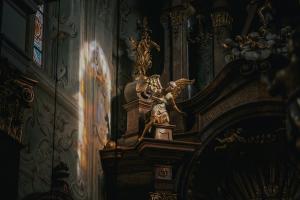
Art By Michael Pointner.
As Catholics, we should “be ready to give an explanation to anyone who asks you for a reason for your hope.” (1 Peter 3:15). How can this be done? Enter apologetics.
Because the word apologetics sounds very similar to the word apology, it may seem that Catholics are to express regret or remorse for their faith. This could not be farther from the truth. Apologetics is the English translation of the Greek word apología, which means to give a systemic and reasoned defense of one’s beliefs and actions. The most famous example of this is The Apology of Socrates.
Since Catholic apologetics is generally categorized into three approaches: classical, evidentialist, and presuppositional, I will devote one paper to each type of method. This essay will focus on classical apologetics.
The classical method is usually attributed to Saint Anselm and Saint Thomas Aquinas. Historically, the classical method consisted of two steps. First, one presented arguments for the existence of God. Second, one sought to establish that such a being is the God evidenced in the Judeo-Christian tradition: the God of the Bible. Recently, some have added a third step, which is to argue for the truth of Catholicism. I will adhere to this three-step approach to the classical method.
Both theology and philosophy have developed arguments for proving the existence of God. One of the more unique arguments utilized by the classical method is the ontological argument. Ontology is a subset of metaphysics that studies the nature of existence. The argument is formulated this way:
By definition, God is a being that which none greater can be imagined. A being that necessarily exists in reality is greater than a being that does not necessarily exist.
Thus, by definition, if God exists as an idea in the mind but does not necessarily exist in reality, then we can imagine something greater than God. However, we cannot imagine something greater than God.
Thus, if God exists in the mind as an idea, then God necessarily exists in reality. God exists in the mind as an idea. Therefore, God necessarily exists in reality.
As one can see, the argument is a priori. That is, the ontological argument is not reliant on experience but solely on reason and logic. The ontological argument does not exhaust the proofs for God’s existence. It is, however, the one most associated with the classical method of apologetics.
Having sought to establish the existence of God, the second step is to show why such a deity is consistent with the God depicted in the Bible.
According to some anthropological studies, human history has seen the worship of approximately eighteen thousand different gods. In light of such staggering numbers, why is the Christian God – the God of the Bible – the one true God?
In his outstanding work Introduction to Christianity, Pope Benedict XVI observes that the God of Christianity is the God of philosophy. The scriptural data suggest that God is one, eternal, and personal. Therefore, a philosophical approach must eliminate polytheism and pantheism and provide evidence of a personal God.
By definition, God possesses every possible perfection, including existence. If multiple gods existed, then they would differ from each other. A property or attribute would belong to one god that did not belong to another. However, this entails a privation of some good which is impossible if God is that which possesses every perfection. Therefore, the belief in many gods is not tenable, and polytheism is false.
Pantheism asserts that the universe – and everything in it – is God. Obviously, pantheism is unbiblical, but it is also untenable from a philosophical perspective. The universe is itself an effect and does not exist necessarily. What does not exist necessarily must be caused by another. However, God cannot be caused by another while simultaneously existing necessarily. Therefore, the universe cannot be God. Moreover, as time began with the universe, the cause of the universe (i.e., God) must exist independent of time. That is, God must be eternal.
Finally, we can infer that God is a personal being using the same line of reasoning. It has been shown that the universe is contingent. Whatever is contingent does not exist necessarily, and what does not exist necessarily is a result of a choice. Choice is a product of the will, and the will is a power of an intellect. An intellect can only exist in a personal being. It follows then that the first cause (God) is a personal being.
The final step in the classical apologetics method is to argue for the truth of Catholicism. Is it possible to show that Catholics worship the God proven by philosophy and revealed to human beings in the Bible?
As an act of faith, Christianity asserts that God became a human being (without ceasing to be God). Faith is not irrational, but rather it is suprarational. In this case, this act of faith is predicated on the historical record of Jesus of Nazareth. Put differently, Catholicism believes that the historical person Jesus of Nazareth is also God incarnate. This is evidenced by the actions of Jesus, in particular, the Resurrection.
Most important to the subject at hand is that God (in the person of Jesus) created the Catholic Church. Jesus did this by installing Peter as the Church’s first pope. “And so I say to you, you are Peter, and upon this rock [a play on Peter’s name] I will build my church, and the gates of the netherworld shall not prevail against it.” (Matthew 16:18). It is this statement by Christ combined with the events of Pentecost that testify to the truth of Catholicism.
Apologetics, like faith itself, is illative. That is to say that apologetics is composed of a series of inferences. Of course, some inferences are more persuasive than others. In the preceding essay, I have endeavored to provide a brief overview of one such method called classical apologetics.
Education and Religion
History and Religion
Previous Post

June 30, 2024
Was The Crucifixion an Act of Child Abuse?
Next Post

July 14, 2024 What Is Evidential Apologetics?
Recent Comments
"Why would it matter if atheism is wrong? The fact that Catholic and Protestant scholars ..."
Beyond the Absence of Belief: The ..."
"Kaiser Member Service Proponents often compare atheism to not collecting stamps—it is the lack of ..."
Beyond the Absence of Belief: The ..."
""these dual denials (objective truth and objective meaning)"This is not accurate. Post-modern thought does not ..."
Defending the Faith in a Post-Truth ..."
"The theologians still haven't received the memo. Your opposition are no longer atheists, but they ..."
Defending the Faith in a Post-Truth ..."
Browse Our Archives
Select a Category Abortion Atheism Catholicism. Catholicism. God. Theophany. Christmas Eschatology Faith and Works. God. Holy Spirit Intelligent Design Jesus Christ Justice Law Politics Protestantism Religion Sabbath Salvation. Soteriology. The Bible Theology Uncategorized
Select a Month October 2026 September 2026 August 2026 July 2026 June 2026 May 2026 April 2026 March 2026 February 2026 January 2026 December 2025 November 2025 October 2025 September 2025 August 2025 July 2025 June 2025 May 2025 April 2025 March 2025 February 2025 January 2025 December 2024 November 2024 October 2024 September 2024 August 2024 July 2024 June 2024 May 2024 April 2024 March 2024 February 2024 January 2024 December 2023 November 2023 October 2023 September 2023 August 2023 July 2023 June 2023 May 2023 April 2023 March 2023 February 2023 January 2023 December 2022 November 2022 October 2022 September 2022 August 2022 July 2022 June 2022 May 2022 April 2022 March 2022 February 2022 January 2022 December 2021
Follow Us!
TAKE THE
Religious Wisdom Quiz
What book of the Bible tells about Jesus’ birth?
Select your answer to see how you score.
Hebrews Acts Luke Revelation
Related posts from Summa Catholic

The Anatomy of Divine Revelation in Catholic Thought

Beyond the Absence of Belief: The Implications of...

Can Catholic Apologetics Survive a Postmodern World?

From Samaria to Sanctity: Analyzing The Woman At...
TRENDING AT PATHEOS Catholic

The Parable Of The Sower And The Word...
One of Christ’s most famous parables is that of the sower who...

Rejecting Doom: Christian Hope And Human Action
Christianity is a religion of hope. We are to have hope and...

Why I Choose the Eucharist Over the Sermon
Choose the Eucharist, Not the Sermon What are we supposed to get...

5 Design Elements Found in Spiritually Rooted Homes
Putting Spirituality Into Home Decor Our homes are more than our living...

Credo: A Story of God Told with the...
About 10 years ago, I began to imagine a personal "Credo" that...

The Anatomy of Divine Revelation in Catholic Thought
The claim that God has made Himself known to human beings is...
view all Catholic blogs
What Are Your Thoughts?leave a comment
Ad-Free & Subscriber Log-In Subscription Support
- About Us
- 2026 Calendar
- Videos
- Podcasts
- Library of World Religions
- Faith In Media Tracker
- Advertise With Us
- Write for Us
- Privacy Policy
- Terms of Service
- Do Not Sell My Data
- Contact Us
- Radiant Digital
- Manage Newsletter Subscriptions
- Unsubscribe From Notifications
- Sitemap
Copyright 2008-2026, Patheos. All rights reserved.
Subscription Support Ad-Free & Subscriber Log-In
Follow Patheos