
BuddhistCatholicContemplativeEvangelicalGeneral ChristianHinduJewishLatter-day SaintMuslimNew VisionsProgressive Christian
Beliefs
- Buddhist
- Catholic
- Contemplative
- Evangelical
- General Christian
- Hindu
- Jewish
- Latter-day Saint
- More Voices
- Muslim
- New Visions
- Pagan
- Progressive Christian
Topics
- Religion News
- Food and Religion
- Sports and Religion
- Religious Art
- Religious Music and Entertainment
- Religious Events
- History and Religion
- Style and Religion
- Politics and Religion
- Women in Religion
- Recreation Outdoors and Religion
- Business Finance and Religion
- Careers Workplace and Religion
- Education and Religion
- Family Parenting and Religion
- Health Fitness and Religion
- Home and Religion
- Relationships and Religion
- Technology and Religion
- Travel and Religion
Columnists
- Buddhist Columnists
- Business Finance and Religion Columnists
- Careers Workplace and Religion Columnists
- Catholic Columnists
- Contemplative Columnists
- Education and Religion Columnists
- Evangelists Columnists
- Family Parenting and Religion Columnists
- General Christian Columnists
- Health Fitness and Religion Columnists
- Hindu Columnists
- History and Religion Columnists
- Home and Religion Columnists
- Jewish Columnists
- More Voices Columnists
- Latter Day Columnists
- Muslim Columnists
- New Visions Columnists
- Nonreligious Columnists
- Pagan Columnists
- Politics and Religion Columnists
- Progressive Columnists
- Recreation Outdoors and Religion Columnists
- Relationships and Religion Columnists
- Religion News Columnists
- Religious Art Columnists
- Religious Events Columnists
- Religious Music and Entertainment Columnists
- Sports and Religion Columnists
- Style and Religion Columnists
- Technology and Religion Columnists
- Travel and Religion Columnists
- Women in Religion Columnists
Resource Library
- 2026 Calendar
- Library of World Religions
- The 100 Most Holy Places on Earth
- Patheos Answers
- Podcasts
- Videos
- Faith Leaders Database
- Anglican Episcopalian
- Bahai
- Baptist
- Buddhism
- Christianity
- Confucianism
- Eastern Orthodoxy
- Hinduism
- Holiness and Pentecostal
- ISKCON
- Islam
- Judaism
- Lutheran
- Methodist
- The Church of Jesus Christ of Latter-day Saints
- New Age
- Paganism
- Presbytarian and Reformed
- Protestantism
- Religion Behind the Scenes
- Roman Catholic
- Scientology
- Shia Islam
- Sikhism
- Sufism
- Sunni Islam
- Taoism
- Zen
- See all religions
Research Tools
 Ad-Free & Subscriber Log-In Subscription Support
Ad-Free & Subscriber Log-In Subscription Support
Follow Patheos 

- Trending:
- Forgiveness
- |
- Marriage
- |
- Consciousness
- |
- Death Penalty
- |
- Election
- |
- Halloween

- Home
- Catholic
- History and Religion
- Right, Wrong, and Evil
Right, Wrong, and Evil
Last updated on: September 4, 2024 at 12:02 pm by David Schloss
Right, Wrong, and Evil 2024-09-04T12:02:01-04:00 David Schloss
Patheos Explore the world's faith through different perspectives on religion and spirituality! Patheos has the views of the prevalent religions and spiritualities of the world.
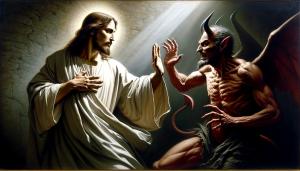
Art by Kar3nt.
Arguably, the most difficult challenge facing philosophy, theology, and religion is the problem of evil. The problem can be framed in different ways, depending on the purpose of the discussion.
For example, one can argue that the existence of evil militates against the existence of God. “If one of two contraries be infinite, the other would be altogether destroyed. But the word “God” means that He is infinite goodness. If, therefore, God existed, there would be no evil discoverable, but there is evil in the world. Therefore, God does not exist.” (Aquinas, Saint Thomas. The “Summa Theologica” of St. Thomas Aquinas. 1917). It should be pointed out that Aquinas is not making this argument, but rather, he is anticipating an objection to God’s existence.
Nevertheless, the above argument can be utilized by atheists. However, the existence of evil is no safe haven for atheists either. Even if God does not exist, evil remains. Further damning for atheists is that in the absence of God, they have no objective claim to call anything evil.
From a theological perspective, it is tempting to offer God’s answer to Job and leave it at that. (See Job 38-40). The text is too long to quote here, but it essentially comes down to God pointing out that human knowledge is insufficient to understand God’s designs. There is, of course, much to recommend this response to suffering. No doubt, human beings as creatures cannot understand the works of God as the creator. Still, God’s response to Job may not be satisfying to the one suffering. So, how can we Catholics approach the issue of evil?
First, we must distinguish between evil actions and actions that are right and wrong. Is going through a stop sign evil? What about accessing your neighbor’s wireless connection for free? While most of us would agree that these acts are wrong, we would be less likely to consider them evil.
Unfortunately, the history of mankind is replete with events that almost defy efforts to categorize them. In 2005, Joseph Duncan murdered three members of a family, including a thirteen-year-old boy. All three were bound and beaten to death with a hammer. Mr. Duncan also kidnapped the couple’s two other children and tortured and raped them over a period of six weeks.
Perhaps even more incomprehensible is institutional evil. It is impossible, for example, to simply classify Nazi atrocities as “wrong.” Human experimentation, mass murders, and rape are all part of humanity’s legacy. Nor are these horrors ancient history. Hitler, Mao, Stalin, and the Rwandan genocide are all nightmares that have occurred in the past century.
There are four “responses” to the existence of evil. The first, mentioned above, is to conclude that God does not exist. This is a non sequitur, however. An atheistic worldview does not remove the presence of evil or wipe from history the horrors of the twentieth century. Moreover, as the historian Jeffrey Russell notes, “the atheist rulers such as Lenin, Hitler, Stalin, Mao Zedong, and Pol Pot tortured, starved and murdered more people in the twentieth century than all the combined religious regimes of the world during the previous nineteen centuries.” (Russell, Jeffrey Burton. Exposing Myths About Christianity. InterVarsity Press, 2012).
The second response is more theologically profound. It concludes that the presence of evil in the world indicates that God is not all good. There are two ways to address this argument. First, one can simply point to Scripture, which states that God is good (e.g., Psalm 100:5 and Mark 10:18). The second way is to argue from the nature of evil. Evil, by definition, is a lack or privation of what ought to exist. Since God exists necessarily (as the first cause of creation), He cannot be lacking in any perfection. The reason is that lack indicates something outside of oneself, and there cannot be anything independent of that which exists necessarily. Therefore, it is impossible for God not to be good.
Another approach is one taken by the followers of Manichaeism. Manichaeism posited that the universe was a battleground between the spiritual realm, which was considered good, and the material world, which was seen as evil. Manichaeism appears to contradict Scripture, however, and was deemed a heresy in the fourth century.
The final response to evil is to see it as an effort by the Devil to negate the will of God. Before proceeding with this concept, it is essential not to let human beings off the hook, so to speak. It is too easy for those who engage in evil acts to exclaim that the Devil made them do it. Humans have free will and are not pawns of Satan. Rather, we must admit that we are complicit in the terrors of this world. Still, evil as a power wielded by the Devil must be given as much consideration as Scripture allows.
One encounters the Devil very early in the Bible. The serpent that tempts Eve is generally considered to symbolize the Devil. Christ Himself confronts and is tempted by Satan. The Devil as the tempter is an essential biblical motif. If evil is a privation, then the ultimate evil is the negation of the will of God. The Devil seeks to accomplish this negation by tempting us to act in ways that contradict God’s will.
In a very real sense, we are born into a world at war. The struggles and violence that all of us witness in the physical realm are only manifestations of the war between God and the Devil that occurs in the spiritual realm. All of this may seem abstract, but for Catholics, the strategy of spiritual warfare is quite simple. One must cease from committing mortal sin and avoid the occult, both of which open our lives to the influence of the enemy.
The secular world often eschews the concepts of good and evil in favor of moral relativism. However, as Catholics, we must be able to accept the reality of evil if only to be on guard against it.
History and Religion
Education and Religion
Previous Post

June 9, 2024
A Biblical Survey Of The Afterlife
Next Post
June 23, 2024 God Or Science?
Recent Comments
"Why would it matter if atheism is wrong? The fact that Catholic and Protestant scholars ..."
Beyond the Absence of Belief: The ..."
"Kaiser Member Service Proponents often compare atheism to not collecting stamps—it is the lack of ..."
Beyond the Absence of Belief: The ..."
""these dual denials (objective truth and objective meaning)"This is not accurate. Post-modern thought does not ..."
Defending the Faith in a Post-Truth ..."
"The theologians still haven't received the memo. Your opposition are no longer atheists, but they ..."
Defending the Faith in a Post-Truth ..."
Browse Our Archives
Select a Category Abortion Atheism Catholicism. Catholicism. God. Theophany. Christmas Eschatology Faith and Works. God. Holy Spirit Intelligent Design Jesus Christ Justice Law Politics Protestantism Religion Sabbath Salvation. Soteriology. The Bible Theology Uncategorized
Select a Month October 2026 September 2026 August 2026 July 2026 June 2026 May 2026 April 2026 March 2026 February 2026 January 2026 December 2025 November 2025 October 2025 September 2025 August 2025 July 2025 June 2025 May 2025 April 2025 March 2025 February 2025 January 2025 December 2024 November 2024 October 2024 September 2024 August 2024 July 2024 June 2024 May 2024 April 2024 March 2024 February 2024 January 2024 December 2023 November 2023 October 2023 September 2023 August 2023 July 2023 June 2023 May 2023 April 2023 March 2023 February 2023 January 2023 December 2022 November 2022 October 2022 September 2022 August 2022 July 2022 June 2022 May 2022 April 2022 March 2022 February 2022 January 2022 December 2021
Follow Us!
TAKE THE
Religious Wisdom Quiz
What did David use to calm Saul when Saul was troubled by a harmful spirit?
Select your answer to see how you score.
Trumpet Flute Harp Drum
Related posts from Summa Catholic

The Anatomy of Divine Revelation in Catholic Thought

Beyond the Absence of Belief: The Implications of...

Can Catholic Apologetics Survive a Postmodern World?

From Samaria to Sanctity: Analyzing The Woman At...
TRENDING AT PATHEOS Catholic

Rejecting Doom: Christian Hope And Human Action
Christianity is a religion of hope. We are to have hope and...

It’s What Comes From Within Which Matters
One of the most difficult things for us to understand is why...

Why I Choose the Eucharist Over the Sermon
Choose the Eucharist, Not the Sermon What are we supposed to get...

5 Design Elements Found in Spiritually Rooted Homes
Putting Spirituality Into Home Decor Our homes are more than our living...

Credo: A Story of God Told with the...
About 10 years ago, I began to imagine a personal "Credo" that...

The Anatomy of Divine Revelation in Catholic Thought
The claim that God has made Himself known to human beings is...
view all Catholic blogs
What Are Your Thoughts?leave a comment
Ad-Free & Subscriber Log-In Subscription Support
- About Us
- 2026 Calendar
- Videos
- Podcasts
- Library of World Religions
- Faith In Media Tracker
- Advertise With Us
- Write for Us
- Privacy Policy
- Terms of Service
- Do Not Sell My Data
- Contact Us
- Radiant Digital
- Manage Newsletter Subscriptions
- Unsubscribe From Notifications
- Sitemap
Copyright 2008-2026, Patheos. All rights reserved.
Subscription Support Ad-Free & Subscriber Log-In
Follow Patheos